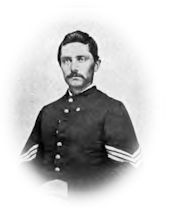
Tuesday, 11th—It snowed today and turned quite cool. Some troops marched past here on their way to St. Louis.
February 2012

11th. Commenced to make my quarters at Quartermaster Thayer’s. Wrote a line home and sent it in Charlie’s to sister.
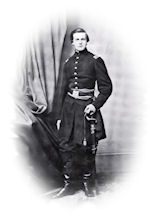
Camp Porter, Virginia,
Tuesday, Feb. 11, 1862.
Dear Cousin L.:—
“Norton, ‘Putty’ has brought you a valentine this time, I’ll warrant,” said one of my messmates, as I entered the tent last night and flung down my axe (I had been out on fatigue duty all day, making a government road to Washington, for the old roads are impassable on account of the mud). “Well, let me look at it,” said I. and he handed me your letter of the 7th. It was not a valentine, but it pleased me much more than one of those sentimental things would have done.
I presume I do have considerable more time for writing than you do, but your remark about your household cares, etc., made me think of what Mother often says: if she had only one or two children to care for she might have a little time to herself. I see that any one who has a family to care for has enough to do to be constantly busy. From morning till night there is always something to do. I have commenced writing, but that ever recurring question comes again, “What shall I write”? It seems to the soldier when he takes up the pen as though there was nothing to write unless he has something to tell of gallant exploits in his own occupation, a brilliant victory over superior numbers of the enemy, in which he was one of the heroes. With something like that for a text he can write. Pages of foolscap are far too small to contain all he has to relate to his friends then, but, ah me, I’ve no such resource. A man is not a hero till he is shot at and missed. He who is shot at and killed is covered with the sod and forgotten by all but the narrow circle of his immediate friends. His name is once seen in the list of killed at the great victory, but lightly passed over, while the readers turn to honor the heroes who participated in the victory but were shot at and missed.
You want to know something of our “arrangements, beds, meals, etc.” I might describe the interior of our tent in my poor way, and that will serve as a specimen of the whole, though each mess arranges its own tent in any way to suit the members. We have the large round tent, about eighteen feet across the bottom and tapering to a point at the top. A round pole in the center supports it, and, on this pole, two tables are suspended by ropes, one above the other, and so arranged that we can lower them to use as tables or raise them up above our heads. As to beds, we have every style and form that never were seen in a cabinet shop. We used to sleep on the ground or on pine boughs when we had the small or wedge tents, but when we obtained these we concluded to be a little more extravagant. Lumber in Virginia is out of the question. A very patriotic Union man about two miles from here refused to sell me a couple of fence boards six inches wide for $1.50, so I made up my mind to be my own saw-mill. At the time we encamped here, there were hundreds of acres of worn-out tobacco lands grown up with small pines in the neighborhood. They grow very close together, slim and straight. “Necessity is the mother of invention,” says the old adage, and so it proved with us. We cut down any number of the poles, peeled the bark, got a few pounds of nails at the sutler’s and made our bedsteads, or bunks, we call them. They are like berths in a steamer, one above another, room for two above and two below, and for another back under the side of the tent. This, for one side of the tent, accommodates six men ; another like it on the other side, six more. For the “mattress.” or “downy bed,” we hewed the poles flat and rather thin so they spring some and laid them side by side as close as possible. At night we spread our overcoats on the poles, take our knapsacks for pillows, and, covering ourselves with our blankets we enjoy such sleep as many a one who rests in the most luxurious bed might envy. Our robe de nuit is very simple, merely our every day dress, minus cap and boots. My rifle and cartridge box hang by my side, my cap lies on my knapsack, and my boots stand on the ground within my reach every time I sleep, so that, if the long roll beats, I can be with the company in line of battle in two minutes. We retire early, not so much from choice as necessity. At 9 o’clock the “taps” are beaten and all lights must be extinguished. It is rather uninteresting sitting in the dark, so that hour generally finds us “coiled up,” as the boys express it. At daylight the “reveille” is sounded, the men turn out and the roll is called. Soon after breakfast is ready, consisting of bread, meat (pork, bacon or beef) and coffee. We now have our soft bread baked in the regiment, but we have eaten a great many of the crackers, or pilot bread, as it is called. Some of this was good, but the greater part very poor, moldy, wormy, and made of poor flour, etc. Several barrels had crackers stamped “T. Weld & Co., Boston, 1810”; Company I say they had a barrel marked “B. C. 97.” I don’t know whether the crackers or the barrel was made before Christ, but I think it must have been the barrel. We finally concluded that fresh bread, although lacking so many romantic associations, would be more nutritious, so we brought in a fine lot of brick that a secesh had provided to build for himself a fine house, made some splendid ovens, and now we have good bread. We have a little sheet-iron stove in our tent that does very well when it is not too cold, and we can cook a good many little extras, stew dried fruit, etc., and we manage to live quite comfortably. The paper you sent I have not received. It will probably arrive to-night. We have a great many papers. The Washington papers are here before breakfast every morning, the New York papers, “Erald,” Tribune and Times, the day after they are published ; Baltimore and Philadelphia papers the same day, and then we have Frank Leslie’s, Harper’s Weekly, Illustrated News and Forney’s War Press. Friends at home send us the Independent and the Evangelist, the Advocate, the Guardian, etc., so that generally we are well supplied, but we devour papers with a rapidity that would astonish them that have less leisure time.
Last night a man died at the hospital. I can hear the band as they are paying their last respects to his remains. We have lost but one from our company. Poor Pickard died at the hospital in the latter part of January, I have sometimes thought that I could die on the battlefield and be content, but to die in a military hospital, away from my dearest friends, with only the rough hand of a fellow soldier to close my eyes to their last sleep, would be hard to bear. It was a gloomy day when we buried Pickard. Great piles of black clouds came rolling up from the west, and now and then a flake of snow came sailing down, mingling with the dead leaves as they went whirling over the frozen ground till they dropped together into some hollow to lie and be forgotten. I was one of the eight selected as the escort for the body, and I was much impressed with the solemnity and beauty of the military burial. The procession was formed at the hospital, the escort first with arms reversed, the pallbearers with the body, the chaplain, the band, and the company and friends of the dead. The band played a beautiful but mournful dirge, and we moved slowly to the grave. We buried him under a large oak tree on an eminence overlooking a wide prospect of this once beautiful country. Arrived at the grave, the coffin was set down and the chaplain read the beautiful burial service and the body was lowered to its last rest. We fired three volleys over the grave, the drums meanwhile beating a low muffled roll, and then we turned back to camp. Thus rests on the soil of the “Old Dominion” a humble, honest man and a good soldier. Half a dozen miles off sleep the ashes of the “Father of his Country.” The world admires and honors him, and weeps over his grave, and yet, who can say that Adam Pickard, in his humble sphere, did not his duty to his country as well as the immortal Washington? He left his wife and little children when his country needed him, and now his wife is left a widow and his children fatherless. It was a stern fate, but he looked it sternly in the face and died like a true soldier, leaving his family to God and giving his life to his country.
Tuesday.—Roanoke Island has fallen—no particulars heard.
February 11.—The Nashville American, of this day, has the following: From the beginning of this war to the present time, the constant cry of the people of the South has been, God and the British are on our side. That cry has seemed to satisfy too many of these whose lives and all have been at stake, that we would triumph without proper energy of our own. The first news that is looked for in the morning paper is the “Latest Foreign Intelligence.” We are like the “unprofitable servant” to whom was given the one talent. Instead of putting it to use, we have digged in the earth and hid that which was given to us. Still we put our trust in God and the British. The disaster at Fishing Creek, and the equally fatal result at Fort Henry, may begin to open our eyes to the fact that God and the British will not help us until we learn to help ourselves. These defeats may also teach us that which every great general found out before he fought many battles, that individual bravery is valueless against organized drill and discipline. It behooves the people of Tennessee, at least to awake to the impending danger. The twelve months system of volunteering will not save us. The hordes of Lincoln have volunteered for the war to subjugate. Will we not enlist for the same length of time to defend ourselves and our homes?
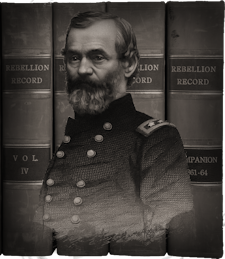
—Dr. Luther V. Belt,, Medical Director to Gen. Hooker’s division, in the National Army, died a camp, near Budd’s Ferry, Md., this evening.
Dr. Bell was a distinguished physician, a native of New-Hampshire, and enjoyed a prominent European as well as national reputation. His family connections, as well as himself, filled many of the most honorable and important positions in the records of his native State. Subsequently he removed to Massachusetts, and took charge of the McLean Asylum for the Insane, at Somerville, in which position he won the attention and applause of eminent European physicians, as well as these of his more immediate surroundings. For several years he was also President of the Massachusetts Medical Society. He had always taken a lively interest in politics, and held many important offices, among which may be mentioned that of the Governor’s Council. He was also several times made a candidate for Congress, and the Gubernatorial chair of Massachusetts.
Immediately following the attack on Fort Sumter, he offered himself to the Governor of Massachusetts as surgeon in any of the regiments which might require his service. His offer was eagerly accepted, and he was appointed Surgeon to the Eleventh Massachusetts volunteers, and with them departed for the seat of war. He was present at the battle of Bull Run, and distinguished himself by his unremitting attentions to the wounded, both friends and foes, and among the last he lingered devotedly among the suffering soldiers on the field, upon the retreat of the forces on Washington. Soon after he was appointed by President Lincoln a Brigade-Surgeon, under General Hooker.
When Gen. Hooker was appointed Major-General of a division, Dr. Bell was promoted to his staff, and since acted as Medical Director.
He was amiable and courteous, and was greatly beloved by all with whom he came in contact, and by none more so than the officers and soldiers of the Eleventh Massachusetts volunteers, who experienced the pleasures and benefits of his generous liberality and eminent medical skill.— N. Y. Times, February 23.
—This afternoon, the Sawyer gun, at Newport News, Va., burst while being fired. Privates Josiah Jones, of Company C, and James Shepard, of Company B, of the Twenty-ninth Massachusetts regiment, were instantly killed, and W. W. Bowman, of Company I, same regiment, was seriously injured. Jones belonged in Greenpoint, Long Island, and Shepard in Lowell, Mass. Four or five other persons, who were in the vicinity, were also injured, but none of them seriously.
—A flag of truce was sent from Fortress Monroe to Craney Island, Va., early this morning, to inform General Huger that the prisoners of war from Fort Warren, had arrived. The bark was accordingly towed up opposite Sewell’s Point, by the steamer Rancocas, and the tug Adriatic; and at about one o’clock, the rebel steamer West Point came out from Norfolk, and the prisoners were transferred. They numbered four captains, three first lieutenants, six second lieutenants, two third lieutenants, and three hundred and eighty four others, rank and file, and colored servants. They were taken at Hatteras and Santa Rosa, and were the last of the prisoners of war at Fort Warren, except Commodore Barron.
—The Richmond Examiner, of this date, publishes an elaborate communication, the object of which is to show that the proper national emblem for the South, would be a “single star.” The editor, however, disapproves the idea, as not original, and suggests that a more appropriate symbol is the “horse.”—(Doc. 34.)
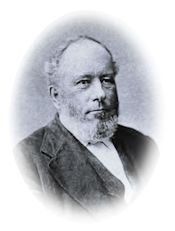
Feb. 10. The prisoners are a motley looking set, all clothed (I can hardly say uniformed) in a dirty looking homespun gray cloth. I should think every man’s suit was cut from a design of his own. Some wore what was probably meant for a frock coat, others wore jackets or roundabouts; some of the coats were long skirted, others short; some tight fitting, others loose; and no two men were dressed alike. Their head covering was in unison with the rest of their rig; of all kinds, from stovepipe hats to coonskin caps; with everything for blankets, from old bedquilts, cotton bagging, strips of carpet to Buffalo robes. The Wise legion are a more soldierly looking set; they wear gray cloth caps of the same pattern, and long sheep’s gray overcoats with capes. Most of the officers are smart, good looking young men, wearing well-fitting gray uniforms, not unlike those of our own officers.
It is not dress altogether that makes the man or the soldier. I find among these chaps some pretty good fellows. I came across one young man from Richmond; he was smart appearing and very loquacious. In some talk I had with him he said; “This has turned out not as I wished, but not different from what I expected when we saw the force you had. In fact we had no business staying here after seeing your strength. We have met the enemy and we are theirs. I accept the situation and am glad it is no worse. I am Secesh clear through, and after I am exchanged, shall be at you again. We are now enemies, but in peace friends, and when this little dispute is settled, if any of you fellows ever come to Richmond, hunt me up. If alive, you will be welcome as long as you choose to stay, and when you leave, if you don’t say you have had as right smart a time as you ever had, call me a liar and I will call you gentlemen.” The fellow gave me his card and said his father owned a plantation just out of the city.
I met one fellow, a long, lank, lean, long-haired, sullen, cadaverous looking chap, and asked him what he was doing here. “Well,” he said, “not much; but you ‘uns was right smart to get through that swamp. We thought the devil couldn’t get through it.” “So you think what the devil can’t do, Yankees can’t, do you? You mustn’t take the devil for your guage in estimating Yankees; if you do you will always get beat. We can give him points, and bent him every time.” He looked a little incredulous, but did not seem inclined to go into any argument about it.
These fellows threw away a good many pistols and knives which they carried, many of which our boys have found. The knives are large, coarse, ugly looking things, forged at some country blacksmith shop, by a bungling workman, out of old rasps, scythe-points and anything containing steel. I asked one fellow what they carried those knives for, what use they put them to? “Oh!” he said, “them’s Yankee slayers.” “Yankee slayers? And have you slain many Yankees with them?” “Wal, no, but we thought they mought come handy in close action.” “And did you think you would ever get near enough to the Yankees to use them?” “Wal, we didn’t know but we mought.” “Well, sir, those knives are too heavy to carry, and you don’t need to carry them, for long before you would ever get near enough to the Yankees to use them the places that now know you would know you no more forever.”
The boys are mixing in among the prisoners, talking over the fight, trading jack-knives, buttons and such small notions as they happen to have, and getting acquainted with each other. The weather is warm and pleasant, like May. The robins and other birds are singing as in summer. The robins seem like old friends and neighbors and I cannot help thinking that perhaps some of them had their nests last summer in the trees and bushes which grow in our own door yards and gardens at home.
Our gunboats have wiped from the face of the earth that part of the Confederate navy which prowled around these waters. They chased them up the Pasquotank river to Elizabeth City, where, after less than an hour’s engagement, the enemy set their boats on fire and fled.
Monday Feb 10th 1862
Genl Chas P Stone was arrested yesterday for Treason and sent to Fort Lafayette. News through Norfolk that a Battle was going on at Roanoke Island, Genl Burnside having attacked it. No particular news from the West. It has been a beautiful bright day. Mercury this morning stood at 20. Lieut Gould from the 27th came over today and is stopping with us tonight.
______
The three diary manuscript volumes, Washington during the Civil War: The Diary of Horatio Nelson Taft, 1861-1865, are available online at The Library of Congress.
Monday, 10th—Nothing of importance. A squad of men went out into the country for supplies and brought in some corn meal, molasses and honey.
10th. On duty up town again. Played chess with Bugler Adams. Called at Mr. Crockett’s. Not at home. Played a game of pool.


