Following the American Civil War Sesquicentennial with day by day writings of the time, currently 1863.

February 2012

Navy Department,
February 10, 1862.

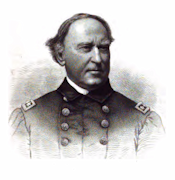
Flag-officer D. G. Farragut, U. S. Navy,

Commanding Western
Gulf Blockading Squadron,

Ship Island,

Sir: I inclose to you herewith sketches from the United States Engineer Bureau relative to the works on the Mississippi River; also a memorandum prepared by General Barnard, United .States Army, who constructed Fort St. Philip. The most important operation of the war is confided to yourself and your brave associates, and every light possible to obtain should be carefully considered before putting into operation the plan which your judgment dictates.
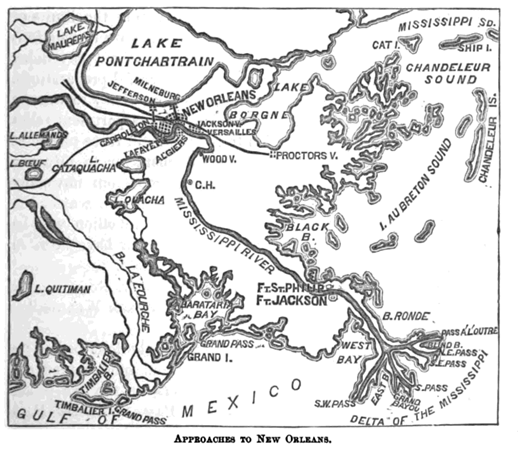
approaches to New OrleansIt is reported that nineteen feet of water can be carried over the bar. If this be true, the frigate Mississippi can be got over without much difficulty. The Colorado draws about twenty-two feet; she lightens one inch to twenty-four tons; her keel is about two feet deep. The frigate Wabash, when in New York in 1858, drew, without her spar-deck guns, stores, water casks, tanks, and coal (excepting thirty tons), aft twenty feet four inches, forward sixteen feet, or on an even keel eighteen feet four inches. This would indicate a very easy passage for this noble vessel, and, if it be possible to get these two steamers over, and perhaps a sailing vessel also, you will take care to use every exertion to do so. The powerful tugs in the bomb flotilla will afford the necessary pulling power. The tops of these large steamers are from thirty to fifty feet above the fort, and command the parapets and interior completely with howitzers and musketry. The Wachusett at Boston; the Oneida, Richmond, Varuna, and Dakota at New York; and the Iroquois from the West Indies, are ordered to report to you with all practicable dispatch, and every gunboat which can be got ready in time will have the same orders. All of the bomb-vessels have sailed, and the steamers to accompany them are being prepared with great dispatch. It is believed the last will be off by the 16th instant.

Eighteen thousand men are being sent to the Gulf to cooperate in the movements which will give to the arms of the United States full possession of the ports within the limits of your command. You will, however, carry out your instructions with regard to the Mississippi and Mobile without any delay beyond that imposed upon you by your own careful preparations. A division from Ship Island will probably be ready to occupy the forts that will fall into your hands. The Department relies upon your skill to give direction to the powerful force placed at your disposal, and upon your personal character to infuse a hearty cooperation among your officers, free from unworthy jealousies. If successful, you open the way to the sea for the great West, never again to be closed. The rebellion will be riven in the centre, and the flag to which you have been so faithful will recover its supremacy in every State.

Very respectfully, etc.,

Gideon Welles.

Monday Night.—Still greater uneasiness about Roanoke Island. It is so important to us—is said to be the key to Norfolk; indeed, to all Eastern North Carolina, and Southeastern Virginia. We dread to-morrow’s papers.

The lady on Street has disappointed me. She met me with a radiant smile when I went to see her this evening, saying, “She agrees; she must, however, remove the wardrobe and bureau, as she wants them herself; but there’s a closet in the room, which will answer for a wardrobe, and I reckon that a table with a glass on it will do for a bureau.” “Oh, yes; only give me a good bed, some chairs and a washstand, and I can get along very well. Can I see the room?” “Yes; it is a back-room in the third story, but I reckon you won’t mind that.” My heart did sink a little at that communication, when I remembered Mr. _____’s long walks from Bank Street; but there was no alternative, and I followed her up the steps. Great was my relief to find a large airy room, neatly carpeted, and pleasant in all respects. “This will do,” said I; “take the wardrobe and bureau out, and put a table in, and I shall be very well satisfied.” “I have a small table,” she replied, “but no glass; you will have to buy that.” “Very well, I will do that. But you have not yet told me your terms.” “Will you keep a fire?” “Oh, certainly, in my room.” “Then my charge is ___.” I stood aghast!” My dear madam,” said I, “that is twenty dollars more than the usual price, and three dollars less than our whole salary per month.” “Well, I can’t take a cent less; other people take less because they want to fill their rooms, but I was only going to take you for accommodation; and I can fill my rooms at any time.” Now the lines of her face were not undecided. I turned, and as I walked up the already lighted streets of my native city, feeling forlorn and houseless,

“In happy homes I saw the light

Of household fires gleam warm and bright;”

and hope that I was not envious. My friends were very sympathetic when I returned, not, however, without a certain twinkle of the eye denoting merriment, as it exactly coincided with a most provoking prophecy made by Mr. C. as I set out; and I joined in a hearty laugh at my own expense, which was a real relief to my feelings.

No good news from Roanoke Island. Fort Henry has fallen; that loss is treated lightly, but the enemy have turned their attention to Fort Donelson, on Cumberland River, which, if taken, would give them free access into the heart of Tennessee.

February 10.—The expedition which had been sent up the Tennessee River, after the capture of Fort Henry, returned to the railroad crossing, twenty-five miles above the fort.

The expedition, embracing the gunboats Conestoga, Taylor and Lexington, under Lieutenant Phelps, left Fort Henry on the sixth inst., and on the same day it destroyed a quantity of camp equipage, which had been abandoned by the rebels.

On the following day, (the seventh,) several rebel transport steamers were pursued, and two of them, laden with military stores, were abandoned and burned by their crews.

On the same night, at Cerro Gordo, Tenn., the steamboat Eastport, in process of alteration into an iron-plated gunboat, and large quantities of timber and lumber, were seized, and the Taylor was left behind to protect them, until the return of the expedition.

On the morning of the eighth, at Chickasaw, Miss., two other steamboats — the Sallie Wood and Muscle—were seized; and on the same day, at Florence, Ala., three other steamboats were burned, and great quantities of supplies for the rebel army were taken and destroyed.

The expedition proceeded no farther up the river; but a deputation of citizens waited on Lieutenant Phelps and requested him to respect their persons and the property of the citizens, and the railroad bridge, which connects Florence with the railroad on the south bank of the river, all of which was complied with.

Returning to Cerro Gordo, the prize steamboats Eastport, Sallie Wood and Muscle, were laden with upward of a quarter of a million of feet of valuable lumber and ship-timber, which, with all the iron, machinery, spikes, plating, nails, etc., belonging to the rebel gunboats, was carried down to the Union lines.

A rebel encampment at Savannah, Tenn., was also broken up, and considerable quantities of arms, clothing, shoes, provisions, etc., were secured or destroyed.

The expedition met with the most gratifying proofs of loyalty everywhere on the Tennessee River; twenty-five Tennesseans were enlisted at Cerro Gordo, by Lieutenant Gwin of the Taylor, and the most perfect success crowned the arduous labors of the party.—(Doc. 32.)

—Ethan A. Hitchcock was confirmed as Major General of Volunteers in the Army of the United States.

— General Hunter proclaimed martial law throughout the State of Kansas, and declared the crime of jayhawking should be put down with a strong hand and summary process.

—Commander Rowan, with fourteen vessels, left Roanoke Island yesterday afternoon, and at six minutes past nine, this morning, when off Cobb’s Point, N. C, he attacked the rebels’ squadron, which had fled from Roanoke, under Commander Lynch, and two batteries, mounting five guns. Within twenty minutes a schooner belonging to the enemy, struck her colors, and was burned by her crew; and immediately afterward, the crews of the Powhatan, Fanny, Sea Bird and Forrest, ran them ashore and set fire to them, while these of the Raleigh and Beaufort ran their vessels into the Canal and escaped; the Ellis was captured, and brought away by the Union forces.

The battery on Cobb’s Point was also abandoned by the enemy, and occupied by acting Master’s Mate Raymond during the morning; and before ten o’clock Elizabeth City also surrendered. —(Doc. 33.)

To Mrs. Lyon

Cairo, Sunday, Feb. 9, 1862.—Since writing to you there has been a battle and victory at Fort Henry, on the Tennessee river. The battle was fought on our side by the gunboats, our infantry taking no part in It. We are not stationed here permanently. We were only left because we had not our blue uniforms.[1] We have them now. But for this we should doubtless have been at Fort Henry. The boys are much disappointed. We may go there yet, as regiments are constantly going up there. I suppose they will have another fight in a few days on the Cumberland river about fourteen miles east of Fort Henry, at Fort Donelson, but we have no orders as yet.

I have been for the last two days acting as President of a Regimental Court Martial for the trial of minor offenses. There were twelve cases before us. It takes a good deal of evidence in my court to convict.


[1] When the soldiers enlisted, gray uniforms were furnished by the State. This caused confusion because the Confederates also wore gray uniforms—hence the change.

Cape Girardeau, February 9, 1862.

I, like a good boy, wrote you a long letter yesterday, and, like a careless fellow, lost it. I told you in it how we “300” of us, left here in the p.m. of last Monday, rode all night and at daylight made a desperate charge into Bloomfield where we found and captured nothing. How a little party of 15 of our boys were surprised some eight miles beyond Bloomfield by 80 Rebels and one of them captured, one badly wounded and another’s horse shot and he at last accounts running in the swamps. How the major got together his men and went out and captured some 20 of the bushwhackers and killed five and how he returned to the Cape, etc. You have read about this riding and marching all night until I expect you hardly think of its being fatiguing and somewhat wearing on the human system, etc., but allow me to assure you that it is. Novice as I am in riding, the cold and fatigue were so severe on me that I slept like a top horseback, although I rode with the advance guard all the time and through country the like of which I hope you’ll never see. There is a swamp surrounding every hill and there are hills the whole way. Damn such a country. We passed, a small scouting party of us, the bones of seven Union men. They were all shot at one time. I didn’t go with the party to see them. One of our guards went out with a party of nine of the 17th Infantry boys and captured some 20 secesh and brought in, in a gunny sack, the bones of five other Union men. I noticed there were no skulls and asked the guide where they were. He said that “as true as truth the secesh who murdered them had taken the skulls to use for soup bowls.” I was talking with a man to-night who had his two sons shot dead in the house by his side last week. A gang of fellows came to the house while he was eating supper and fired through between the logs. He burst open the door and escaped with but one shot in him after he saw that his sons were killed. I can hardly believe that these things are realities, although my eyes and cars bear witness. In my reading I can remember no parallel either in truth or fiction for the state of things we have in this southeastern portion of Missouri. Anyone can have his taste for the marvelous, however strong, glutted by listening to our scouts and the refugees here. I thank God from my heart that dear old Illinois knows nothing of the horrors of this war. The 17th left here yesterday for Fort Henry. The boys were very glad to start. The old 8th was there with the first. I almost wish I had stayed with her. Without bragging or prejudice I am satisfied that the 8th is the best in every respect of the whole 100 regiments I have seen and has the best colonel. Colonel Kellogg is now commanding the post and Sid. is “A. A. A. General,” and I am “A Regimental Adjutant.” My duties are light, though, and I am in tip-top health. That ride didn’t hurt me at all. I can stand riding with the best of them. I suppose that Sam will be with us soon. I hope our regiment will be ordered to Kentucky. I believe I’d rather be shot there than to bushwhack around in Missouri much longer. The major and I will get along capitally. He stands fatigue equal to any of us. He and I took a ride of 30 miles alone through the swamps the other day. Send my watch the first chance you have.

Sunday, February 9. — Nothing of any special interest happened. Received a letter from George Weld enclosing draft.

Sunday 9th

Have been out to church all day with all the family but Holly, he has a very bad cold. The air has been cool and Bracing today and the sun has shown nearly all day. The sight of the sun again has been here quite reviveing. Ed Dick[erson] & Alex Tower called this afternoon while we were at church, did not stay till we returned. Charles & Sallie spent the evening. Chas re-vaccinated all of us. Yesterday for the first time we tried the “ariated Bread” baked in Baltimore. It is certainly a great improvement in the Bread line. It is soon to be made here. We are sure customers for the “New kind of Bread.”

______

The three diary manuscript volumes, Washington during the Civil War: The Diary of Horatio Nelson Taft, 1861-1865, are available online at The Library of Congress.

9th.—The Court of Inquiry to examine into the conduct of my hospital affairs yesterday, decided that they would not investigate—that the accusations were the result of personal ill feelings. At least, so a member of the court informed me. I begged him to insist on an inquiry, and the court has reconsidered its action, and will investigate. I hope there will be a full expose of the whole conduct of the hospital. I have long desired it.

Sunday, 9th—Company inspection this morning. We had preaching by the chaplain in the forenoon, and the boys had prayer meeting in the evening.

9th. Sunday. Went out and heard Chaplain Hawkins upon “Following Christ.” Went to Mr. Campbell’s to dinner—a good one. Stayed for some time, had hickory nuts.