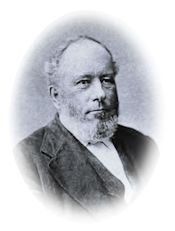
Feb. 9. A hard looking lot this morning, and no doubt feeling as hard as we looked. Tired, hungry, ragged, covered with mud, and sore from our flesh being torn and scratched with the tangle-brush and briars through which we forced ourselves yesterday. After a good ration of whiskey and a breakfast of fried bacon, with hot coffee, we began to limber up and feel a little more normal. We can now look over the field and see the results of yesterday’s work. Our regiment lost six killed and 47 wounded, some of them probably fatally. Our whole loss was 42 killed and 209 wounded. The enemy’s loss is not known, but is probably less than ours. Today the gunboats are after the Confederate flotilla and no doubt will give them a taste of what happened yesterday. It will probably be reported at headquarters in Richmond that their navy in these waters has become a thing of the past. Our march up from the battle-ground, yesterday afternoon, was rather an interesting one, if men nearly dying from exhaustion can be said to get interested. The trees for a mile in front of our line are marked and scarred by our shot, showing the terrible effectiveness of our rifles. The road was strewn with guns, knapsacks, equipments, blankets and everything that impeded their retreat or which they thought they had no further use for. Passing a little brown house by the wayside I noticed quite a crowd of surgeons and officers standing around. Crowding my way up to the little open window, I saw the pale, quivering form of a young man lying on a cot, with a slight covering over him, apparently in a dying condition. I inquired if any one knew who he was, and was told it was Capt. O. Jennings Wise, son of ex-Governor Wise. He had received a mortal wound and could not possibly survive many minutes. He was editor of one of the Richmond papers and captain of the Richmond Light Infantry Blues, the crack company of that city. He was a brave young fellow, and his was the last company to leave the redoubt, and then only when he fell mortally wounded.
February 2012

Sunday Night.—Painful rumours have been afloat all day. Fort Henry, on Tennessee River, has been attacked.
We went to St. James’s this morning, and St. Paul’s tonight. When we returned we found Mr. N. and Brother J. awaiting us. They are very anxious and apprehensive about Roanoke Island.
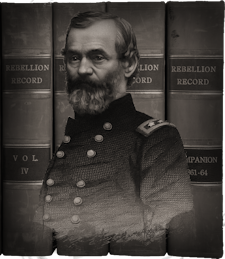
February 9.—Secretary Stanton ordered the arrest and incarceration in Fort McHenry of one Doctor Ives, a correspondent of the New-York Herald, on the charge of being a spy, and for violating the rules and regulations of the War Department. According to the order of Secretary Stanton, Ives introduced himself into the chambers of the Department, when private consultations were being held, and demanded news for publication.
—The Seventy-sixth regiment of Ohio Volunteers, under command of Colonel C. R. Woods, passed through Columbus on their way to Kentucky.—Cincinnati Gazette, February 11.
—The efficiency of United States mortar-boats was fully tested to-day by Captain Constable, U. S. N., in the Mississippi River, just below Cairo, Ill., and near Fort Holt, on the Kentucky shore. The experiments showed that thirteen inch shells, filled with sand, could be thrown a distance of three and a half miles— the time of flight being thirty-one seconds, and the recoil of the gun-carriage about two feet. Filled with powder, the shells could be thrown much further.— (Doc. 31.)
—Brigadier-general Charles P. Stone was arrested in Washington this morning, at two o’clock, by a posse of the Provost Marshal’s force, and sent to Fort Lafayette, New-York harbor. The charges against General Stone are: First, for misbehavior at the battle of Ball’s Bluff; second, for holding correspondence with the enemy before and since the battle of Ball’s Bluff, and receiving visits from rebel officers in his camp; third, for treacherously suffering the enemy to build a fort or strong work, since the battle of Ball’s Bluff, under his guns, without molestation; fourth, for a treacherous design to expose his force to capture and destruction by the enemy, under pretence of orders for a movement from the commanding general, which had not been given.
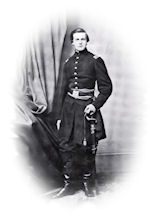
Camp Porter, Feb. 8, 1862.
Dear Sister L.:—
“All quiet along the Potomac” has become a by-word, it is used so often. Nothing stirring. Mud is triumphant and all business except guard and picket duty is suspended, unless I should mention a little target practice. Last night just after roll-call we heard tremendous cheers up at the right of the regiment. Company after company seemed to vie with each other to see which could cheer loudest. Finally, when half our boys had got to bed, the orderly came into the street with “Fall in, Company K, fall in.” Out they tumbled and into line, when Captain A. said the general had just received a dispatch containing such good news that he had sent his orderly down to read it to the boys. He read a telegram stating that a fleet of gun-boats had gone up the Tennessee river, bombarded and taken the rebel Fort Henry and captured General Floyd, Tilghman and staff, twenty cannons and sixty prisoners. Captain A. proposed nine cheers for the Union victory. They were given and the Zouave tiger to close on. Every one thought that the ex-Secretary Floyd had been taken, but this morning’s papers disclose a cruel sell. Instead of Generals Floyd and Tilghman, it was General Lloyd Tilghman, commandant of the fort, who was captured. It was a great victory for us, but we were very much disappointed after all. There is no other man whom I would be so much pleased to have taken as that “thafe o’ the wurreld’ Floyd. Jeff Davis wouldn’t begin.
General Porter commands our division, containing twelve regiments or three brigades, thus:
General Fitz John Porter’s Division.
First Brigade, General Morell.
Sixty-second Pennsylvania, Colonel Black.
Ninth Massachusetts, Colonel Cass.
Fourteenth New York, Colonel —–.
Fourth Michigan, Colonel —–.
Second Brigade, General Martindale.
Twenty-fifth New York, Colonel Kerrigan.
Second Maine, Colonel —–.
Twenty-second Massachusetts, Colonel Henry Wilson.
Eighteenth Massachusetts, Colonel Lee.
Third Brigade, General Daniel Butterfield.
Sixteenth Michigan, Colonel T. B. W. Stockton.
Eighty-third Pennsylvania, Colonel John W. McLane.
Forty-fourth New York, Colonel Stryker.
Seventeenth New York, Colonel Lansing.
Artillery.
Sprague’s Rhode Island Battery.
Griffin’s Battery D. Fifth United States.
Follett’s Battery.
Cavalry.
Averill’s Regiment.
Gorham’s Regiment.
Eighth Pennsylvania Regiment.
Third Pennsylvania Regiment.
This is the force under Porter; quite a little army in itself. The Massachusetts troops are fine fellows, three regiments in the division. The “Farmers Regiment” raised by Senator Wilson is among them. He (Senator Wilson) is not the acting colonel at present, however, having returned to the Senate. The Ninth Massachusetts are mostly Irish Catholics. They will fight, I think, like the old Sixty-ninth New York at Bull Run. The Twenty-fifth New York is composed of New York roughs, Bowery boys, “Dead Rabbits,” etc. Their colonel has been court-martialed on charge of treason, communicating with the enemy, drunkenness, etc. He is deprived of his command. They seem to keep to themselves and have nothing to do with any other regiment. I never saw but one of them in our camp. The Sixty-second Pennsylvania was raised at Pittsburg and is twelve hundred strong, commanded by ex-Governor Black of Nebraska, formerly of Pittsburg. The Forty-fourth New York (the Ellsworths) you have heard enough of them to know them by this time—their camp is next to ours, and the two regiments are as united in feeling and everything as brothers. We are like one great regiment. The Seventeenth New York in our brigade seems to have a grudge against both of us.
Feb. 8. At daylight, the order to fall in was heard on all sides. Putting on my equipments and taking Spitfire and a big sweet potato, which I had with much labor succeeded in baking, I took my place in my company. The brigade all ready, Gen. Foster gave the order to march. He, with Col. Upton, took his place at the right of our regiment, marching by the flank into the woods. We soon came out to the pickets and the road that runs through the island. Here we filed to the left, marching up the road. Company A, Capt. Pickett, was thrown out as skirmishers. They soon fell in with the enemy’s pickets and drove them in. The column moved up the road to within a short distance of the clearing, in front of the rebel works. On the right of the road the ground was hard and free from brush, but on the left was an almost impenetrable swamp, covered with a dense growth of tangle-brush and horse briars. The right wing of the regiment filed to the right, while the left plunged into the swamp, and with swords and jack-knives, succeeded in cutting a path until they had penetrated the swamp far enough to form our line. The regiment was now nearly all in the swamp, the right resting just across the road. The howitzer battery had taken position in the road, in front of our right wing. The 23d and 27th Massachusetts formed on our right, while the 10th Connecticut was held in reserve. We were now in line in the swamp, and facing to the front, commenced firing. The battery had already opened the ball, and were receiving the attention of the enemy in front.
We could see nothing to shoot at, but taking our range by the smoke of the enemy’s guns we blazed away. We fired high, low and obliquely, thinking if we covered a wide range of ground, we might possibly lame somebody, and it seemed our shots must have proved troublesome, for they turned their attention to us, pouring musketry and canister shot without stint into the swamp. We were up to our knees in mud and water, so their shot passed over us without doing much damage. We were now ordered to cease firing and advance, but how to advance was the question. We could stand on a bog and cut away the briars in front of us and jump to another one; where they were not too large we could crawl through them, tearing not only our clothes but our hides as well. The officers rendered good service in cutting away the briars with their swords. In this way we could advance a few steps at a time and then fire a few rounds; the enemy all this time showing us marked attention.
Capt. Foster of company D was the first man I saw hit. I was watching him as he stood on a bog, cutting away the briars with his sword, and thinking of him as colonel of the old 8th regiment Massachusetts volunteer militia, in which I used to muster. The shot struck him near the eye. He whirled round on the bog, and would have fallen had not three of his men caught him and led him to the rear.
I was rather amused at the major’s plan of rifle practice; he was practicing with a large revolver, shooting into the air at an elevation of about 80 degrees. Some one asked him what he was trying to act out. “Why,” replied the major, “you see my shots attain their summit directly over the enemy, and if one of those shot in falling should hit a man on top of his head, his goose is cooked just as effectually as though he had been hit with a cannon ball.”
By cutting and crowding ourselves through the briars, we advanced to within about 300 yards of the enemy. Our ammunition being now exhausted and having been in the swamp about three hours we were ordered out. The 21st Massachusetts took our places and the 51st New York and 51st Pennsylvania regiments forced their way through to the left front; the three regiments succeeded in getting out on the enemy’s right flank. Seeing that all was now lost, the rebels took to their heels for the head of the island, followed by Reno’s and Foster’s brigades. At the head of the island, near the enemy’s camp, was Gen. Burnside with the 24th Massachusetts regiment, to whom Col. Shaw, in command of the Confederate forces, surrendered. By this, about 3000 prisoners, with their arms, ammunition and stores, fell into our hands. But the greatest prize of all, old ex-Governor Wise, slipped through our fingers. Perhaps, having some premonitions of the fate which awaited his command, he wisely took himself off the island last night, leaving his command with Col. Shaw, of the 8th North Carolina regiment. The old governor probably acted on the principle of the militia captain who was about leading his company into action. He made them a little speech, telling them to be brave and valiant, not to run until actually forced to. “But,” he said, “in case that should happen, and I being a little lame, I think I had better start now.”
Thoughts.
During the action I had seen quite a number hit and led back to the rear, but I had little time to think much about it. After the chase commenced and we marched through the little redoubt and over the ground held by the enemy, and I began to see the mangled forms of dead and dying men, I was filled with an indescribable horror and wanted to go right home. I now began to realize what we had been doing, and thought that, if in this age of the world, with all our boasted civilization and education, men could not settle their differences short of cutting each other’s throats, we were not very far removed from barbarism. But I suppose so long as the nature of man is ambitious and selfish he will try to obtain by force what he cannot attain by other means. It was about night when we reached the Confederate camp, found the business had all been done, and Gen. Burnside was master of the situation. We now appropriated to our own use the log barracks of the enemy, leaving them to secure lodgings as best they could, as we had done the night before, with only this difference; they had a large body-guard over them, to see that they were orderly and kept the peace.
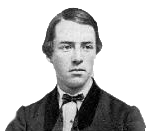
Saturday, February 8. — Wrote an account of a court-martial for Captain Locke. Morning, snowed slightly, cloudy the remainder of the day. Nothing of interest happened. Captain McHarg, brigade quartermaster, said that General Porter would not allow him to get me any flooring. I can’t conceive why he should do so, but I suppose for some good reason.
Saturday 8th
Nothing new at all today, a little skirmishing over the River. Some Rebels killed and sixteen prisoners taken and brought in here last night. I have not been out and have not been on Pa. Ave for some days past.
______
The three diary manuscript volumes, Washington during the Civil War: The Diary of Horatio Nelson Taft, 1861-1865, are available online at The Library of Congress.
Saturday, 8th—It is the same old thing over. We cleaned up our accouterments for inspection tomorrow.
Hall’s Hill, Va., Feb. 8, 1862.
Dear Mother, — I am now safely fixed in my tent on this hill. The tent is as warm as our parlor and can if necessary be heated to a much higher temperature. I have kept a good fire going all the time in order to dry the ground and get the dampness out. It is now comparatively dry, considering what it was when the tent was first pitched. The ground then was a perfect mud hole, but now is quite decent. For a flooring I have savin boughs, and I intended to have a plank, or rather board flooring put down, but General Porter would not allow me to get one, saying that we should be here so little while that it would not be worth while to get one. By the way, please tell Father of this remark that General Porter made at dinner to-day. After reading the account of the taking of Fort Henry he said that now, unless some terrible blunder was made, we were sure of beating them, i.e. rebels, everywhere we met them. He is not a man who talks much, and reminds me of Uncle Oliver in that respect. One can rely on what General Porter says. He is very kind and pleasant to me and every one, but I should not like to do anything he did not like, for I guess any one who did so would catch a blessing. He is not quick-tempered or anything of that kind, but he has an eye that shows some determination. He is a very handsome man, and reminds me of Tutor Gurney, but without Gurney’s projecting under jaw, and with dark colored beard and whiskers pretty closely cut. . . .
The country round here is pretty desolate looking. As fast as the army advances down go the trees, and soon they disappear in the stoves of the different camps.
There is any amount of quail and rabbits out here, and when I get a good opportunity I shall shoot some of them.
General Porter asked me about my brothers and sisters the other day. He asked me if I was the eldest, as he said there was a baby there when he left, about two or three months old.
Please tell Aunt Eliza that as far as I can find out the soldiers are well provided with everything and do not need anymore mittens. Stockings are always welcome, as they wear out easily owing to the feet slipping so in the mud. In regard to the stockings being ribbed or not, it does not make much difference. I delivered the mittens and socks to the men in my company which is now fully provided. Tell her that her socks are a great comfort to me, being so soft.
There is not much war news here. Our pickets captured 14 rebels the other day and one 4-horse wagon. It is really impossible to realize that we are so near the enemy. In fact, one never can realize it, unless he gets into a skirmish or fight with them.
We have some fine bands here, and it is quite pleasant to hear them play, it being almost the only amusement our soldiers have. The men are all drilling in target practice now and the best shots receive prizes.
8th. One day behind hand. Hardly realize that time passes so swiftly. Up town nearly all day on duty.


