Following the American Civil War Sesquicentennial with day by day writings of the time, currently 1863.

August 2012

Thursday, 21st—There is one train a day over the railroad. It is a combination train, and comes in at 6 p. m. and departs at 8 o’clock in the morning. The train does not run at night for fear the track might be torn up, as the rebels are so near.

Some very hot weather now. We get all the fruit that we want here, and have plenty of other rations at this camp. We have fresh pork and sweet potatoes. The potatoes we either boil in kettles or bake in ashes.

21st. Thursday. Went with two Company F men and got breakfast at a farmhouse. Some of the boys had had nothing to eat for 36 hours. Ham and corn bread. Borrowed 20 cents and paid. They asked nothing but we preferred to pay them. Major Burnett, with detail of five started for Fort Scott. Several of us contrived to go too. Got breakfast out three miles, milk and honey. A man came up. We frightened him so he swore he was secesh and made himself ridiculous generally for a union man. Had a secesh horse, taking care of it. Brought him in. In the morning put a rope around a boy’s neck and made him take the oath with some meaning. Letters from Minnie, Melissa and Fannie.

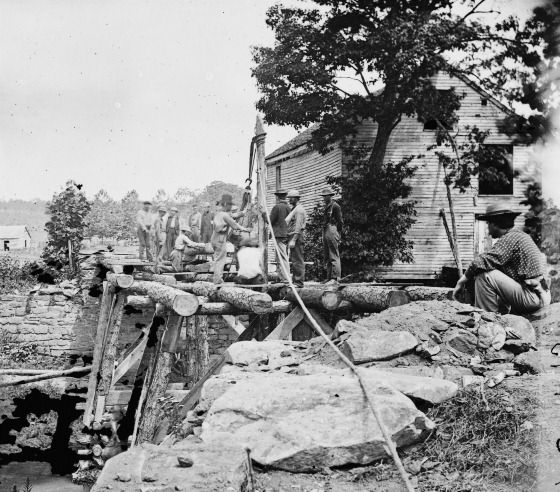
1862 August Fauquier Sulphur Springs, Va., vicinity. Troops building bridges across the north fork of the Rappahannock

Troops building bridges across the north fork of the Rappahannock in the vicinity of Fauquier Sulphur Springs, Va., by Timothy H. O’Sullivan in August 1862.

It is highly likely that the fellow on the right is the photographer, O’Sullivan.  This is the fifth photo I’ve found in this period of time – July and August 1862 – where he appears in the image.

Library of Congress image.

____

The four other images from the summer of 1862 with images that include O’Sullivan were published in the following posts:

August 21—Left at 4 A.M. and arrived in Richmond at 6 P.M. Marched to Camp Lee, two miles from the city, and put up any tent we could get hold of, as it was raining very hard and too dark to see. We are all O. K. now.

AUGUST 21ST.—Some apprehensions are felt by a few for the safety of this city, as it is supposed that all the troops have been withdrawn. This is not so, however. From ten to fifteen thousand men could be concentrated here in twenty-four hours. Richmond is not in half the danger that Washington is.

August 21st. Marched bright and early, arriving at Yorktown about noon and put up our tents on the identical spot occupied by us while awaiting shipment to West Point, in the spring; felt quite at home. As soon as the camp was established, all hands were dismissed for a swim, and the waves were quickly whispering lullabys in the ears of the dusty and weary warriors of the first division. Got a lot of gossip here. It seems the army is being transferred as speedily as possible by transports, from both this place and Newport News, to Alexandria and Washington, to head off Lee, who is really in front of the army of Virginia, under Pope somewhere on the Rapidan. The coast here is covered with troops awaiting transportation, and are loading night and day; but it is a big undertaking to transport by ships one hundred thousand men, together with their material, and it takes a good deal of time. General McClellan, it is rumored, has been removed, or is to be, on dit; that the President is disgusted with him; his want of success and very disagreeable relations with the government, constantly throwing all the blame on Washington for his failure, is a little too much, even for our long-suffering and patient President.

After a capital swim, several of us rode through the quaint, slow, old town, which we found just as dirty as ever, the pigs still running at large, feeding on the filth from the tumble down houses; received orders to be ready to march early in the morning for Newport News, as transports were awaiting us; weather magnificent.

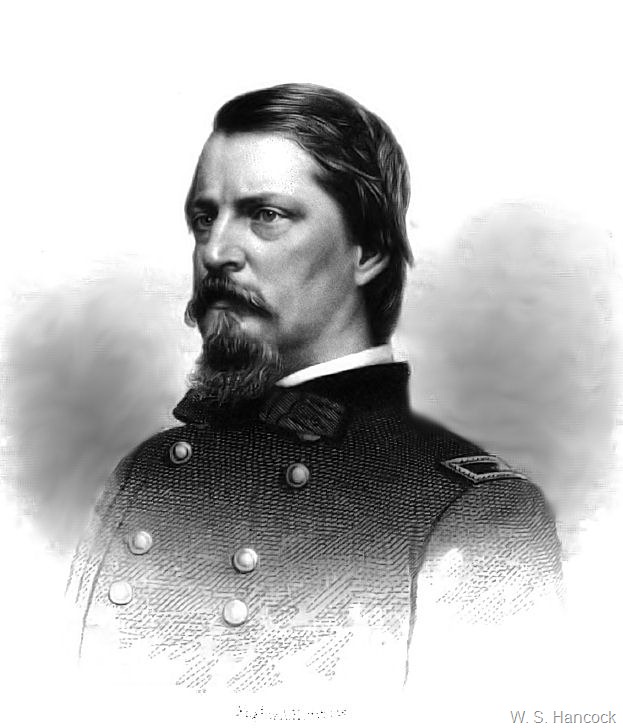
hancock_w_s

August 21.—Jeff Davis issued an order from Richmond, directing that Major-Gen. Hunter and Brig.-Gen. Phelps should no longer be held and treated as public enemies of the rebel States, but as outlaws; and that in the event of the capture of either of them, or that of any other commissioned officer of the United States employed in drilling, organizing, or instructing slaves, with a view to their armed service in the war, he should not be regarded as a prisoner of war, but held in close confinement for execution as a felon, at such time and place as Jeff Davis might order. —To-day the Union army, under Gen. Pope, and the rebel army, under Gen. Lee, faced each other on the Rappahannock, the former on the north and the latter on the left bank of the river. An attempt was made on the part of the rebels to cross the river at Kelly’s Ford, for the purpose of turning the position of the Unionists, but it was foiled by General Reno, who opened fire with his batteries, and then followed it with a cavalry charge, which put them to flight, and determined them to make no more attempts to cross at Kelly’s Ford.—(Doc. 104.)

—A war meeting was held at Southficld, Staten Island, N. Y. —Thomas Shultzer, one of the editors of the Maryland News Sheet, was released from Fort McHenry, on taking an oath not to engage in newspaper business, nor do any thing to aid and abet rebellion during the continuance of the war. Carpenter and Neilson, the responsible editors and publishers of the same paper, refused to take the oath.

—The rebel schooner Eliza, loaded with salt and other contraband goods, was captured off Charleston, S. C, by the United States steamer Bienville.

—The Union pickets on Pinckney Island, near Hilton Head, S. C, were attacked by a superior force of rebel troops, and thirty-two of their number taken prisoners, three killed and three wounded.—A very large and enthusiastic war meeting was held at St. Louis, Mo., in the Mercantile Library Hall, at which Gov. Gamble made the principal speech. He recommended a most vigorous war policy in the State, and deprecated the disposition to find fault with the policy of the Federal Government. He recommended the extermination of the guerrillas in the State, and would make the secessionists pay for the protection they received from the Government. He would drive South all non-combatants who denounced the Government. The military authorities held bonds from the rebels to the amount of over a million of dollars, and he advised all broken bonds to be collected at once. The speech was received with tremendous applause.

—A severe fight took place at Gallatin, Tenn., between a body of Union troops under the command of General R. W. Johnson, and an inferior force of rebel cavalry, under Col. John H. Morgan, resulting in a rout of the Unionists with great loss.—(Doc. 187.)


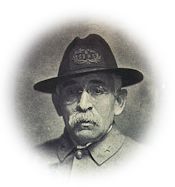
Winfield Scott Hancock (February 14, 1824 – February 9, 1886) was a career U.S. Army officer and the Democratic nominee for President of the United States in 1880. He served with distinction in the Army for four decades, including service in the Mexican-American War and as a Union general in the American Civil War.

Lynchburg, August 20.—Mr. _______ and myself arrived here last night, after a most fatiguing trip, by Clarksville, Buffalo Springs, then to Wolfs Trap Station on the Danville road, and on to the Southside Railroad. The cars were filled with soldiers on furlough. It was pleasant to see how cheerful they were. Poor fellows! it is wonderful when we consider what the next battle may bring forth. They were occupied discussing the late battle at Cedar Run, between General Jackson and a portion of Pope’s army, commanded by Banks. It was a very fierce fight, and many casualties on both sides; but we won the day—the Lord be praised! Lynchburg is full of hospitals, to which the ladies are very attentive; and they are said to be very well kept. I have been to a very large one to-day, in which our old home friends, Mrs. R. and Miss E. M., are matrons. Every thing looked beautifully neat and comfortable. As a stranger, and having so much to do for my patient at home, I find I can do nothing for the soldiers, but knit for them all the time, and give them a kind word in passing. I never see one without feeling disposed to extend my hand, arid say, “God bless you.”

August 20 — This morning at three o’clock we renewed our march, and from all appearances through a poor country. At about nine o’clock we crossed the Rapidan at Mitchell’s Ford, which landed us in Culpeper County and in a beautiful level plain and good land. We marched on in a northeastern course, crossed the Culpeper and Fredericksburg road, and still pressed toward the Rappahannock. When we halted we were only about a mile from the Yankee lines. While we halted some of our cavalrymen brought in a few Yankee prisoners that had just been captured, who reported that the enemy was strongly posted not far ahead and was preparing to charge us; but these same prisoners lied.

However, on the strength of the report, General Stuart formed a line of battle in a beautiful level grassy field and splendid fighting ground for cavalry. Captain Pelham’s battery was in position on the right of the line.

There were about three thousand horsemen drawn up in line, all with drawn sabers, ready to receive a charge or make one. A glance over the field and along the battle line was at once grand, magnificent, and inspiring. Three thousand burnished sabers glittered in the sunlight, ready to be wielded by determined men whose steady and silent gaze to the front, where the enemy was supposed to lurk, pre-signified that every man was spellbound, fascinated, and inspired by the splendor of the sheen and the grandeur of the warlike martial array that was as gorgeous as a dress parade. Yet every man was ready and expecting to receive the shock of battle. We remained in battle line about two hours, waiting for the Yankee charge they did not make; and now I am confident that the Yankee prisoners wilfully lied to-day when they said that their cavalry was preparing to charge General Stuart’s in that particular locality, because the Yankee cavalry is not so awfully chargy when they find something a little dangerous to charge. After General Stuart found that the Yankee charge was a myth we were ordered to move up toward the Orange and Alexandria Railroad. In moving up we passed through a little hamlet called Stevensburg. When we passed there I saw some of General Hill’s infantry marching toward the Rappahannock. We struck the railroad a few miles below Culpeper Court House, then moved down the railroad to Brandy Station, which is about six miles below the Court House.

Our cavalry had a fight with the Yanks this afternoon, and repulsed them, below Brandy Station.

We fell back about three miles toward Culpeper Court House and camped for the night. The country around Brandy is beautiful. Looking east and south the land is as level as a lake.


August 20th.

Last evening, after hard labor at pulling molasses candy, needing some relaxation after our severe exertions, we determined to have some fun, though the sun was just setting in clouds as watery as New Orleans milk, and promised an early twilight. All day it had been drizzling, but that was nothing; so Anna Badger, Miriam, and I set off, through the mud, to get up the little cart to ride in, followed by cries from the elder ladies of “Girls! Soap is a dollar and a half a bar! Starch a dollar a pound! Take up those skirts!” We had all started stiff and clean, and it did seem a pity to let them drag; so up they went —you can imagine how high when I tell you my answer to Anna’s question as to whether hers were in danger of touching the mud, was, “ Not unless you sit down.”

The only animal we could discover that was not employed was a poor old pony, most appropriately called “Tom Thumb,” and him we seized instantly, together with a man to harness him. We accompanied him from the stable to the quarter where the cart was, through mud and water, urging him on with shouts and cries, and laughing until we could laugh no longer, at the appearance of each. The cart had been hauling wood, but that was nothing to us. In we tumbled, and with a driver as diminutive as the horse, started off for Mr. Elder’s, where we picked up all the children to be found, and went on. All told, we were twelve, drawn by that poor horse, who seemed at each step about to undergo the ham process, and leave us his hind quarters, while he escaped with the fore ones and harness. I dare say we never enjoyed a carriage as much, though each was holding a muddy child. Riding was very fine; but soon came the question, “How shall we turn?” — which was not so easily solved, for neither horse nor boy understood it in the least. Every effort to describe a circle brought us the length of the cart farther up the road, and we promised fair to reach Bayou Sara before morning, at that rate. At last, after fruitless efforts to dodge under the harness and escape, pony came to a standstill, and could not be induced to move. The children took advantage of the pause to tumble out, but we sat still. Bogged, and it was very dark already! Would n’t we get it when we got home! Anna groaned, “Uncle Albert!” Miriam laughed, “the General!” I sighed, “Mrs. Carter!” We knew what we deserved; and darker and darker it grew, and pony still inflexible!

At last we beheld a buggy on a road near by and in answer to Morgan’s shouts of “Uncle! Uncle! come turn our cart!” a gentleman jumped out and in an instant performed the Herculean task. Pony found motion so agreeable that it was with the greatest difficulty we prevailed on him to stop while we fished seven children out of the mud, as they pursued his flying hoofs. Once more at Mr. Elder’s, we pitched them out without ceremony, and drove home as fast as possible, trying to fancy what punishment we would receive for being out so late.

Miriam suggested, as the most horrible one, being sent to bed supperless; Anna’s terror was the General’s displeasure; I suggested being deprived of rides in future; when all agreed that mine was the most severe yet. So as we drove around the circle, those two set up what was meant for a hearty laugh to show “they were not afraid,” which, however, sounded rather shaky to me. I don’t think any of us felt like facing the elders; Miriam suggested anticipating our fate by retiring voluntarily to bed; Anna thought we had best run up and change our shoes, anyway; but at last, with her dare-devil laugh, Miriam sauntered into the room, where they all were, followed by us, and thrusting her wet feet into the fire that was kindled to drive away the damp (followed also by us), commenced a laughable account of our fun — in which we, of course, followed, too. If I had fancied we were to escape scot free, we would most surely have got a scolding. It is almost an inducement to hope always for the — worst! The General did not mention the hour! did not prohibit future rides!

While we were yet toasting, a negro came in with what seemed a bank-note, and asked his master to see how much it was, as one of the women had sold some of her watermelons to the three soldiers of the morning, who had given that to her for a dollar. The General opened it. It was a pass! So vanish all faith in human nature! They looked so honest! I could never have believed it of them! But it looked so much like the “shinplasters” we are forced to use, that no wonder they made the mistake. To discover who had played so mean a trick on the poor old woman, the General asked me if I could decipher the name. I threw myself on my knees by the hearth, and by the flickering light read “S. Kimes. By order of C! H!! Luzenberg!!! Provost Marshal!!!! Onolona, Miss.,” with a gasp of astonishment that raised a burst of laughter against me. Thought he was taken prisoner long ago! At all events, I did n’t know he had turned banker, or that his valuable autograph was worth a dollar!