Following the American Civil War Sesquicentennial with day by day writings of the time, currently 1863.

August 2012

August 20, Wednesday. Memo. Soon after hostilities commenced, in the spring or summer of 1861, a letter from William D. Porter to his son was published. The son had joined the Rebels, and so informed his father, who wrote him he thought he had committed a mistake. But, having taken this step, he advised him to adhere and do his duty. At that time W. D. P. was on duty in the Pacific. I immediately detached and ordered him home. He reported to me in great distress; disavowed the letter; said it was a forgery, that his son and himself were on bad terms and the letter had been written and published to injure him. There was, he informed me, much disagreement in the family; his son had been alienated from him, and, like David, sympathized with the Secessionists, while he (W.) had taken the opposite course. David, he remarked, was the intimate friend of Jefferson Davis and the Rebel conspirators, and he had expected that he would act with them, and he had no doubt that David’s course had injured him; confounding him with D., he was made accountable for D.’s acts. David said he had no doubt that Bill wrote the letter, and I was of that opinion.[1] William had, not without reason, the reputation of being very untruthful, — a failing of the Porters, for David was not always reliable on unimportant matters, but amplified and colored transactions, where he was personally interested especially, but he had not the bad reputation of William. I did not always consider David to be depended upon if he had an end to attain, and he had no hesitation in trampling down a brother officer if it would benefit himself. He had less heart than William.

Had a conversation with the President in relation to W. D. Porter, who was the efficient officer that attacked and destroyed the Rebel armored ram Arkansas. Porter is a bold, brave man, but reckless in many respects, and unpopular, perhaps not without reason, in the service. He has been earnest and vigorous on the Mississippi, and made himself. The Advisory Board under the late law omitted to recommend him for promotion. It was one of the few omissions that I regretted, for whatever the infirmities of the man I recognize his merits as an officer.

His courage in destroying the Arkansas was manifest. Both the flag officers were delinquent in the matter of that vessel at Vicksburg, and I so wrote each of them. Admiral Farragut cannot conceal his joy that she is destroyed, but is not ready to do full justice to Porter.

I canvassed the whole question, — the law, the proceedings, the difficulties, the man, the officer, the responsibility of promoting him and of my advising it, — yet I felt it a duty, if service rendered in battle and under fire were to govern. The President conversed with me most fully, and said,” I am so satisfied that you are right generally, and in this case particularly, that I say to you, Go ahead, give Porter as you propose a Commodore’s appointment, and I will stand by you, come what may.”

Sent a letter of reproof to Colonel Harris and also one to Lieutenant-Colonel Reynolds of the Marine Corps, between whom there is a bitter feud. Almost all the elder officers are at loggerheads and ought to be retired. Reynolds had been tried by court martial on charges preferred by Harris, and acquitted, though by confessions made to me personally guilty. But a majority of the anti-Harris faction constituted the court, and partisanship, not merit, governed the decision. I refused to approve the finding. In his turn, Reynolds brought charges against Harris, and of such a character as to implicate others. To have gone forward would have been to plunge into a series of courts martial for a year to come.

McClellan’s forces have left the banks of James River several days since. Their exodus I think was not anticipated at Richmond, nor believed until after all had left and crossed the Chickahominy. We are beginning to hear of the arrival of the advance guard at Acquia Creek, Alexandria, and Fredericksburg. In the mean time Pope is being heavily pressed at Culpeper by Stonewall Jackson and the whole accumulated forces from Richmond, which has compelled him to fall back on the left bank of the Rapidan, his policy being to keep the enemy in check until McClellan’s forces can unite with him.


[1] I some years later, and after William’s death, learned from Admiral Farragut and Mrs. Farragut that they knew the letter to be a forgery and that it was got up for mischievous purposes. — G. W.
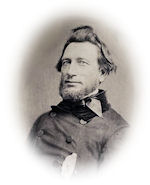
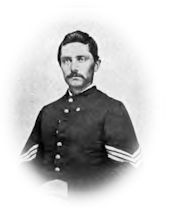
20th.—These men, who were yesterday worn out and abused, who needed all the rest they could get, were ordered up this morning at half-past 2, to march at 4, and then, after being formed into line, were kept waiting till 6. The Surgeons dare not say, “General, permit me to suggest that this is rapidly exhausting the nervous energies of the men, and that last night, we had to leave over sixty, overcome by the fatigue of the day.” It would have been deemed insolent and insubordinate in a Surgeon to have suggested that the two hours which the soldiers spent on their feet, waiting for their officers to get ready, might have been spent with great benefit to their health and energies, in bed, and the Surgeons must be dumb and the men sick.

We are to-day passing over some of the places of our former defeats—Big and Little Bethel, and the localities of some of our unsuccessful skirmishes.

Wednesday, 20th—Nothing of importance.

On the 14th of August—McClellan’s attempt to reach Richmond via the Chickahominy swamps having proved a disastrous failure—the transfer of the army to Washington began.

Lieutenant Robert Wilson of J. H.’s regiment wrote home at the time a letter which might easily have come from any regiment in the Army of the Potomac. “Six days’ march,” he says, “to Newport News, choking with dust, parched with thirst, melting by day and freezing by night, poorly fed and with nothing but the sky to cover us. You can judge of our exhausted condition when I tell you that six miles before we reached the camp at Newport News the 16th Regiment, N. Y. Vols., numbered only 184 men in the ranks, though men straggled in, so that there were 400 in the morning, and the 16th is no straggling regiment. Next day embarked on transports and arrived at Alexandria, sorrowful and humiliated when looking back over a year and finding ourselves on the same ground as then. The debris of the Grand Army had come back to its starting place with its ranks decimated, its men disspirited, its morale failing, while the thousands who sleep their last sleep on the Peninsula demand the cause of their sacrifice.”

August 20. — The 126th Regiment, just organized, was mustered into service at Camp Swift, Geneva. Those that I know who belong to it are Colonel E. S. Sherrill, Lieutenant Colonel James M. Bull, Captain Charles A. Richardson, Captain Charles M. Wheeler, Captain Ten Eyck Munson, Captain Orin G. Herendeen, Surgeon Dr Charles S. Hoyt, Hospital Steward Henry T. Antes, First Lieutenant Charles Gage, Second Lieutenant Spencer F. Lincoln, First Sergeant Morris Brown, Corporal Hollister N. Grimes, Privates Darius Sackett, Henry Willson, Oliver Castle, William Lamport.

Dr Hoyt wrote home, “God bless the dear ones we leave behind; and while you try to perform the duties you owe to each other, we will try to perform ours.”

We saw by the papers that the volunteers of the regiment before leaving camp at Geneva allotted over $15,000 of their monthly pay to their families and friends at home. One soldier sent this telegram to his wife, as the regiment started for the front: “God bless you. Hail Columbia. Kiss the baby. Write soon.” A volume in ten words.

I Get On The Retired List.

August 20. Until recently I have been quite a popular commander of Sunday church parties. The boys would get-up their parties and get me a pass to take them into town to church. I would take them in and, halting on some convenient corner, would deliver myself of a little speech. I would say, “Boys, I have always believed in the largest tolerance in matters of religion and politics, and as much as I should like to have you attend church with me, if you have any preferences you are at liberty to enjoy them; far be it from me to impose my authority on your feelings or conscience. I shall expect you on the corner at the appointed time that we may report back in camp in season for dress parade.” Now, if they couldn’t have had a tolerably good time under those conditions, it certainly was no fault of mine. But this, like every other good thing, could not always last. One Sunday afternoon, when we gathered on the corner, one of the party failed to put in an appearance. After waiting beyond a reasonable time, he was defaulted and we returned to camp. About night he came in, showing unmistakable signs of having been on the hardest kind of fatigue duty. Instead of going to his quarters as he was told to, he thought it was his duty to interview the captain. That interview resulted in a court martial, before which I was ordered to appear. I was asked numerous questions, all of which I answered to the lest of my knowledge and belief, and my evidence not only convicted the prisoner but reflected somewhat on myself, for in summing it up, they somehow fixed it up in such a way as to make it appear that 1 was in the practice of taking parties into town on Sundays, ostensibly to church and then letting them go wherever they pleased, and inquired of me if that was not about the true solution of the problem. Wishing to avoid controversy, I assented. I was then told that I could retire from that august presence, a privilege of which I availed myself immediately, but what I noticed as being rather singular, after that little interview I was in command of no more Sunday parties.

Wednesday, 20th.—Company F sent out as reserve pickets. Feds made as though they would charge our picket line with cavalry.

AUGUST 20TH.—We have now a solution of the secret of Pope’s familiarity with the country. His guide and pilot is the identical Robt. Stewart who was sent here to the Provost Marshal—a prisoner. How did he get out? They say money did it.

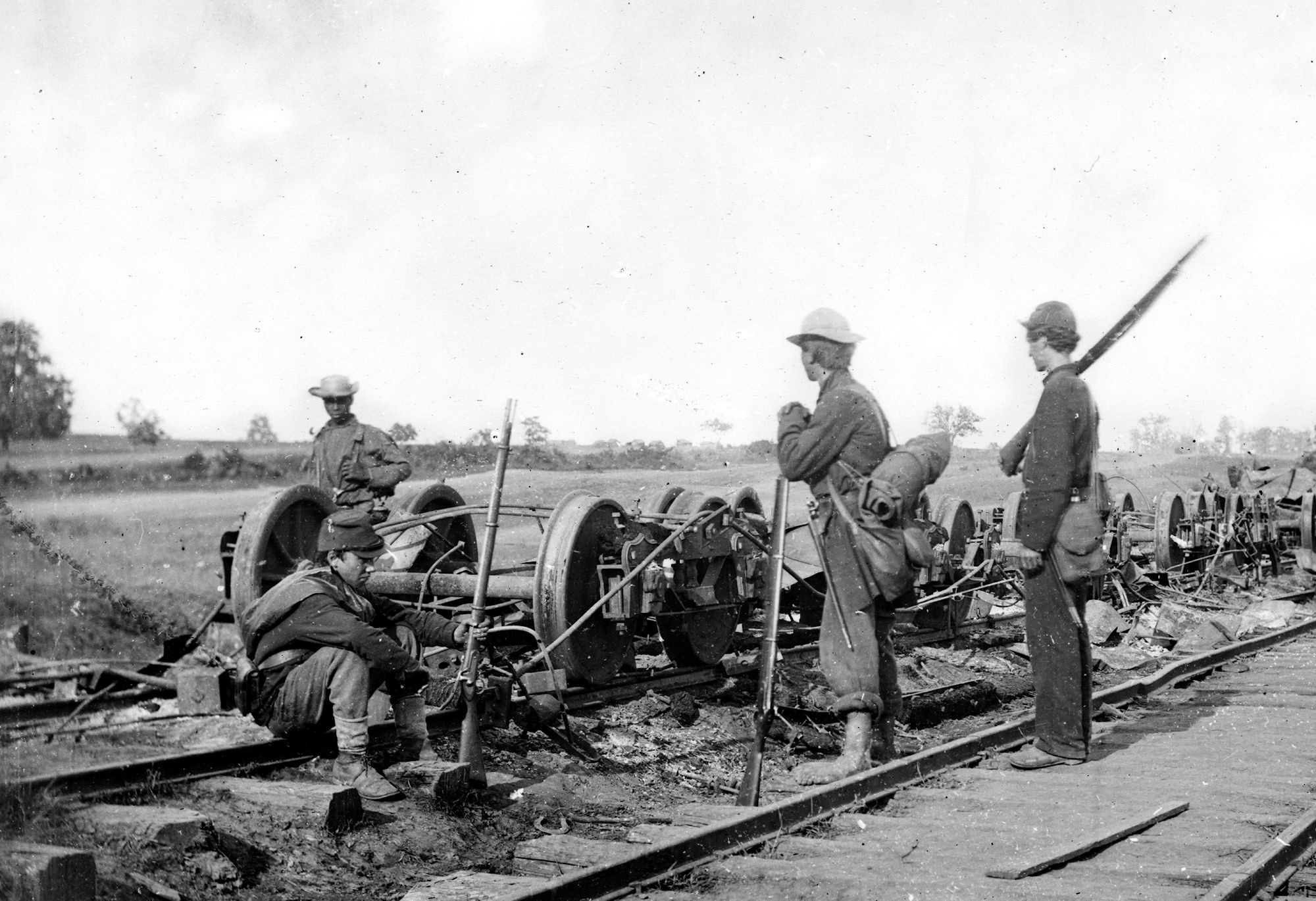
1862 August Manassas Junction, Va. Soldiers beside damaged rolling stock of the Orange & Alexandria Railroad

Manassas Junction, Va. Soldiers beside damaged rolling stock of the Orange & Alexandria Railroad; photograph taken by Timothy H. O’Sullivan.

Library of Congress image.

August 20th. At 7 A. M. were en route again, and at noon entered the ancient city of Williamsburg, halting just on the outskirts of the town. Colonel Parisen, Doctor McKim, and I rode over the place, which is interesting on account of its antiquity and the college buildings; the bricks used in the buildings were sent over from England; they are very plain and substantial, but not particularly imposing; there are many quaint colonial houses now deserted on streets that are grass grown, and save for a few chattering darkies, utterly deserted. Melancholy, indeed, is the fate of this once flourishing town, now simply a monument of past generations. After an hour’s halt the column marched three miles northeast of the town, passing over the battlefield, where Haincock gained renown. The earthworks are still standing, just as the rebels left them, except that nature, always generous, has spread a graceful mantle of green about them, making them look less suspicious to the soldier’s eye.