Following the American Civil War Sesquicentennial with day by day writings of the time, currently 1863.

August 2012

AWOL 001dr

(click on image to view larger version)

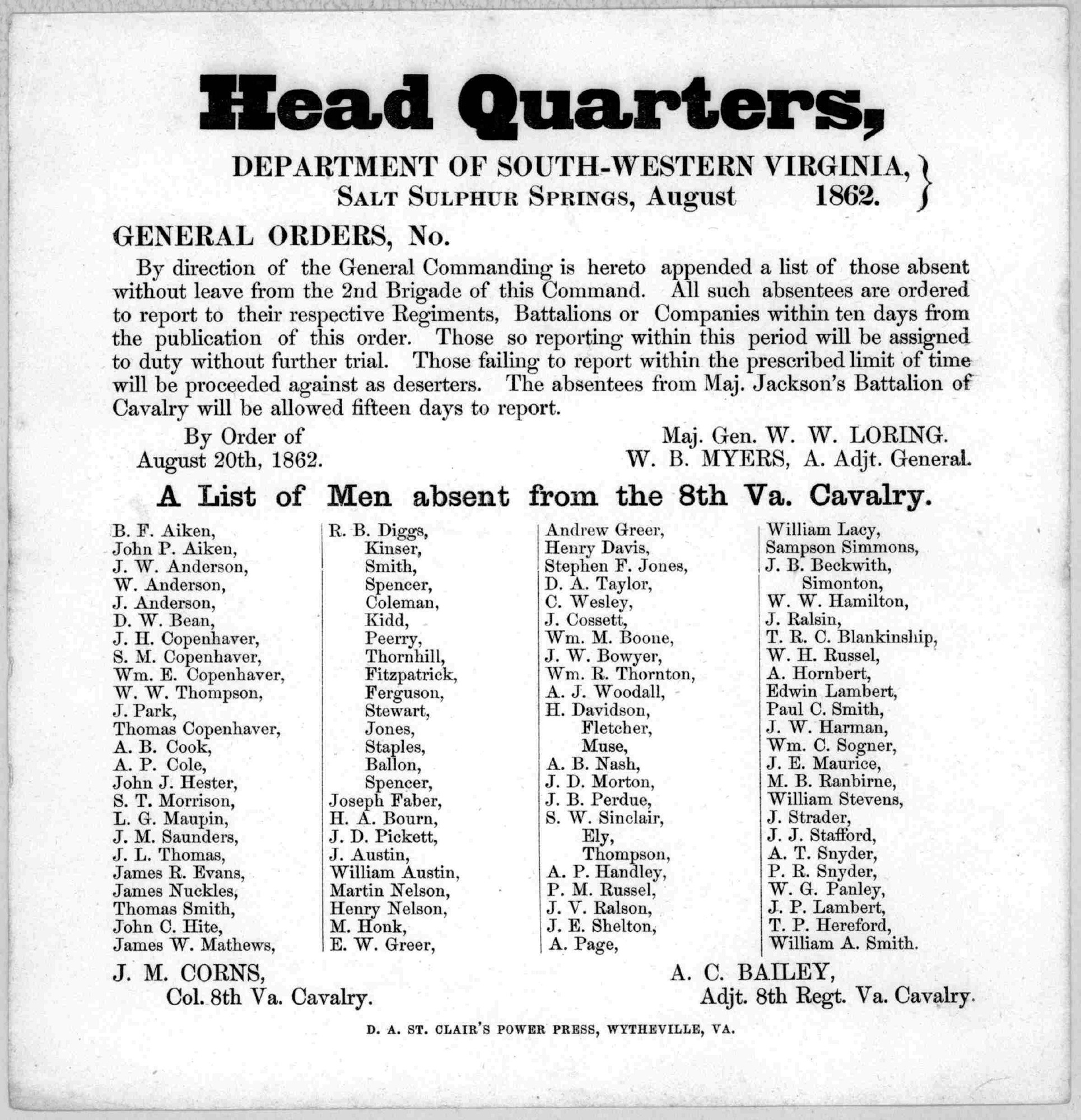
Head Quarters,
DEPARTMENT OF SOUTH-WESTERN VIRGINIA,
Salt Sulphur Springs, August……….1862.

GENERAL ORDERS, No.

By direction of the General Commanding is hereto appended a list of those absent without leave from the 2nd Brigade of this Command. All such absentees are ordered to report to their respective Regiments, Battalions or Companies within ten days from the publication of this order. Those so reporting within this period will be assigned to duty without further trial. Those failing to report within the prescribed limit of time will be proceeded against as deserters. The absentees from Maj. Jackson’s Battalion of Cavalry will be allowed fifteen days to report.

By Order of
August 20th, 1862.

  • Maj. Gen. W. W. LORING.
  • W. B. MYERS, A. Adjt. General.
  • A List of Men absent from the 8th Va. Cavalry.
  • B. F. Aiken,
  • John P. Aiken,
  • J. W. Anderson,
  • W. Anderson,
  • J. Anderson,
  • D. W. Bean,
  • J. H. Copenhaver,
  • S. M. Copenhaver,
  • Wm. E. Copenhaver,
  • W. W. Thompson,
  • J. Park,
  • Thomas Copenhaver,
  • A. B. Cook,
  • A. P. Cole,
  • John J. Hester,
  • S. T. Morrison,
  • L. G. Maupin,
  • J. M. Saunders,
  • J. L. Thomas,
  • James R. Evans,
  • James Nuckles,
  • Thomas Smith,
  • John C. Hite,
  • James W. Mathews,
  • R. B. Diggs,
  • Kinser,
  • Smith,
  • Spencer,
  • Coleman,
  • Kidd,
  • Peerry,
  • Thornhill,
  • Fitzpatrick,
  • Ferguson,
  • Stewart,
  • Jones,
  • Staples,
  • Ballon,
  • Spencer,
  • Joseph Faber,
  • H. A. Bourn,
  • J. D. Pickett,
  • J. Austin,
  • William Austin,
  • Martin Nelson,
  • Henry Nelson,
  • M. Honk,
  • E. W. Greer,
  • Andrew Greer,
  • Henry Davis,
  • Stephen F. Jones,
  • D. A. Taylor,
  • C. Wesley,
  • J. Cossett,
  • Wm. M. Boone,
  • J. W. Bowyer,
  • Wm. R. Thornton,
  • A. J. Woodall,
  • H. Davidson,
  • Fletcher,
  • Muse,
  • A. B. Nash,
  • J. D. Morton,
  • J. B. Perdue,
  • S. W. Sinclair,
  • Ely,
  • Thompson,
  • A. P. Handley,
  • P. M. Russel,
  • J. V. Ralson,
  • J. E. Shelton,
  • A. Page,
  • William Lacy,
  • Sampson Simmons,
  • J. B. Beckwith,
  • Simonton,
  • W. W. Hamilton,
  • J. Ralsin,
  • T. R. C. Blankinship,
  • W. H. Russel,
  • A. Hornbert,
  • Edwin Lambert,
  • Paul C. Smith,
  • J. W. Harman,
  • Wm. C. Sogner,
  • J. E. Maurice,
  • M. B. Ranbirne,
  • William Stevens,
  • J. Strader,
  • J. J. Stafford,
  • A. T. Snyder,
  • P. R. Snyder,
  • W. G. Panley,
  • J. P. Lambert,
  • T. P. Hereford,
  • William A. Smith.
  • J. M. CORNS,
    Col. 8th Va. Cavalry.
  • A. C. BAILEY,
    Adjt. 8th Regt. Va. Cavalry.

D. A. ST. CLAIR’S POWER PRESS, WYTHEVILLE, VA.


Library of Congress

Broadsides, leaflets, and pamphlets from America and Europe
Auguet 20.—British subjects who had declared their intentions to become citizens of the United States, being apprehensive that they might be drafted into the militia, Secretary Seward informed them, through the British Charge d’ Affairs at Washington, that none but citizens were liable to military duty in the United States.— Secretary Seward’s Letter.

—E. Kirby Smith, the rebel General, from his headquarters in East-Tennessee, issued the following address to the citizens of Knox County, and the adjacent counties in Kentucky:

“Finding that you have been deceived by the misrepresentations of our enemies, and have been induced by them not only to leave your homes, but also to resort to the cowardly practice of bushwhacking, I now promise you that, if you return quietly to your homes and lead orderly lives, you will not be disturbed, but will be protected in your rights.

“If, on the contrary, you persist in firing upon my soldiers from the woods, you will be hung when you are caught, and your houses and property will be destroyed.”

—To-day the Union army, under Gen. Pope, reached the Rappahannock River, in its retreat from the Rapidan, closely followed by the rebel army, under Gen. Lee. At Brandy Station the two armies came within sight of each other, and the rear-guard of the Nationals, supposing the advance of the rebels to be a mere skirmishing party, turned for the purpose of driving them back; but on charging upon them, they discovered their error, for after receiving two or three volleys, which thinned their ranks considerably, they retreated to the bridge at the station, closely pursued by the rebels. Here the Unionists were supported by two batteries of artillery, which opened fire on the rebels with great effect, compelling them to fall back undercover of the adjacent woods.— (Doc. 104.)

—A fight took place at Edgefield Junction, Tenn., between a small number of the Fiftieth Indiana volunteers and a superior force of rebel guerrilla cavalry belonging to Col. John H. Morgan’s command, resulting in a retreat of the latter, with a loss of seven men killed and twenty wounded.

—A fight took place near Union Mills, Mo., between a force of National troops, under the command of Major Price, and a party of rebel guerrillas. The Nationals did not discover the rebels until they were fired upon from an ambush; but, notwithstanding this disadvantage, they charged upon them and put them to flight, capturing sixteen horses, a number of guns and swords, and a quantity of lead and powder. Four of the rebels were taken prisoners and one killed. Four of the Union party were killed and three wounded.—St. Louis Democrat, August 23.

Note: This letter—a document written in 1862—includes terms and topics that may be offensive to many today.  No attempt will be made to censor or edit 19th century material to today’s standards.

Tuscumbia, Ala., August 19, 1862.

Tis the old, old, story, burning railroad bridges, skirmishing between our scouts and theirs, etc. They opened on a new program by firing into a train, two days since, wounding five men only, though they put 200 shots into the engine and cars. They are burning cotton in very good style. Night before last eight fires were visible from our headquarters, and last night four. They destroyed about $300,000 in the two nights. They’re getting scared about their negroes, and are carrying them off to the mountains as fast as possible. The blacks are scrambling in this direction to a very lively tune. Over 100 came in on one road within the last 24 hours. About 50 can be used in a regiment to advantage, but I am thoroughly opposed to receiving any more than we have work for within our lines. You have no idea what a miserable, horrible-looking, degraded set of brutes these plantation hands are. Contempt and disgust only half express one’s feelings toward any man that will prate about the civilizing and christianizing influence of slavery. The most savage, copper savage, cannot be below these field hands in any brute quality. Let them keep their negroes though, for we surely don’t want our Northern States degraded by them, and they can’t do the Southerners any good after we get them driven a few degrees further down. These nigs that come in now, say that their masters were going to put them in the Southern Army as soldiers. I’m sure the Southerners are too smart for that, for a million of them aren’t worth 100 whites. General Paine is gobbling up these secesh here and starting them North kiting. How they are shaking in their boots. Paine is going to clean out the country and make it Union if there is nothing but desert left. There are a number of very fine people here, such men as Jacob H. Bass, highly honorable, conscientious, etc., but strong believers in State sovereignty, and because their State has seceded, they are secessionists, and for no other reason. Paine is going to make them walk the plank with the rest. It looks a little hard to me, as they are willing to be paroled, but I’ll never say stop when anybody is pounding the secesh.

We sailed August 13th from New Orleans, and reached Forts Jackson and St. Philip, where we remained over night, and received a salute for the Admiral. We got under way on the following morning, and proceeded to Pilot Town. We found several fine U. S. ships here, among them the U. S. ship Pampero, with which we slightly collided, doing little damage. We here took in our spare spars and rigging, which we had stripped off on entering the river, and also removed the chain cable from our ship’s side.

On the 16th we left for Ship Island, getting aground on the bar as we went out, and arrived off Ship Island on the same evening. We went into port on the following morning, and found lying here the U. S. frigate Potomac, and U. S. sloop-of-war Richmond. The Rhode Island arrived on the 19th, and we left the same day for Pensacola, via Mobile Bay. On arriving off Mobile we found on the blockade the U. S. frigate Susquehanna, with several gunboats. We received and returned a salute from the Susquehanna, and passed on to Pensacola. We arrived off the place in the evening, and went into the harbor on the following morning, and moored the ship off the Navy Yard.


Headquarters 5th Army Corps, Camp at Newport News, August 19.

Dear Hannah, — I have had no chance to write since my first letter to Father as the army has been in motion since that time. We left Harrison’s Landing on Thursday, 8 P.M., and reached Barrett’s Ford on the Chickahominy, a distance of twenty miles, by 7 o’clock the next morning. We crossed the Chickahominy on the pontoon bridge just constructed, 2000 feet in length, and camped on this side. Saturday at 4 A.M. we started for Williamsburg, about 12 miles distant, and made our headquarters in the President’s house at William and Mary’s College. Williamsburg is an old-fashioned city of 4000 inhabitants, although now mostly deserted. Sunday at 6 P.M. we started for Yorktown, 14 miles off, and from there pushed on to Newport News, 28 miles, reaching here at 8 o’clock yesterday morning. The whole army is now across the Chickahominy and the bridge taken up. I am somewhat tired, but in other respects perfectly well.

Prison life did not leave any bad effects upon me, except the natural one of weakness. I was well all the time, with the exception of some slight eruption, which broke out on my body, probably a mild form of scurvy. My chief annoyance was from the lice. Every morning for over six weeks I looked over my clothes carefully, and as regularly found two or three of the disgusting old fellows, besides any amount of nits and young ones. The building was full of them and whenever any one hammered on the floor above, down came the lice. I have always had a great horror of them, and found them rather hard to bear. All the officers were in the same condition. Our life was the same from one day’s end to another. Our mess (No. 2) took breakfast at 7.30. We had sour bread, coffee made from rye and bought (75 cts. lb.) by ourselves. Then we would read or play cards or go to sleep during the forenoon until 1 o’clock, when we dined on bread and greasy soup. The afternoon was spent in much the same way as the morning. Supper we took at 6, and at 9 went to bed.

I don’t want Father to send my horse on. I shall buy one on here. As soon as I can get a chance I shall have my things sent on to me, but at present I don’t know where to have them sent to. I think we shall go to Aquia Creek. We probably go on board to-night.

I have not heard from home yet and do not know why letters do not come. I hope you are all well. I was very anxious while in prison until I heard from the general that Father was well and relieved of all anxiety about me. . . .

August 19 —Last night just as we were getting into sleep deep enough to feel good, that confounded old bugle bleated out for us to get up and get ready to march at eleven o’clock. Soon afterwards found us on the march through pitchy darkness, stumbling slowly down the Fredericksburg road. We marched till four o’clock this morning, halted about two hours, countermarched, and went back again over the same road, picketing within one mile of Orange Court House. We remained there until two o’clock this afternoon, then moved back again to where we halted this morning, which is thirteen miles east of Orange Court House. This seems to be see-saw day in the marching business. We did not halt there more than about fifteen minutes, then marched on toward Fredericksburg. We followed the main road about five miles, then turned off to the left and moved about four miles in a northerly course. We marched until two hours after dark.

The road we passed over this morning is hilly and rough and creeps snake-like through a dense pine thicket. The Lord only knows where we are camped to-night — I don’t — but I believe we are somewhere in the northeastern part of Orange County. This morning at daylight the First Regiment of Virginia Cavalry passed us. It is General J. E. B. Stuart’s old regiment. This morning was the first time I saw it.

August 19th.

Yesterday, two Colonels, Shields and Breaux, both of whom distinguished themselves in the battle of Baton Rouge, dined here. Their personal appearance was by no means calculated to fill me with awe, or even to give one an idea of their rank; for their dress consisted of merely cottonade pants, flannel shirts, and extremely short jackets (which, however, is rapidly becoming the uniform of the Confederate States).

• • • • • • • • • • •

Just three lines back, three soldiers came in to ask for molasses. I was alone downstairs, and the nervous trepidation with which I received the dirty, coarsely clad strangers, who, however, looked as though they might be gentlemen, has raised a laugh against me from the others who looked down from a place of safety. I don’t know what I did that was out of the way. I felt odd receiving them as though it was my home, and having to answer their questions about buying, by means of acting as telegraph between them and Mrs. Carter. I confess to that. But I know I talked reasonably about the other subjects. Playing hostess in a strange house! Of course, it was uncomfortable! and to add to my embarrassment, the handsomest one offered to pay for the milk he had just drunk! Fancy my feelings, as I hastened to assure him that General Carter never received money for such things, and from a soldier, besides, it was not to be thought of! He turned to the other, saying, “In Mississippi we don’t meet with such people! Miss, they don’t hesitate to charge four bits a canteen for milk. They take all they can. They are not like you Louisianians.” I was surprised to hear him say it of his own State, but told him we thought here we could not do enough for them.

19th.—Moved at 7 this morning. Marched to-day over much of the same ground which we travelled over on our way to Richmond. But strange! There was scarcely a spot which I could recognize. Heretofore my memory of places has been almost wonderful. Why could I not now recognize? Has age impaired my memory, or was my mind at the time of passing so occupied with weightier matters that ordinary scenes and circumstances made no impression!

At 12 M. to-day we reached Yorktown. How wonderfully our minds deceive us in estimates of places and things associated with great events! Whoever heard of Yorktown, that city on the banks of the noble York River, on the sacred soil of the great State of Virginia? The famous city where Lord Cornwallis took his stand to crush out the American rebellion—the city in which was fought the last great battle for American independence—the mother of a nation, and which lives to have witnessed the growth of that nation through youth to maturity, from the feeble efforts of infancy to the power of a giant, and still lives to look on her offspring: sent by the convulsive struggles of its own strength, perhaps to final dissolution. I ask what mind can contemplate a city associated with all these events and recollections, without being possessed of ideas of its vastness and its splendor? But what the reality? Yorktown is a little dilapidated old village, which never contained a population of over 200 or 300, and at the commencement of this war not over 150. When I look on its insignificance, or rather on its significant littleness, I find it difficult not to detract from the ideas of greatness, associated with the great men who figured there. How wonderfully have the great advantages which nature has lavished on this State been prostituted to the one great idea of maintaining her peculiar institution, which she has nursed and defended against the approaches of the world, as she would protect and encourage the whims and weakness of a sickly girl.[1]

A circumstance occurred to-day so painful that I should like to forget it, yet so suggestive of the trials of this army and of the discouragements which has occasioned much of their indifference to events, that I feel it a duty to record it, that it may not be forgotten. On the late retreat from Richmond, most of the men found it necessary to throw away everything which impeded their progress, even their canteens. During our stay at Harrison’s Point they had not been fully replaced. This morning we started early. The day has been intensely hot, the dust almost insufferable. Gen. H—— was in command of his brigade. We had made a rapid march of about ten miles. The men were fatigued, foot-sore and thirsty. In many instances, two or three having to depend on one canteen, it was soon emptied, and when we stopped to rest after the ten mile march, we were in sight of a large spring of beautiful cold water. But the General ordered that not a man should leave the ranks to fill his canteen. It was hard to bear, but the men submitted in patience till they saw the soldiers from other brigades passing from the spring with their canteens filled. This was too much, and they commenced crying out “Water, water.” Immediately the General dashed amongst them, proclaiming “mutiny,” and demanding the offenders. Of course no one could tell who they were. He then turned upon the Regimental and Company officers, “damned them to hell,” and spent some time in consigning the soldiers to the same comfortable quarters. After he had got them all labeled for that kingdom, he told them that their officers were “not worth a G—d d—n,” and having exhausted his vocabulary of gentlemanly expletives, calculated to encourage subordination, he called the men into line and put them through the evolutions of a brigade drill for about half an hour, and thus were they rested to resume the march. These men—this remnant of a fine army, who had been dragged through the putrid swamps of the Chickahominy till they were more like ghosts than men, were thus rested, thus drilled, thus marched, thus abused. Surely the end is not yet.


[1] I think that all the towns on this noble river, from its source to its mouth, will not amount in the aggregate to a population of 2,000 souls! And the same may be said of the James River, from Richmond to its outlet; and yet these rivers pass through one of the finest agricultural regions in the world. There is not a spot of earth, the wheat from which can compete in market with that of the James River.

Tuesday, 19th—We received orders that two companies are to go out every three days about four miles east of the camp, to guard the railroad at the deep cut. On the third day they are to be relieved by two other companies from the regiment. It is a dangerous place to be on picket.

On Steamer Monitor, Kanawha River,
August 18, [1862]. Evening.

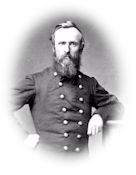
Dear Wife : — I am four hard days’ marching, and a few hours’ travel on a swift steamer nearer to you than I was when I last wrote you, and yet I am not on my way home. You will see in the newspapers, I suppose, that General Cox’s Division (the greater part of it) is going to eastern Virginia. We left our camps Friday, the 15th, making long and rapid marches from the mountains to the head of navigation on this river. We now go down to the Ohio, then up to Parkersburg, and thence by railroad eastwardly to the scene of operations. My new regiment fills slowly, I think, and it may be longer than I anticipated before I shall be called for at Cincinnati, if at all. There is talk of an order that will prevent my going to the new regiment, but I think it is not correctly understood, and the chance, it seems to me, is that I shall go home notwithstanding this change of plan.

Our men are delighted with the change. They cheer and laugh, the band plays, and it is a real frolic. During the hot dusty marching, the idea that we were leaving the mountains of west Virginia kept them in good heart.

You will hereafter direct letters to me “General Cox’s Division, Army of Virginia.”

August 19. Evening. Same steamer on the Ohio River. —

Dearest : — We have had a particularly jolly day. The river is very low, and at many of the bars and shoals we are compelled to disembark and march the troops around. In this way we have marched through some villages, and fine farming neighborhoods in Meigs County. The men, women, and children turned out with apples, peaches, pies, melons, pickles (Joe took to them), etc., etc., etc., in the greatest profusion. The drums and fifes and band all piped their best. The men behaved like gentlemen and marched beautifully. Wasn’t I proud of them? How happy they were! They would say, “This is God’s country.” So near you and marching away from you! That was the only sad point in it for me. Only one man drunk so far; his captain put him under arrest. He insisted on an appeal to me, and on my saying, “It’s all right,” he was sober enough to submit, saying, “Well, if the colonel says it’s right, it must be right,” so he made no trouble.

I shall write daily until we get to Parkersburg — that is on the line of railroad to Chillicothe, I believe. No more tonight.

[R. B. Hayes.]

Mrs. Hayes.