Moscow, Saturday, Nov. 22. Griffith Thomas, E. W. Evans and myself went to the spring in woods, washed our clothes and returned by one o’clock. Weather warm and pleasant during the day but very cold nights.
November 2012
November 22.—A party of National troops, consisting of details from four companies of the First New-York cavalry, under the command of Captain Harkins, had a skirmish with the body of rebels near Winchester, Va., and succeeded in capturing four men and thirty horses.—Baltimore American.
—Major-General Sumner, commanding the right grand division of the army of the Potomac M Fredericksburgh, Va., in reply to a communication from the Mayor and Common Council of that town, praying that the town should not be fired upon, informed them that he was authorized to say that so long as no hostile demonstration was made from the town it would not be shelled. —(Doc. 54.)
—Commander Foxhall A. Parker, of the steamer Mahaska, in conjunction with a body of land forces under Brigadier-General Naglee, made an expedition into Mathew County, Va., and together destroyed twelve salt-works, with a large quantity of salt, burned five schooners, two sloops, and a number of scows and boats, and captured a lighter and twenty-four large canoes. They also destroyed a vessel on the stocks.—Report of Admiral Lee.
—A party of rebels made an attack upon the National forces near Halltown, Va., but were driven back by General Geary, who opened on them a masked battery of six guns.—The Secretary of War issued an order discharging from military custody all persons who had been arrested for discouraging volunteer enlistments, opposing the draft, or for otherwise giving aid and comfort to the rebels; also discharging all persons who had been arrested in the rebel States, and sent from such States for disloyalty or hostility to the Government of the United States, upon giving their parole to do no act of hostility against the Government, nor render aid to its enemies.
Friday, 21st.—Cold and cloudy; sending on troops daily. My birthday.
Camp 103d Illinois Infantry, La Grange, Tenn.,
November 21, 1862.
Every one seems to think that we will start about day-after to-morrow, Monday. We have drawn eight days’ rations, and 200 rounds of ammunition has also been drawn for our corps. I don’t think we have more than 14,000 in our corps, Logan’s and McKean’s Divisions, although there are some eight or ten new regiments here that I don’t know, where assigned. Report to-day says that Sherman has moved from Memphis on the Holly Springs Pike.
We are having delightful weather. No fires are necessary until dark, and we have had no frosts since our arrival. Hope we will keep ahead of cold weather if compatible with the interests of the service. I “borrowed” some citizens clothes and wrote myself a pass as suttler’s clerk, last night, and strolled around the town a couple of hours. There are many fine buildings here, among the rest two very large academies. Many of the Memphian nobility have country seats here, some of them most elegant. Holly Springs, though, is the most important summer rendezvous for the Memphis folk. Our people have left the Springs, and I don’t know that we have any troops in advance of this place. I am very comfortable in my quarters. Have plenty of blankets and a good stove. My colored boy, Dave, went into the country 20 miles last night and returned this p.m. with his wife, a delicate looking black woman, neat and much above the ordinary slave. She has been a sewing girl all her life, and I think would be worth something to a family that has much plain sewing to do. I think I will try to send her to Mrs. S. C. Thompson. “Dave” is a first rate cook and waiter, and I’ll keep him with me until the war closes (if he don’t spoil) and then take him to his woman. How’d you like a good colored woman for your kitchen? This woman mended my pants (I have two pairs) as neatly as any tailor could. Our regiment beats 19 out of 20 of the old ones for discipline, and averages with them for drill. Colonel Dickerman is a star, and Lieutenant Colonel Wright is proving himself much better than we expected. Colonel Oglesby has figured away ahead of anybody I’ve heard of yet in procuring wagons, tents, etc., for this regiment. Ours is the only regiment I’ve heard of yet that is allowed to retain the old complement of transportation, equipage and tents. I’m officer of the day and ’tis my duty to make the rounds of the sentinels to-night at 1 or 2 o’clock; but in consideration of—etc., think the formality will be dispensed with.
November 21 —Rained last night. I had some Yankee prisoners in charge over night.
Friday night, November 21st.
Lying on my face, as it were, with my poor elbows for a support, I try to pass away these lonely hours. For with the exception of old Mrs. Carter, who is downstairs, and the General, who is elsewhere, Anna and I are the only white people on the place. The cause of this heartless desertion is a grand display of tableaux vivants at Jackson, for the benefit of the Soldiers’ Hospital, and of course it would be sinful to stay away, particularly as Anna is a great deal better, and I need no care. . . .
Friday, 21st—No news of importance. We are now in the regular routine of camp life, with drill twice a day. The quartermaster received a consignment of clothing and blankets for some of the men of our regiment.
Friday, 21st. Took three powders and at night had another chill. Drank some capsicum tea. Slept pretty well.
Moscow, Friday, Nov. 21. Weather cold and frosty. 2 P. M. bugle sounded the assembly, “Fall in”, when we were given orders to prepare to march immediately. The horses were harnessed, everything packed ready for further orders which after an hour waiting, came, to unharness. It proved to be an alarm caused by a party of guerillas making a dash upon our foraging train, capturing some seventy mules, then skedaddling before the escort could come up.
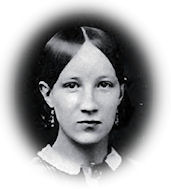
November 21.—This is my twentieth birthday. Anna wanted to write a poem for the occasion and this morning she handed me what she called “An effort.” She said she wrestled with it all night long and could not sleep and this was the result:

“One hundred years from now, Carrie, dear,
In all probability you’ll not be here;
But we’ll all be in the same boat, too,
And there’ll be no one left
To say boo hoo!”
Grandfather gave me for a present a set of books called “Irving’s Catechisms on Ancient Greeks and Romans.” They are four little books bound in leather, which were presented to our mother for a prize. It is thus inscribed on the front page, “Miss Elizabeth Beals at a public examination of the Female Boarding School in East Bloomfield, October 15, 1825, was judged to excel the school in Reading. In testimony of which she receives this Premium from her affectionate instructress, S. Adams.”
I cannot imagine Grandmother sending us away to boarding school, but I suppose she had so many children then, she could spare one or two as well as not. She says they sent Aunt Ann to Miss Willard’s school at Troy. I received a birthday letter from Mrs Beaumont to-day. She wants to know how everything goes at the Seminary and if Anna still occupies the front seat in the school room most of the time. She says she supposes she is quite a sedate young lady now but she hopes there is a whole lot of the old Anna left. I think there is.


