Following the American Civil War Sesquicentennial with day by day writings of the time, currently 1863.

Wednesday, January 16, 2013

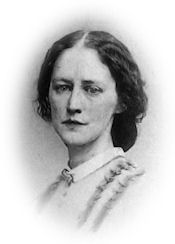
From Jane Stuart Woolsey:

PORTSMOUTH GROVE.

My dear Cousin Margaret: Now that I have been long enough in this place to have learned tolerably well my topography, the names and titles of my coadjutors, how to make out my diet books, etc., . . . I can take breath (and “my pen ” as the soldiers always say in their letters) to say that we are well and more than contented with our present position. . . . Georgy already has her “department” almost completely organized and supplied, and develops daily an amount of orderly foresight and comprehensive carefulness which would astonish one who has watched her somewhat erratic career from childhood. I, who have always rather held myself up to her as a model of the non-spasmodic style, find myself in secret and in reluctance borrowing ideas of her. She has found her work certainly, at least at present. . . . We are nine miles away, as Sarah pathetically observes, from a spool of cotton, and of course this has its effect. There was a time when Newport made it a sort of fashion, and curious crowds infested the wards with plum jam and cucumbers, but now “the season” at Newport is over and the supplies in a measure fall off. . . . We are fortunate in having a good and active young man for a chaplain. He has a large and very attentive audience on Sunday and at daily evening prayers, and it is quite refreshing to hear the full soldiers’ chorus in all the good old hymns. Last Sunday two soldiers were received into the church and baptized. Mr. Proudfit is a Presbyterian. . . . As to our house, it would not be fair to call it a shanty, as the doctors have taken so much pains or pleasure in fitting it up. . . . The outer walls are double and filled in with paper shavings (I believe), and this, with large stoves, will keep us warm; perhaps too warm some fine windy midnight. “Wooden walls” keep out all enemies according to the old song, but they don’t keep out voices, for there is Georgy saying (I can hear it as if she were at my elbow), “I shall never be able to settle down into the conventionalities of society after the wandering life I have led these five years. Once a vagabond always a vagabond; I shall marry an army surgeon and go out to the frontier!” . . . Miss Wormeley, our chief, is clever, spirited and energetic in the highest degree—a cultivated woman, with friends and correspondents among the best literary men here and in England, John Kenyon and the Browning family for instance,—a great capacity for business and not a single grain of mock-sentiment about her. . . . One good thing has happened to-day. Miss Wormeley is made agent of the Sanitary Commission here, with sole authority to draw and issue supplies, and we are to have an office full of comforts for the men at once. . . .

P. S.—All the barracks are to be plastered, large bath-rooms and steam wash-house to be built immediately, bad men turned out and good ones put in. “The kid begins to go,” and I can see by candle-light it’s halfpast midnight and time I was dreaming an hour ago.
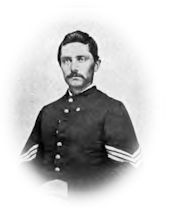
Friday, 16th—The snow continued today with a high wind. I loaned Lieutenant Spencer $15.00.1 I went to the city today to purchase some supplies, spending in all $1.00. This evening we received our long-looked-for knapsacks with our extra underwear, which was quite welcome. Those of us who were not fortunate enough to secure extra underclothes when at Holly Springs, as some did, were obliged to wear one undersuit for forty-nine days without changing. When we now cast them aside, some of the boys declared that there was almost enough life in their clothes to walk.


1 Mr. Downing informs me that, as was the common practice, this loan was evidenced only by a verbal contract.—Ed.

16th.—Just returned from Richmond. B’s situation still precarious, and I am obliged to stay with him a great deal. I see a number of officers and other gentlemen in his room; they seem to be in fine spirits about the country. Our President’s Message has been enthusiastically received. It is a noble production, worthy of its great author. I think the European public must contrast it with the Northern “Message” most favourably to us.

Several friends have just arrived from Yankeedom in a vessel fitted out by the Northern Government to receive the exchanged prisoners. About six hundred women and children were allowed to come in it from Washington. They submitted to the most humiliating search, before they left the wharf, from men and women. The former searched their trunks, the latter their persons. Mrs. Hale, of California, and the wife of Senator Harlan, of Iowa, presided at the search. Dignified and lady-like! One young friend of mine was bringing five pairs of shoes to her sisters; they were taken as contraband. A friend brought me one pound of tea; this she was allowed to do; but woe betide the bundle of more than one pound! Some trunks were sadly pillaged if they happened to contain more clothes than the Northern Government thought proper for a rebel to possess. No material was allowed to come which was not made into garments. My friend brought me some pocket-handkerchiefs and stockings, scattered in various parts of the trunk, so as not to seem to have too many. She brought her son, who is in our service, a suit of clothes made into a cloak which she wore. Many a gray cloth travelling-dress and petticoat which was on that boat is now in camp, decking the person of a Confederate soldier; having undergone a transformation into jackets and pants. The searchers found it a troublesome business; not the least assistance did they get from the searched. The ladies would take their seats, and put out first one foot and then the other to the Yankee woman, who would pull off the shoes and stockings—not a pin would they remove, not a string untie. The fare of the boat was miserable, served in tin plates and cups; but, as it was served gratis, the “Rebs” had no right to complain, and they reached Dixie in safety, bringing many a contraband article, notwithstanding the search.

The hated vessel “Harriet Lane,” which, like the Pawnee, seemed to be ubiquitous, has been captured near Galveston by General Magruder. Its commander, Captain Wainwright, and others were killed. Captain W. was most intimately connected with our relatives in the “Valley,” having married in Clarke County. He wrote to them in the beginning of the war, to give them warning of their danger. He spoke of the power of the North and the impotency of the South. He thought that we would be subjugated in a few months—little did he anticipate his own fate, or that of his devoted fleet.

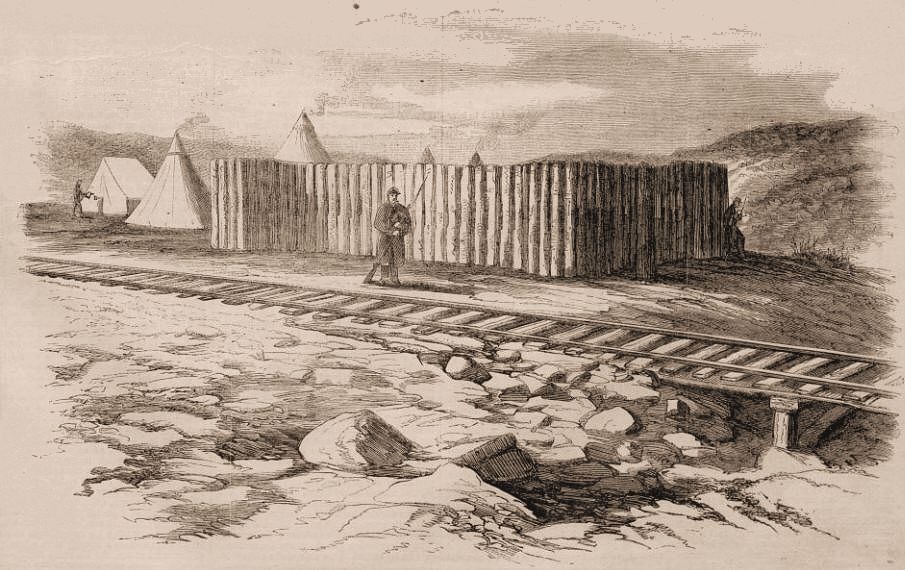
Stockade on the Louisville and Nashville Railroad

ON this page we reproduce a sketch sent us by our special artist in Tennessee, Mr. Frank Beard, representing one of the numerous STOCKADES erected on the line of the Louisville and Nashville Railroad for the protection of the track. Every bridge of consequence is guarded by one of these stockades, and most of the stations likewise. Garrisoned by a few disciplined troops, these stockades can resist the attack of a very large force indeed. What a picture of grim war these stockades conjure up!

(Published February 7, 1863, in Harper’s Weekly.)

by John Beauchamp Jones

JANUARY 16TH.—Gen. Lee is in the city, doubtless to see about the pressure upon him for reinforcements in North Carolina. Gen. Smith still writes from Goldsborough for more men, with doleful forebodings if they be refused.

From Eastern Tennessee, we have bad accounts of outrages by the disloyal inhabitants, who have fled, to escape conscription, to the mountains and caves, many of them taking their families. At night they emerge from their hiding-places, and commit depredations on the secessionists.

It has been blowing a gale for two days, and there are rumors of more losses of the enemy’s ships on the coast of North Carolina.

A letter was received by the government to-day from Arizona, justifying Col. Baylor for his policy of dealing with the Indians. I do not hear of any steps yet on the part of the President.

A report of the commandant at Camp Holmes, Raleigh, N. C., states that 12,000 conscripts have been received there altogether; 8000 have been sent off to regiments, 2000 detailed on government work, 500 deserted, etc.

The Enquirer to-day publishes the fact that a ship, with stores, merchandise, etc., has just arrived at Charleston; that six more are on the way thither, and that a steamer has successfully run the blockade from Wilmington with cotton. This notification may increase the vigilance of the blockading fleet. The Enquirer is also perpetually tilting with the Raleigh Standard. I doubt the policy of charging the leading journals in North Carolina with predilections for the Union. I believe the Enquirer has no settled editor now.

Mr. Foote favors the conscription of Marylanders. If such an act should be likely to pass, Gen. Winder will be beset with applications to leave the Confederacy.

January 16.—General James G. Blunt having discovered that certain attorneys and war claim agents, in his military district, had been guilty of endeavoring to incite dissatisfaction and insubordination among the soldiers, issued an order to his subordinates, authorizing the arrest of all such offenders, and that they be sent to his headquarters at Fort Leavenworth, Kansas, with the charges against them preferred.—Commander Couthouy, and the officers of the United States steamer Columbia, which vessel was stranded at Masonboro Inlet, N. C, yesterday, surrendered themselves to the rebels, under Colonel Lamb, this day.

—The naval expedition up the White River, Ark., under the command of John G. Walker, of the gunboat Baron DeKalb, landed at Duvall’s Bluff, meeting with no resistance, and captured two eight-inch guns and carriages, two hundred stands of arms with their accoutrements, and three platform cars, upon which the guns were being hoisted, when the rebels took the alarm and fled. Lieutenant Walker also captured seven prisoners. He then retired, leaving the place in the charge of the troops under General Gorman, who arrived shortly after the captures were made.—Lieutenant Walker’s Report.

—The funeral of Major-General O. M. Mitchel took place at Plymouth Church, Brooklyn, N. Y., this day.—The English sloop Brave, from Nassau, N. P., was captured by the gunboat Octorora.— An enthusiastic Union meeting was held at New Orleans, La., at which speeches were made by Thomas J. Durant, and others, and resolutions urging an earnest and vigorous prosecution of the war were adopted unanimously.—New-Orleans) True Delta.

—The transport ship Planter, with men and material belonging to the National army, was wrecked this morning, near Stranger’s Key, Bahama.—The rebel steamer Oreto, escaped from Mobile harbor, Ala., running directly through the National fleet blockading that place.—(Doc. 107.)

Buntyn Station, Friday, Jan. 16. Clear though cold morning. S. Beaver, S. E. Sweet, E. W. Evans, T. J. Hungerford and myself, having a permit from Captain, started for Memphis at 8 in the morning, going afoot on the railroad. Travelled briskly until within two miles of town, when we were halted by a guard, with orders not to pass any officer or private of Quinby’s Division without a pass signed by officer commanding, but suggested that we had been in the service long enough to know how to pass a guard. Taking the hint we turned back about fifteen rods, then going through the snow around a field, passed in to town undisturbed. Stayed in town some four hours, went to the gallery, had my likeness taken. Spent money. Returned by the evening roll call better off than most of the boys, as we were able to walk straight as we had taken no liquor. Considerable tired nevertheless.