Following the American Civil War Sesquicentennial with day by day writings of the time, currently 1863.

January 2013

Thursday, 22d January.

What a rush of visitors last night! One would imagine they had all come by appointment, expressly to have an impromptu dance, which they certainly enjoyed, by the way. There was little Captain C——, the Susceptible and Simple, who so innocently says “I seen” and “I done it,” without the faintest suspicion of the peculiarity, and looks so sweet, and guileless, and amiable, and soft, that I can’t help wondering if he would be sticky if I touch him. Indeed, I think his hands stick, at least; for when he told me good-bye, it was with the greatest difficulty that I extracted mine from his grasp (he having forgotten to return it during a long farewell address), and even when I succeeded in recovering it, by being almost rude, it was not released without a very sensible pressure from the putty, or whatever it is that is so tenacious. I am afraid it is rather a habit of his, which has lost all force or meaning by being too frequently repeated. Then there was a horrid little wretch, vulgar and underbred (to my idea), to whom I was introduced as Mr. G——. . . . But here is Lieutenant Dupré, whom I have not yet introduced, though we have met before. Tall, good-looking, a fine form, and not a sparkling face, I am inclined to believe that his chief merit lies in his legs. Certainly when he dances he puts his best foot forward, and knows it, too. Miriam, who adores dancing, is flirting openly with this divinity of the “Deux Temps” and polka, and skims around with his arm about her (position sanctified by the lively air Lydia is dashing off on the piano) with a grace and lightness only equaled by his own. And Lieutenant Duggan, with his good, honest, clever face which so unmistakably proclaims him “Tom,” we know already, so no further description is needed. Captain Fenner, too, is well known, with his short, though graceful figure, his good-humored, intelligent face, irresistible imperial, and that roguish expression about that large mouth which displays such handsome teeth, and seems to say, “Don’t trust me too far.”

Little Captain C—— tells me a long story about how Colonel Steadman had come to him and asked if he believed it possible that Miss Morgan had put her life and happiness in the hands of a homoeopathic physician; how he considered her fate sealed; and what a shame it was to trifle with such a sad affair, at my age, too, ruined for life! It was dreadful! Too sad! Hereupon, as continuing the story, he remarks that being asked his opinion by the Colonel, he agreed perfectly and thought with him it was an appalling sacrifice, and oh, all sorts of things! Anything, just to make me miserable and unhappy!

Well, what is written will come to pass. First comes a doctor with a butchering apparatus who cups and bleeds me unmercifully, says I’ll walk ten days after, and exit. Enter another. Croton oil and strychnine pills, that’ll set me up in two weeks. And exit. Enter a third. Sounds my bones and pinches them from my head to my heels. Tells of the probability of a splinter of bone knocked off my left hip, the possibility of paralysis in the leg, the certainty of a seriously injured spine, and the necessity for the most violent counter-irritants. Follow blisters which sicken even disinterested people to look at, and a trifle of suffering which I come very near acknowledging to myself. Enter the fourth. Inhuman butchery! wonder they did not kill you! Take three drops a day out of this tiny bottle, and presto! in two weeks you are walking! A fifth, in the character of a friend, says, “My dear young lady, if you do, your case is hopeless.” What wonder that I am puzzled? A wiser head would be confused. I want to believe all, but how is it possible? “What will be, will be.”

• • • • • • • • • • • •

Bon! here comes a note from Mr. Halsey! Ah ça! Lend him “Zaidee”? Certainly! Here is a postscript three times the length of the note; voyons. Will Miss Sarah make the annotations he requested, in “Kate Coventry”? He is anxious to have the lady’s opinion on the questions of taste and propriety which so frequently occur in the book. . . . I’ll not attempt such a display; yet there are several passages I am dying to mark. One in particular, speaking of the peculiarities of men, of how they are always more at ease when they have their hands employed, drawing confidence and conversation from a paper-knife and book to tumble, a pair of scissors and a thread to snip, or even from imbibing the head of a cane, I am anxious to call his attention to. If I dared add to the list, “or a cord and tassel to play with”! This nervous Mr. Halsey is wearing out my pretty blue tassel that Frank admires so much; he says he can talk better when he dangles it. Think the hint might save it in the future!

January 22, Thursday. There is a rumor that Fitz John Porter, whose trial of over forty days has interested the public, is found guilty and has been cashiered. A different result was reported at the close of the trial a fortnight since. It was then said he was unanimously acquitted. I did not give implicit credit to that rumor, though I read none of the testimony; but my impressions and observation and all that I heard at the War Department in relation to Porter and other generals in the day and time of their occurrence for which he was arraigned were such I could not believe him wholly guiltless. The finding and punishment are severe, but I apprehend not entirely undeserved. I do not, however, impute to him disloyalty or treachery, but he was one of a mortified clique or combination who, were vexed and dissatisfied, not without cause perhaps, that an inferior officer for whom they had not high regard should have been brought from a distant department and placed over them, their plans and operations broken up, and the commander whom they respected and to whom they were attached superseded and virtually disgraced. But if the country was made to suffer by this mortified partisan combination, it was a crime which should not go unrebuked or unpunished. Porter may not have been the chief or only sinner, though the victim in this combination.

It was not a wise or judicious movement to place Pope at the head of the army last summer. If I am not mistaken those who participated in it now think so. An intrigue against McClellan brought him and Halleck here. Perhaps under no circumstances was Pope equal to the command given him, but I thought then and still believe he was not faithfully and fairly sustained by Porter and his associates. McClellan and most of his generals were vexed and irritated. They had some cause for dissatisfaction, but not to the injury of the country. Fitz John Porter, the intimate of McClellan, entered with all the ardor of a partisan and a clansman into the feelings and wrongs of his commander. He and the set to which he belonged did not, I thought at the time, wish Pope to acquire great glory; their zeal for victory was weak when he commanded, and the battle was lost. To some extent the results at the second Bull Run fight are attributable to the bad conduct of the generals. It has been evident the soldiers of the Army of the Potomac were not enthusiastic for Pope, — that they did not like him. This is true, but who chilled them? Who encouraged their dislike?

The Weehawken has arrived at Hampton Roads, having rode out the gale without making a port. No man but John Rodgers would have pushed on his vessel in that terrific storm. The Nahant, a better vessel, sought the Breakwater, as did some of our best wooden steamers.

General Burnside was to have made a forward movement, but the storm prevented. There are rumors that the army is much demoralized, that the soldiers do not give their confidence to Burnside, doubt his military capacity, and that some of the generals are cool. There is, I think, some truth and some exaggeration in all these reports.

22nd. Thursday. Had a good visit with Ma. In the afternoon met the “B. F.” at Will’s. Adjourned to Thursday lecture by Prof. Fairchild. Liked it well. In the evening called on Fannie. Home early with Ma.

Washington Thursday Jan’y 22nd 1863

Another chilly, wet, misty, muddy day. It has passed off very quietly. But we were somewhat startled to learn tonight that Maj Genl Fitz John Porter was “cashiered and dismissed from the Service.” The verdict of the court is said to have been unanimous. McDowell will come out better. There is a rumor tonight that there has been another Battle near Fredericksburgh and that Genl Hooker is mortaly wounded, but I think it is only a rumor. The evening “Republican” contained it. Genl Burnsides address to the Army of the Potomac is in the “Star” this evening. My old friend John Merchant (& Lady) from Lyons called on me this morning. I showed them round the Pat office and this evening called and spent an hour or two with them at Mr Wm Ormes where they are stoping on E St. Mrs Merchant (who was Harriet Cole, daughter of Joseph Cole deced) is a cousin of Mrs Orme. Mr O is one of the wealthy men of Washington, has lived here near forty years. A girl who has been with the army and acted as female scout in “Seigels Corps” called here while we were at dinner to see Capt Johnson of the “Light Brigade” distinction. The Capt would not see her. She claims that he promised to marry her and seemed quite disconsolate. I did not see her. I weighed 142lb today. Am well and hearty as I ever was. For dinner today we had a nice meat pie, chickens & Beef, potatoes (Irish & sweet), turnip, cabbage and celery. For desert Rice pudding with a cup of tea. We dine at 5 o’clock. $30.00 pr month for room and Board, fire & light.

Thursday, 22d—Today we enjoyed the first warm, clear day for more than two weeks, the snow having entirely disappeared. Our fleet continued all day without a stop. We met the White river expedition returning to Memphis from Napoleon, Arkansas. We tied up for the night about one hundred miles above Vicksburg.

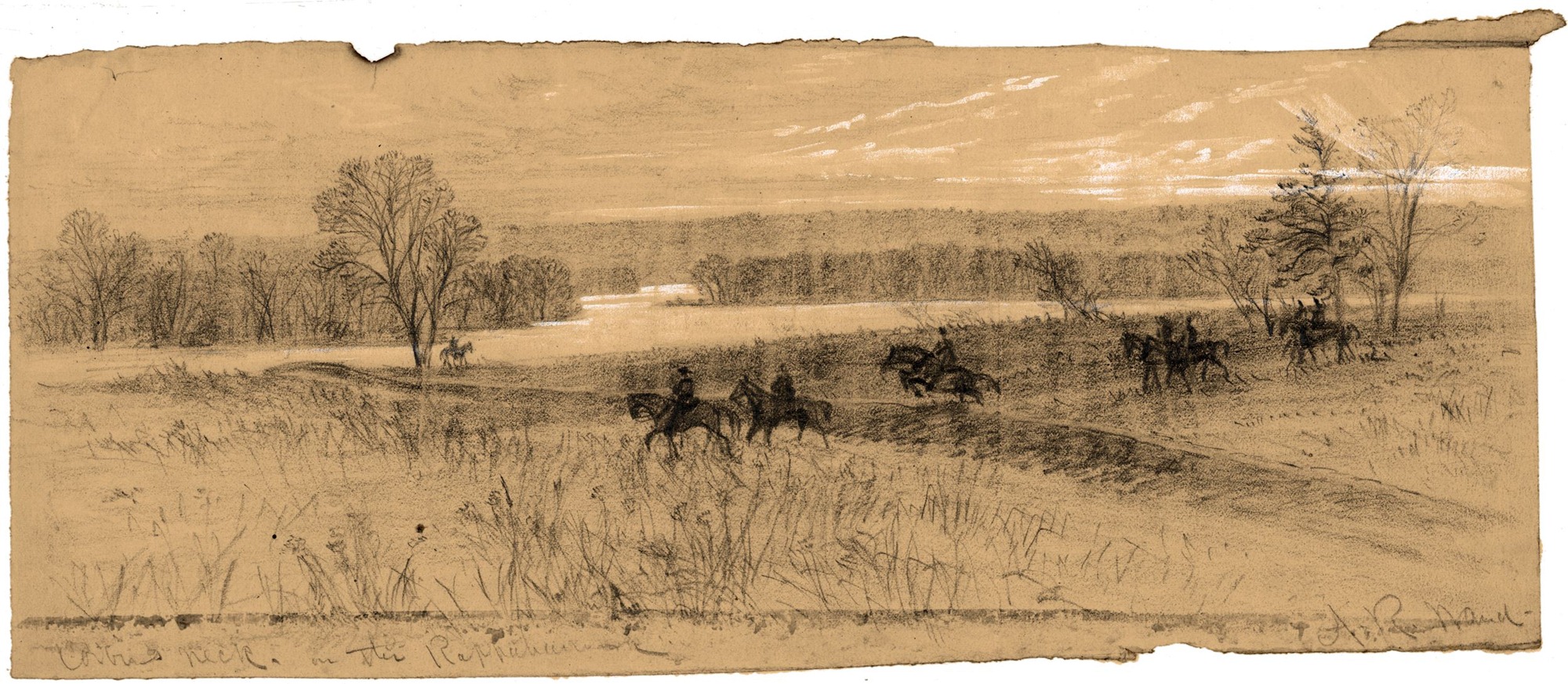
Corbins Neck on the Rappahannock


Medium: 1 drawing on tan paper : pencil and Chinese white ; 12.7 x 31.2 cm. (sheet).


  • Signed lower right: A.R. Waud.
  • Title inscribed lower left.
  • Published in: Harper’s Weekly, February 28, 1863, p. 140.


Library of Congress image.

by John Beauchamp Jones

JANUARY 22D.—We have reliable intelligence of the sinking of the U. S. gun-boat Hatteras, in the Gulf, by the Alabama. She was iron-clad, and all the officers and crew, with the exception of five, went down.

Gen. Whiting telegraphs to-day for the use of conscripts near Wilmington, in the event of an emergency. Several ships have just come in safely from abroad, and it is said a large number are on the way.

Mr. Miles yesterday reported, from the Military Committee, a bill repealing the existing exemption law, and embracing all male residents between the ages of 18 and 45 years. The President, or Secretary of War, to have authority to grant exemptions in certain cases, if deemed expedient. This ought to give us 200,000 more men. And they will be required.

A resolution was passed demanding of the Commissary and Quartermaster-General the number of their employees capable of performing military duty. It would be well to extend the inquiry to the War Department itself.

A letter from Norfolk states that at a grand ball, in celebration of the emancipation of the negroes, Gen. Vieille opened the dance with a mulatto woman of bad character as his partner; and Mrs. V. had for her partner a negro barber.

January 22.—The second attempt on the part of the Union army of the Potomac, under the command of General Burnside, to obtain possession of the southern bank of the Rappahannock as a base of operations against Richmond, was unsuccessful. The attempt was foiled by a rainstorm, which made the roads impassable.—(Doc. 110.)

—The brig Windward was captured and burned by the rebel privateer Oreto, off Cuba,—John Gill Shorter, rebel Governor of Alabama, issued an address to the people of that State, urging them again to come forward in the defence of the Southern government, and expressing the hope that none would “be permitted to hide under cover of home from their appropriate duty.”— See Supplement.

Buntyn Station, Thursday, Jan. 22. Sunny and warm. All quiet in camp. Exercised the horses on the course. Weighed 140 pounds. Read Parson Brownlow’s book in the evening.

Wednesday, 21st.—Crossed swamp half-mile wide.