Following the American Civil War Sesquicentennial with day by day writings of the time, currently 1863.

January 2013

January 17.—Major-General Joseph E. Johnston, of the rebel army, issued a general order modifying a previous order issued from his headquarters, in relation to unauthorized absentees belonging to the departments of Tennessee, Alabama, Mississippi, and Louisiana, so as to grant them a full pardon provided they should return to their proper commands by the twelfth of February.—Jackson Mississippian.

—Des Arc, Ark., was taken possession of without opposition by Captain Walker of the gunboat De Kalb, and a regiment of infantry commanded by Colonel Spicely of the Twenty-fourth regiment of Indiana volunteers.—A skirmish took place at Pollocksville, N. C, resulting in the flight of the rebels and the occupation of the town by the National troops.—At Liverpool, England, an antislavery conference took place, at which Mr. Spence, a sympathizer with the rebel government, attempted to resuscitate the argument that slavery could be supported on Scriptural grounds, but he was refused a hearing. A resolution in favor of the National Government was carried by a large majority, and a committee was appointed to bring the subject before the people of Liverpool.—Numbers of families who, during the expected attack on Charleston last summer, removed from that city, returned “to their homesteads, content to await the storm that may at any time burst over their heads, and to abide the result.” Mobile Register.

Buntyn Station, Saturday, Jan. 17. Was spent in resting from the tramp to town. Sunny but raw, did not take much of the snow off. Rebuilt our chimney.


Washington Friday Jan’y 16th 1863

Rumors today of a movement of the Army of the Potomac. It is believed to be a good time for it. The Rebels have undoubtedly been sending off a portion of their Army to Tennessee and N Carolina and I think our army will cross the River above Fredericksburgh, but perhaps below. More Battles and more killed and wounded, more pain and suffering. But perhaps the War is but just begun. We can and will fight for years for the preservation of the Union, if necessary, if our finances are put in a good condition. That is or seems to be now the worst feature of the business. But the Rebels must be much the worst off in that respect. We have at any rate got the most men and the most money and can stand the War the longest time. Young Ed Rogers from Lyons called upon me today and we agreed to go up to the Camp of the 138th together this afternoon, but I have not seen him since and waited so long for him that I could not go myself. Bought some Books for the Boys which I will send by mail tomorrow. I am quite well pleased with my new position in the office as Examiner of Patent Deeds. The Board is composed of three, Mr Martin Buel, Mr O Abell, and myself. We also examine the Records. The Churches are all to be given up and the “Ascension” is clear of Patients. But the order in regard to that church has been countermanded. Chas has order to have it ready tomorrow for 100 patients again.

Friday, 16th.—Balance of regiment came over; marched four miles; snow on the ground.

Note: This letter—a document written in 1862—includes terms and topics that may be offensive to many today.  No attempt will be made to censor or edit 19th century material to today’s standards.

Camp 103d Illinois Infantry, Jackson, Tenn.,

January 16, 1862. (1863)

It commenced raining early the morning of the 14th and did not cease until about 2 a.m. the 15th, since when it has snowed steadily until within two hours. The snow is some eight inches deep, underneath which is mud immeasurable. The rain the last six or eight hours came through our tent as through a sieve, the snow came in at the top, through the door, and blew under the curtains. Everybody’s wearing apparel, blankets, and self absorbed all the damp possible, and besides carried all that would hold on outside. Our stove was in this extremity our comfort and our joy. We kept two loyal Ethiopians busy during the two days, getting wood, and feeding said comforter. Great was the tribulation, and much audible cursing resulted, while the secret history of oaths unuttered, would I’m afraid, fill many volumes, and in all human probability cause, if made public, the appointment of many army chaplains. This is the first winter weather that we have had, and I’ll be willing if it proves the last, although there is a half melancholy pleasure in spludging around in this slop and taking the weather as it comes, without its first being made to feel the refining influence of house walls and good warm fires. Our men have become quite soldier-like, and endure without much murmuring the little ills as they come. It shows some of the principles of manhood, you must believe, when men stand this weather in these worthless little wedge tents, without fires and without grumbling. I got four of my men discharged to-day, and want to discharge some six or eight more. When I get my deadheads off my hands will have some 70 good men left. Rather think now, that we are stationary here for the winter, but we may possibly be sent to Vicksburg, than which nothing will suit us better. There are some eight or nine regiments here, two or three of them cavalry. The enemy is pretty well cleared out of this strip of country, and if Rosecrans gets down into North Alabama, opinion seems to be that some of us can be spared from here for Vicksburg and Port Hudson. Several houses have been burned here lately. This town will share the fate of Holly Springs, sure, if the Rebels trouble us here any more. ‘Tis fearfully secesh, and a little fire will, I think, help to purify it. Isn’t it wonderful how with so much fighting everywhere I have escaped so long? The whole of the 10th Illinois Infantry were with me in luck until the last fight at Murfreesboro, and am not certain they participated in that. There are two regiments here that have endured all of this storm without tents. I suppose the Lord takes care of them fellows, if it’s a fact that he looks after sheared sheep and birds. From my heart I pity them, though that strikes me as something like the little boy who, when his mother put him to bed and covered him with an old door, told her how much he pitied folks who had no doors to cover themselves with while they slept. That’s a story mother and aunt used to tell me in my trundle-bed days. Wonder if aunty has forgotten the story that used to make Tip and me rave. All about how that “great big prairie wolf bit a wee boy’s head off.” I almost forgot that I am out of woollen socks. Have only the pair of socks that are on my feet. Put them on this morning, and there were so many holes that I could hardly tell where to put my feet in. Wish you’d send me three or four pair. Will make cotton ones do until then. I can send you a nigger baby if it would be acceptable. They are more “antic” than either a squirrel or monkey. I have two he niggers, two she’s and three babies, mess property. Think I will either have to drown the babies, or sell them and the women, whom I endure because their husbands are such good hands. Will you take one?
January 16.—I have just returned from another horseback ride with Mrs. N.; we visited the small-pox hospital, but were not allowed to go in; about six of Mrs. N.’s nurses were there as patients. She inquired how they were, and if they needed any thing. They have very nice quarters, and one of our ablest army surgeons—Dr. Kratz—to attend them. The mortality from this loathsome disease is little or nothing.

I am as much pleased as ever with the wild and romantic scenery here; it is so varied. As we rode through the woods we came to many

1x1t1x1t“A forest glade, which, varying still.
Here gave a view of dale and hill;
There, narrower closed, till overhead
A vaulted screen the branches made.” 1x1t

Mrs. N. told me much about the scenery in Virginia, and said if I were to see that I would not be so enthusiastic about the views in Tennessee. I am not so sure about that, although Virginia has one advantage over Tennessee—the Atlantic Ocean—which to me would be a great one. This place is about three hundred and fifty miles inland from the gulf, or the ocean.

As I rode along side of this angelic woman, and listened to her conversation, I discovered a combination of admirable traits in her character, such as I never met in any woman before. She is

1x1t1x1t“A perfect woman, nobly planned,
To warn, to comfort, and command.”

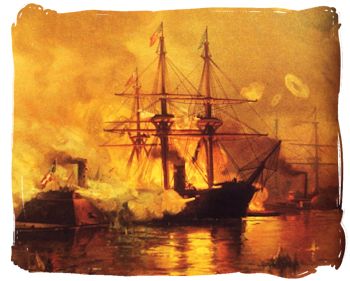
January 16th. This morning, at ten o’clock, the officers, twelve men, and marine guard of this ship went on shore to attend the funeral of Lieutenant-Commander T. McKean Buchanan, who was killed in action by the rebels in Berwick’s Bay, while commanding the Calhoun on Jan. 14th, 1863. To-day we received another mail from home, which gladdened the hearts of many.


Stoneman Station, Va.,
March 16, 1863.

Dear Cousin L.:—

I received a letter from O. M. last week. He appeared to be enjoying himself well. The weather was June-like, and the boys went round in their shirt sleeves when off duty.

He says there is a nigger regiment near him with black commissioned officers. What do you think of that idea? Contact with the contraband has so modified his ideas already that he don’t like to see them in the same uniform he wears, and woolly headed captains are a step in advance of his ideas. Ain’t you glad you wasn’t born in the South where such ideas originate?

Just as you say, there is nothing to write about the war. “Pugnacious Joseph” still maintains a state of masterly inactivity.

We had a thunderstorm last night, but the storm was snow. Robins were singing in the morning. That was spring-like, but this morning is winter again.

Of course I cannot move till we get the command, so I am waiting the progress of events. A constant indulgence of my Kendallistic propensities enables me to keep a stiff upper lip.

From home I hear that father expects to move to Michigan in April. I shall have no home to go to now, will I? L. is gone and it never did seem like home when she wasn’t there. I shall have to look out for myself if I ever do get through the war.

E. writes me that he don’t want to go west, but if I will only say the word he will be down here in the Eighty-third as soon as steam can carry him. He is not eighteen yet, but will be to-morrow, and I think he better wait, don’t you? I have had all I could do to keep him at home. He promised me once that he would not enlist without my consent, and the next letter I received from him he was in a company in Harrisburg. He excused himself on the plea of extraordinary circumstances (Stuart’s raid into Pennsylvania), and I couldn’t blame him much, as he went home again soon. Perhaps you will think I do wrong to discourage him, but I cannot bear the thought of his coming. It seems to me one in our family is enough, but I am afraid that, just so sure as there is another excitement, he will come. He will never go home if he does, at least so it seems.

January 16, Friday. Little of interest in the Cabinet. Chase, who has been absent a week, was present; Stanton did not attend. No navy or army matters discussed. Chase says the New-Yorkers are generally coming into his financial views, that all in Philadelphia approve them; thinks they should be made a party test. No one responded to this, — an indication that they were not prepared to have him set up a standard of financial, political, or party orthodoxy for them.

A flurry in the Senate to-day over a letter from General Meigs, who had been coarsely assailed a day or two since by Wilkinson of Minnesota. The Senatorial dignity was ruffled by the manly rebuke of the soldier. There is an impotent and ridiculous attempt at self-sufficient and presuming airs, an exhibition of lame and insolent arrogance, on the part of many Senators towards men who are, to say the least, their equals in every good quality. Not long since J. P. Hale undertook to vent his personal spite in the Senate on Admiral Smith, who regards the public interest more than the wordy, personal, and selfish schemes of the New Hampshire Senator. The dignity of the Senator was bruised by the old sailor’s blunt honesty, who demanded a committee with power and an investigation to whitewash the Senator or blackwash the Admiral.

Camp Near Falmouth, Va.

Jan. 16th, 1863.

My dear Mother:

We have orders to march to-morrow. I cannot say whether we will positively do so, but it is certainly intended that we move very shortly.

I do not know whether the movement is intended as an advance, or whether it is proposed, as was the case a couple of weeks ago, to fall back on Washington. It is generally supposed that the first will be the case. I am glad for anything like a movement, and I trust that this time we may have a successful encounter with the enemy. But oh, I do trust, too, that, should I come unharmed out of whatever dangers are before me, I will be able to get out of this Regiment. I do not want any further connection with foreigners. I would almost prefer never to come out alive from this campaign, if it is only to prolong the present disagreeable associations.

No matter, though, I am always content when actually in motion. The thought of being really able to contribute something, however little, to the Cause, is then dominant, and I can afford to forget the more selfish feelings that I cannot repress in camp. This letter must be short, for I am pressed for time.

Good-bye. God bless you all. All will be for the best. If we are to fight, pray God to give us victory.

Affec’y., Will.