Following the American Civil War Sesquicentennial with day by day writings of the time, currently 1863.

January 2013

[Diary] January 4.

A grand celebration at the church. The children sang, “Sound the loud timbrel,” and “Oh, none in all.”

General Saxton, General Seymour, Mr. Milne, Mr. Williams, Mr. Harrison, and Mr. French addressed the people. They all dined here, I sitting at table opposite to Mr. Soule, having General Saxton on my right hand, General Seymour on my left. The dinner passed pleasantly, when some spirit prompted me to bring in General McClellan, when the two generals opposite each other blazed up, General Seymour being an admirer of McClellan and General Saxton saying a few noble, outspoken words against his pro-slavery principles. He spoke brave, true words about freedom for the blacks. General Seymour did not agree with him. This malapropos subject came near causing a little disagreeable stiffness. Soon after dinner all went home. General Seymour seems to be full of impulse and fire, but too much impressed by a residence of former years in Charleston in favor of the “chivalry.”

4th. Sunday. Stayed at home and read the Independent and newspapers. Passed the day very quietly. Wrote a letter home.

Jane, Sarah Woolsey and G. were meantime nicely established at the hospital six miles from Newport, R. I., with a jolly little thin board house built for the nursing staff; their rooms 1o x 1o, furnished from home with every comfort, and work fairly begun.

1x1t

Jane Stuart Woolsey to Abby Howland Woolsey:

PORTSMOUTH GROVE, January, ’63.

Dear Abby: This morning in the grey (I don’t know how she managed to be up and seeing) Sarah looked in at the ventilator and announced, “Girls, there’s a big black steamer Hospital off the hospital dock.—The soldiers have come!”

She proved to be the Daniel Webster with 290 men from Fredericksburgh, many of them! There she lies at this writing, two o’clock, no tug having been got up from Newport, and the tide being so excessively low that she can’t move in. They have boarded her in boats however, and report the men very comfortable—short, delightful trip from Fortress Monroe, plenty to eat and no very bad cases on board. . . . Everything is ready for 450. Clean wards, clean beds, clean clothes and the best of welcomes. Georgy and I, who have the medical division, will not profit much. We shall get the sulky old “chronics” and “convalescents,” and Sarah and H. Whetten will have all the surgical cases; but we shall go to see them all the same, and they shall have all our stores, soft towels, jelly and oranges.

Shingling the barracks goes on bravely. I think things will be all so much finished to the satisfaction of Mr. Jefferson Davis, by spring, that he will perhaps retain us in office! . . .

7 P. M. The men are all safely landed, housed and suppered, and all the surgeons are busy dressing wounds. They must work all night. The men are bright as buttons and jolly. Tell Harriet Gilman that her shirts are blessing Fredericksburgh men to-night.

Dr. Edwards, surgeon-in-charge, in the handsomest way offers to turn out anybody we wish and put in anybody we wish, so if you know of any first-rate candidates amenable to female influence, forward us their names.
Sunday, 4th—This morn before day our Army commenced to retreat. I left the Regiment on the Plaza in M. and went out to the end of the Wilkerson pike. Got my clothing and came across to the Salem pike, found a number of unparoled Yanks on my way. I met Gen’l Buford but he would not send back to parole them. I went on to town, went to see Miss Kate, took a bite to eat and bid them goodbye. Went up to Mr. Lane’s and from there out to Col. Smith’s Regiment and back to Col. Cox in town. He promised to attend the Yanks. I then started for the Command. Came out to Col. Lytle’s, stopped, found Morton of the Battery there. I took supper there but did not know where I was until the young ladies came down. Miss Mollie came in glad to see me, was then introduced to Miss Mollie Turner and Miss Alice Hord, staid till 11 o’clock, time passed very pleasantly. Came on to Camp.

Sunday, 4th—I was on picket again today. A work train came in from Memphis, and four trains passed through going to Memphis; but none of them brought provisions, and as our provisions are so low, the division quartermaster sent all the teams to Memphis to bring provisions.

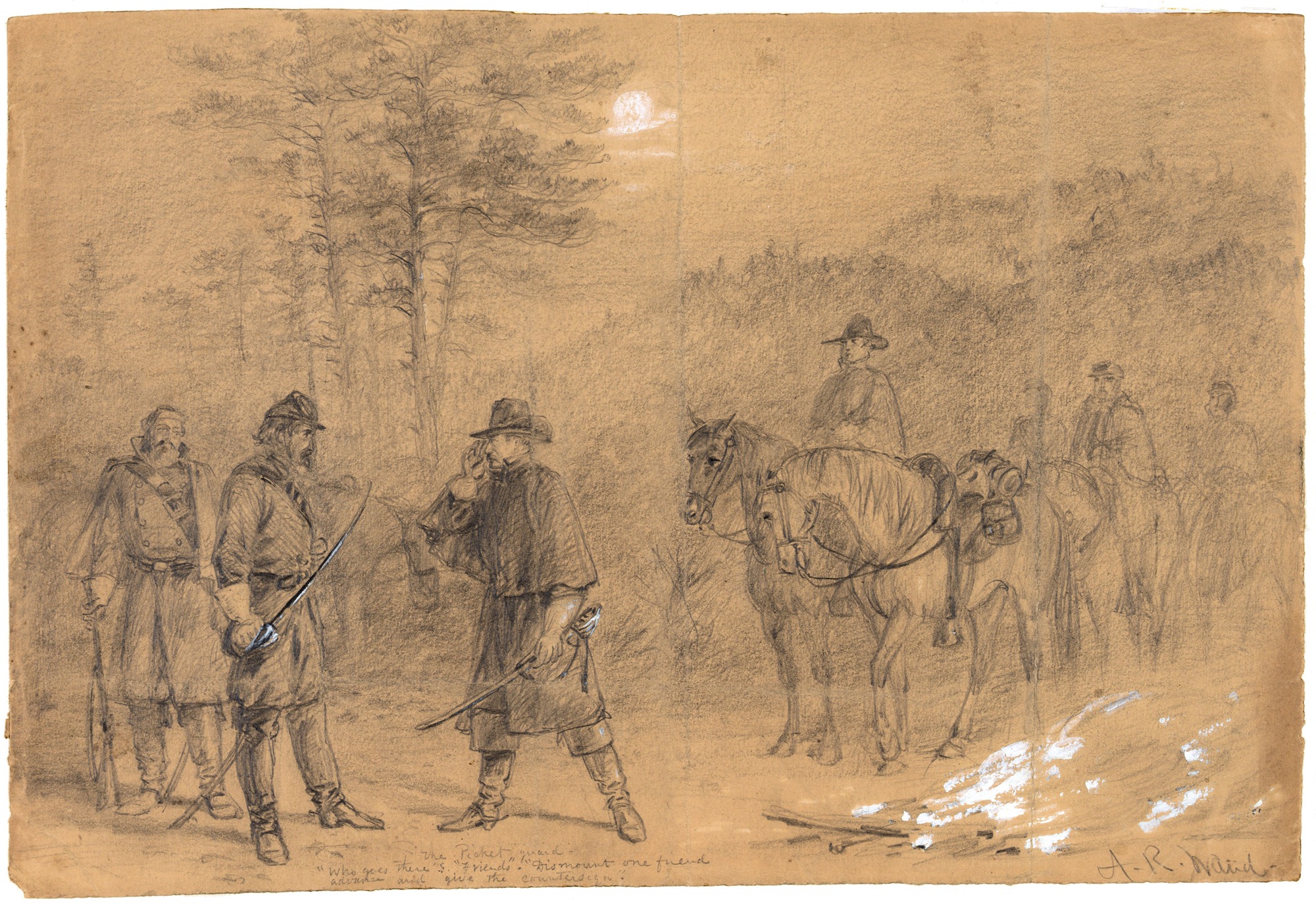
The picket guard. Who goes there. Friends

Title: The picket guard. “Who goes there?” “Friends.” “Dismount one friend, advance and give the countersign.”

  • Signed lower right: A.R. Waud.
  • Title inscribed below image.
  • Published in: Harper’s Weekly, Feb. 14, 1863.

Library of Congress image.

by John Beauchamp Jones

JANUARY 4TH.—We have nothing additional from Murfreesborough, but it is ascertained that the bridges burned by the enemy on the Virginia and Tennessee Railroad cannot be repaired in a month.

It really does seem that some potent and malign influence, resident at the capital, some high functionary, by some species of occultation, controlling the action of the government, a Talleyrand in the pay of both governments, and balancing or equalizing disasters between them to magnify his importance and increase his reward, has been controlling many events since the beginning of this war, and is still engaged in the diabolical work. It now appears that several regiments were withdrawn from the vicinity of Bristol, whose presence there was necessary for the protection of the railroad and the bridges. They were brought hither after Lee’s defeat of Burnside, for the protection of the capital! The President was away, and Mr. Seddon was now in the War Office. But Gen. Cooper is old in office, and should have known better; and Gen. G. W. Smith certainly must have known better. Just suppose we had been beaten at Murfreesborough, and our communications cut, west and east and south! There would have been no escape.

It had even been proposed to take a large portion of Lee’s men from him, so that he must be inevitably defeated on the Rappahannock, but Lee’s resignation would have shocked the people unbearably. Great injury was done him by abstracting some 20,000 of his men by discharges, transfers, and details. Nothing but his generalship and the heroism of his men saved us from ruin. The disasters of Donelson, Newbern, Nashville, Memphis, Roanoke, New Orleans, Norfolk, etc. may be traced to the same source. But all new governments have been afflicted by a few evil-disposed leaders.

Our people in arms have upheld the State; they have successfully resisted the open [click to continue…]

January 4.—Major-General Hurlbut, commanding District of Tennessee, issued an order at Memphis, warning the resident sympathizers with guerrillas, that threats having been made that the railroads in his command would be interrupted, he would, for every attempted raid upon such roads, send to the South ten families of the most noted secessionists in Memphis, and those to be selected from the wealthiest and highest social position.—General Order, No. 10.

—At Galveston, Texas, the rebel General J. B. Magruder issued the following proclamation: “Whereas, the undersigned has succeeded in capturing and destroying a part of the enemy’s fleet, and in driving the remainder out of the harbor of Galveston and beyond the neighboring waters, and, the blockade having been thus effectually raised, he therefore proclaims to all concerned, that the harbor of Galveston is open for trade to all friendly nations, and their merchants are invited to resume their usual commercial intercourse with this port.”—Official Proclamation.

Buntyn Station, Sunday, Jan. 4. A busy day for the boys of the 6th Battery, as they were in expectation of staying in the place for some time. Harness racks, feed troughs, shebangs, tables, etc. were put up from lumber carried some forty rods, where it had been stored with the intention of building. The tents were floored mostly. S. E. Sweet, Sampson Beaver, E. W. Evans and myself built a house 6 by 8, 2 ft. high lower end, with a fireplace in the side. Stood guard. Very pleasant evening.

Washington Saturday Jan’y 3, 1863

We could not have finer weather, the air is soft and balmy as May. It is much like a northern Indian summer. The same blue haze rests upon the horizon. The roads and fields are dry and everything (out doors) invites one to make an excursion. But the beautiful groves on the hilltops have an ominous look even on this side of the River. Everything bears the Mark of the Camp. On the Virginia side of the River, the beautiful groves themselves have nearly all been destroyed to give a good and unobstructed sweep to the cannon in the Forts which crown the Hill Tops. War, like a destroying angel, has passed over the fair fields, and the hills and valleys of the “old dominion.” Rebellion has brot a bitter cup to her lips. War, like the dread Sirocco, has swept over her fields, leaving them desolate. A terrible battle has been raging near Nashville Tenn. for the past two or three days. We get no definite news from there tonight and do not yet know the result. But from all accounts it is the bloodiest battle of the War yet fought. Frank must be yet in the Hospital from his wounds rcd on the 8th Dec at Franklin. We may expect active operations now in the South West. Vicksburgh I think is now in our hands, if not it will soon. I wrote home today, sending a Draft for $50. I went up to the Navy Yard after office hours and took dinner at Mr Angels. Spent an hour or two very pleasantly. His Brother from NY City was there, a very shrewd inteligent man. I walked back to my lodgings, some 21/2 miles. Mr Angel moves to Dutchess Co NY this month, He having purchased a farm there.