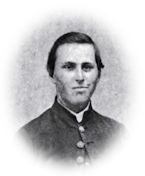
January 1st. When off picket duty try to keep comfortable by the picket fires and chopping wood for the large camp fire just outside the church. No place in the church for fires.
January 2013
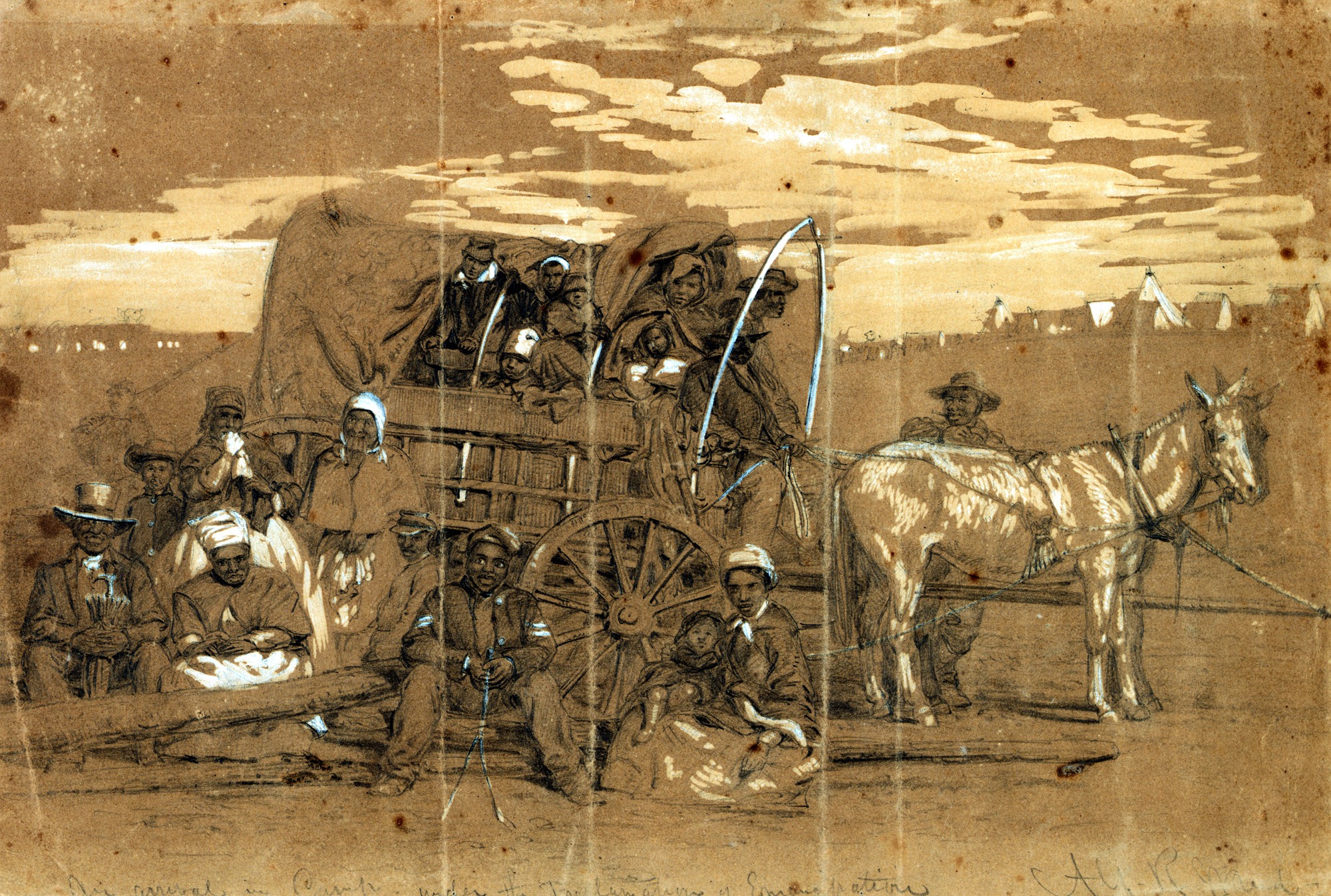 Alfred Waud worked up this sketch from a photograph, probably made in his presence by David B. Woodbury on January 1, 1863. It was published in Harper’s Weekly, January 31, 1863, p. 6.
Library of Congress image.
..
When compared with the photograph, it shows that the photo is actually an reversed stereograph.
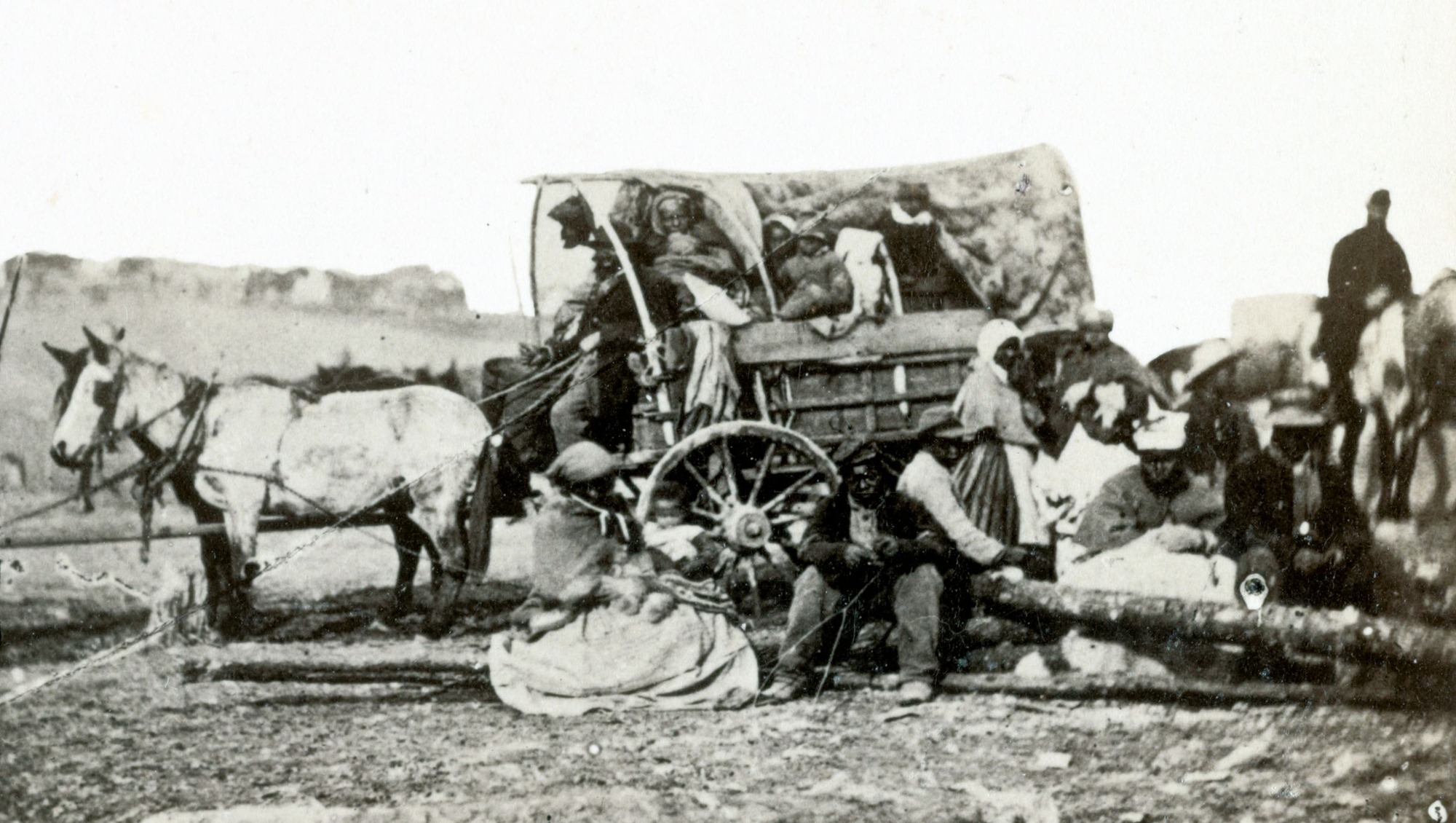
Photo shows African American men, women, and children seated in front of and inside a mule-drawn covered wagon. Artist Alfred Waud worked up a sketch from this photograph, probably made in his presence by David B. Woodbury on January 1, 1863. The drawing, called “An arrival in Camp–under the Proclamation of Emancipation” was published in Harper’s Weekly, January 31, 1863, p. 6 and is now at the Library of Congress.
Library of Congress image.
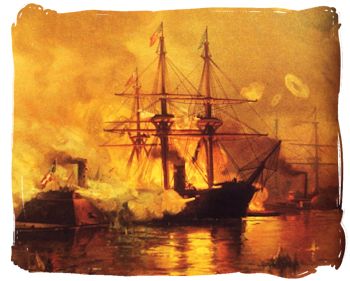
New Orleans, January 1st, 1863. Nothing of importance has occurred this day.
January 1st, Thursday, 1863.
1863! Why I have hardly become accustomed to writing ’62 yet! Where has this year gone? With all its troubles and anxieties, it is the shortest I ever spent! ’61 and ’62 together would hardly seem three hundred and sixty-five days to me. Well, let time fly. Every hour brings us nearer air freedom, and we are two years nearer peace now than we were when South Carolina seceded. That is one consolation. . . .
I learn, to my unspeakable grief, that the State House is burned down.
January 1, 1863, Thursday. The New Year opens with a bright and brilliant day. Exchanged congratulations at the Executive Mansion with the President and colleagues, at eleven this morning. The usual formalities. Officers of the Army and Navy came in at half-past eleven. I left before twelve.
The Emancipation Proclamation is published in this evening’s Star. This is a broad step, and will be a landmark in history. The immediate effect will not be all its friends anticipate or its opponents apprehend. Passing events are steadily accomplishing what is here proclaimed.
The character of the country is in many respects undergoing a transformation. This must be obvious to all, and I am content to await the results of passing events, deep as they may plough their furrows in our once happy land. This great upheaval which is shaking our civil fabric was perhaps necessary to overthrow and subdue the mass of wrong and error which no trivial measure could eradicate. The seed which is being sown will germinate and bear fruit, and tares and weeds will also spring up under the new dispensation.
Blair mentioned at my house a few evenings since that General McClellan assumed command of the Army of the Potomac last September without orders; that, finding military affairs in a disordered and confused condition, he sought an interview with the President, Stanton, and Halleck respectively, and also called to see him (Blair), but he was absent; that he then called his staff and left, but met me, to whom alone he communicated whither he was going and his purpose. This, Blair tells me, is the statement made by McClellan to Governor Dennison, who has been stopping with Blair. I well remember meeting him at that time, but my understanding has been that McC. received command of the Army by order of the President on recommendation of Halleck.
January 1—This month we have done nothing but move our camp once, and drill. Had to send all our baggage away. Hereafter nothing more will be hauled for us in wagons. There are rumors flying about that we will soon leave here.
[Diary] January 1, 1863.
We rejoiced at midnight with great pride and joy to think that our country is at last free.
We were late in the morning, and when we reached the ferry saw the Flora depart without us. Sergeant Arthur took us across in his boat, and we waited at the General’s house until the Flora’s second trip. It was a thousand pities, for when we reached Camp Saxton at Smith’s plantation,[1] we arrived through the dense crowd at the foot of the platform only in time to see Colonel Higginson[2] standing between his two color-bearers, Robert Sutton and Prince Rivers, looking small — tall and large man as he is — compared with them; but we missed Colonel Higginson’s speech, which was stirring and eloquent.
In one of the pauses of the exercises, just after the regiment received its colors, I believe, the soldiers and people spontaneously broke out with “My Country, ‘t is of thee,” and Colonel Higginson made happy use of this incident. Mrs. Gage and others had spoken; Mr. Zachos’ poem had been read, Mr. Judd’s also.
We sang the John Brown song with the people, were then asked up to the platform with the other ladies, and all was over. There was a grand barbecue, and we went to see the oxen, each standing roasted whole in its pit. As we went to reembark, Captain Saxton made his horse rear and bow to the ladies several times. At last he grew restive and would have thrown Captain S. if Mr. Fairfield had not sprung to the rescue.
At the General’s again we dined, I sitting at his right hand, he taking me in to dinner. The staff, Mrs. Gage, Miss Thompson, and our party were the guests. Dinner over, we sat up in the General’s parlor and talked, I with Mrs. Gage, the General and Captains amusing themselves decking out Nelly and Tilly with scarfs and swords. I observed that the General gave his yellow scarf to Tilly, his red one to Nelly, thus letting Miss Thompson rank Nelly. They retained these scarfs all the evening.
I wore my blue silk dress and it looked well, but not so pretty as Miss Louise Kellogg’s, who came with other guests to the dance. This was opened by the General and myself in a cotillion — neither of us dancing the Lancers. I found I had not forgotten, and I enjoyed it exceedingly.
[1] On Port Royal Island.
[2] Thomas Wentworth Higginson.
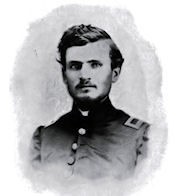
Friday, Dec. 28th, 1862, till Jan. 1st, 1863. Received and answered home letters. Kept at my old duties of Com. Sergt., not very arduous. Delos went home, having received a telegram that his presence was needed there. They had a real family gathering of friends from east, south and west. Came back the 31st and made us most homesick. Wrote a letter, a good one too, to Will, intending to send it by C. G. F. but he did not let me know when he left, so I destroyed it, getting too old.
Well, the year as a whole has passed much more rapidly and pleasantly than I anticipated a year ago. To be sure I never could be satisfied to spend a life in such service, still I have rather enjoyed the life I have been leading, because a sense of duty prompted me to it. My sufferings have been light indeed.
Of one thing I am sure. Had I spent the year at home, though I would have enjoyed it much, I would have been a poor, frail, sickly boy longing for death to come quickly and suddenly. Nearly so I felt January last. I hoped that health would come quickly or that by the fate of war my life would be sacrificed. A lingering death I have always had a horror of. Even now did I know that my fate were to die of consumption 8 or 10 years hence or to be shot in battle in six months, I should prefer the latter I believe. In fact, I have no desire to live a frail dependent boy any length of time. I presume this feeling has influenced me greatly in going upon so many expeditions, when I have been where I need not have gone at all. I have felt that this time I can go as well as any one else and if I fall, the world loses nothing, if somebody else fell, the contrary. Still I never went where bullets were flying but I thought seriously of my past life, my preparation to die. Sometimes there would be a hesitation, but only for a minute.
February, Independence.
March, Platte City, Fort Scott.
April, Carthage, Horse Creek, Neosho, Cowskin Prairie.
May, Fort Scott, Tola.
June, On the march to Indian Territory.
July, Cabin Creek.
August, Fort Scott, Lone Jack.
September, Springfield, Mo.
October, Sarcoxie, Grandby, Newtonia, Coalbed.
November, Arkansas, Pea Ridge, Bentonville, Maysville, The Mills, Osage Springs, Jones Mills, Fayetteville, Tannery, Boonsboro, Boston Mountains, Cane Hill.
December, Fort Scott, Leavenworth, Ohio.
Columbus, Ohio
Jan. 1st. In Camp Chase. Charlie went home and D. R. H. returned to camp. Saw D. R. and John Devlin. Brought a note and stick of candy from home.
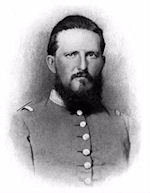
Camp Winder, Caroline Co., Va., January 1, 1863.
I have not heard from you since the battle. Since then we have had a quiet time and everything looks like rest for some time to come. The men are fixing up their shanties for the winter. They seem happy and contented. It is sad to look back on the year just closed. We have suffered much; many good men have gone to their long home. Our loss has been 1220 in killed and wounded— more men than we could turn out for a fight to-day. Out of the fifteen field officers elected last spring, five have been killed and six others wounded, leaving only four that have escaped unhurt. In these losses are many whom we were always accustomed to regard as our best men. I published to-day an order naming our camp, which gives some facts of our history, and I send you a copy of it.
How are the matters at home? In the excitement of active work, I have too much to do to harass myself with idle dreams of home; but now since we are at rest I cannot keep my mind from it. I feel there is nothing which I would not give to be with you for an hour or a day. I could have gone home and have spent a couple of weeks when I received my appointment, before taking command; but I really thought the brigade was sadly in need of a commander, and that it was my duty to stay. Now I am fixed and must apply for leave just as any private in the ranks. I know it would not improve my standing with my superior officers to ask for a leave, but still I feel very much tempted to do it. If the snow falls deep, and we have such severe weather as to preclude the possibility of active work, my homesick malady may get the better of me. I would like to see you, Matthew, Galla and the baby. Have the children forgotten me? It seems so long since I saw them.
Just here an officer calls who says he comes upon the disagreeable duty of placing me in arrest by order of Gen. Taliaferro, who regards a communication which I sent him to-day as very disrespectful. Very good; there is a small chunk of a row to be settled, which I shall do in that calm spirit which becomes the man who means to vindicate himself and his conduct. He says my communication was disrespectful. I say it was not, and cannot possibly be so construed by any intelligent and disinterested officer. I feel sure that I have done nothing at which my worst enemy could find cause for complaint. An arrest for some causes would be a serious affair, but in a matter such as this it is trifling to me. The offence of Genl. Taliaferro, in abusing his power as my superior officer, I think he will find, in the opinion of all disinterested gentlemen, is a much graver offence than any I have committed. I wish him no harm, however; and I shall do nothing more in the matter than what I may think, after calm and mature reflection, ought to be done. Do not give yourself any anxiety about it, as there is nothing in it to involve either my character as an officer or a gentleman. The difficulty arose about a sealed communication from St. Pritchard, Judge-Advocate of the court martial in session in my brigade, which was addressed to Gen. Chilton, Adjutant to Genl. Lee, and sent by me to Genl. Taliaferro to be forwarded to its destination. It was returned to me, opened, with an endorsement that it did not comply with the army regulations as to endorsing and forwarding it. I replied that as St . Pritchard was on detached service, I did not think his communication to Genl. Lee was in any way under my control or that of Genl. Taliaferro, and that as he had taken the liberty of breaking the seal and returning the paper, it would be sent to its destination through some other channel. Perhaps he differs with me upon the point, and thinks I meant to be offensive. So much for this piece of news. Now, darling, I will bid you good-night.
__________
General Orders No. 1
Headquarters Paxton’s Brigade,
Camp Winder, January 1,1863.
In memory of the gallant officer who led the brigade at the battles of Winchester, Port Republic and Richmond, and whose valuable life was lost at Cedar Mountain, the present encampment is called Camp Winder. In the losses of the year just closed, twelve hundred and twenty killed and wounded, you have much to mourn. The eye moistens with an unbidden tear to find that many of the officers whom your free choice had appointed to lead you, of the messmates and comrades you loved, are missing now. On Richmond, Manassas, or on some other field of carnage, they have met a soldier’s fate and found a soldier’s grave. In its achievements you have much cause for pride. You have marched fifteen hundred miles, encountering the snows and ice of winter in the mountains of Morgan and Hampshire; the heat and miasma of summer in the swamps of Henrico and Hanover. You have met the enemy in nine severe battles, and in all, save one, God has blessed your arms with victory. You have the proud satisfaction of knowing that you have participated in the campaign which has given your country a brilliant name in history, and that you have contributed with your blood to its success. To-day you begin another year in the service of your country, and in the achievement of its independence. God speed you in your glorious work! You begin the campaign with but twelve hundred muskets —a small number, it is true, but borne by men inured alike to the dangers and the hardships of the service, who will make up in hardy courage what they lack in numbers. Imitate the valor of Winder, Allen, Baylor and Neff, and you have a brilliant future before you.
(Signed) E. F. Paxton,
Brig.-Genl.
.
Official.
Friend C. Cox, A. D. C.


