Friday Feb’y 6th 1863.
This day has passed off very quietly. Some rebel stories floating about tonight to the effect that there had been a “raid” on Aquia Creek, that all our immense Stores had been Burned &c. “Secesh” has been quite jubilent about it this evening. It is, of course, all “bosh.” I stoped at Charleys this evening and staid an hour. The baby is getting quite interesting. It is so good natured and quiet, drinks a quart of milk a day, sucks her thumb when she is asleep and grows fat. I went from there to the rooms of Rev Mr Read (at Dr Munsons) and staid there an hour. They (He and his wife) are very friendly and confide their secrets to me. He wants the Agency of the NY S.R. Assn to travel through the State. I will do what I can to get it for him as I think him a “sterling” man. Mrs R also attends the NY “Rooms” and deals out to the soldiers such articles as are sent to the Asson for them. She has spent her whole time for months past and should be paid in some way. I called down below upon Dr Munson & family. They always have so much to say that I can never get away from them. They would like much to have me come back there to Board, perhaps I may sometime. They told me all their secrets about Ostrander (which I knew before). The old Lady talked all the time. “Teal” was wide awake. The fat one slept and snored. The Doct dozed. I did not get released till 1/2 past 10.
NY S.R. Assn = NY S(oldiers). R(elief). Assn
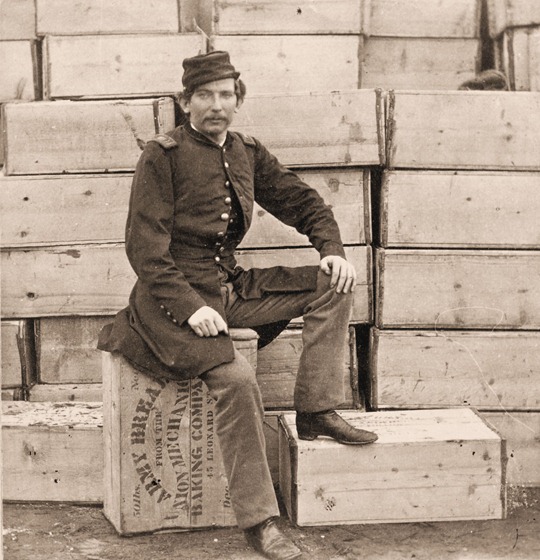
Back of Card:
“Hard Tack.”
There is no necessity to tell the “boys” what this is; they all remember the old chorus of the old army song about “Hard Tack:”
“Many days we have crunched you until our jaws are sore,
Oh! “Soft Bread” come again once more.”
______________________
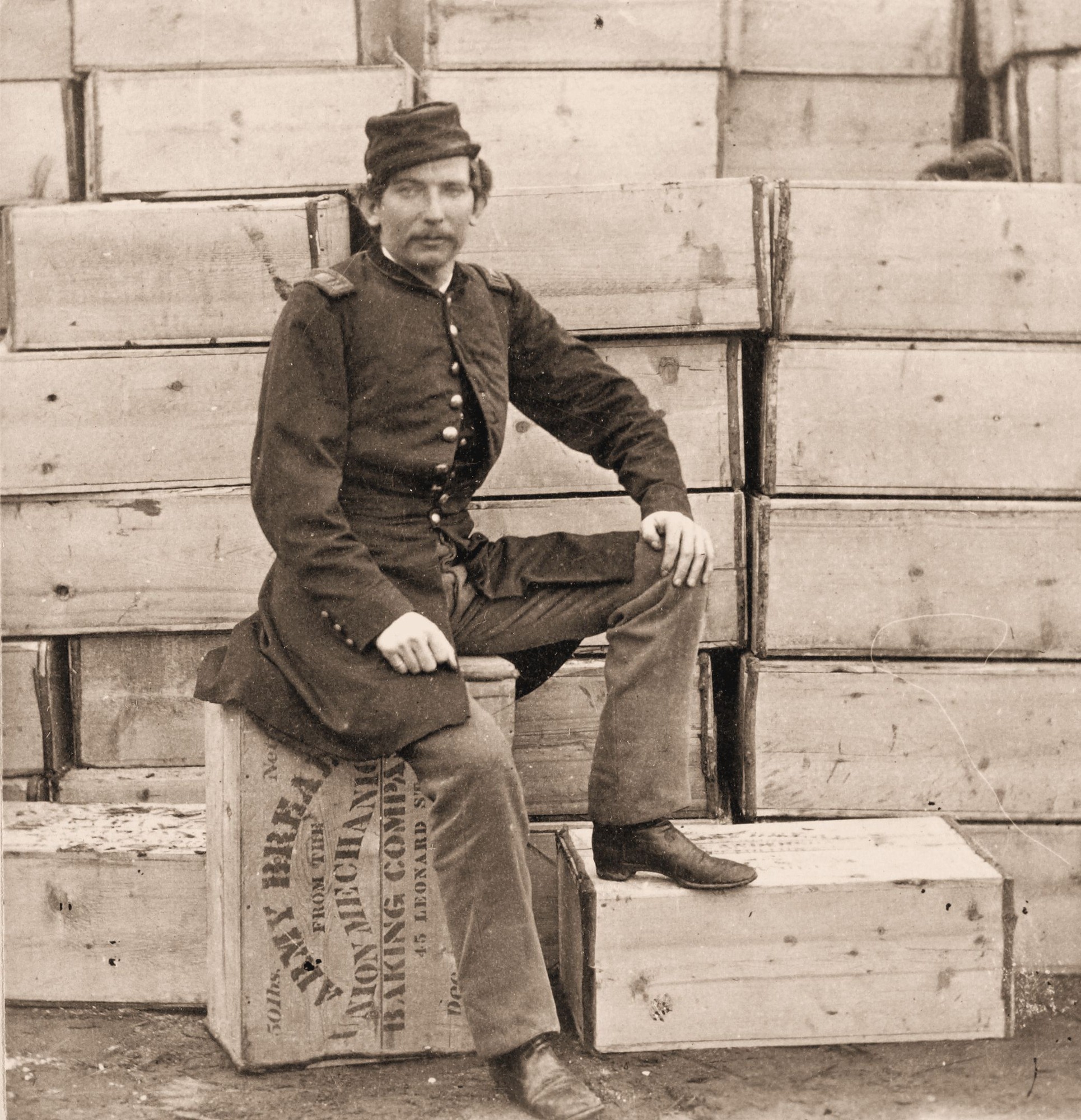
Stereograph showing Union Captain J. W. Forsyth, the Provost Marshall, sitting on a crate of hardtack, a cracker like bread served to soldiers, at Aquia Creek, Virginia. Crate says “50lbs. net. Army Bread from the Union Mechanic Baking Company, 45 Leonard St.”
Library of Congress image.
FEBRUARY 6TH.—Gen. Lee thinks Charleston will be assailed, and suggests that all the troops in North Carolina be concentrated near Wilmington, and he will undertake the defense of the rest of the State. Nevertheless, if the government deems it more important to have his troops sent to North Carolina, than to retain them for the defense of Richmond, he must acquiesce. But he thinks Hooker will attempt the passage of the Rappahannock, at an early day, if the weather will admit of it. In regard to the last attempt of Burnside to cross his army (when he stuck in the mud), Gen. Lee says it was fortunate for the Federals that they failed to get over. No doubt he was prepared for their reception.
Congress is doing nothing but voting money for themselves. The President (some of the members say) is their master, and they await his nod. These are his enemies.
February 6.—A detachment from companies H and F, of the Fifth New-York cavalry, under the command of Captain Penfield, made a raid into Middleburgh, Va., and at Aldie captured eight of the First Virginia rebel cavalry, and the post-master at Little Washington. They were en route to a ball given to them by the citizens of that place, and were fully armed and equipped.— The rebel Colonel Cushman, the celebrated “cotton-burner,” was arrested at his residence, near Ripley, Tenn., and taken to Columbus.—Cincinnati Gazette.
—A party of the Twelfth Virginia rebel cavalry, attacked the mail-coach between Martinsburgh and Winchester, Va., this afternoon, and captured the driver and occupants of the coach, Brigadier-General Cluseret’s assistant adjutant general and aid-de-camp among the number. The aid managed to escape, and reported the affair to General Milroy, who immediately ordered out two companies of the First New-York cavalry to cut off their retreat. Companies A and K, commanded by Captain Jones, and Lieutenant Laverty respectively, were sent out. Captain Jones left Lieutenants Laverty and Watkins with a small party at Millwood, thirteen miles from Winchester, while he and Lieutenant Boyd went on still further. The Captain’s party had scarcely moved away, when the rebels made their appearance at Millwood, with all they had captured. Lieutenant Laverty immediately ordered a charge, and dashed upon them, when the rebels broke and ran, though fighting desperately as they fled. They were chased seven miles. The expedition resulted in the recapture of all which the rebels had taken, and the killing of one of them, and taking prisoner of another. The escape of the remainder of the rebels was owing to its being night. Lieutenant Laverty was the only one injured, on the National side.
Thursday, 5th—Boys had grand snowball. Gave Col. Harrison a taste. Came up Columbia road, twenty miles, to little village of Wharton, took up quarters. We went up creek three miles and back close to Headquarters and camped in road, making fires of the fence. I got fodder and we spread it on the snow and blankets on fodder; slept comfortably.
February 5th, Thursday night.
A letter from Lavinia has come to me all the way from California. How happy it made me, though written so long ago! Only the 30th of June! Lavinia has changed, changed. There is a sad, worn-out tone in every line; it sounds old, as though she had lived years and years ago and was writing as though she were dead and buried long since. Lavinia, whose letters used to keep me in sunshine for weeks at a time! Well! no wonder she is sad. All these dreary years from home, with so faint a hope of ever again seeing it, and all these sorrows and troubles that have befallen us, combined, are not calculated to make her happy. But I wish she had kept her cheerful heart. Well, perhaps it is easier for us to be cheerful and happy, knowing the full extent of our calamities, than it is for her, knowing so little and having just cause to fear so much. Courage! Better days are coming! And then I’ll have many a funny tale to tell her of the days when the Yankees kept us on the qui vive, or made us run for our lives. It will “tell” merrily; be almost as lively as those running days were. One of my chief regrets over my helplessness is that I will not be able to run in the next stampede. I used to enjoy it. Oh, the days gone by, the dreary days, when, cut off from our own people, and surrounded by Yankees, we used to catch up any crumb of news favorable to our side that was smuggled into town, and the Brunots and I would write each other little dispatches of consolation and send them by little negroes! Those were dismal days. Yet how my spirits would rise when the long roll would beat, and we would prepare for flight!
February 5, Thursday. Seward sent me this morning a scary dispatch which he proposed to give each of the foreign ministers, in relation to the blockade at Galveston, which he, unwisely, improperly, and without knowledge of the facts, admits has been raised, but which he informs them will be again immediately enforced. I was exceedingly annoyed that he should propose to issue such a document under any circumstances, and especially without consultation. It is one of those unfortunate assumptions, pregnant with error, in which he sometimes indulges. I toned and softened his paper down in several places, but told the clerk to give Mr. Seward my compliments and say to him I totally objected to his sending out such a paper.
February 5—Resumed our promenade at 7 this morning, and for a change it is raining hard. Therefore the snow is melting. Consequently, the roads are nice and soft. Halted at 3 this evening—still raining. We made ourselves as comfortable as possible— made a good fire to dry ourselves by, but the worst of it is we have no rations, and the wagons are behind. We went to sleep in our wet clothing, with a cup of coffee as our supper. It rained and snowed all night.
5th. Continued the reading of “Tom Brown.” The talk of consolidation is making the boys very much dissatisfied. There will be more deserters. In the evening recited my lesson.
Thursday, 5th—Weather pleasant. I was detailed to go out on picket, but the order was countermanded. There is some talk of our leaving the place. It is reported in camp that on account of the flood the work on the canal had to be given up, and that an effort would be made to turn the current of the river through the canal, thus letting the river cut it.