Washington Thursday Feb’y 5th 1863.
I hardly know how to fill out a page tonight. It has been cold and Stormy having snowed most of the day, tonight the snow is more like rain and the weather has moderated. I was on the Ave after I left the office and bought a pair of rubbers, then came home directly to my room, which I have not left since except for dinner. I have been writing over a couple pages of foolscap upon the Analogy which exists betwen a Nation and an individual. In a Nation the whole Territory may be compared to the body of a man. The inhabitants are the living Soul. The Mountains are the Bones. The Rivers and roads and canals are the veins and arteries. Trade and Commerce is the Blood which circulates through them & the industrial system of the Nation is the real nutriment which gives life and vigor to the body giving to the Blood its sustaining and life giving principle. I pursued the comparison much farther. I also wrote some verses for Julias Album should they suit her. There is no news worthy of notice today. I have been in the office as usual. The concert proved a “Sell” to the Committee. Ostrander deceived them in every way. But has now time to repent as he was arrested before the concert yesterday for obtaining property by false pretenses and is now in Jail. He has been a Clerk in the Land office for something over a year. But his game is up now. Past 11 o’clock.
Buntyn Station, Thursday, Feb. 5. About three inches of snow. Quite cold all day. E. W. E. went to town; was called on to guard S. Sanger for discharging a revolver. Very cold.
FEBRUARY 5TH.—It snowed again last night. Tuesday night the mercury was 8° below zero.
A dispatch from Gen. Beauregard says sixty sail of the enemy have left Beaufort, N. C., for Charleston. A British frigate (Cadmus) has arrived at Charleston with intelligence that the Federal fleet of gun-boats will attack the city immediately; and that the British consul is ordered away by the Minister at Washington. The attack will be by sea and land. God help Beauregard in this fearful ordeal!
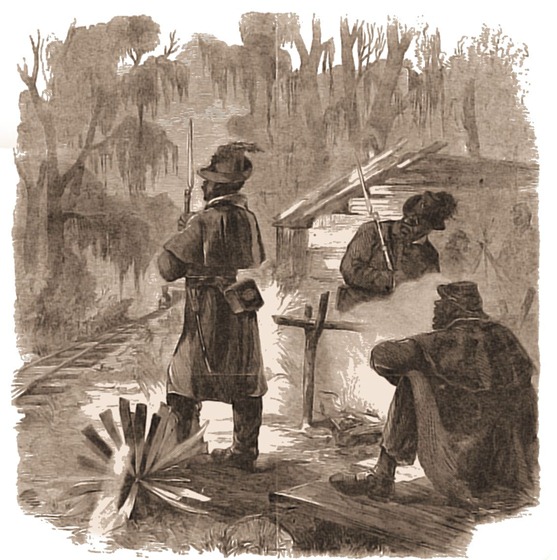
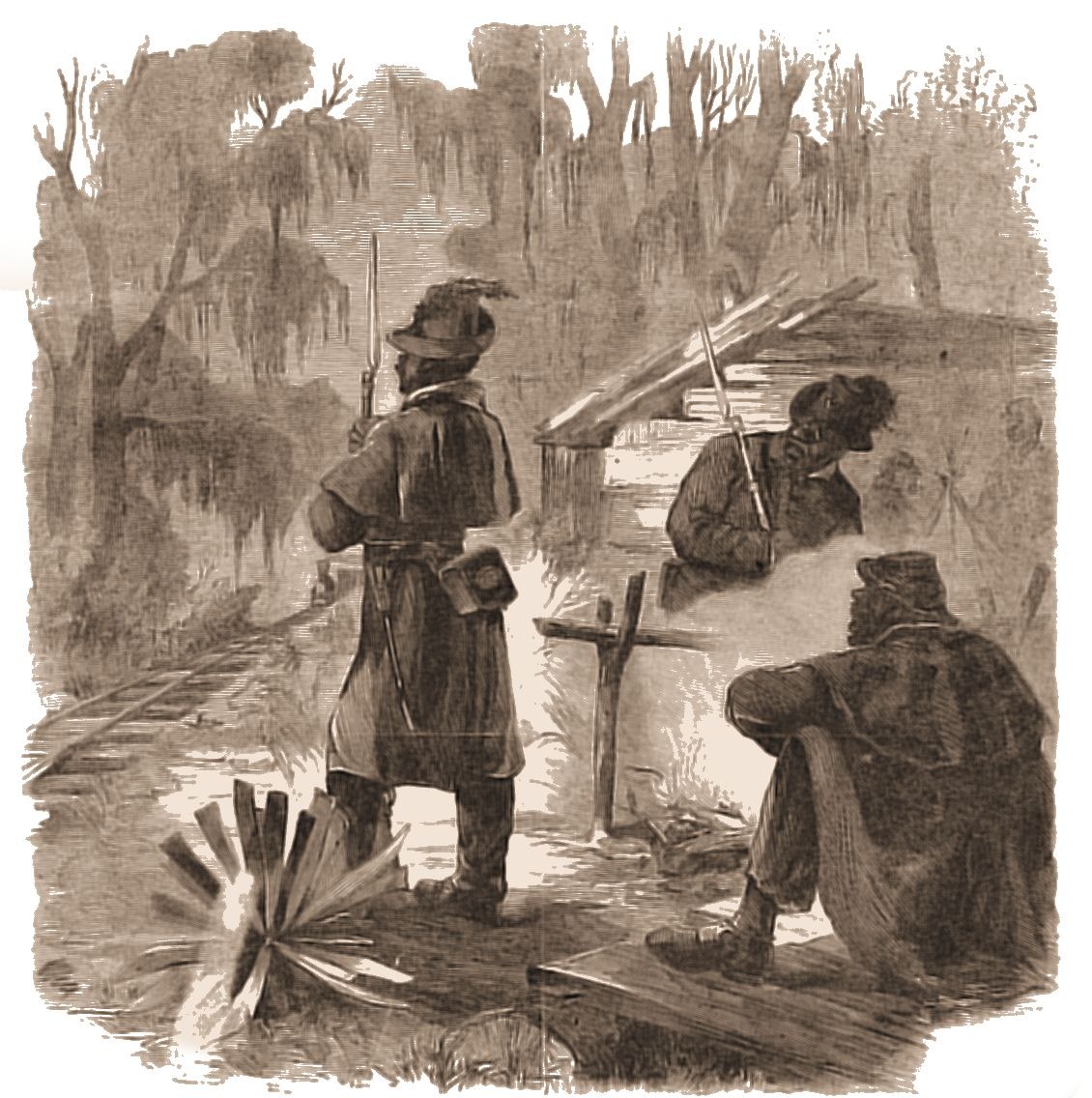
Pickets of the First Louisiana “Native Guard” Guarding the New Orleans, Opelousas, and Great Western Railroad. (March 7, 1863 issue of Frank Leslie’s Illustrated Newspaper.)
_______________
Scenes in Louisiana.
Our artist has sent some sketches which illustrate, in a striking degree, some novel phases of life, both military and civil, which the present struggle is involved. The fact of black regiments being actively employed is not an novelty, since they have been for some time part of the British military system, which, with its usual commonsense, avails itself of every aid in the pursuit of its objects. Our Artist says that among the cypress swamps of Louisiana Negro soldiers are invaluable, and accompanies his sketch of the pickets of the first Louisiana native troops, guarding the New Orleans, hope Eleusis and Great Western Railroad, with some remarks which we quote:
“In this swamp in the wilderness the ‘ soldiers’ are eminently useful. The melancholy solitude, with the spectral cypress trees, which seem to stand in silent despair, like nature’s sentinels waving in the air wreathes of grey funereal moss, to warn all human beings of latent pestilence around, though unendurable to our soldiers of the north, seems an elysium to these sable soldiers, for the swampy forest has no horrors to them. Impervious to miasma, they only see the home of the coon, the possum and the copperhead, so that with ‘de gun that Massa Sam gib ‘em’ they have around them all the essential elements of colored happiness, except ladies’ society.”
February 5.—Captain Wm. K. Ranney, of the Fortieth regiment of Missouri militia, while on a scouting expedition on Bear Creek, Johnson Co., Mo., encountered a party of rebel guerrillas. “On seeing them he put spurs to his horse and commanded his men to follow, which they did with a will, and coming up with the enemy, routed them on the double-quick, the fleeing rebels leaving seven dead on the field. Pursuing the rebels about seven miles, night came on, and the weather being extremely cold, he gave up the chase. Captain Ranney and all of his men escaped unharmed.”—Lieutenant-Colonel Brown’s Stport.
—The British Parliament was opened and the Queen’s-speech was read, in which she said: “Her Majesty’s relations with foreign Powers continue to be friendly and satisfactory. Her Majesty has abstained from taking any step with a view to induce a cessation of the conflict between the contending parties in the North-American States, because it has not yet seemed to Her Majesty that any such overtures could be attended with a probability of success. Her Majesty has viewed with the deepest concern the desolating warfare which still rages in those regions; and she has witnessed with heartfelt grief the severe distress and suffering which that war has inflicted upon a large class of Her Majesty’s subjects, but which have been borne by them with noble fortitude and with exemplary resignation. It is some consolation to be led to hope that this suffering and this distress are rather diminishing than increasing, and that some revival of employment is beginning to take place in the manufacturing districts.”
—A small detachment of National cavalry was attacked at Wigginton’s Mills, near Stafford Store, Va. At the first fire, Dixon, the scout who was wounded a few days previous in a skirmish with a party of South-Carolinians, was again wounded seriously. The rebels were finally dispersed, and several of the neighboring farmers were arrested. —New-York Times.
—Captain Robert Maupin, of the rebel army, was captured in the vicinity of Columbia, Mo., by a party of National troops under the command of Lieutenant-Colonel Russell, of the Sixty-First Missouri regiment.—Missouri Statesman.
Wednesday, 4th—Came back to Ventress’s on Creek. Snowed to-night—awful time.
February 4, Wednesday. Governor E. D. Morgan was yesterday elected Senator in place of Preston King. If the latter was not to be returned, Morgan was probably the best of the competitors. He will make a useful Senator if he can persistently carry out his honest convictions, but I know of no one who can, just at this time, make good the place of King. He has been cheated and deceived. The country sustains a loss in his retirement. He is honest, faithful, unselfish, and earnestly patriotic.
We have the whole world agog with an account of an onset on our fleet before Charleston. The Mercedita is reported to have been surprised and sunk, and other vessels damaged. But the great hullabaloo is over a report that the whole blockading fleet ran away, — the foreign consuls at Charleston went out and could see none of the vessels, —and the blockade is by the Rebels declared raised. Seward called on me in great trepidation with these tidings. Told him most of the stuff was unworthy of a moment’s consideration. Not unlikely the Mercedita may have been surprised and sunk, as she is of light draft and was probably close in. If there had been other vessels captured or sunk, we should have had their names. It looked to me as if the budget was made up for the European market by the foreign consuls, who are in fact Rebel agents, and I asked why their exequaturs were not annulled.
The New York papers have sensation headings over the Charleston news, and the Tribune has a ridiculous article about blockade, more wild, if possible, than Seward.
February 4—This morning, at 4 o’clock, we were waked up by the pleasant sound of long roll. We were ordered to get ready to march. It is very cold, snow nine inches deep. We laid in Goldsboro until noon, expecting to get cars to take us away, but were then told we would have to march to Kinston. We took up our line of march at 3 in the evening and halted at dark. It is truly awful. The snow is very deep and as cold as thunder. We marched eight miles without resting. We then fixed our bed in the snow and stole fodder for a bed and rails to make fire. We took snow, put it in our kettles, and made coffee. When I say coffee, I mean Confederate coffee—parched corn—that is our coffee. Ate our corn bread and bacon and retired to our couches and slept as good if not better than Abe Lincoln.
Mrs. Lyon’s Diary
Fort Henry, Tenn., Feb. 4—A dispatch from Colonel Lowe yesterday called the Thirteenth to Fort Donelson. We had a night of great excitement. All the men went out of camp except the sick, and all that could stand up on their feet followed. We heard that the Thirteenth was fighting about six miles out. We could hear the cannon boom once in a while. After dark, and all night, the couriers were running. They brought news that some of the officers were killed. I had to bear this alone, for I could not tell the wives, and thought it might not be true; and if it was I did not want to be the one to tell them. We packed up everything, and were ready to start at a moment’s notice. We were to take the boat and go down the river a few miles. After midnight the ladies all got together in our tent and talked. They seemed to depend upon me. I felt myself a very weak stick—I knew of these reports, and felt so nervous.
Tuesday, 4th. Let Thede go to town on my mare. Read “Tom Brown.” Became quite interested. There seems so much reality in all the sports and tricks. In the evening went to tactic school at Co. K’s quarters. Like it well.