Following the American Civil War Sesquicentennial with day by day writings of the time, currently 1863.

April 2013

Wednesday, April 22d,
New Orleans.

Yesterday we arrived; I thought we should never get here. Monday we had almost given up in despair, believing the schooner would never return. But in the evening, when all were gathered in our room discussing our hopes and fears, a sail was perceived at the mouth of the bayou, whereupon every one rushed out to see the boat land. I believe that I have not mentioned that this Bonfouca is on a bayou of the same name that runs within a few yards of this house. It is an Indian name signifying Winding River, which struck us as very appropriate when we watched the schooner sailing now to the left, now to the right, apparently through the green fields; for the high grass hid the course of the stream so that the faintest line was not perceptible, except just in front of the house. All was now bustle and confusion, packing, dressing, and writing last words to our friends at home, until half-past eleven, when we embarked.

This is my first experience of schooners, and I don’t care if I never behold another. The cabin where Mr. Kennedy immediately carried me, was just the size of my bed at home (in the days I had a home) and just high enough to stand in. On each side of the short ladder, there was a mattress two feet wide. One of them Mrs. R—— had possession of already, the other was reserved for me. I gave the lower part of mine to Minna and Jennie, who spent the rest of the night fighting each other and kicking me.

Just before twelve we “weighed anchor” and I went on deck to take a last look at Dixie with the rest of the party. Every heart was full. Each left brothers, sisters, husband, children, or dear friends behind. We sang, “Farewell dear land,” with a slight quaver in our voices, looked at the beautiful starlight shining on the last boundary of our glorious land, and, fervently and silently praying, passed out of sight.

God bless you, all you dear ones we have left in our beloved country! God bless and prosper you, and grant you the victory in the name of Jesus Christ.

I returned to my mattress, and this is the way we spent the night.

Mrs. R——, rocking and moaning as she sat up in bed, whined out her various ills with a minute description of each, ceasing the recital only to talk of her son’s body which lay on deck. (Yesterday morning she was sitting crying on his coffin while a strange woman sat on its head eating her bread and cheese.) Mrs. Bull, one of the most intelligent and refined ladies I have yet met, who is perfectly devoted to me, sat by me, laughing and talking, trying her best to make every one comfortable and happy in her unobtrusive way. Mother talked to Mrs. R—— and cried at the thought of leaving her children fighting and suffering. The space between the two beds was occupied by three Irishwomen and Mrs. Ivy’s two babies. The babies had commenced screaming as they were brought into the pen, at which I was not surprised. Having pitched their voices on the proper key, they never ceased shrieking, kicking, crying, throwing up, and going through the whole list of baby performances. The nurses scolded with shrill voices above the bedlam that had hushed even Mrs. R——’s complaints; Jennie and Minna quarreled, kicked, and cried; and as an aggravation to the previous discomforts, a broad-shouldered, perspiring Irishwoman sat just by my head, bracing herself against my pillow in the most unpleasant style. I endured it without flinching until about half-past three, when the condensed odor of a dozen different people and children became unendurable, and I staggered up on deck where Miriam and Mrs. Ivy had been wise enough to remain without venturing below. They laid me on a bench in the stern, rolled me up in shawls to keep off the heavy dew, and there I remained until daylight with them, as wide awake as ever.

At daylight there was a universal smoothing of heads, and straightening of dresses, besides arrangements made for the inspection of baggage. Being unwilling for any Christian to see such a book as this, I passed a piece of tape through the centre leaves, and made Miriam tie it under her hoops. At sunrise we were in sight of the houses at the lake end. It seemed as though we would never reach land.

I forgot to speak of our alarm as we got in the lake. No sooner had we fairly left the bayou than the sky suddenly became threatening. The captain shook his head and spoke of a very ugly night for the lake, which sent everybody’s heart to their throats, and alarmed us immeasurably. We got talking of the sailor’s superstition of crossing the water with a corpse, until we persuaded ourselves that it was more than probable we would founder in the coming storm. But the severest storm we met was the one in the cabin; and all night the only wind was a head breeze, and the spicy gale from below.

When we at last entered the canal, I beheld the animal now so long unseen, the Yankee. In their dark blue uniforms, they stood around, but I thought of the dear gray coats, and even the pickets of Madisonville seemed nobler and greater men than these. Immediately a guard was placed on board, we whispering before he came, “Our dear Confederates, God bless them.”

We had agreed among ourselves that come what would, we would preserve our dignity and self-respect, and do anything rather than create a scene among such people. It is well that we agreed. So we whispered quietly among ourselves, exhorting each other to pay no attention to the remarks the Yankees made about us as we passed, and acting the martyr to perfection, until we came to Hickock’s Landing. Here there was a group of twenty Yankees. Two officers came up and asked us for papers; we said we had none. In five minutes one came back, and asked if we had taken the oath. No; we had never taken any. He then took down our names. Mother was alone in the coop. He asked if there was not another. The schooner had fifteen passengers, and we had given only fourteen names. Mother then came up and gave her name, going back soon after.

While one went after our passes, others came to examine our baggage. I could not but smile as an unfortunate young man got on his knees before our trunk and respectfully handled our dirty petticoats and stockings. “You have gone through it before,” he said. “Of course, the Confederates searched it.” — “Indeed, they did not touch it!” I exclaimed. “They never think of doing such work.” — “Miss, it is more mortifying to me than it can be to you,” he answered. And I saw he was actually blushing. He did his work as delicately as possible, and when he returned the keys, asked if we had letters. I opened my box and put them into his hand. One came near getting me into serious trouble. It was sent by some one I never saw, with the assurance that it contained nothing objectionable. I gave it sealed to the man, who opened it, when it proved to be rather disagreeable, I judged from his language. He told me his captain must see it before he could let me have it, and carried it off. Presently he came back and told me it could not be returned. I told him to burn it then, as I neither knew the writer, the contents, nor those it was written to. “I may save you some difficulty if I destroy it,” he remarked, whereupon he tore it up and flung it into the canal. I have since found I had cause to be grateful; for just after came an officer to see the young lady who brought that letter. I showed the pieces in the water, saying the young man had torn it up, which seemed to annoy him; it was to be sent to headquarters, he said.

Then came a bundle of papers on board carried by another, who standing in front of us, cried in a startling way, “Sarah Morgan!” — “ Here” (very quietly). — “Stand up!” — “I cannot” (firmly). — “Why not?” — “Unable” (decisively). After this brief dialogue, he went on with the others until all were standing except myself, when he delivered to each a strip of paper that informed the people that Miss, or Mrs. So-and-So had taken and subscribed the oath as Citizen of the United States. I thought that was all, and rejoiced at our escape. But after another pause he uncovered his head and told us to hold up our right hands. Half-crying, I covered my face with mine and prayed breathlessly for the boys and the Confederacy, so that I heard not a word he was saying until the question, “So help you God?” I struck my ear. I shuddered and prayed harder. There came an awful pause in which not a lip was I moved. Each felt as though in a nightmare, until, throwing down his blank book, the officer pronounced it “All right!” Strange to say, I experienced no change. I prayed as hard as ever for the boys and our country, and felt no nasty or disagreeable feeling which would have announced the process of turning Yankee.

Then it was that mother commenced. He turned to the mouth of the diminutive cave, and asked if she was ready to take the oath. “I suppose I have to, since I belong to you,” she replied. “No, madam, you are not obliged; we force no one. Can you state your objections?” “Yes, I have three sons fighting against you, and you have robbed me, beggared me!” she exclaimed, launching into a speech in which Heaven knows what she did not say; there was little she left out, from her despoiled house to her sore hand, both of which she attributed to the at first amiable man, who was rapidly losing all patience. Faint with hunger, dizzy with sleeplessness, she had wrought on her own feelings until her nerves were beyond control. She was determined to carry it out, and crying and sobbing went through with it.

I neither spoke nor moved. . . . The officer walked off angrily and sent for a guard to have mother taken before General Bowens. Once through her speech, mother yielded to the entreaties of the ladies and professed herself ready to take the oath, since she was obliged to. “Madam, I did not invite you to come,” said the polite officer, who refused to administer the oath; and putting several soldiers on board, ordered them to keep all on board until one could report to General Bowens. Mother retired to the cabin, while we still kept our seats above.

Oh, that monotonous, never-ending canal! We thought it would go on forever. At last we came to the basin in the centre of the city. Here was a position for ladies! Sitting like Irish emigrants on their earthly possessions, and coming in a schooner to New Orleans, which a year ago would have filled us with horror. Again the landing was reached, and again we were boarded by officers. I don’t know how they knew of the difficulty mother had made, but they certainly did, and ordered that none should leave until the General’s will was made known.

Mrs. Bull and Mrs. Ivy, after a long delay and many representations, at last prepared to leave. I was sitting in the spot I had occupied ever since before daylight, with nothing to support me above my hips. All of us had fasted since an early and light supper the night before; none had slept. I was growing so weak from these three causes, and the burning sun (for it was now twelve), that I could hardly speak when they came to tell me good-bye. Alarmed at my appearance, Mrs. Bull entreated the officer to allow me to leave the boat. No, he said; it was impossible; we should remain on board until General Bowens could come. We may get an answer in half an hour, or we may not get it for some time; and there we must stay until it came. “But this young lady has been ill for months; she is perfectly exhausted, and will faint if she is not removed immediately,” pleaded Mrs. Bull. She did not know my powers of control. Faint! I would have expired silently first! The officer said those were his orders; I could not leave. “Do you think you are performing your duty as a gentleman and a Christian? This young lady has obtained her pass already, without the slightest difficulty,” she persisted. Still he said he was acting according to orders. Not to be baffled, she begged that she might be allowed to take me to Brother, telling him who he was, while our trunk, Miriam, Tiche, and mother would remain as hostages. Then he gave a reluctant consent on condition I left my number, so he could go after me when I was wanted.

I don’t know what good came of the consent, for there I was to remain until something, I don’t know what, happened. I only know I was growing deathly sick and faint, and could hardly hold myself up, when some time after Mrs. Bull and Mrs. Ivy left (under the impression that I was to go immediately), a gentleman in citizen’s clothes came to me and said he had obtained permission for me to wait General Bowens’s orders in his office, a few steps from the schooner. Thankful for so much, I accepted his arm and slowly dragged myself along to the first shelter I had seen that day. By some wonderful condescension Miriam and mother were allowed to follow; and with the guard at the door, we waited there for half an hour more until our sentence could be received.

Miriam had written a line to Brother as soon as possible, telling him of the situation, and while we were waiting in this office, I half dead with fatigue, a carriage dashed up to the door, and out of it stepped Brother. I felt that all our troubles were over then. He looked so glad to see us that it seemed a pity to tell the disagreeable story that yet remained to be told. But once heard, he made all go right in a few moments. He got into the carriage with mother, to take her to General Bowens, while we got into another to come to the house. I saw no more of the guard or officer.

When we arrived, Sister was too astonished to speak. She did not believe we would come when it was ordered that all should take the oath on entering. If we had only realized it I don’t think we would, either.

In half an hour mother got back. Supported by Brother’s presence, she had managed to hold up her right hand and say “ Yes “ to the oath — which was more than any of us had done.

• • • • • • • •

Brother found an officer at the door who had been ordered (before he took mother to the General) to arrest her and confine her in the Custom-House. I suppose Miriam and I would have shared the imprisonment with her. But Brother has a way of making all these things right; and the man was sent back without accomplishing his mission.
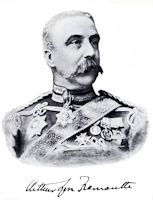

22d April (Wednesday).—We got under weigh at 5 A.M., the mules looking rather mean for want of grass.

At 8 Am. we reached the Nueces river, the banks of which are very steep, and are bordered with a beautiful belt of live oak-trees, covered with mustang grapes.

On the other side of the Nueces is “Oakville,” a miserable settlement, consisting of about twenty wooden huts. We bought some butter there, and caught up Ward’s waggons. The women at Oakville were most anxious to buy snuff. It appears that the Texan females are in the habit of dipping snuff—which means, putting it into their mouths instead of their noses. They rub it against their teeth with a blunted stick.

We reached grass about 10 A.M., and “nooned it,” the weather being very trying—very sultry, without sun or wind.

We hitched in at 1.15 — Ward’s waggons in our front, and a Frenchman’s four-horse team in our rear. At 4 P.M. we reached the “Weedy,” a creek which, to our sorrow, was perfectly dry. We drove on till 7 P.M., and halted at some good grass. There being a report of water in the neighbourhood, Mr Sargent, the Judge, Ward, and the Frenchman, started to explore; and when, at length, they did discover a wretched little mud-hole, it appears that a desperate conflict for the water ensued, for the Judge returned to us a mass of mud, and presenting a very crestfallen appearance. Shortly after, Mr Sargent appeared, in such a bad humour that he declined to cook, to eat, to drink, or do anything but swear vehemently.

Deprived by this contretemps of our goat’s flesh we had recourse to an old ham and very stale bread.

We met many cotton trains and government waggons to-day, and I think we have progressed about thirty-four miles.

Wednesday, 22d—We landed at Milliken’s Bend early this morning and went into camp on a large plantation about a mile from the levee of the river.

April 22, Wednesday. Admiral Bailey writes — and I have similar information from other sources — that an immense trade has sprung up on the Rio Grande; that there are at this time from one hundred and eighty to two hundred vessels off the mouth of that river, when before the War there were but six to eight at any one time. Ostensibly the trade is with the little city of Matamoras, but it is notoriously a Rebel traffic. Goods are received and cotton exported by this route under our own as well as foreign flags. I have suggested in one or two conversations with Mr. Seward that it was a favorable opportunity to establish some principle of international law relative to the rights and obligations of adjoining countries having a mutual highway, as the United States and Mexico have in the Rio Grande; that we should require Mexico to prevent this illicit traffic, or that they should permit us to prevent it; but Seward is not disposed to grapple the question, is afraid it will compromise us with the French, says Mexico is feeble, dislikes to make exactions of her, etc., etc. I yesterday wrote the Secretary of the Treasury and the Secretary of War in regard to this illicit trade. Our own countrymen should not have ready clearances and facilities for this traffic, and it may be necessary to establish frontier military posts to prevent it. Perhaps my letters may cause the subject to be taken up in the Cabinet, and lead the Government to adopt some preventive measure; if not, the blockade will be evaded and rendered ineffectual. The Peterhoff with its mail and contraband cargo was one of a regular line of English steamers, established to evade the blockade by way of Matamoras.

Received the President’s letter and interrogatories concerning the mail. The evening papers state that the mail of the Peterhoff has been given up by District Attorney Delafield Smith, who applied to the court under direction of the Secretary of State, “approved” by the President. It is a great error, which has its origin in the meddlesome disposition and loose and inconsiderate action of Mr. Seward, who has meddlesomely committed himself. Having in a weak moment conceded away an incontestable national right, he has sought to extricate himself, not by retracing his steps, but by involving the President, who confides in him and over whom he has, at times, an unfortunate influence. The interference with the judiciary, which has admiralty jurisdiction, is improper, and the President is one of the very last men who would himself intrude on the rights or prerogatives of any other Department of the Government, one of the last also to yield a national right. In this instance, and often, he has deferred his better sense and judgment to what he thinks the superior knowledge of the Secretary of State, who has had greater experience, has been Senator and Governor of the great State of New York, and is a lawyer and politician of repute and standing. But while Mr. Seward has talents and genius, he has not the profound knowledge nor the solid sense, correct views, and unswerving right intentions of the President, who would never have committed the egregious indiscretion, mistake, of writing such a letter, and making such a concession as the letter of the 31st of October; or, if he could have committed such an error, or serious error of any kind, he would not have hesitated a moment to retrace his steps and correct it; but that is the difference between Abrabam Lincoln and William H. Seward.

I have set Watkins[1] and Eames[2] to ransack the books.

Upton[3] must help them. I want the authorities that I may respond to the President. Though his sympathies are enlisted for Seward, who is in difficulty, and I have no doubt he will strive to relieve him and shield the State Department, we must, however, have law, usage, right respected and maintained. The mail of the Peterhoff is given up, but that is not law, and the law must be sustained if the Secretary of State is humiliated.

The Philadelphians are fearful the acceptance of League Island will not be consummated, and have written me. I have replied that there is a courtesy and respect due to Congress which I cannot disregard.


[1] A clerk in the Navy Department.
[2] Charles Eames, a well-known admiralty lawyer of Washington.
[3] Francis H. Upton, counsel for the captors of the Peterhoff and in other prize cases during the War.

April 22. — Rode down to the river, and saw the places where it is intended to cross the river. Three bridges are to be where Franklin formerly crossed, and two a mile below. Two also at Bank’s Ford, where I did not go. The report is that our cavalry all crossed at Rappahannock Station to-day and that the Orange and Alexandria R.R. is running. The general and Captain Clapp and Major Hewitt and myself formed the party that went out this morning. A division of General Reynolds’s corps went clown to Port Royal with some of our canvas pontoons. They came back again without crossing.

Friday, May 22nd.

Left Raleigh about 9 o’clock yesterday morning. The road from Raleigh to Weldon is the most crooked and through the most broken country I ever saw. Every foot of it is over an embankment or through a deep cut. The land along the route is all poor and barren and yet there are some beautiful residences and the people seem to be doing well. How they live I cannot tell. There were occasionally fine apple orchards and clover fields. I had the good fortune to meet up with Mr. Carpenter, a member of the North Carolina legislature. He was a pleasant companion and had some genuine whiskey, having married the heiress of a distiller. I made also the acquaintance of an old gentleman named Miller, who was on his way to Richmond to see two wounded nephews, one of whom had lost an arm; he also had some whiskey, which he said came from the drug store and must be good. He had also some cakes, good ham and fresh butter, which I enjoyed very much. He is a Baptist and is acquainted with Mr. Lemmond, of Waco, Texas. We reached Weldon about 5 o’clock in the afternoon, and as the cars were not to start until 9 o’clock, I concluded to take a stroll. I obtained a drink of the coldest water I ever drank and observed the address of Captain H. A. Troutman on a box, which put me on the lookout for him. I soon met him and we had a long talk on old college times. He had married a Miss Napier. John Neely is dead; Miss Lou is married to Ed. McClure. Billy Clifton has become a devout Baptist. Charley Boyd, John McLemore and Lucius Gaston are all killed; murdered by fanatical vandals; ten thousand mercenaries cannot pay for such men as these. They helped to make and adorn the character of a noble people. They were all my college friends. We loved each other and cherished common hopes of a happy future.

I went to supper with Troutman. He boards with the post commissary, who, of course, gets a little of everything. We had light rolls, scrambled eggs, genuine coffee, salmon, etc., for supper. The commissary is run by Mr. Peterson, brother of Judge Peterson, of San Antonio, Texas. We left Weldon at 9 o’clock and jogged along slowly until about 3 o’clock a. m., when we reached Petersburg. I shouldered my carpet-bag, overcoat and blanket and walked a mile to the depot. Cars left Petersburg about 5 o’clock a. m., and ran so slowly that I had ample time to inspect the country. When we came within eight miles of Richmond I observed a large amount of timber felled on either side of the road and fortifications thrown up to prevent the advance of the Yanks. When we came within three miles of Richmond one of the bars which connects the cars broke, and we were detained for half an hour or more, but another engine very opportunely came up behind us and pushed us on to Richmond. I found it a much more beautiful place than I had anticipated. The scenery in crossing James River is especially attractive. I put up at the American Hotel and spent the day in wandering “up and down” and “going to and fro” in it. I called on Miss Wigfall, Mrs. Chestnut, Miss Nannie Norton (who was absent), Miss Mary Fisher, Mr. and Mrs. Barnwell and met there Mrs. Carter. Called at the Cabinet Quarters and delivered to C. S. Senator Hon. James Chestnut, a letter (from Hon. Guy M. Bryan, of Texas) to the president. I went to the Ballard House to see Hon. H. P. Brewster, of Texas; was unable to find him. Delivered Mr. Carter’s letter to Mr. Winston, who was too busy to notice me, so I retired. I gave him also the letter to Mrs. Benton. Dined with Colonel and Mrs. Chestnut, in company with Billy Preston, who is now major of artillery. Had fish and corn bread, rice and lettuce for dinner, with iced whiskey to wash it down. After dinner went to the Spotswood Hotel, met Captain Rice and Jimmy Winn, also Minnie Moses, whom I have not seen for eight years. He is a clerk in some of the departments. I returned to Miss Mary Fisher’s in the afternoon and left my overcoat in her charge. I am too tired to make comments, though I have seen a great deal to write about. I am writing this in the public room of the American Hotel about 11 o’clock at night. They have charged me $7.50 for supper, night’s lodging and breakfast.

April 22—Ordered to our brigade at 12 M.

by John Beauchamp Jones

APRIL 22D.—The President is reported to be very ill to-day—dangerously ill—with inflammation of the throat, etc. While this is a source of grief to nearly all, it is the subject of secret joy to others. I am sure I have seen some officers of rank to-day, not fighting officers, who sincerely hope the President will not re-cover. He has his faults, but upon the whole is no doubt well qualified for the position he occupies. I trust he will recover.

The destruction of the Queen of the West, and of another of our steamers, is confirmed. Is not Pemberton and Blanchard responsible ?

The loss of two guns and forty men the other day, on the Nansemond, is laid at the door of Major-Gen. French, a Northern man! Can it be Gen. Cooper (Northern) who procures the appointment of so many Northern generals in our army?

I cut the following from the Dispatch of yesterday:

Produce, etc.—Bacon has further declined, and we now quote $1.25 to $1.30 for hog-round; butter, $2.25 to $3 per pound; beans in demand at $20 per bushel. Corn is lower—we quote at $6 to $6.50 per bushel; corn meal, $7 to $9 per bushel—the latter figure for a limited quantity; candles, $3.50 to $3.75 per pound; fruit—dried apples, $10 to $12; dried peaches, $15 to $18 per bushel; flour—superfine, $31 to $32; extra, $34; family, $86; hay is in very small supply—sales at $15 per cwt.; lard, $1.65 to $1.70 per pound; potatoes—Irish, $3 to $10; sweet, $10 to $11 per bushel; rice, 25 to 33 cents per pound; wheat, $6.50 to $7 per bushel.

Groceries.—Sugars have a declining tendency: we quote brown at $1.15 to $1.25; molasses, $9 to $10 per gallon; coffee, $1 to $4.50; salt, 45 cents per pound; whisky, $28 to $35; apple brandy, $24 to $25; French brandy, $65 per gallon.

April 22. —Tompkinsville, Ky., was visited by a party of rebels who burned the court-house and several other buildings in the place and killed five Union men.—Two regiments of the First army corps of the army of the Potomac, marched to Port Conway, crossed the river to Port Royal on pontoons, and captured a rebel mail and took several prisoners.—New- York Times.

—The rebel steamer Ellen was this day captured by a party of Union troops in a small bayou in the vicinity of the Courtableau, La.—(Doc. 171.)

—Seven men belonging to the Eighth regiment of Missouri cavalry who were captured on the nineteenth by a band of rebel guerrillas in Dallas County, having been carried to Cedar County, Mo., were stripped of their clothing and inhumanly shot. Immediately after this, the guerrillas proceeded to the house of Obadiah Smith, a Baptist minister in-Cedar County, and on his attempting to escape they shot him.—St. Louis Democrat.

—The cargo of the steamer Wave (destroyed by the rebels to prevent her from falling into the hands of the Unionists) was this day captured in the vicinity of Bayou Cocodue, La., by an expeditionary force under the command of General Dwight— (Doc . 171.)

—A portion of General Reynolds’s national forces entered and occupied McMinnville, Tenn.— Major McGee, of the Third Virginia cavalry with sections of Rowan’s, Utt’s, and White’s cavalry, encountered a force of three hundred rebels at a point near Strasburgh, Va., and after a brief and brilliant fight drove them from their position. One man of Rowan’s company was killed, and mother wounded. The rebel loss was five killed, and nine wounded, beside twenty-five prisoners and forty horses.

—Six gunboats and twelve barges succeeded in passing the rebel batteries at Vicksburgh tonight,—National Intelligencer.

Millikens Bend, Wednesday, April 22. Heavy rain all night, making it very muddy to drill. Standing gun drill in the afternoon. 4th Brigade of 3rd Division inspected on the drill ground and addressed by Governor Yates of Illinois, inspiring and encouraging.