April 23.—Lieutenant Cushing, with a party of men belonging to the National gunboat Commodore Barney, with a small howitzer, visited Chuekatuck, Va., where he encountered and defeated forty rebel cavalrymen, killing two, and capturing three of their horses fully equipped. Lieutenant Cushing lost one man killed.—The British schooner St. George was captured off New-Inlet, N. C, by the National steamer Mount Vernon.—The sloop Justina was captured off the Little Bahama Bank, by the gunboat Tioga.
April 2013
Millikens Bend, Thursday, April 23. Very warm. Ordered to prepare for park inspection at 8 A. M. Stood waiting until 9, when we went out to drill. No inspection. Standing gun drill P. M. 11th Ohio Battery and 1st Missouri left to-day. Boats ran the blockade last night.
Thursday, April 23rd. Got up early this morning and read Bulwer’s “Strange Story” until called to breakfast; after breakfast went to the cars and started to Shreveport; the track is laid for sixteen miles to Jonesville; we traveled over this at very good speed, jolting and swinging a good deal; at Jonesville we took a stage and dragged along for five miles very slowly, but after changing horses got on very well to Mrs. Eppe’s, where we had the only nice meal I have found at any place on the road; reached Shreveport about 3:30 p. m.; stopped at the Veranda; went to the quartermaster and got transportation to Alexandria; went down to see the gunboat, Missouri, now being built. I do not understand technicalities well enough to describe her; she is about 120 feet long and the most solid, massive piece of work I ever saw, covered with railroad iron. I started out with Lieutenant Ochiltree to find a private boarding house; found one; don’t know the name of the proprietress; charges two dollars per day; sent our baggage around; took a seat in front of quartermaster’s office to look at the ladies passing, and other interesting sights; saw some really pretty ones and felt better for it; started home to supper and stopped to take a drink, saw a fight between a red-headed member of the Fourth Texas, from Navarro county, and a citizen of Shreveport; Fourth Texas was worsted and was carried off to the guard house; I went on to supper; after supper discovered a Baptist church on opposite side of the street lighted up; went over and found the minister and two men and four women holding prayer meeting; staid until the meeting closed and concluded that the Shreveport church was in a luke-warm condition; after church I stood in the street and heard a hopeful widow sing some very pretty songs; went back to my boarding house.
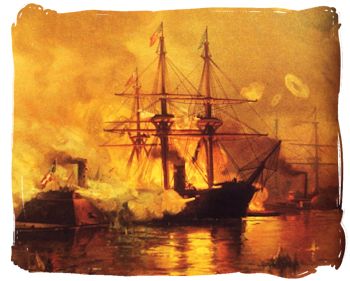
April 22d. Commences with cool, pleasant weather. Crew employed painting ship, &c. Our color has always been black, but owing to a late order from the Department, at Washington, all vessels composing the Western Gulf Squadron are now to be painted a lead color, which is hardly distinguishable from the water of the Mississippi.
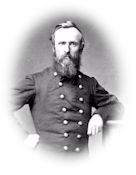
Camp White, April 22, 1863.
Dear Uncle: — We have a pleasant camp, just enough for men to do to keep them out of mischief. About as easy soldiering as we ever had. You can stay on the opposite side of the river at a fair hotel for seven dollars per week, or on this side in a comfortable tent, better grub, for nothing. If you can do better at home, we can make up the difference in novelty. So come soon. We shall have a superior foe driving us out or worrying us badly in a month or two, and at your time of life that might be uncomfortable. I think we shall be let alone now until after the first of June. General Jenkins learned that a small force had no fun coming in here and a large force can’t live here until the first of June or after.
I hope we shall soon see the drafting begin. It ought not to be delayed a day now.
Sincerely,
R. B. Hayes.
S. BIRCHARD.
Wednesday, [April] 22. — A good spell of weather just ended. Drilling, boating, ball-playing, and the like make the time pass pleasantly. Last Sunday had a Mr. Little preach to us on the bank of the river. Several young ladies, a good audience of soldiers, and a good sermon. Mr. Little brought a sort of hand organ and was the chief musician — an eccentric, witty man, capable and zealous.
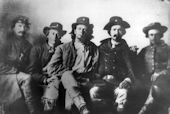
Wednesday, 22nd—Rain ceased; bright and clear this morning. We came on to Alexandria. I spent the evening working with my mule’s feet. After supper I went over to Lodge to assist in conferring some side degrees. I took 1001; staid till 11 o’clock. Came back and went to bed. In a few minutes ordered to saddle up. Yanks coming down on us like thousand of brick from Liberty, Snow Hill and all around. We marched all night. I and Jack and Bill Kyle got together. Couldn’t keep up with Regiment. Stopped at daylight, got breakfast, fed horses and traveled on. Crossed river—nearly swimming. Came out three miles and camped.
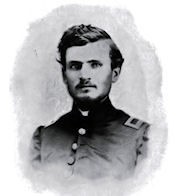
Wednesday, 22nd. Finished Fannie’s letter and mailed it. Pitched quoits awhile with Charlie Fairchild. Read in an old Atlantic. “Old Age and Hundred Days in Mo.” Boys went out and got a beef from 1st Ky. Issued rations from what we had. Received some from 3rd Battalion. Stayed out doors till tattoo. Commenced raining. Wrote a letter home. Got a Cincinnati paper of the 20th.

Mrs. Lyon’s Diary.
April 22.—Mrs. Wemple quite sick. We were going home together. She feels so badly about my going without her, and William does not want me to go alone and has put a veto on my going yet.
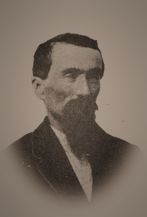
April 22— We renewed our march early this morning through Brock’s Gap. We crossed one of the main branches of the headwaters of the North Fork of the Shenandoah some six or eight times during the day. At one ford the water was deep and the current rapid. The water ran into our limber chests, but fortunately did no serious damage, as it only wet the butt end of the shell. We followed one of the incipient headstreams of the Little Shenandoah until it dwindled down to a little mountain rill, and then we crossed a little ridge and struck the headwaters of Lost River, which flows through a narrow mountain-hemmed valley along the southeastern edge of Hardy County. Camped this evening where the Mount Jackson and Moorefield road crosses Lost River, about twenty miles southeast of Moorefield and about twenty miles northwest of Mount Jackson.


