Following the American Civil War Sesquicentennial with day by day writings of the time, currently 1863.

April 2013

18th.—A letter from our son J. to-day; full of pleasant feeling at finding himself again in the Army of Northern Virginia. He is just established near General Jackson’s head-quarters, as Surgeon of the First Virginia Battalion; had just breakfasted with Stonewall, and is filled with enthusiastic admiration for the great Christian soldier and patriot.

The enemy seems to have left Charleston. The Northern papers, after much circumlocution, prevarication, and boasting of a successful reconnoissance, acknowledge that they were greatly injured by their last attack on it. “All quiet on the Rappahannock,” continues to be reported. God grant that it may continue so!

Yesterday spent-in the hospital; some of the men are very ill. I go back to-morrow.

by John Beauchamp Jones

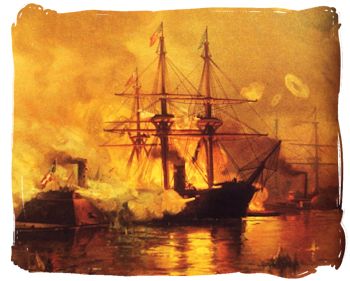
April 18TH.—We have nothing more from the Peninsula, Suffolk, N. C., or South Carolina; but it is rumored that the enemy’s gun-boats (seven or eight) have passed down the Mississippi in spite of our batteries at Vicksburg, which sunk one of them. If this be true, it is bad news.

We have lovely weather now, and vegetation shows signs of the return of the vernal season. We shall soon have blossoms and roses in abundance, and table vegetables too, to dispel the fears of famine. But we shall also have the horrid sounds of devastating war; and many a cheerful dame and damsel to-day, must soon put on the weeds of mourning.

Gen. Jos. E. Johnston has assumed the command of the army of Tennessee. Gen. Howell Cobb is preparing for the defense of Florida. We do not hear a word from Lee or Jackson—but this is the ominous silence preceding their decisive action.

Bacon fell to-day from $2 to $1.50 per pound, and butter from $3.50 to $3.25; potatoes are $16 per bushel. And yet they say there is no scarcity in the country. Such supplies are hoarded and hidden to extort high prices from the destitute. An intelligent gentleman from North Carolina told me, to-day, that food was never more abundant in his State; nevertheless, the extortioners are demanding there very high prices.

This evening we have dispatches (unofficial) confirmatory of the passing of Vicksburg by the enemy’s gun-boats. One of them was destroyed, and two disabled, while five got by uninjured. This is not cheering. No doubt an attack by land will be made, by superior numbers, and blood will gush in streams!

It is now said that Longstreet has captured two gun-boats in the Nansemond, and taken 600 prisoners; and that the Yankees in Norfolk have been thrown into great commotion. The general in command there, Veillé, has adopted very stringent measures to keep the people sympathizing with our cause in subjection. Perhaps he fears an outbreak.

The weather continues fine, and we must soon have important operations in the field.

April 18.—The rebel side-wheel steamer St John was captured while endeavoring to run the blockade into Cape Romaine Inlet, by the National steamer Stettin.—A reconnoissance of Sabine Pass, Texas, was made by a party from the National gunboats Cayuga and New-London. On landing near the light-house they were fired on by concealed rebels, Captain McDermott of the Cayuga being killed, and his crew of five men captured. Captain Reed of the New-London was wounded, together with four of his men.— Fayetteville, Ark., garrisoned by a force of National troops under the command of Colonel Harrison, was this morning attacked by a strong body of rebels, but after a desperate contest of six hours’ duration, they were repulsed with considerable loss.—(Doc. 172.)

Millikens Bend, Saturday, April 18. Cloudy—indications of rain. Boys busy expressing their money home, paying debts and some investing in chuck-luck. Had battery drill in the afternoon of two hours.

Friday, April 17th. I left Rusk on the morning of the 16th on a six passenger coach; there were fourteen aboard; the driver was skillful and the road good; I was suffering intensely from dysentery and had a high fever from breakfast time until sundown; oh, the long, long weary miles pent up in that crowded coach; I slept half an hour at Henderson; at the next stand I bathed in the horse bucket and my fever left me; I chewed a piece of salt ham; it was now dark; I laid down on top of the stage coach and was very comfortable about half of the night, but suffered tortures during the latter part of the night; reached Marshall about 7 o’clock in the morning; sent for a physician and will remain here for a day or two, until I am able to travel; Lieutenant Selman had a cup of genuine coffee made for me which I enjoyed very much; Burwell Aycock is trying to get a soft boiled egg for me; I think I will be well in a day or two; this attack was brought on by a check of perspiration after becoming overheated in the walk of four miles to Palestine.

April 17th. Commences with warm and pleasant weather. At five-thirty A. M., called all hands, and hove up anchor; got under way, and were once more stemming the current of the Mississippi, which is none other than a four-knot one, by the way. In many instances the residences of the rich and affluent planters or merchants looked to be deserted by the owners, and the overseer and negroes working in the fields were the only parties to be seen. What an example of the ravages of war! and how many fair ones occupy apartments in some of these dwellings, closed up, as I have said, as if they were haunted and deserted, who have a husband, father, brother, or other relative, in this war, fighting against their country, and, according as they have been made to believe by corrupt politicians and arch traitors, for their rights, their altars, and their firesides; when, if the truth were known, they had taken up arms to overthrow the best government the sun ever shone upon, and substituted a monarchy, placing bad men in power—a government for a few, not for a whole. How men can, in this enlighted age, become so deluded, is a wonder.

17th April (Friday).—Having spent last night in a Mexican saddle, our bullock-rug in the sand appeared to me a most luxurious bed.

We hitched in at 5 A.M., and struck water at 9 A.M., which, though muddy in appearance, was not so bad to drink.

I walked ahead with the Judge, who, when sober, is a well-informed and sensible man. Mr Sargent and I are great friends, and, rough as he is, we get on capitally together.

A Mr Ward, with three vehicles—a rival of Mr Sargent’s—is travelling in our company. He drove his buggy against a tree and knocked its top off, to the intense delight of the latter.

We breakfasted under difficulties. The wind being high, it drove up the sand in clouds and spoiled our food. Our travelling companion, Mr ——, is a poor little weakly Israelite, but very inoffensive, although he speaks with a horrible Yankee twang, which Mr Sargent and the Judge are singularly free from.

We went on again at 2 P.M. I had a long talk with a big mulatto slave woman, who was driving one of Ward’s waggons. She told me she had been raised in Tennessee, and that three years ago she had been taken from her mistress for a bad debt, to their mutual sorrow. “Both,” she said, “cried bitterly at parting.” She doesn’t like San Antonio at all, “too much hanging and murdering for me,” she said. She had seen a man hanged in the middle of the day, just in front of her door.

Mr Sargent bought two chickens and some eggs at a ranch, but one of the chickens got up a tree, and was caught and eaten by the Ward faction. Our camp tonight looks very pretty by the light of the fires.

17th. In the morning got breakfast and brushed my clothes. Went to town with the Lt. to get five days’ rations. Saw Gen. Carter, a man slightly gray, whiskers and a good kind look. Took dinner on Co.’s account. 3rd Battalion came in. Saw Bob. Issued rations before dark. Wrote to Fannie in the evening. Ordered to march to Somerset at 10. Up till 2 A. M. Then slept again till morning.

April 17. —I have to drop and catch my pencil as I can; for we are doing tremendous work. O people who clamor for rapid movements! if you only knew what forced marches after a flying enemy cost us poor fellows, who have to make them! — the burden being: so heavy, the roads so dusty, and the noon-sun so burning hot. It is Saturday morning. Since Wednesday morning, we have pursued the flying rebels fifty miles. I have just seated myself, with my stiff limbs stretched on the grass, under the shadow of a rough stable belonging to a miserable plantation in these back regions of Louisiana. I only make this little note; for the pursuit is not ended, and I ought to use this respite for sleeping and eating; rather than writing.

April 17 — I saw the Maryland Line of infantry drill to-day. The men are well drilled and their regimental maneuvers were as regular and precise as clockwork.