Following the American Civil War Sesquicentennial with day by day writings of the time, currently 1863.

April 2013

April 17, Friday. No reports from Charleston. Am in hopes that side issues and by-play on the Mississippi are about over and that there will be some concentrated action. Porter should go below Vicksburg and not remain above, thereby detaining Farragut, who is below, from great and responsible duties at New Orleans and on the Gulf. The weak and sensitive feeling of being outranked and made subordinate in command should never influence an officer in such an emergency. Porter has great vanity and great jealousy but knows his duty, and I am surprised he does not perform it. Wrote him a fortnight since a letter which he cannot misunderstand, and which will not, I hope, wound his pride.

But little was before the Cabinet, which of late can hardly be called a council. Each Department conducts and manages its own affairs, informing the President to the extent it pleases. Seward encourages this state of things. He has less active duties than others, and watches and waits on the President daily, and gathers from him the doings of his associates and often influences indirectly and not always advantageously their measures and movements, while he communicates very little, especially of that which he does not wish them to know.

Blair walked over with me from the White House to the Navy Department, and I showed him the correspondence which had taken place respecting captured mails. Understanding Seward thoroughly, as he does, he detected the sly management by which Seward first got himself in difficulty and is now striving to get out of it. My course he pronounced correct, and he declared that the President must not be entrapped into any false step to extricate Seward, who, he says, is the least of a statesman and knows less of public law and of administrative duties than any man who ever held a seat in the Cabinet. This is a strong statement, but not so overstated as would be generally supposed. I have been surprised to find him so unpractical, so erratic, so little acquainted with the books, — he has told me more than once that he never opened them, that he was too old to study. He has, with all his bustle and activity, but little application; relies on Hunter and his clerk, Smith, perhaps Cushing also, to sustain him and hunt up his authorities; commits himself, as in the case of the mails, without knowing what he is about.

Millikens Bend, Friday, April 17. Were ordered to prepare for general inspection at 9 A. M. Got off from guard in time to mount my team. Formed three lines on the plain in front, viz: 1st line, 3rd Brigade; 2nd line, 3 batteries of artillery; 3rd line. 1st Brigade. (2nd Brigade not yet arrived from above). Were inspected by Adjutant General Thomas of Washington and Colonel Sanborn ( commanding Division in sickness of Quinby) and staff. After inspection the troops were brought in a solid square when General Thomas was introduced by General Grant, and spoke of the policy of the administration in regard to the contrabands, which was received with cheers; followed by Colonel Sanborn and lieutenant colonel of the 72nd Volunteers.

Went to the convalescent camp of the 23rd, found Hugh Hughes very low in body and mind. Returned just in time to receive my pay up to the first of March, $13.00 here, $40.00 per allotment. Heard soon the tremendous roar of artillery. Heard last night seven gunboats and two or three transports run the blockade at Vicksburg, burning one transport. Hospital cleared off as fast as possible, expecting to get some wounded in soon. Great activity all around. 2nd Brigade arrived at night.

Friday, 17th—The Sixth Division was reviewed today by General McArthur. We heard some very heavy cannonading last night down toward Vicksburg. The report is that four gunboats and six transports with five hundred thousand rations on board ran the blockade. Another large fleet loaded with troops went down the river today.

Hi all,

Once again, I got behind on some of these diaries, journals and other works from 1863.  I thought I had more margin than I did – and neglected to make sure.  When I did, I found that a number of the writers had no posts for several weeks.

I’m in the process of correct that and, when I’m caught up, will provide a summary of all of the posts, with links, in chronological order.

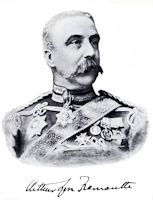
In the meantime, I do have one new 1863 writer, Sir Arthur James Fremantle, a British Coldstream officer that recorded his 1863 journey through the southern states in a diary that was subsequently published.  This diary started in March 1863.

_________

Preface

At the outbreak of the American war, in common with many of my countrymen, I felt very indifferent as to which side might win; but if I had any bias, my sympathies were rather in favour of the North, on account of the dislike which an Englishman naturally feels at the idea of Slavery. But soon a sentiment of great admiration for the gallantry and determination of the Southerners, together with the unhappy contrast afforded by the foolish bullying conduct of the Northerners,, caused a complete revulsion in my feelings, and I was unable to repress a strong wish to go to America and see something of this wonderful struggle.

Having successfully accomplished my design, I returned to England, and found amongst all my friends an extreme desire to know the truth of what was going on in the South; for, in consequence of the blockade, the truth can with difficulty be arrived at, as intelligence coming mainly through Northern sources is not believed; and, in fact, nowhere is the ignorance of what is passing in the South more profound than it is in the Northern States.

In consequence of a desire often expressed, I now publish the Diary which I endeavoured, as well as I could, to keep up day by day during my travels throughout the Confederate States. The latter portion of the Diary, which has reference to the battle of Gettysburg, has already appeared in ‘Blackwood’s Magazine;’ and the interest with which it was received has encouraged me to publish the remainder.

I have not attempted to conceal any of the peculiarities or defects of the Southern people. Many persons will doubtless highly disapprove of some of their customs and habits in the wilder portion of the country; but I think no generous man, whatever may be his political opinions, can do otherwise than admire the courage, energy, and patriotism of the whole population, and the skill of its leaders, in this struggle against great odds. And I am also of opinion that many will agree with me in thinking that a people in which all ranks and both sexes display a unanimity and a heroism which can never have been surpassed in the history of the world, is destined, sooner or later, to become a great and independent nation.

2d March 1863.—I left England in the royal mail steamer Atrato, and arrived at St Thomas on the 17th.

22d March. — Anchored at Havana at 6.15 A.M….

23d March. — Left Havana in H. M. S. Immortality, at 11 A.M. Knocked off steam when outside the harbour.

1st April.—Anchored at 8.30 P.M., three miles from the mouth of the Rio Grande, or Rio Bravo del Norte, which is, I believe, its more correct name, in the midst of about seventy merchant vessels.

2d April. — The Texan and I left the Immortalité in her cutter, at 10 A.M., and crossed the bar in fine style.

3d April (Good Friday).—At 8 A.M. I got a military pass to cross the Rio Grande into Mexico, which I presented to the sentry, who then allowed me to cross in the ferry-boat.

4th April (Saturday).—I crossed the river at 9 A.M., and got a carriage at the Mexican side to take my baggage and myself to the Consulate at Matamoros.

5th April (Sunday).—Mr Zorn, or Don Pablo as he is called here, Her Majesty’s acting Vice-Consul, is a quaint and most good-natured little man—a Prussian by birth.

6th April (Monday).—Mr Behnsen and Mr Colville left for Bagdad this morning, in a very swell ambulance drawn by four gay mules.

7th April (Tuesday).—Mr Maloney sent us his carriage to conduct Captain Hancock, Mr Anderson, and myself to Brownsville.

8th April (Wednesday).— Poor Don Pablo was “taken ill” at breakfast, and was obliged to go to bed.

9th April (Thursday).—Captain Hancock and Mr Anderson left for Bagdad in Mr Behnsen’s carriage at noon.

10th April (Friday).—We roused up at daylight, and soon afterwards Colonel Duff paraded some of his best men, to show off the Texan horsemanship, of which they are very proud.

11th April (Saturday). — Mr ——, the Unionist, came to me this morning, and said, in a contrite manner, “I hope, Kernel, that in the fumes of brandy I didn’t say anything offensive last night.”

12th April (Sunday).—I took an affectionate leave of Don Pablo, Behnsen, Oetling, & Co., all of whom were in rather weak health on account of last night’s supper.

13th April (Monday).—I breakfasted with General Bee, and took leave of all my Brownsville friends.

14th April (Tuesday).—When we roused up at 4 A.M. we found our clothes saturated with the heavy dew; also that, notwithstanding our exertions, the hogs had devoured the greatest part of our pet kid, our only fresh meat.

15th April (Wednesday).—I slept well last night in spite of the tics and fleas, and we started at 5.30 P.M. After passing a dead rattlesnake eight feet long, we reached water at 7 A.M.

16th April (Thursday).—Now our troubles commenced.
Friday, 17th—Lieut. Davis and Emmet Trammel came by to-day and took dinner. Learned all about the Regiment from them. Camped at A. To-day was a beautiful day. I did not feel so well as I have for a1 few days before. Fine time for farmers to work.

April 17—At daylight this morning our company was ordered to go on picket at Shingle Landing, five miles from Bellevue. I asked Colonel Morehead to let me go with them, but he refused, and said I should stay with the colors, but I went without his permission. In a march of five miles we waded through three miles of swamp, knee-deep. We are in a devil of a position. The enemy can cut us off from our command easily, as we cannot return, except through the swamp, which of course would be very slow progress. At 4 this evening we were recalled, and met our regiment on the march and fell in. Colonel Morehead did not miss me from the colors. We marched seven miles and halted for the night.

17th.—On going to the hospital yesterday, I found that young Stansberry had died, surrounded by sympathizing friends, and having a bright hope of a blessed immortality. We are anxious about our armies everywhere, from the Mississippi to the seaboard. Rumours are rife about General Longstreet having thrown his forces between Norfolk and the Yankee army at Suffolk. In the mean time we must possess our souls in patience.

April 17. — General sent me down early in the morning to Hope Landing with an order to Mr. Waterman to send up the train immediately, and also ordered me to direct the train. I reached Hope Landing at about o’clock and started the train by 12. Such a miserable, green, balky, God-forsaken set of horses I never saw before in my life. All the 23 teams utterly refused to draw except one, which went ahead very well. To make matters worse, there was a corduroy road leading up a very steep hill which we had to go over in the first part of our journey. After getting all the teams up the hill, I rode on to Stafford Court House to see Colonel Asmussen, General Howard’s chief of staff. I got a detail of 100 men from him and went back to the wagons with them. On my way to Colonel A.’s I stumbled on General Slocum’s headquarters, and found Charles Horton, Morse, and Motley. I got my wagons as far as Stafford Court House by 8 P.M., having gone some three miles in 8 hours. Colonel Asmussen gave me a bed, a stable for my horse, etc., and treated me very kindly indeed. In the evening I had a guard placed over my wagons, having first telegraphed for permission to park at Stafford Court House for the night, which was granted. I went to General Slocum’s in the evening and passed a pleasant hour with Morse, Horton, and Motley. Day pleasant. Cloudy part of time.

by John Beauchamp Jones

APRIL 17TH.—From the Northern papers we learn that the defeat at Charleston is called by the enemy a RECONNOISSANCE.

This causes us much merriment here; McClellan’s defeat was called a “strategical movement,” and “change of base.”

We have some rumors to-day, to the effect that Gen. Hill is likely to take Washington and Newbern, N. C.; Gen. Longstreet, Suffolk; and Gen. Wise, FortMagruder, and the Peninsula—he has not troops enough.

Gold advanced 7 per cent. in New York when the news of the “reconnoissance” reached that city.

We are planting almost every acre in grain, to the exclusion of cotton and tobacco—resolved never to be starved, nor even feel a scarcity of provisions in future. We shall be cutting wheat in another month in Alabama and other States.

Among the other rumors, it is said Hooker is falling back toward Washington, but these are merely rumors.

The President is in a very feeble and nervous condition, and is really threatened with the loss of sight altogether. But he works on; and few or no visitors are admitted. He remains at his dwelling, and has not been in the executive office these ten days.

Col. Lay was merry again to-day. He ordered in another foreign substitute (in North Carolina).

Pins are so scarce and costly, that it is now a pretty general practice to stoop down and pick up any found in the street. The boarding-houses are breaking up, and rooms, furnished and unfurnished, are rented out to messes. One dollar and fifty cents for beef, leaves no margin for profit, even at $100 per month, which is charged for board, and most of the boarders cannot afford to pay that price. Therefore they take rooms, and buy their own scanty food. I am inclined to think provisions would not be deficient, to an alarming extent, if they were equally distributed. Wood is no scarcer than before the war, and yet $30 per load (less than a cord) is demanded for it, and obtained.

The other day Wilmingtonmight have been taken, for the troops were sent to Beauregard. Their places have since been filled by a brigade from Longstreet. It is a monstrous undertaking to attempt to subjugate so vast a country as this, even [click to continue…]

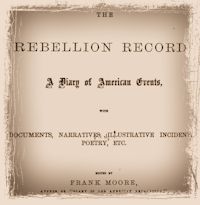
April 17.—Brigadier-General Daniel A. Donelson, commanding the rebel department of East Tennessee, died near Knoxville. He was the nephew of General Andrew Jackson.—The rebel schooner Alabama, was captured off Mobile, while endeavoring to evade the blockade, by the National steamer Susquehanna. — Com. Hitchcock’s Despatch.

—A large detachment of the Ninety-ninth and One Hundred and Thirtieth New-York regiments had a successful skirmish with the rebels at the South-Quay road, near Suffolk, Va., and succeeded in killing and wounding a considerable number of them. In the encounter the Nationals had two killed and three wounded.

—Colonel H. B. Grierson, in command of a strong force of Union cavalry, left La Grange, Tenn., on a raid through the State of Mississippi. (Doc. 170.)

—A skirmish took place at Bear Creek, Tenn., between a party of Nationals under the command of General Dodge, and the rebels, resulting in the retreat of the latter. Captain Cameron of the Ninth Illinois cavalry was killed.—A detachment of National troops under General Grover, encountered a large force of rebels at Bayou Vermilion, La., and opening upon them with artillery, drove them from their position.—(Doc. 171.)