April 10—Got to our line at 6 this morning. The Yankees had fallen back. They had nineteen regiments and twenty-one pieces of artillery. They left in a hurry. One of their colonels was killed and I don’t know how many men. We left Blount Creek Bridge at 4 this evening, marched nine miles on our way back to Bellevue. We met the Bethel regiment, and I met several friends of my old company.
April 2013
News From Along the Line.
April 10. The siege of Washington on the Pamlico river continues, and heavy firing is heard from there every day. We learn they have got Gen. Foster shut up there and he is in danger of being made prisoner. That may be, but I will bet ten to one he holds the keys and will never take off his cap to any general in the Confederate service.
The weather is most extraordinary, throughout February, March and up to this time, April 10th, it has been just like spring. Many of the men have laid out flower gardens, and some have even planted seeds and beguile themselves into believing it possible they may remain to see them grow. The fields and adjacent woods are full of wild flowers and many of them have been transferred to the soldier’s plots, especially the bluet, a tiny, modest flower, which here covers with its beauty the banks and shady nooks of woods. The dainty anemone, which grows profusely in damp places, is also much in evidence; these garden patches look very pretty, and are much thought of.
Cicero considers that a garden is the greatest refreshment to the spirits of man, without which, he says, “buildings and palaces are but gross handiworks,” which proves that men’s tastes are much to-day what they were nineteen centuries ago.

by John Beauchamp Jones
APRIL 10TH. —We are not informed of a renewal of the attack on Charleston. It is said our shot penetrated the turret of the Keokuk, sunk.
In New York they have been exulting over the capture of Charleston, and gold declined heavily. This report was circulated by some of the government officials, at Washington, for purposes of speculation.
Col. Lay announced, to-day, that he had authority (oral) from Gen. Cooper, A. and I. G., to accept Marylanders as substitutes. Soon after he ordered in two, in place of Louisianian sutlers, whom he accompanied subsequently—I know not whither. But this verbal authority is in the teeth of published orders.
Lebanon, Ky., April 10th, 1863.
We left Bardstown on April second and marched to this place, twenty-eight miles, in two days. How long we may remain here I cannot even conjecture. Kentucky is like a seething volcano, ready to burst into flames at any moment; nothing but the concentration of a large force can prevent an uprising. I think the presence of so many Michigan boys may have a soothing effect.
April 10.—Jefferson Davis, in compliance with the request of the rebel Congress, issued an address to the people of the rebellious States, invoking their attention “to the present position and future prospects of our country, and to the duties which patriotism imposes on us all during this great struggle for our homes and our liberties.”— (Doc. 159.)
—Lieutenant Rickertson, of the Eighteenth Ohio regiment, stationed at Demosville, Ky., having received information that a band of rebels were in the habit of holding meetings at Morris’s Mills, in Campbell County, left his camp on the day before yesterday for the purpose of capturing them. He did not find them at Morris’s Mills, but two miles farther on, near Roushe’s house, he captured two men belonging to the guerrilla band under “Jim Caldwell.” Continuing the pursuit yesterday, Lieutenant Rickertson encamped within “thirty yards of the rebels without cither party having a knowledge of it, and this morning Caldwell’s party got the start, Lieutenant Rickertson, upon hearing of their movement, following in pursuit.” The rebels were not overtaken until they reached the vicinity of Germantown, in Mason County, where they were surprised and completely routed. Lieutenant Daniels of the rebel party was killed in the fight that took place, and three others were wounded. Caldwell escaped on a very fleet horse, while his men, except three who were captured, fled to the woods, leaving their horses in the hands of the Nationals.—Chicago Tribune.
—Franklin, Tenn., was attacked by the rebel forces under General Van Dorn, who were repulsed and routed by the Union army of occupation, under the command of General G. Granger. —(Doc. 160.)
—The rebels in the vicinity of Fort Donelson, Tenn., having been gathering all the horses fit for cavalry service, General Rosecrans ordered all the good animals in that neighborhood to be taken by the forces under his command. While engaged in this duty, seventy of his men met an equal number of rebels near Waverly, when a fight ensued, in which twenty-one of the latter, including Major Blondin and two captains, were taken prisoners.—Captain A. G. Webster was executed by the rebels at Camp Lee, near Richmond, Va.—Richmond Whig.
—The expedition which went out from Newbern, N. C, under General Spinola, to reinforce General Foster at Washington, returned to Newborn, having been unsuccessful in their object.
April 10. — Charles Whittier came over here this morning, and after getting my monthly report ready, and having sent it in, and having my tri-monthly report well under way, I started off with Whittier to see John White.[1] We came by headquarters just as the President and General Hooker came out, on their way to review the Eleventh and Twelfth Corps. On our way we came to the camp of the 16th Massachusetts and stopped and saw Captain Amory. We then continued on our way over the corduroy road until we came to the camp of the 1st New York Volunteers. Both sides of the corduroy road were lined by Sickles’s corps, who were out to cheer Father Abraham. We found John in, and spent a very pleasant hour with him. From there we went to Belle Plain, to see about the pontoon boats. I found Major Cassin there, and Captain Wood. Saw the canvas boats, and reported their condition to the general. On my way back I stopped at Rush’s Lancers’ camp, and saw Winsor, Furness, and Davis.
When I arrived here at camp, I found that the general had gone out on a reconnoissance toward and beyond White Oak Church, General Reynolds’s headquarters. He told me in the evening that it was Lieutenant Comstock’s plan to cross the river below Fredericksburg. The general did not seem in favor of such a move. Sent in my tri-monthly report this evening. Day pleasant.
[1] John C. White, my classmate.
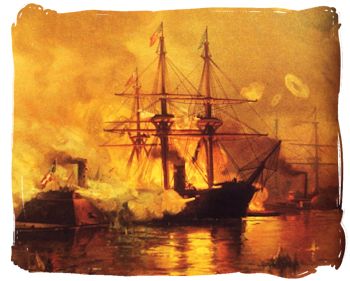
April 9th. At six A. M., got up anchor and steamed up the river; at eleven A. M., two rebel steamers were discovered ahead of us near the mouth of Red River (one of which was of large proportions), and approaching same with the intention of entering it. They no doubt had in our absence come out of Red River and transported a mail and provisions to the Confederate army at Vicksburg, and were now returning, having accomplished their work; as soon as we were discovered by them, they everlastingly did get up and keep putting on a full head of steam to escape capture by the “infernal Yanks,” as they called us. The larger steamer of the two was successful in her effort to escape, but the other was bagged by us, a shot from our Sawyer rifle hitting her, or passing so near to the heads of those on board that they brought up with their craft among the bushes, and commenced blowing the steam whistle of same for assistance from the other, which was by this time well up Red River, her smoke only being visible to us from outside. Some of her crew made their escape, I believe, by taking to the bushes, when they saw that their cry for help was of no avail. Since we had come to an anchor off the mouth of Red River, in the Mississippi, and this steamer was just a few yards up first-mentioned stream, around a point of land. We sent the Albatross, our tender ( a light draught gunboat), after our prize; she was successful in her mission, and soon returned with a miniature paddle-wheel boat, by name the J. D. Clarke, and brought her alongside of us.
The Albatross brought also three prisoners on board of us from off the rebel steamer,—one a secesh major, another an engineer, and the third party a fireman of the boat. This afternoon the Admiral paroled two of the above-mentioned parties, the engineer and fireman, and retained the major.
We are at anchor off the mouth of Red River, with logs on the ship’s side, about where the boilers and machinery are situated, as a protection against injury from rebel rams, should they be so pugnacious as to come out of Red River some dark night and try their butting powers.
Camp White, April 9, 1863.
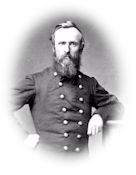
Dear Uncle: — Yours of the 3rd received. Yes, Jenkins made a dash into Point Pleasant, but he dashed out before doing much mischief with a loss of seventy-five killed and prisoners. He attacked one other post garrisoned by men under my command but was repulsed. His raid was a failure. He lost about one hundred and fifty men while in this region and accomplished nothing. But we expect repetitions of this thing, and with our present force we shall probably suffer more another time.
I do not look for an end of the war for a long time yet. I am glad the late elections show the second sober thought to be right. We can worry them out if we keep at it without flagging.
Come on, it will be good weather in a few weeks.
I send you a soldier’s photograph of our log-cabin camp near Gauley. It is not good. You can see the falls beyond the camp and the high cliffs on the opposite side of the Kanawha. My quarters were at the long-roofed cabin running across the street towards the back and right of the picture.
Sincerely,
R. B. Hayes.
S. Birchard.
9th. A little after sunrise, went to breakfast at a private house. So many slaves about here, more than white folks by far. Started on at 8 P. M. After nine miles passed through Flemingsburg. Men, women and children were out with flags and handkerchiefs. It did our hearts good. Passed through Tilton. Drake and I stopped at a house and got dinner. Went on to Sherburne and camped. Chamberlain got thrown and hurt badly. Got wagon for the boys.


