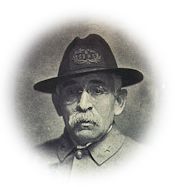
April 8—This morning Tom Tiotter, Katz and myself went with Captain White to meet three Yankees with a flag of truce; but they would not come half way, so Colonel Owens ordered us back. We then— we three—went to our siege-gun and saw the town very plainly. They fired at us while we were there. The fire was returned, and we could see the Yankees dodge.
April 2013
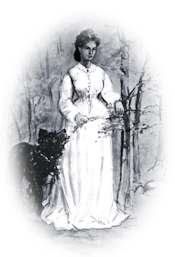
April 8th [1863]. Mrs. Waugh came over this morning to see if we would go to Greenville with her. I did not feel well, but made the attempt to dress myself; I was still in doubt when she left us to dress. In attempting to put on my clothes I was so weak that I felt fainty, and so determined to delay. I wrote her a note, putting off till some other time. I had not finished it when in rushed Mary Harrison, almost wild with joy. In these sad times a little joy will sometimes leaven the whole lump. Mary has just received two letters from her aunt Ellen, whose husband is a colonel in our army. She is at Franklin, Louisiana, a few hours’ ride on the car from this place. She is there with Sibley’s army, and that army is mostly composed of “Texans.” “We were soon almost as excited as she—a certain wild hope of getting out, there and under the protection of some of our people; get to Texas, or at least, hear of our sisters and brothers. A Captain Harley, mentioned in the late taking of Galveston, is a friend of Mrs. Riley’s (Mary’s aunt). He is also a friend of Mr. Randolph’s, and is the very redoubtable hero to whose care he was about to commend us when he was stationed at Galveston before its first fall, and when we thought we had some chance of reaching it. This gentleman (knight, nowadays) his two friends proclaim to be the ugliest of the ugly, but he is accomplished, wise, kind and brave, and, like all brave men, ready to serve a woman (I don’t say “lady”). He is at Franklin, and what is more than probable, Dick and James Pye, who were also in Galveston’s defence service, are there. They, my brother-in-law’s brothers, would be friends indeed; many and many an unthinking, joyous day have we spent together in the old times past. Never then did they or we think of the brass buttons, the stripes, the shoulder-straps and the grey cloth which now represents a new idea (Greybacks, these Federals call our soldiers), when, in the old time, before our two families moved South, we sat on the banks of the blue Potomac, watching the white sails and listening to the “Hail, Columbia,” of the steamers; little did we think that the dear river would one day shut out old Maryland from our country. They are Texans now, wearing her colors, bearing her lone star banner, and we have a foothold still in this desolated Louisiana; and Maryland, our mother, is torn and oppressed by Federal soldiers, and she, for her undecided course, the scorn, the pity of the world. Oh, is it not best to die early?
I was almost forgetting Mary Harrison and her letters. Well, her aunt wants her, and indeed, the whole family, to come to her immediately; says she is splendidly situated with the army and can make them comfortable. The girls are crazy to go out, but all depends on their father and these Federals. Ginnie said to Mary, “Yes, you can hear from your friends, but we hear nothing.” With one of her impulses, Mary leaped from her chair, and throwing her arms around Ginnie, kissed her, saying, “Yes, I thought of you as soon as I got my letter; I ought to be ashamed to tell you of it.” She then fell to begging us to go out with them if they went, promising us a warm welcome at her aunt’s and a splendid time until we could get farther on our journey. I have met Mrs. Riley, and like her very much. She has seen much of the world, and yet preserves her kindliness; she is both cultivated and agreeable. I have almost a hope of getting out. Oh, what a joy it would be to be under the roof of kindred once more! Sister, the children, Claude and brother [Washington LeGrand]; I never knew how much I loved them until now. Mary’s excited talk gave her a headache, and we made her a cup of tea, and we sat and had a long chat. But for Mrs. Norton’s making us nervous, saying every now and then, “Can’t listen to anything I have to say,” we could have had a pleasant time. Presently Mr. Randolph came in, and he and Mary having met here so often, Ginnie met him in the parlor with, “Yes, Miss Harrison is here; walk in; she has been here for some time.” Whereupon he blushed mightily. Mary made Ginnie introduce her to him as he entered, which made him blush again. Mrs. Dameron was here, too, and the talk was too mixed up for Mrs. Norton to take it all in, and while Mr. Randolph was telling her something, she spoke sharply to Ginnie, who was listening to Mary, to “Stop and listen to somebody.” “I am listening to somebody,” returned Ginnie, bowing to Mary. This was high satire, and when I remarked that “Miss Harrison was annihilated,” and Mary said she would never have the boldness to speak again, and Mr. Randolph had stopped in the middle of his speech and blushed, she became confused, and in some sort made apology. “Well,” she said, “when anybody is telling anything interesting, I want every one to hush and hear it.” Mr. Randolph was trying to convince her that we had Farragut, and as we had heard all his arguments before, and as we were sitting
[Here the Journal, as preserved, abruptly ends.]

by John Beauchamp Jones
APRIL 8TH.—We learn to-day that the enemy bombarded our forts at Charleston, yesterday, two hours and a half. But few of our men were injured, and the forts sustained no damage of consequence. On the other hand, several of the iron-clads and monitors of the enemy were badly crippled; one of the latter, supposed to be the Keokuk, was sunk. Since then the bombardment has not been renewed. But no doubt the enemy will make other efforts to reduce a city which is the particular object of their vengeance.
Every one is on the qui vive for further news from Charleston. Success there will make Beauregard the most popular man in the Confederacy, Lee excepted.
Speculation is running wild in this city; and the highest civil and military officers are said to be engaged, directly or indirectly, in the disgraceful business of smuggling. Mr. Memminger cannot be ignorant of this; and yet these men are allowed to retain their places.
April 8.—The Richmond Dispatch of this date, said: “We have published the gist of the correspondence between Mr. Mason and Lord Russell, on the question of the legality of the blockade of our ports by the Yankee Government, and the recognition of the Confederacy. No Southern man can read it without feelings of indignation and contempt—indignation for the cold and stony haughtiness, not to say rudeness of manner of the British Minister toward Mr. Mason, afterward only partially atoned for by a disavowal of any personal disrespect, and contempt for the subterfuges resorted to, to cover a selfish policy. . . We must not forget, whatever the ministry may do or propose, that our country has received the most valuable assistance from the people of England, and at this time there are schemes on foot there, of great importance to us.”—The English schooner Maggie Fulton, while attempting to run the blockade at Indian River Inlet, Fla., was captured by the bark Gem of the Sea.—The Union gunboat George Washington, while on a reconnoissance up Broad River, S. C, was stranded, and soon afterward attacked by a party of rebels on shore, who succeeded in throwing a shell into her magazine and blowing her up. Two of the Unionists were killed and eight wounded, all belonging to the Third Rhode Island artillery.—A party of rebel guerrillas, under Woodward, captured and burned the steamers Saxonia and Lovell, on the Cumberland River, after killing the captain of the latter, and severely wounding the captain of the former.
—The Tallahatchie fleet, consisting of the divisions under Generals Ross and Quimby, and numerous gunboats and mortar-boats, arrived at Helena, Ark. The expedition, which had been absent forty-three days, left Fort Greenwood on the fifth. As soon as the bustle was observed by the rebels, they opened a brisk fire upon the woods where batteries had been planted, which continued till the last boat steamed up the river. On the passage, the boats were frequently fired on by guerrillas. A number of soldiers were wounded and twenty-five or thirty killed.
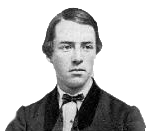
April 8. — To-day there was a review of the Second, Third, Fifth, and Sixth Corps by the President. It was one of the finest spectacles I have ever seen. The different corps arranged in line, with their flags of all colors, contrasting well with the dark blue of the uniforms, was a very pretty sight. As they passed in review they would come to the shoulder, and then double-quick as soon as past the President. I went over in the evening to see Starr,[1] and had a very pleasant time. Received a letter from Hannah full of interesting items. Mounted guard this evening quite successfully, and I believe made no mistake. This is the third time that we have had brigade guard-mounting. Day very pleasant. Several ladies were at the review, and among others Mrs. Lincoln. The President’s son rode at the head of the reviewing column. It was quite exciting when riding through the lines, as we did, at a full gallop. There were several ditches in the way which we had to leap, and in trying to do so some were stuck in the mud, others thrown, etc. It was quite amusing for those who got through safely.
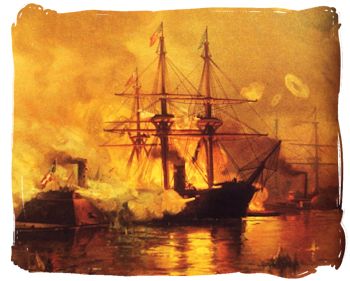
April 7th. This afternoon some men were seen on shore making signals with a flag. Thinking it to be some parties from the lower fleet wishing to communicate with us, we ordered our army signal officer to exchange signals with them, but he found that it was impossible to do so, as they used different signals from ours. The gunboat Albatross then got under way, and found them to be some of the enemy, and shelled them off.
Between eight and nine o’clock, P. M., as near as I can recollect, we fired three guns at intervals of three minutes each, and sent up three rockets with same intervals intervening, to attract the attention of lower fleet, but received no answer to same. Mr. Gabaudan, the Admiral’s Secretary, with despatches, left the ship in a skiff to run the gauntlet of the rebel batteries, taking with him a contraband for oarsman, to communicate with the vessels below. Another skiff with two contrabands in it was sent away from the ship about the same time as the one first mentioned, for the purpose of distracting the attention of the emeny’s pickets from the other boat, or in case either were discovered, to give one a chance to escape. About ten o’clock P. M., a rocket was observed sent up from below, as a signal from the lower fleet that the experiment had proved a success.
Tuesday, April 7th.
I believe that it is for true that we are to leave for New Orleans, via Clinton and Ponchatoula, this evening. Clinton, at least, I am sure of. Lilly came down for me yesterday, and according to the present programme, though I will not answer for it in an hour from now, we leave Linwood this evening, and Clinton on Thursday. I am almost indifferent about our destination; my chief anxiety is to have some definite plans decided on, which seems perfectly impossible from the number of times they are changed a day. The uncertainty is really affecting my spine, and causing me to grow alarmingly thin. . . .
7th. After doing stable duty, went up to Co. H and got some ham, bread and coffee. Read the morning paper and wrote to Delos. A little after noon received orders to march. Fed, packed up and marched down to the boat. Saw Al Bushnell. Other battalion along. Took supper with Capt. Stewart on the boat. Had a berth with A. B. Good sleep.
April 7, Tuesday. The result of the election in Connecticut yesterday is gratifying. Buckingham is reelected Governor by three thousand majority.
The President has not returned from the Rappahannock. There was consequently no Cabinet-meeting. Consul Dudley at Liverpool writes that he is instituting legal proceedings in the English courts against some of the vessels which the Rebels, aided by English capital, are fitting out, but meets with discouragement or has no encouragement in unexpected quarters. Wrote Mr. Seward that the zeal of Dudley should be commended, and unless very decided measures are taken, and strong representations made, we shall be involved in difficulty. John Bull must understand that whilst we deprecate war, we don’t fear him and shall not passively submit to outrage and aggression. A loan of fifteen million dollars has recently been made to the Rebels by English capitalists, which would never have been consummated had the English officials disapproved. With these means, which the Englishmen will ultimately lose, the Rebels can purchase vessels, ordnance, munitions, and prolong the war. Mercenary England will be benefited if our commerce is destroyed, and our country be weakened and exhausted. Sumner thinks the alliance with slavery will be so unpopular with the English people as to restrain the Government, but confesses he begins to have fearful misgivings.
On the Coldwater, Tuesday, April 7. Warm and pleasant. Entered mouth of Coldwater 8 A. M. Travelled well till towards evening. The channel grew more crooked and difficult. 4 P. M. landed to take on rails, then went on. Tied up in a low swampy cane-brake. Water much lower than when descending. An occasional darky to be seen with mule and plow at work in the field, but in most cases the darky had “hung up the shovel and the hoe.” Music and dancing in the evening. Washed.
P. S. I write this at the still hour of midnight, all is quiet and their minds far away from here in the happy land of dreams. No sound save the tiresome tramp of the poor pent-up brutes which have not laid down since we embarked. What a time for thought. Two hours yet of guard.


