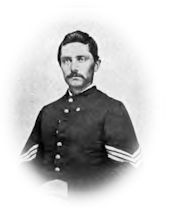
Tuesday, 7th—The sanitary goods were issued to the different companies of the regiment today; the boys are pleased with the many good things that came from Iowa. Received orders to clean up for inspection.
April 2013
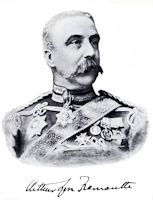
7th April (Tuesday).—Mr Maloney sent us his carriage to conduct Captain Hancock, Mr Anderson, and myself to Brownsville.
We first called on Colonels Luckett and Buchel; the former is a handsome man, a doctor by profession, well informed and agreeable, but most bitter against the Yankees.
We sat for an hour and a half talking with these officers and drinking endless cocktails, which were rather good, and required five or six different liquids to make them.
We then adjourned to General Bee’s, with whom we had another long talk, and with whom we discussed more cocktails.
At the General’s we were introduced to a well-dressed good-looking Englishman, Mr ——, who, however, announced to us that he had abjured his nationality until Great Britain rendered justice to the South.[1] Two years since, this individual had his house burnt down; and a few days ago, happening to hear that one of the incendiaries was on the Mexican bank of the river, boasting of the exploit, he rowed himself across, shot his man, and then rowed back. I was told afterwards that, notwithstanding the sentiments he had given out before us, Mr —— is a stanch Britisher, always ready to produce his six-shooter at a moment’s notice, at any insult to the Queen or to England.
We were afterwards presented to ——, rather a sinister-looking party, with long yellow hair down to his shoulders. This is the man who is supposed to have hanged Mongomery.
We were treated by all the officers with the greatest consideration, and conducted to the place of embarkation with much ceremony. Colonel Luckett declared I should not leave Brownsville until General Magruder arrives. He is expected every day.
Mr Maloney afterwards told us that these officers, having given up everything for their country, were many of them in great poverty. He doubted whether —— had a second pair of boots in the world; but he added that, to do honour to British officers, they would scour Brownsville for the materials for cocktails. At 3 P.M. we dined with Mr Maloney, who is one of the principal and most enterprising British merchants at Matamoros, and enjoyed his hospitality till 9.30. His wine was good, and he made us drink a good deal of it. Mr Oetling was there, and his stories of highway robberies, and of his journeys en chemise, were most amusing.
At 10 P.M. Mr Oetling conducted us to the grand fandango given in honour of the reported victory over the French.
A Mexican fandango resembles a French ducasse, with the additional excitement of gambling. It commences at 9.30, and continues till daylight. The scene is lit up by numerous paper lanterns of various colours. A number of benches are placed so as to form a large square, in the centre of which the dancing goes on, the men and women gravely smoking all the time. Outside the benches is the promenade bounded by the gambling-tables and drinking-booths. On this occasion there must have been thirty or forty gambling tables, some of the smaller ones presided over by old women, and others by small boys.
Monté is the favourite game, and the smallest silver coin can be staked, or a handful of doubloons. Most of these tables were patronised by crowds of all classes intent on gambling, with grave, serious faces under their enormous hats. They never moved a muscle, whether they won or lost.
Although the number of people at these fandangos is very great, yet the whole affair is conducted with an order and regularity not to be equalled in an assembly of a much higher class in Europe. If there ever is a row, it is invariably caused by Texans from Brownsville. These turbulent spirits are at once seized and cooled in the calaboose.
[1] It seems he has been dreadfully “riled” by the late Peterhoff affair.
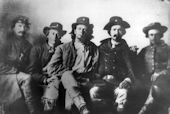
Tuesday, 7th—Marched on way to Liberty far enough to consume the day when we turned back in getting to Camp; had to go down and up a pretty steep mountain. The Yankees had possession of Liberty; drove Morgan’s men out. We came back to Ballou’s (Blues) and camped. Nothing for our horses to eat or ourselves.
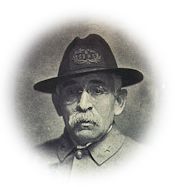
April 7—To-day the firing was very heavy. We hit the Yankee gunboat again to-day, and made the dust fly out of their breastworks.

April 7th. I have been quite sick, and am still too weak to write and sew much; so depressed in spirits that I find no diversion in anything. Within the last week the great Yazoo expedition has been abandoned; so also has the Port Hudson one. What Banks has done so far can not aid his infamous Government much. A few days ago the paroled prisoners in town received a notice to appear before a certain person at a given hour, or be fetched by the military. They obeyed the order, not knowing what was to become of them, whereupon they were locked up in the Custom House and sent off to be exchanged secretly, so that no crowd could collect and see them off. They left at night, and spite of secret movements, some knew of them and would at least appear upon the levee, though they dared make no demonstration in favor of the Confederate cause. One gentleman waved his hat to the departing boat and was immediately arrested. He proved to be a Scotchman, and nothing could be done to him. Ladies are constantly arrested for the color of the roses they wear on their bosoms and bonnets. Alas! for handkerchiefs bearing the Confederate flag! One of the paroled prisoners about to depart was presented with two roses by a lady—one red and the other white; he placed them in his button-hole, and the defiant exhibition caused his arrest and return. He was Lieutenant Musselman, and he was much disappointed at not being able to go with his companions beyond the lines. A flag of truce boat arrived here, but none of our people were allowed to put foot on the shore or to receive their friends on the boat. Mrs. Shute, who has been separated from her son for two years, went down to the levee to try to get a glimpse of him. She was denied the privilege of even standing on the shore and even getting a far-off glance at him. She went to each authority in town, begging the privilege of seeing him but for a moment or two on board the boat, but was refused.
There has never been such great and small tyrannies practised in the world before, I verily believe, as by those who now conduct the affairs of this city. A lady can not give a party in her own home without she receives a permit from some such creature as Captain Miller, or has her company broken in upon by the police. Such things make my blood boil, “Confederate blood,” the Era would say. Mrs. Wells was here yesterday; just received a letter from her daughter whom she sent outside the lines months ago. The officers tell her, Mattie Wells says, that everything is going on splendidly for us, and that our troubles will be over in May. Sarah Wells also writes that they all look cheerful, and are far from starvation. Matty Wells has been the victim of a physician’s blunder—he gave her poison, fortunately not in sufficient quantities to cause death, but she was perfectly blind for days. The mother is almost crazed about her two girls. She is here alone, her husband’s property having been seized here. He ran the blockade and went to Vera Cruz. Her relations at the North are very rich. She says she would go to them but fears her girls would not be happy there. They were born in the South, though they have until now passed much time in the North, and loved it. The horrors of this civil strife are too great to realize. I saw a day or two ago two sad-looking women on the street. “This is fulfilling the Scriptures,” said one; “the sons are fighting against the fathers, and the fathers against the sons.”
Mrs. Wilkinson has not yet gone out, having been put off from day to day by these miserable wretches here. Those who have taken the oath and are favorable to the Federal cause, can go out. The officers will positively deny that there is a schooner or any other opportunity for removal, when they know just as positively that people of their own stamp, who will swear to anything, are going often. The Wilkinsons have frequently summoned their friends for last goodbyes, having been promised immediate transit, but here they are still. The Wilkinson girls hurried Mary Ogden and Betty Neely in from Greenville day before yesterday, having been promised by General Sherman that they should go out the next day; the same gentleman told Mrs. Wells the very same day that they would not get off for weeks. They are sitting with their trunks packed and their daily interests are suspended, having been told that they might receive but an hour’s notice to depart. They treat Mrs. Wilkinson this way because her sons are in the army, her husband killed at Manassas, and because she will not take the oath. Mary Ogden was here yesterday, looking very badly and complaining. Lizzie and Jule look like roses; so also does Betty Neely. Mrs. Dameron, too, looks very healthy and very pretty. She is plump and clean-looking. She has been parted from the kindest and best of husbands for a whole year now. What a blessed thing good nerves are; ’tis a good thing, too, to lack that realizing sense of surrounding evils which eats out the very life principle when it once takes possession. It kills Ginnie and myself; we dwell on our misfortunes and those of others until the whole world seems Hope’s sepulcher.
Doctor Cartwright once said to Ginnie, “Oh, what a joyous little creature you were intended to be by Nature—how happy you might have been.” The old Doctor saw that no disease but that of the mind preyed upon her. He tried once to learn of me what it was that made her so unhappy, but finding that I could not confide, he desisted and wound up by telling me that we must go about more and be cheerful. We must marry, he said; but learning that it was quite impossible for us to love anyone, he said that it was not necessary for a woman to love before marriage, so that a man did. “Every woman,” said he, “will love the man who is kind to her.” Heavens, what a theory! The Doctor is a theorist, I know, but I am glad that he has not the power to practice upon his patients after this style. He was horrified when I told him that if I married a person without love that I should hate him afterward and myself, too. Dr. C—— realizes more fully than any man I ever knew the word “philosopher,” but no man knows how to philosophize about a woman—there are pages in her heart-history which the wisest of them can never read.
Many friends have been to see us. Ginnie looks so tired and ill; she is constantly telling me that I look so; indeed, our great anxiety about each other does us much harm. To meet her sad, pale face in the mornings is sometimes as much as I can bear. We two have grown to love each other very tenderly. People laugh and say that they think of us as one person. Our most angry words with one another are in the other’s behalf. Indeed, I am often worried over Ginnie when she refuses to eat some little delicacy, which these hard times have made scarce, because I won’t take it, too. It is very common for us to say to each other, “I will not touch one mouthful unless you do, too.” This seems a silly way to act, and sillier to record, but even in small matters we think the most of the other’s comfort than our own; to save the other little labors more than repays for taking them to ourselves. I know that if I were to die Ginnie could not be comforted, and should I lose her, I am finished forever. Were there no death or suffering in the world such love would be a source of infinite sweetness, but as it is, there is fear in every heart-throb.
The time passes; we hear no word from those that are near and dear. If letters have been sent, they have failed to reach us in these sad times. My sisters, my poor maimed brother, can it be that we are never, never to meet any more? It seems so. We may die in this Yankee-beset town and have no kindred to close our eyes! I sometimes wonder if they are not very anxious about us; but they know that we have friends here, and may not remember us as we remember them. Indeed, I would not wish them to know how we suffer, knowing that they can not reach us with help. Whenever I have been able to send off a few lines to them, I have said that we are well and safe. God forgive the untruth, but I hope some of my words have reached them. We are as well as sleepless nights and headaches from anxiety can leave us, and we have some friends, and many who say they are friends—one whom I would trust as a brother and one to whom I would not fear to open my heart as to a sister. I shall never forget Mr. Randolph and Mrs. Waugh. Simple-hearted, honest, true and kind, wiser and more spirited than those who pretend to more.

by John Beauchamp Jones
APRIL 7TH. —Nothing definite has transpired at Charleston, or if so, we have not received information of it yet.
From the West, we have accounts, from Northern papers, of the failure of the Yankee Yazoo expedition. That must have its effect.
Judge Campbell, Assistant Secretary of War, has decided in one instance (page 125, E. B. Conscript Bureau), that a paroled political prisoner, returning to the South, is not subject to conscription. This is in violation of an act of Congress, and general orders. It appears that grave judges are not all inflexibly just, and immaculately legal in their decisions. Col. Lay ordered the commandant of conscripts (Col. Shields) to give the man a protection, without any reason therefor.
It is now said large depots of provisions are being formed on the Rappahannock. This does not look like an indication of a retrograde movement on the part of Gen. Lee. Perhaps he will advance.
This afternoon dispatches were received from Charleston. Notwithstanding all the rumors relative to the hostile fleet being elsewhere, it is now certain that all the monitors, iron-clads, and transports have succeeded in passing the bar, and at the last accounts were in readiness to begin the attack. And Beauregard was prepared to receive it. To-morrow we shall have exciting intelligence. If we are to believe what we hear from South Carolinians, recently from Charleston (I do believe it), Charleston will not be taken. If the ground be taken, it will not be Charleston. If the forts fall, and our two rams be taken or destroyed, the defenders will still resist. Rifle-pits have been dug in the streets; and if driven from these, there are batteries beyond to sweep the streets, thus involving the enemy and the city in one common ruin.
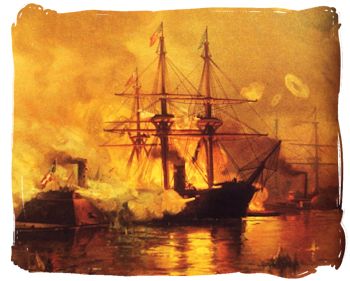
April 7.—Fort Sumter, in Charleston harbor, S. C., was this day attacked by a fleet of ironclad monitors and gunboats, under the command of Admiral Du Pont; but after a terrific bombardment of two hours’ duration, they withdrew from the contest discomfited.—(Doc. 158.)
—The United States gunboat Barataria was lost while making a reconnoissance in Amite River, La.—A successful expedition into Gloucester County, Va., to capture and destroy cattle and grain belonging to the rebels, was made by Colonel A. H. Grimshaw, of the Fourth Delaware infantry. He succeeded in destroying over ten thousand dollars’ worth of property that had been collected for the use of the rebels, and in capturing over three hundred cattle, sheep, etc.—Philadelphia Inquirer.

The great fight at Charleston S.C. April, 7th 1863: between 9 United States “Iron-Clads,” under the command of Admiral DuPont; and Forts Sumter, Moultrie, and the Cummings Point Batteries in possession of the Rebels. The Iron-Clads carried only 32 guns, while the Rebel Forts mounted over 300 of the heaviest calibre, but notwithstanding the great odds, the little Iron-clads went bravely into the fight, and for nearly two hours were under the most terrible fire ever witnessed on this earth, but being unable to reach Charleston on account of obstructions in the harbor, the Admiral reluctantly gave the order for the battle to cease, and the fleet to retire from the unequal contest. – The Keokuk was the only Iron-clad disabled in the fight.
Currier & Ives.
Library of Congress image.
___________
Fight at Charleston products from Exit78 at zazzle.com
April 7. —We all started out this morning, except Perkins, to see the review, by the President, of the army. On arriving at headquarters, we found that the review was postponed on account of the mud. Day pleasant.
April 6th. At four thirty A. M., weighed anchor and steamed down the river, arriving off Bayou Sara, which is about forty-eight miles below the mouth of Red River. Came to anchor and sent two boats on shore in charge of officers, the crews of which were armed, for the purpose of destroying some ten thousand bushels of corn meal and sweet potatoes found piled upon the levee, which had been transported by rebel steamers down the river, and landed there for transportation to the Confederate army at Port Hudson, as we afterwards learned from conversation with the inhabitants of this village, who flocked around us while we were employed making way with it. Every bag, except what we thought proper to take on board the ship for the officers’ and men’s consumption, was thrown into the muddy Mississippi. The villagers thought it hard to destroy this property in this manner, since they had to pay so high for it; but we, not wishing to have it reach the enemy, could not see it in this light. Before finishing this, let me remark that Bayou Sara was once a very handsome spot, but last year guerillas invested it and fired upon our transports, and the iron-clad Essex opened upon the place and laid it in ruins. A few frame buildings and the walls of some brick ones only remain to tell its fate. The remains of these buildings look to the observer like the ruins of some ancient castles in the old world, and the artist might here find a good subject for his pencil and canvas.
At one thirty P. M. got under way again, continuing on our trip down the river until within five miles of Port Hudson, when we turned around and came to anchor. From our anchorage the rebel batteries at Port Hudson, are visible to the eye, and many an officer and blue jacket has remarked that he cannot conceive how we ever stood the concentrated fire of and passed those batteries with so little loss of life and injury to ship, on the night of ever-memorable 14th of March last.


