Following the American Civil War Sesquicentennial with day by day writings of the time, currently 1863.

April 2013

by John Beauchamp Jones

APRIL 2D.—This morning early a few hundred women and boys met as by concert in the Capitol Square, saying they were hungry, and must have food. The number continued to swell until there were more than a thousand. But few men were among them, and these were mostly foreign residents, with exemptions in their pockets. About nine A.M. the mob emerged from the western gates of the square, and proceeded down Ninth Street, passing the War Department, and crossing Main Street, increasing in magnitude at every step, but preserving silence and (so far) good order. Not knowing the meaning of such a procession, I asked a pale boy where they were going. A young woman, seemingly emaciated, but yet with a smile, answered that they were going to find something to eat, I could not, for the life of me, refrain from expressing the hope that they might be successful; and I remarked they were going in the right direction to find plenty in the hands of the extortioners. I did not follow, to see what they did; but I learned an hour after that they marched through Cary Street, and entered diverse stores of the speculators, which they proceeded to empty of their contents. They impressed all the carts and drays in the street, which were speedily laden with meal, flour, shoes, etc. I did not learn whither these were driven; but probably they were rescued from those in charge of them. Nevertheless, an immense amount of provisions, and other articles, were borne by the mob, which continued to increase in numbers. An eye-witness says he saw a boy come out of a store with a hat full of money (notes); and I learned that when the mob turned up into Main Street, when all the shops were by this time closed, they broke in the plate-glass windows, demanding silks, jewelry, etc. Here they were incited to pillage valuables, not necessary for subsistence, by the class of residents (aliens) exempted from military duty by Judge Campbell, Assistant Secretary of War, in contravention of Judge Meredith’s decision. Thus the work of spoliation went on, until the military appeared upon the scene, summoned by Gov. Letcher, whose term of service is near its close. He had the Riot Act read (by the mayor), and then threatened to fire on the mob. He gave them five minutes’ time to disperse in, threatening to use military force (the city battalion being present) if they did not comply with the demand. The timid women fell back, and a pause was put to the devastation, [click to continue…]
April 2.—At Richmond, Va., a riot occurred in which a large number of women were engaged. They broke open the rebel government stores, and took bread, clothing, and such other materials as they desired, when the militia were ordered out to suppress their proceedings.— (Doc. 163.)

—Eight regiments of General Crufts’s and Hazen’s brigades, of General Palmer’s division, made an effort to capture a rebel brigade stationed at Woodbury, Tenn. Last night at ten o’clock the party, accompanied by a body of Ohio cavalry, left Murfreesboro. General Hazen made a detour of fifteen miles, expecting to begin the attack at daylight this morning. Crufts’s brigade went direct. During the night the rebel pickets extended their lines, so that the advance began skirmishing before General Hazen had posted his troops, and in consequence the rebels escaped, the National cavalry keeping up a running fight for three miles, and capturing thirty of the rebels, besides killing and wounding twelve of their number. Corporal Jacob R. Shaveles, of company E, Third Ohio, was the only one wounded on the National side. “He acted very gallantly, charging a squad of rebels single-handed, and sabreing half a dozen before being shot.”—Cincinnati Gazette.

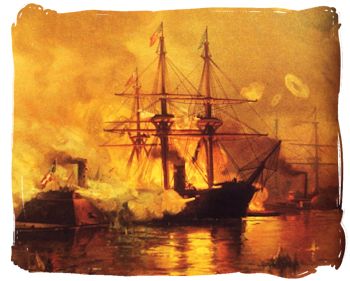
—At daylight this morning, Admiral Farragut, with the National squadron, left Grand Gulf, Miss., and proceeded to the mouth of Red River, destroying on the way a large number of rebel skiffs and flatboats. He arrived at the Red River at sundown.—Secretary Gabandau’s Report.

—Major W. C. Ransom, of the Sixth Kansas cavalry, destroyed the band of rebel guerrillas under Colonel Hicks, in Jackson County, Mo., killing seventeen and hanging two who were engaged in the robbery of the steamer Sam Gaty. He also recovered a portion of the contrabands captured from that steamer, besides taking twenty-one of the guerrillas’ horses, and their camps, with all their equipage, ammunition, etc.—General Curtis’s Despatch.

—As the National gunboat St. Clair was passing Palmyra, twenty-four miles above Fort Donelson, on the Cumberland River, she was fired into by a section of King’s rebel Missouri battery, belonging to the army under General Van Dorn. The third shot struck the supply-pipe of the steamer, rendering her unmanageable, and wounding two of her crew. She was taken in tow by the steamer Luminous, and carried to Cairo, Ill.—General Wright, in command of the National forces in California, issued a proclamation which concluded as follows: “Although the great mass of people on the Pacific coast are eminently patriotic and devoted to the Union, yet, fellow-citizens, we must not disguise the fact that we have traitors in our midst, who are doing all in their power to involve this country in the horrors of civil war; to such persons, I say, pause and reflect well before plunging into the yawning abyss of treason. An indignant people will rise in their majesty, and swift retributive justice will be their certain doom.”

—General Stanley, with two thousand cavalry, and an infantry brigade under Colonel Mathews, left Murfreesboro, on an expedition to capture Morgan’s and Wharton’s rebel regiments of infantry and cavalry at Snow Hill, Tenn. Beyond Auburn they drove in the rebel pickets, the Seventh Pennsylvania cavalry turning the rebel right while Minty’s cavalry, with a battery under Captain Newell, moved up in front. The rebels fled, but were again encountered at Smith’s Ford and on Dry Fork, from both of which places they were driven with some loss. Finally they formed a third line on Snow Hill, when the Second and Fourth Ohio cavalry sent to their rear, succeeded in breaking their line and putting them to flight, with a loss of fifty killed and wounded, and sixty taken prisoners. The Union loss was one private of the Seventh Pennsylvania cavalry killed, and two slightly wounded. Three hundred horses were captured by General Stanley, and carried into Murfreesboro.—General Rosecrans’s Despatch.

April 1st. This morning at five o’clock, William Jones, seaman, who was wounded during the action at Grand Gulf last night, departed this life. At six A. M. weighed and started on down the river; at eleven-fifteen A. M. passed Natchez; at two-thirty P. M. came in sight of Ellis’s Cliffs, beat to general quarters; it was expected we would meet with some opposition, but nothing of a hostile nature occurred; at five P. M. came in sight of Port Adams, beat to quarters as usual, but met with no opposition; both of the above places are most excellent situations for batteries; at six-thirty P. M. arrived at the mouth of Red River; here we brought our fleet to anchor for the night. It will be remembered that our fleet at present consists of three vessels, namely: the Hartford, gunboat Albatross, and ram Switzerland: whereas at one time we could muster about thirty-seven or eight, including the mortar vessels. The contrast is quite impressive to those who are personally interested in the welfare of things on the Mississippi.

Camp White, April 1, 1863.

Dearest: — We are again in communication with America after being cut off about four or five days by General Jenkins. He attacked two posts garrisoned by [the] Thirteenth Virginia — and one had Lieutenant Hicks, the color sergeant and six men of Twenty-third. In both cases General Jenkins was badly worsted losing seventy men killed or captured, while we lost only four killed and five wounded. A sorry raid so far.

Judge Matthews, I see, is to be superior court judge. I suppose his health is the cause. He had a difficulty before he left the Twenty-third which at times unfitted him for service in the field.

Awful weather for tent life the last week — snow, rain, and wind “all to once.” I am really glad you left when you did. A few weeks hence if Jenkins lets us alone we shall be in condition to enjoy your presence.

Love to the dear boys. Webb will, I am sure, study hard when he hears how much I want him to be a scholar. Birch and the others are right of course.

The Prince’s [Prince of Wales] wedding you read, I know. No happier than ours!

Affectionately,

R.

Mrs. Hayes.

Camp White, April 1, 1863.

Dear Uncle: — We have had most disagreeable weather for a week. Part of the time we were cut off from outside world by General Jenkins’ raid below. He has thus far made nothing. He has attacked two of the posts garrisoned by men under my command and been whipped both times with a loss to him of seventy killed and prisoners. Our loss is six. We could take the whole party with cavalry enough. As it is, he will get off.

All fools’ day is a bright cold windy day. We are in tents rather too early for comfort or health. We are glad to see warm weather coming.

Sincerely,

R. B. Hayes.

S. BIRCHARD.

April 1st.—Had fine sport to-day, gigging fish. Whole farms are submerged around Warrenton, three to four feet deep; before they were flooded, they had grown up very thickly in weeds, which now reached above the water. We made two rafts, fastened our bayonets to the large end of long canes. Pushing the rafts through the weeds, when a fish moved it would shake the weeds, and then was our chance to gig him. Our squad got two very fine ones, when the river and wind rose so high we had to quit.

April 1.—William York died yesterday; he was from Williamson County, Tennessee.

A few days ago we had a man die, by the name of George Speaker; he was one of John Morgan’s squadron. He died from a wound received at Shelbyville, in this state. His captain (Goldston) was with him, and had him buried with full honors.

1st. After breakfast and morning work, issued rations. Then cleaned up nicely. Practiced my horse some at jumping. Is learning nicely. Read some in Gail Hamilton and “Les Miserables.” In the evening attended class at Co. H and wrote to Fred Allen.

Mrs. Lyon’s Diary.

April 1, 1863.—We all went on an excursion on the Nevada, up to the rolling mills, a beautiful spot. We got some interesting specimens of slag. Colonel Lowe accompanied us. We had a very pleasant trip.

On the Yazoo, Wednesday, April 1. Made good headway today with but little stoppage. 12 M. landed to take on those left behind and some forage left by the fleet, which had left about two hours before. Buried the corpse and started on. Passed some beautiful plantations with plenty of hogs and cattle, which naturally made our mouths water. Passed the “Pike” at sundown, in a sinking condition. Foraging parties brought in fresh meat in plenty. After tying up, cannonading heard at night. Had a slight attack of ague.