Following the American Civil War Sesquicentennial with day by day writings of the time, currently 1863.

April 2013

On the Yazoo, Thursday, April 2. Very fine. Good country and fine sailing. 12 M. a miscreant fired into the boat and wounded a member of the 93rd severely, the ball entering his left breast. The boat rounded to and tied up, and in an instant the whole regiment was in confusion, running for their arms, etc., etc. Skirmishers were sent out, while Colonel Putnam went with a force in a yawl in search, but returned in an hour; failed to find him, but brought along the man of the house that harbored him as prisoner, after reducing his house to ashes. Nearly all the boats were fired into in a similar manner.

5 P. M. came up to the boats and tied up for the night, staging run out and the horses taken off and exercised. It was at a large plantation of several hundred acres. I rode the Lieutenant’s horse. Foraging parties out in all directions, and chickens, hogs, beef, onions etc. poured in. Several negro villages were set on fire, also the cotton gins, corn-cribs, within reach. The whole air was bright at night with the fire.

Near Richmond, Monday, April 27. Started out at 6 A. M. went about twenty rods, when General Logan rode up and by some means induced the officer to turn back; we unharnessed and turned our horses out to grass. Heavy rain came up and continued. Very disagreeable all day. No shelter. The day seemed very, very long, but night at last came to relieve us, and we went to bed in negro shanties.

Thursday, 2d—Weather warm and pleasant. No news.

Thursday, 2nd—Went out beyond Maj. Winn’s, brought his family and negroes out, skirmished with the Yankees for some time, nothing serious.

2d April. — The Texan and I left the Immortalité in her cutter, at 10 A.M., and crossed the bar in fine style. The cutter was steered by Mr Johnston, the master, and having a fair wind, we passed in like a flash of lightning, and landed at the miserable village of Bagdad, on the Mexican bank of the Rio Grande.

The bar was luckily in capital order—3½ feet of water, and smooth. It is often impassable for ten or twelve days together: the depth of water varying from 2 to 5 feet. It is very dangerous, from the heavy surf and under-current; sharks also abound. Boats are frequently capsized in crossing it, and the Orlando lost a man on it about a month ago.

Seventy vessels are constantly at anchor outside the bar; their cotton cargoes being brought to them, with very great delays, by two small steamers from Bagdad. These steamers draw only 3 feet of water, and realise an enormous profit.

Bagdad consists of a few miserable wooden shanties, which have sprung into existence since the war began. For an immense distance endless bales of cotton are to be seen.

Immediately we landed, McCarthy was greeted by his brother merchants. He introduced me to Mr Ituria, a Mexican, who promised to take me in his buggy to Brownsville, on the Texan bank of the river opposite Matamoros. McCarthy was to follow in the evening to Matamoros.

The Rio Grande is very tortuous and shallow; the distance by river to Matamoros is sixty-five miles, and it is navigated by steamers, which sometimes perform the trip in twelve hours, but more often take twenty-four, so constantly do they get aground.

The distance from Bagdad to Matamoros by land is thirty-five miles; on the Texan side to Brownsville, twenty-six miles.

I crossed the river from Bagdad with Mr Ituria, at 11 o’clock; and as I had no pass, I was taken before half-a-dozen Confederate officers, who were seated round a fire contemplating a tin of potatoes. These officers belonged to Duff’s cavalry (Duff being my Texan’s partner). Their dress consisted simply of flannel shirts, very ancient trousers, jack-boots with enormous spurs, and black felt hats, ornamented with the “lone star of Texas.” They looked rough and dirty, but were extremely civil to me.

The captain was rather a boaster, and kept on remarking, “We’ve given ’em h—ll on the Mississippi, h—ll on the Sabine” (pronounced Sabeen), “and h—ll in various other places.”

He explained to me that he couldn’t cross the river to see McCarthy, as he with some of his men had made a raid over there three weeks ago, and carried away some “renegadoes,” one of whom, named Mongomery, they had left on the road to Brownsville; by the smiles of the other officers I could easily guess that something very disagreeable must have happened to Mongomery. He introduced me to a skipper who had just run his schooner, laden with cotton, from Galveston, and who was much elated in consequence. The cotton had cost 6 cents a pound in Galveston, and is worth 36 here.

Mr Ituria and I left for Brownsville at noon. A buggy is a light gig on four high wheels.

The road is a natural one—the country quite flat, and much covered with mosquite trees, very like pepper trees. Every person we met carried a six-shooter, although it is very seldom necessary to use them.

After we had proceeded about nine miles we met General Bee, who commands the troops at Brownsville. He was travelling to Boca del Rio in an ambulance,[1] with his Quartermaster-General, Major Russell. I gave him my letter of introduction to General Magruder, and told him who I was.

He thereupon descended from his ambulance and regaled me with beef and beer in the open. He is brother to the General Bee who was killed at Manassas. We talked politics and fraternised very amicably for more than an hour. He said the Mongomery affair was against his sanction, and he was sorry for it. He said that Davis, another renegado, would also have been put to death, had it not been for the intercession of his wife. General Bee had restored Davis to the Mexicans.

Half an hour after parting company with General Bee, we came to the spot where Mongomery had been left; and sure enough, about two hundred yards to the left of the road, we found him.

He had been slightly buried, but his head and arms were above the ground, his arms tied together, the rope still round his neck, but part of it still dangling from quite a small mosquite tree. Dogs or wolves had probably scraped the earth from the body, and there was no flesh on the bones. I obtained this my first experience of Lynch law within three hours of landing in America.

I understand that this Mongomery was a man of very bad character, and that, confiding in the neutrality of the Mexican soil, he was in the habit of calling the Confederates all sorts of insulting epithets from the Bagdad bank of the river; and a party of his “renegadoes” had also crossed over and killed some unarmed cotton teamsters, which had roused the fury of the Confederates.

About three miles beyond this we came to Colonel Duff’s encampment. He is a fine-looking, handsome Scotchman, and received me with much hospitality. His regiment consisted of newly-raised volunteers— a very fine body of young men, who were drilling in squads. They were dressed in every variety of costume, many of them without coats, but all wore the high black felt hat. Notwithstanding the peculiarity of their attire, there was nothing ridiculous or contemptible in the appearance of these men, who all looked thoroughly like “business.” Colonel Duff told me that many of the privates owned vast tracts of country, with above a hundred slaves, and were extremely well off. They were all most civil to me.

Their horses were rather rawboned animals, but hardy and fast. The saddles they used were nearly like the Mexican.

Colonel Duff confessed that the Mongomery affair was wrong, but he added that his boys “meant well.”

We reached Brownsville at 5.30 P.M., and Mr Ituria kindly insisted on my sleeping at his house, instead of going to the crowded hotel.


[1] * An ambulance is a light waggon, and generally has two springs behind, and one transverse one in front. The seats can be so arranged that two or even three persons may lie at full length.
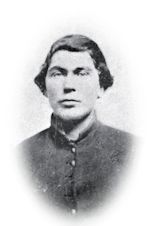

April 2—Our regiment was sent on picket this morning at daylight—one mile from camp and two miles from the enemy. Companies B and G are on the left, A and D on the right, F and I in the center. We are within hailing distance of the Yankee line of pickets. There is not much firing. Tom Tiotter and I are on the color guard. We have nothing to do if we don’t want to, except stay with the colors. So this evening at 4 o’clock we went as near the Yankees as we dared, to see the town of Washington. Saw the place, their breastworks and their camps very plainly. We then returned and slept on our arms all night— that is, we tried to sleep, but could not for the infernal noise from the owls that are in the swamps around us.

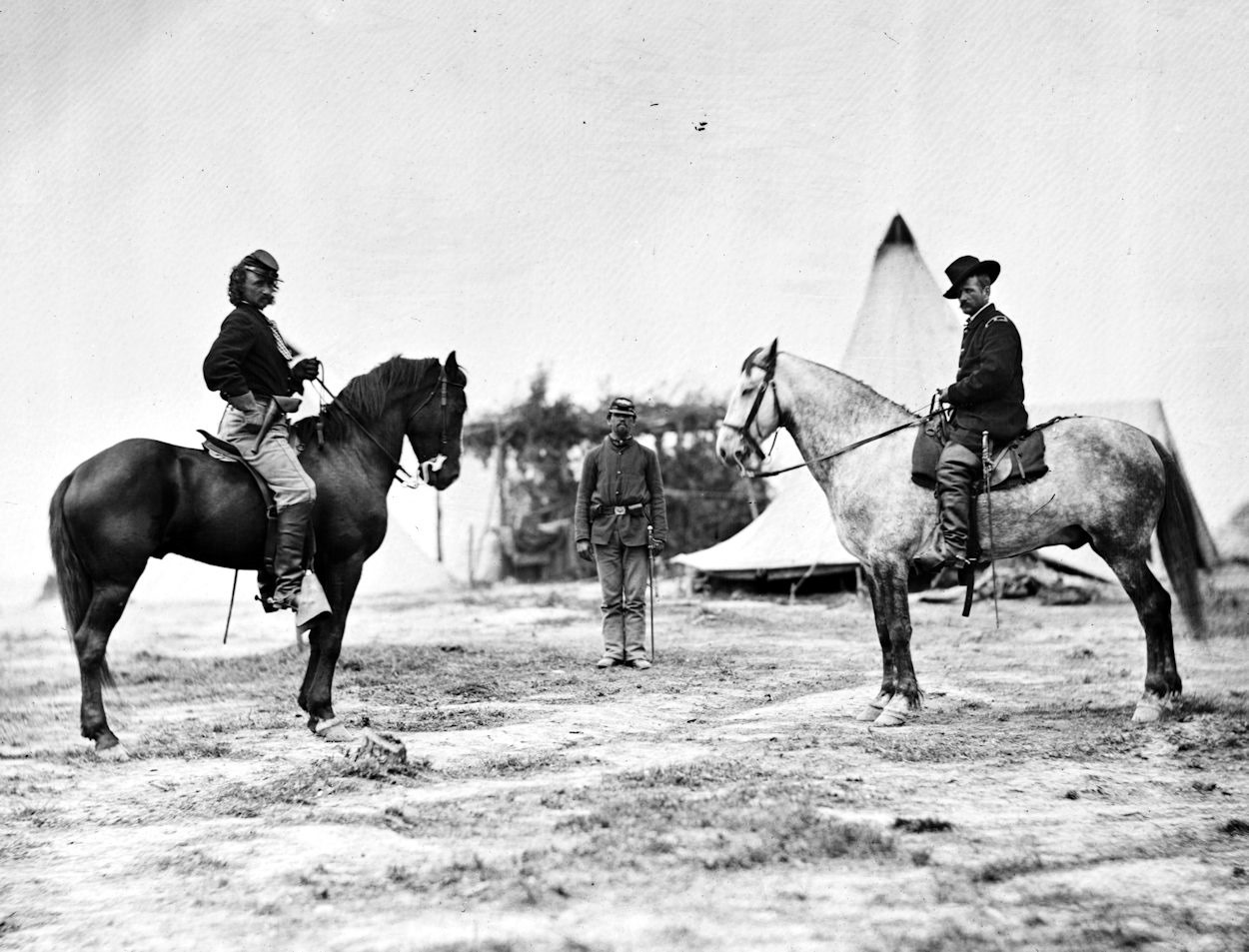
Falmouth, Va. Capt. George A. Custer and Gen. Alfred Pleasonton on horseback


Falmouth, Va. Capt. George A. Custer and Gen. Alfred Pleasonton on horseback; photo by Timothy H. O’Sullivan; April 1863. | Library of Congress image.

________

Custer and Pleasonton products from Exit78 at zazzle.com.

April 2d.—We were shocked when the gentlemen returned, to hear of the riot which occurred in Richmond today. A mob, principally, of women, appeared in the streets, attacking the stores. Their object seemed to be to get any thing they could; dry-goods, shoes, brooms, meat, glassware, jewelry, were caught up by them. The military was called out—the Governor dispersed them from one part of the town, telling them that unless they disappeared in five minutes, the soldiers should fire among them. This he said, holding his watch in his hand. Mr. Munford, the President of the Young Men’s Christian Association, quieted them on another street by inviting them to come to the rooms of the Association, and their wants should be supplied; many followed him—I suppose those who were really in want. Others there were, of the very worst class of women, and a great many who were not in want at all, which they proved by only supplying themselves with jewelry and other finery. The President was out speaking to them, and trying to secure order. The Mayor made them a speech, and seemed to influence them, but I dare say that the bayonets of the soldiers produced the most decided effect. It is the first time that such a thing has ever darkened the annals of Richmond. God grant it may be the last. I fear that the poor suffer very much; meal was selling to-day at $16 per bushel. It has been bought up by speculators. Oh that these hard-hearted creatures could be made to suffer! Strange that men with human hearts can, in these dreadful times, thus grind the poor.

April 2d, 1863.—We have had to move, and have thus lost our cave. The owner of the house suddenly returned and notified us that he intended to bring his family back; didn’t think there’d be any siege. The cost of the cave could go for the rent. That means he has got tired of the Confederacy and means to stay here and thus get out of it. This house was the only one to be had. It was built by ex-Senator G., and is so large our tiny household is lost in it. We only use the lower floor. The bell is often rung by persons who take it for a hotel and come beseeching food at any price. To-day one came who would not be denied. “We do not keep a hotel, but would willingly feed hungry soldiers if we had the food.” “I have been traveling all night and am starving; will pay any price for just bread.” I went to the dining-room and found some biscuits, and set out two, with a large piece of corn-bread, a small piece of bacon, some nice sirup, and a pitcher of water. I locked the door of the safe and left him to enjoy his lunch. After he left I found he had broken open the safe and taken the remaining biscuits.

______

Note: To protect Mrs. Miller’s job as a teacher in New Orleans, the diary was published anonymously, edited by G. W. Cable, names were changed and initials were often used instead of full names — and even the initials differed from the real person’s initials.


April 2. — Channing Clapp came over from camp, and we went over to General Sedgwick’s together. As we found no one in there, we went to General Devens’s[1] where we saw the general, Colonel Eustis, and Lieutenant Davis of the 1st Massachusetts Cavalry. I sent the general’s letter asking for Clapp, to General Williams, and also a communication asking to have him detailed as acting assistant adjutant-general until his regular appointment arrived. Saw General W. personally about it. Weather pleasant, but very windy in the evening.


[1] General Charles Devens, afterwards Justice of the Massachusetts Supreme Court, and Attorney-General of the U. S. under President Hayes.