23rd. Drew rations for the 7th Ohio. Got rations over for the remainder of the month. Potatoes and beans. Thede went out a mile or so with the horses and came back used up. Looks miserable. Eyes glaring and face emaciated. Made me frightened. Had the doctor look at him. Gave some rhubarb, uneasy during the night, cramps. Slept with him. Wrote to Fannie.
May 2013
MAY 23D.—Our regiment lay in the rifle pits to-day, watching the enemy. For hours we were unable to see the motion of a man or beast on their side, all was so exceedingly quiet throughout the day. After dark we were relieved, and as we returned to the camp the enemy got range of us, and for a few minutes their bullets flew about us quite freely. However, we bent our heads as low as we could and double-quicked to quarters. One shot flew very close to my head, and I could distinctly recognize the familiar zip and whiz of quite a number of others at a safer distance. The rebels seemed to fire without any definite direction. If our sharpshooters were not on the alert, the rebels could peep over their works and take good aim; but as they were so closely watched they had to be content with random shooting.
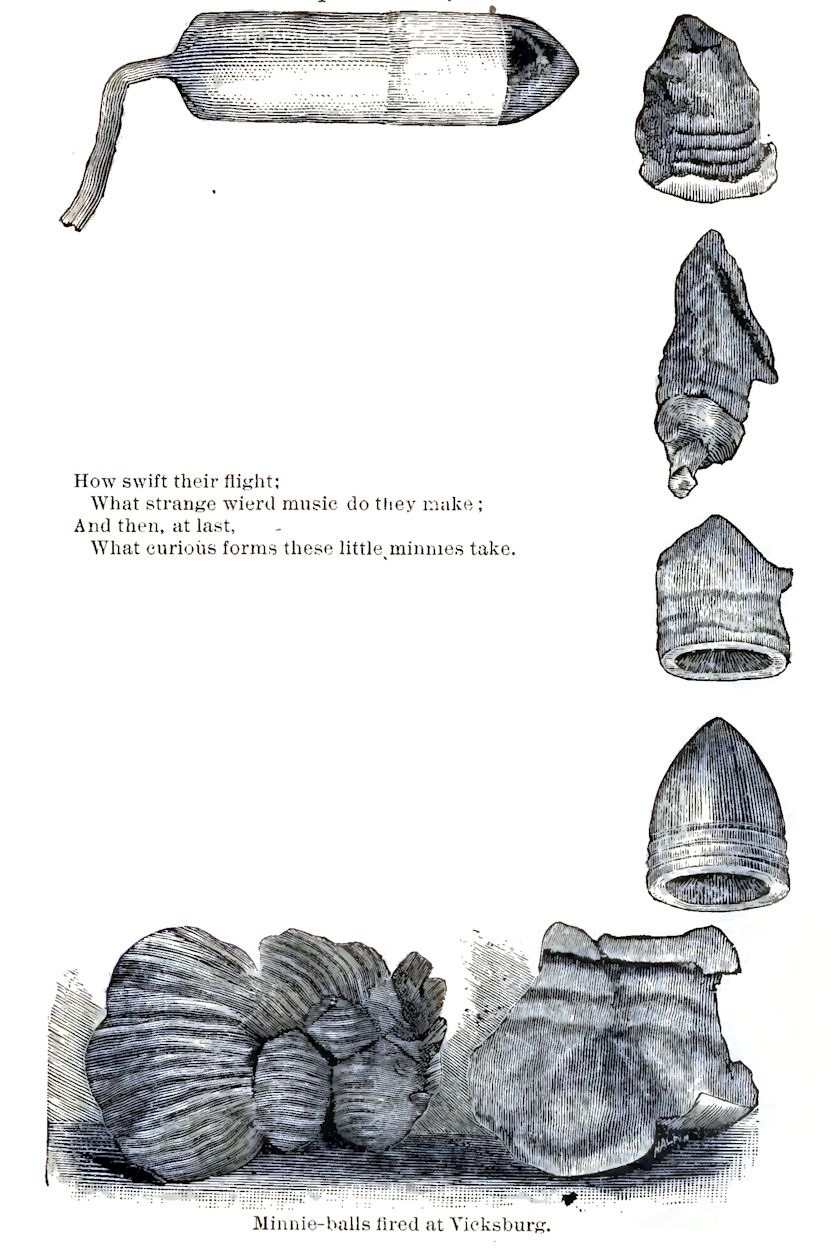 If this siege is to last a month there will be a whole army of trained sharpshooters, for the practice we are getting is making us skilled marksmen. I have gathered quite a collection of balls, which I mean to send home as relics of the siege. They are in a variety of shapes, and were a thousand brought together there could not be found two alike. I have picked up some that fell at my feet—others were taken from trees. I am the only known collector of such souvenirs, and have many odd and rare specimens. Rebel bullets are very common about here now—too much so to be valuable; and as a general thing the boys are quite willing to let them lie where they drop. I think, however, should I survive, I would like to look at them again in after years.
Shovel and pick are more in use to-day, which seems to be a sign that digging is to take the place of charging at the enemy. We think Grant’s head is level, anyhow. The weather is getting hotter, and I fear sickness; and water is growing scarce, which is very annoying. If we can but keep well, the future has no fears for us.
Saturday, 23rd—Went down to Finche’s and got a horse. Mr. Finch came out with us some distance. Came back to Norris; staid all night; nothing to eat.
May 23—Marched fifteen miles and halted. On our to-day’s march we saw any amount of dead horses, which did not smell altogether like cologne.
Before Vicksburg, Saturday, May 23. 8 A. M. We are lying in the road as yesterday, but little fighting yet except with artillery. Rumor says that pioneers are undermining the forts to blow them up. A gentle shower has fallen which has lightened the air and settled the dust, “God-sent” for the poor wounded, of which there are a great many. While writing, the ambulance is waiting for the remains of Colonel Dollins of the 81st Illinois and Colonel Boomer, commander of the 3rd Brigade, both of whom fell yesterday, gallant officers and accomplished gentlemen. 12 M. Cannoneers ordered to the front with entrenching tools, and in an hour the pieces followed into a secreted position on the brow of a steep and rugged hill. A stockade dug for the pieces, into which they were drawn by hand. Limbers put under cover of the hill, and the horses unhitched and tied to the trees. The guns commanded the right. A slow fire was opened which was kept up till dark, of shell and shrapnel, mostly to keep the rebel sharp-shooters back. Drew rations of coffee, ham and hard bread which gave us a supper of good cheer and light hearts.
Fixed our beds under the brow of the hill just out of reach of the little deadly missiles that went whistling over our heads every once in a while in volleys. But we were in unusually good spirits, cracking jokes ‘neath the bright silver moon. No sooner had we begun to travel in the “land of Nod”, when the 3rd Platoon was ordered to turn out, quick and still, hitch up and pull out. It is expected that the rebs will try to cut their way out to-night and we want to be ready. In fifteen minutes we were on the road, moving back toward our old place; unhitched and lay down again with orders to be ready at half past three A. M. Thus we ended another day before Vicksburg.
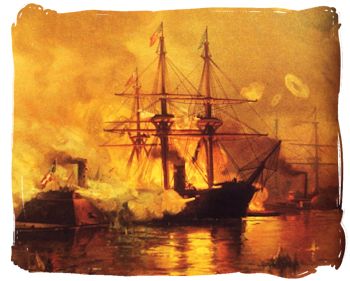
May 23d. Commences with pleasant weather. Two steamers came down the river about two o’clock this A. M., at three o’clock this morning, the mortar schooners below, opened a heavy fire on the batteries at Port Hudson. Between the hours of four and eight A. M. a steamer loaded with cavalry went alongside of the landing; at twelve noon, the Arizona went down the river, iron-clads went up the river. From eight to midnight, heavy firing heard at Port Hudson.
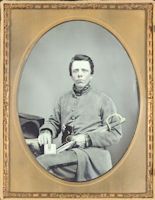
W. R. Clack Private of Co. B. 43 Regt. Tenn. Vols — Aged 24 years 3 mo. and 19 days This May 23, 1863 Yesterday the enemy attempted to charge our breastwork but were repulsed with great slaughter sharp shooters firing this morning -sharp shooting and heavy cannonading continued all day.
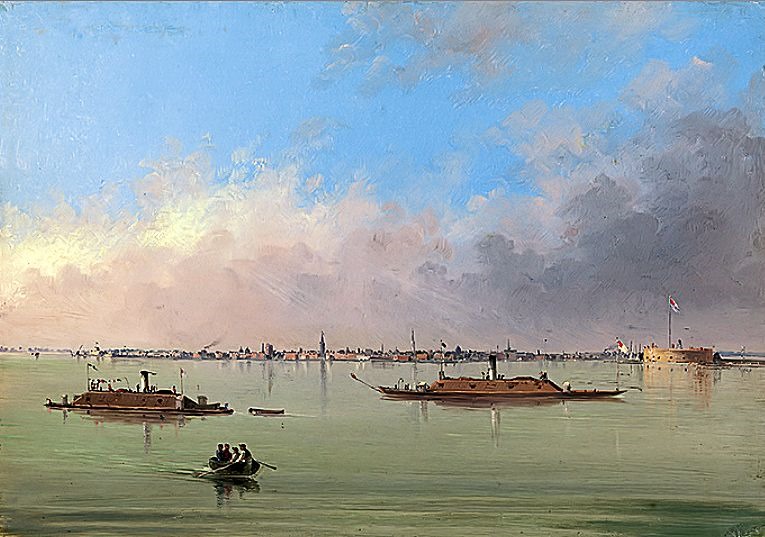
Painting by Conrad Wise Chapman.
“Shows the whole of Charleston and Castle Pinckney; here can also be seen what used to be called the ‘Ladies Gun Boat’,’ because it was constructed from proceeds raised by the ladies of Charleston by the sale of their jewels.” – Conrad Wise Chapman, 1898.
________
Note: The vessels shown are CSS Chicora and CSS Palmetto State.
MAY 23D.—The reports from Mississippi have not been confirmed by official dispatches, and it is understood that the President remarked yesterday, at dinner, that he was satisfied with the condition of affairs in that State. If this be so, Vicksburg must not only be still in our possession, but likely to be held by us at the end of this campaign. The President, I know, feels a peculiar interest in that State, and I learn by a letter from Tennessee, that on the 9th inst. troops left McMinnville for the rescue of Vicksburg—a Texas brigade.
Cavalry continue to pass through this city from the south, while infantry are passing to the south. These movements will puzzle the spies, who are daily, and without difficulty, obtaining passports to leave the Confederate States.
We have Northern papers to-day, containing Gen. Hooker’s grandiloquent address to his army, a few days after his flight. I preserve it here for the inspection of the future generation, and to deter other generals from the bad policy of publishing false statements.
“[Copy.]
“HEADQUARTERS ARMY OF THE POTOMAC,
“May 6th, 1863.
“GENERAL ORDERS No 49.
“The Major-General commanding tenders to this army his congratulations on its achievements of the last seven days. If it has not accomplished all that was expected, the reasons are well known to the army. It is sufficient to say they were of a character not to be foreseen or prevented by human sagacity or resources. In withdrawing from the south bank of the Rappahannock, before delivering a general battle to our adversaries, the army has given renewed evidence of its confidence in itself, and its fidelity to the principles it represents.
“In fighting at a disadvantage we would have been recreant to our trust, to ourselves, our cause, and our country. Profoundly loyal and conscious of its strength, the Army of the Potomac will give or decline battle whenever its interest [click to continue…]
May 23. —The following petition was circulated in Columbus and other portions of Ohio: “The undersigned, citizens of Franklin County, respectfully represent that the most sacred rights of citizens are guaranteed by the Constitution of our fathers. It has been violated in the arbitrary arrest, illegal trial, and inhuman imprisonment of Hon. C. L. Vallandigham. We therefore demand of the President of the United States his immediate and unconditional release.”
—The rebel sloop Fashion, having on board fifty bales of cotton, was captured by a boat expedition from the National steamer Port Royal, at a point forty-five miles above Apalachicola, Fla.—Acting Master Van Slyck’s Report.


