Following the American Civil War Sesquicentennial with day by day writings of the time, currently 1863.

May 2013

MAY 29TH.—”The early bird catches the worm.” We tried the truth of that adage this morning, but failed to make the catch. A few graybacks were seen afar off, but we failed to get within range of them. Where, O where, is General Johnston and the grand army he was to bring against us ? We have looked for him in vain. I have the utmost confidence in Grant’s judgment and the prestige of his army which has never yet known defeat, but I confess, till now, I have been afraid of some attack in our rear. And why such a thing does not occur is a mystery to me—at least an attempt at it. Day by day Grant is intrenching and pushing nearer to the enemy’s works, planting heavy guns and receiving fresh troops, so the opportunity for a saving stroke by the enemy is fast disappearing.

Camped again at dark, within two miles of Mechanicsville, through which we passed, finding all quiet after our cavalry had driven a few rebs beyond the town.

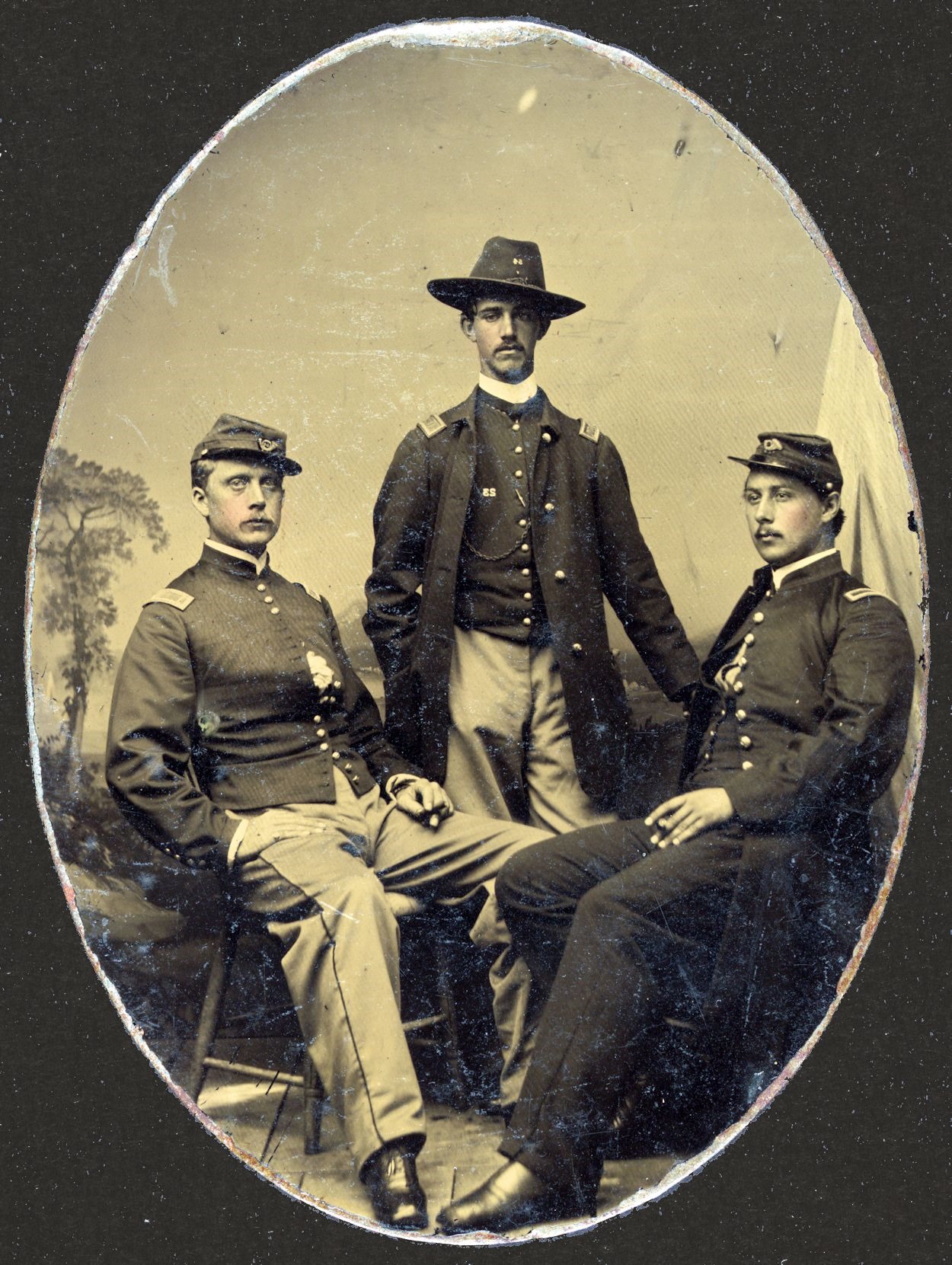
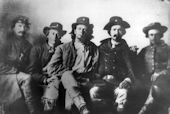
Group shot, officers of the 54th Mass. Colored

Group shot, officers of the 54th Mass. Colored

Image summary: Photograph shows a full-length portrait of three officers of the 54th Massachusetts Infantry Regiment. Sitters have been identified as Second Lieutenant Ezekiel G. Tomlinson, Captain Luis F. Emilio (center), and Second Lieutenant Daniel G. Spear (National Archives records).

Part of William A. Gladstone collection of African American photographs

Library of Congress image.

Civil War Portrait 035

May 29, Friday. We have accounts of farther and extensive depredations by the Alabama. These depredations were near the Line, where the Department, in anticipation of her appearance, had ordered the Vanderbilt. She was specially ordered to Fernando de Noronha, whither the Alabama was expected to go, — where she did go, and where she would have been captured, had instructions been obeyed, and not interfered with. But Admiral Wilkes, having fallen in with that vessel and finding her a commodious ship with extensive and comfortable accommodations, deliberately annexed her to his squadron and detained her in the West Indies as his flagship, hunting prizes, too long for the service on which she was specially sent. I, of course, shall be abused for the escape of the Alabama and her destruction of property by those who know nothing of the misconduct of Wilkes. The propriety of recalling that officer is more apparent than ever. He has accomplished nothing, but has sadly interrupted and defeated the plans of the Department. The country, ignorant of these facts and faults, will disapprove his removal, and assail the Department for the mischief of the Alabama, whereas, had he been earlier removed, the latter would not have happened.

I this morning sent for Admiral Foote and had a free and full talk with him in regard to the command of the South Atlantic Squadron. I am satisfied he would be pleased with the position, and really desired it when he knew Du Pont was to be relieved. I then introduced him to General Gillmore, and with the charts and maps before us took a rapid survey of the harbor and plan of operations. Before doing this, I said to Foote that I thought it would be well for the country, the service, and himself, were Admiral Dahlgren associated with him. He expressed the pleasure it would give him, but doubted if D. would consent to serve as second.

I requested Mr. Fox to call on D. and inform him that I had given Foote the squadron, that I should be glad to have him embark with Foote, and take an active part against Charleston. If he responded favorably, I wished him to come with Fox to the conference. Fox returned with an answer that not only was D. unwilling to go as second, but that he wished to decline entirely, unless he could have command of both naval and land forces. This precludes farther thought of him. I regret it for his own sake. It is one of the errors of a lifetime. He has not seen the sea service he ought for his rank, and there is a feeling towards him, on account of his advancement, among naval men which he had now an opportunity to remove. No one questions his abilities as a skillful and scientific ordnance officer, but some of his best friends in his profession doubt his capability as a naval officer on such duty as is here proposed. It is doubtful if he ever will have another so good an opportunity.

Foote says he will himself see D., and has a conviction that he can induce him to go with him. I doubt it. Dahlgren is very proud and aspiring, and will injure himself and his professional standing in consequence. With undoubted talents of a certain kind he has intense selfishness, and I am sorry to see him on this occasion, as I have seen him on others, regardless of the feelings and rights of officers of greater experience, who have seen vastly more sea service and who possess high naval qualities and undoubted merit. In a matter of duty, such as this, he shows what is charged upon him, — that he is less devoted to the country than to himself, that he never acts on any principle of self-sacrifice. While friendly to him, as I have shown on repeated occasions, I am friendly to others also, and must respect their feelings and protect their rights.

May 29.—A detachment of the First Vermont cavalry had a skirmish near Thoroughfare Gap, Va. with a scouting-party of Stuart’s cavalry, consisting of forty men, commanded by Captain Farleigh, of General Stuart’s staff. The rebels fled precipitately, with the loss of one killed, two wounded, and one man taken prisoner. The Nationals had five horses wounded; but sustained no loss or casualty, with the exception of one man taken prisoner.—The Sixth regiment of Massachusetts volunteers, after two terms of service in the war, returned to Boston, where they were received with great enthusiasm.—New-York Tribune.

—Brigadier-General Reed returned to Lake Providence, La., from an expedition into Mississippi. Three days ago he embarked with a portion of the First Kansas volunteers, and a regiment of Louisiana colored troops. Ascending the river ten miles, the troops landed near Moon lake, from which place they advanced into the interior, and succeeded in capturing sixty head of cattle, and a large quantity of stores belonging to the rebels.

29th. Felt quite feverish in the morning. Afternoon, light attack of ague. Felt miserable all day. Got badly beaten at chess in the morning by Chester. Spent a very restless night. Sore, headache and uneasy every way. Thede very kindly did my work. Col. Kautz went out with 450 men. Aggravating.

29th May (Friday).—I took a walk before breakfast with Dr Quintard, a zealous Episcopal chaplain, who began life as a surgeon, which enables him to attend to the bodily as well as the spiritual wants of the Tennessean regiment to which he is chaplain. The enemy is about fifteen miles distant, and all the tops of the intervening hills are occupied as signal stations, which communicate his movements by flags in the daytime, and by beacons at night. A signal corps has been organised for this service. The system is most ingenious, and answers admirably. We all breakfasted at Mrs ——’s. The ladies were more excited even than yesterday in their diatribes against the Yankees. They insisted on cutting the accompanying paragraph out of to-day’s newspaper, which they declared was a very fair exposition of the average treatment they received from the enemy.[1] They reproved Mrs —— for having given assistance to the wounded Yankees at Wartrace last year; and a sister of Mrs ——’s, who is a very strong-minded lady, gave me a most amusing description of an interview she had had at Huntsville with the astronomer Mitchell, in his capacity of a Yankee general. It has often been remarked to me that, when this war is over, the independence of the country will be due, in a great measure, to the women; for they declare that had the women been desponding they could never have gone through with it; but, on the contrary, the women have invariably set an example to the men of patience, devotion, and determination. Naturally proud, and with an innate contempt for the Yankees, the Southern women have been rendered furious and desperate by the proceedings of Butler, Milroy, Turchin, &c. They are all prepared to undergo any hardships and misfortunes rather than submit to the rule of such people; and they use every argument which women can employ to infuse the same spirit into their male relations.clip_image002
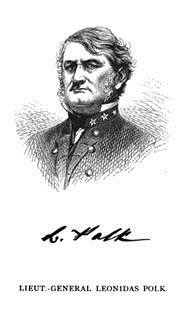
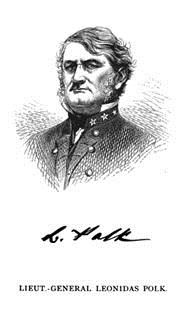
At noon I took leave for the present of General Hardee, and drove over in his ambulance to Shelbyville, eight miles, in company with Bishop Elliott and Dr Quintard. The road was abominable, and it was pouring with rain. On arriving at General Polk’s, he invited me to take up my quarters with him during my stay with Bragg’s army, which offer I accepted with gratitude. After dinner General Polk told me that he hoped his brethren in England did not very much condemn his present line of conduct. He explained to me the reasons which had induced him temporarily to forsake the cassock and return to his old profession. He stated the extreme reluctance he had felt in taking this step; and he said that so soon as the war was over, he should return to his episcopal avocations, in the same way as a man, finding his house on fire, would use every means in his power to extinguish the flames, and would then resume his ordinary pursuits. He commanded the Confederate forces at the battle of Perryville and Belmont, as well as his present corps d’armée at the battles of Shiloh (Corinth) and Murfreesborough. At 6.30 P.M., I called on General Bragg, the Commander-in-chief. This officer is in appearance the least prepossessing of the Confederate generals. He is very thin; he stoops, and has a sickly, cadaverous, haggard appearance, rather plain features, bushy black eyebrows which unite in a tuft on the top of his nose, and a stubby iron-grey beard; but his eyes are bright and piercing. He has the reputation of being a rigid disciplinarian, and of shooting freely for insubordination. I understand he is rather unpopular on this account, and also by reason of his occasional acerbity of manner. He was extremely civil to me, and gave me permission to visit the outposts, or any part of his army. He also promised to help me towards joining Morgan in Kentucky, and he expressed his regret that a boil on his hand would prevent him from accompanying me to the outposts. He told me that Rosecrans’s position extended about forty miles, Murfreesborough (twenty-five miles distant) being his headquarters. The Confederate cavalry enclosed him in a semicircle extending over a hundred miles of country. He told me that West Tennessee, occupied by the Federals, was devoted to the Confederate cause, whilst East Tennessee, now in possession of the Confederates, contained numbers of people of Unionist proclivities. This very place, Shelbyville, had been described to me by others as a “Union hole.” After my interview with General Bragg, I took a ride along the Murfreesborough road with Colonel Richmond, A.D.C. to General Polk. About two miles from Shelbyville, we passed some lines made to defend the position. The trench itself was a very mild affair, but the higher ground could be occupied by artillery in such a manner as to make the road impassable. The thick woods were being cut down in front of the lines for a distance of eight hundred yards, to give range. During our ride I met Major-General Cheetham, a stout, rather rough-looking man, but with the reputation of “a great fighter.” It is said that he does all the necessary swearing in the 1st corps d’arméa, which General Polk’s clerical character incapacitates him from performing. Colonel Richmond gave me the particulars of General Van Dorn’s death, which occurred about forty miles from this. His loss does not seem to be much regretted, as it appears he was always ready to neglect his military duties for an assignation. In the South it is not considered necessary to put yourself on an equality with a man in such a case as Van Dorn’s by calling him out. His life belongs to the aggrieved husband, and “shooting down” is universally esteemed the correct thing, even if it takes place after a lapse of time, as in the affair between General Van Dorn and Dr Peters.

News arrived this evening of the capture of Helena by the Confederates, and of the hanging of a negro regiment with forty Yankee officers. Every one expressed sorrow for the blacks, but applauded the destruction of their officers.[2]

I slept in General Polk’s tent, he occupying a room in the house adjoining. Before going to bed, General Polk told me an affecting story of a poor widow in humble circumstances, whose three sons had fallen in battle one after the other, until she had only one left, a boy of sixteen. So distressing was her case that General Polk went himself to comfort her. She looked steadily at him, and replied to his condolences by the sentence, “As soon as I can get a few things together, General, you shall have Harry too.” The tears came into General Polk’s eyes as he related this episode, which he ended by saying, “How can you subdue such a nation as this!”


[1] ”Losses of William F. Ricks. —The Yankees did not treat us very badly as they returned from pursuing our men beyond Leighton (at least no more than we expected); they broke down our smokehouse door and took seven hams, went into the kitchen and helped themselves to cooking utensils, tin ware, &c.; searched the house, but took nothing. As they passed up the second time we were very much annoyed by them, but not seriously injured; they took the only two mules we had, a cart, our milch cows, and more meat. It was on their return from this trip that our losses were so grievous. They drove their waggons up in our yard and loaded them with the last of our meat, all of our sugar, coffee, molasses, flour, meal, and potatoes. I went to a Lieut.-Colonel who seemed very busy giving orders, and asked him what he expected me to do; they had left me no provisions at all, and I had a large family, and my husband was away from home. His reply was short and pointed—’Starve, and be d—d, madam.’ They then proceeded to the carriage-house, took a fine new buggy that we had never used, the cushions and harness of our carriage, then cut the carriage up and left it. They then sent about sixty of the slyest, smoothest-fingered rogues I have ever seen in the Federal army (all the rogues I ever did see were in that army), into the house to search for whisky and money, while the officers remained in the back-yard trying to hire the servants to tell them where we had money hid. Their search proving fruitless, they loaded themselves with our clothing, bed-clothing, &c.; broke my dishes; stole my knives and forks; refused the keys and broke open my trunks, closets, and other doors. Then came the worst of all—the burners, or, as they call themselves, the ‘Destroying Angels.’ They burned our gin-house and press, with 125 bales of cotton, seven cribs containing 600 bolls of corn, our logs, stables, and six stacks of fodder, a waggon, and four negro cabins, our lumber-room, fine spinning-machine and 500 dollars’ worth of thread, axes, hoes, scythe-blades, and all other plantation implements. Then they came with their torches to burn our house, the last remaining building they had left besides the negro quarter. That was too much; all my pride, and the resolutions that I had made (and until now kept up) to treat them with cool contempt, and never, let the worst come, humble myself to the thievish cutthroats, forsook me at the awful thought of my home in ruins; I must do something, and that quickly;—hardened, thieving villains, as I knew them to be, I would make one effort for the sake of my home. I looked over the crowd, as they huddled together to give orders about the burning, for one face that showed a trace of feeling, or an eye that beamed with a spark of humanity, but, finding none, I approached the nearest group, and pointing to the children (my sister’s), I said, ‘You will not burn the house, will you? you drove those little ones from one home and took possession of it, and this is the only sheltering place they have.’ ‘You may thank your God, madam,’ said one of the ruffians, ‘that we have left you and your d—d brats with heads to be sheltered.’ Just then an officer galloped up — pretended to be very much astonished and terribly beset about the conduct of his men—cursed a good deal, and told a batch of falsehoods about not having given orders to burn anything but corn—made divers threats that were forgotten in utterance, and ordered his ‘Angels’ to fall into line,—thereby winding up the troubles of the darkest day I have ever seen. Mrs Ricks.

” Losses before this last raid: six mules, five horses, one waggon (four-horse), fifty-two negroes.”

[2] This afterwards turned out to be untrue.
London, May 29, 1863

Well! the great blow came! We had to give up our hopes, and I groaned for at least five minutes. But hope springs eternal. On the whole we usually give Hooker the credit of having done the most brilliant thing yet effected by the army of the Potomac under any of its various generals. I am satisfied that the South shook under it to its very centre and will find it hard to bear up against the destruction of its depots, the loss of its ablest general and the crippling of its best army. De l’audace! toujours de l’audace! We want continual, feverish activity, and that is all. Worry them with cavalry raids! Give them all the plagues of Egypt! Let them have no rest, no hope! Revolutionize Louisiana. Lay waste Mississippi! By the time their harvests come, they will have no engines to draw it, no cars to carry it, no tracks to convey it on. And if at last they succeed in getting their independence, it will only be to lie down and die. . . .

As for me, I have passed most of this week up at Cambridge with Mr. Evarts. We went there to see the University and to visit Will Everett, and we chose the Whitsuntide holidays for that purpose. You have met Mr. Evarts and you recollect, no doubt, that he wears his hat so that a plumb line dropped from its centre would fall about twelve inches behind his heels. His speech is Yankee and his whole aspect shouts American with stentorian lungs. Fortunately his conversation and mind make up for his peculiarities of dress and appearance, so that I was always relieved when he took his hat off, and opened his mouth.

Will Everett never appeared so well as when acting the host. . . . He was really extremely polite and obliging and did everything for us he could. He gave us an excellent dinner in his rooms, eight covers, and carried us about most perseveringly. He seems to be well thought of there, and he certainly has a very good set of friends, not very brilliant or noisy, but great scholars and pleasant fellows.

But the most humorous sight was when Mr. Evarts and I went about dining in Hall with the Fellows of the different Colleges. When I found myself the honored guest, sitting among the College dignitaries, I could not help a sort of feeling that I was in somebody else’s place and should soon be found out and expelled. However, it is astonishing what good fellows these gowned individuals may be, and how well they do live. If you could have seen Mr. Evarts and me after dinner at one of the little colleges, conducting a jovial and noisy game of whist, with cigars and brandy and soda-water, and a clergyman and a Fellow of an adjacent College known as Jesus, for our partners, you would have smiled among your sabres and pistols.

The truth is, we were deuced well treated at Cambridge and I enjoyed the visit immensely. We saw everything that was to be seen, and raked up all the dead celebrities, the shades of Milton and Cromwell, as well as the equally solemn shadows of present undergraduates. I wished to become a Fellow, but am afraid it can’t be did. Seriously, I think I have learned enough in the world to be able to employ to much advantage a year or two of retirement. . . .

Friday, 29th—Went to Dixon Springs to-day to get a Yankee saddle; had to wait until the two Regiments of Yankee cavalry and train passed out. We then went in, I and Ward. I went up to Mr. Alexander’s; Miss Mollie knew me, Miss Nannie did not. I took supper and staid till 10 or 11 o’clock and left. Came back to Mrs. Ballou’s.

May 29—Had a general review to-day. General Rodes is our division commander. He and General Lee reviewed us. I see a great change in the appearance of General Lee. He looks so much older than when I saw him at Yorktown. Then his hair was black. Now he is a gray-headed old man. We have five brigades in our division. The commander of my brigade is General Daniels, of North Carolina. One brigade of Georgians is commanded by General Dowles. Iverson, of North Carolina, has another brigade; also General Ramseur, of North Carolina, has a brigade; and General Battle, of Alabama, has a brigade. Our corps is composed of three divisions, ours by General Rodes, one by General Early, and the other by Gen. A. Johnson.

Camp 103d Illinois Infantry, Lagrange, Tenn.,

May 29, 1863.

‘Tis becoming fiendishly warm in this latitude again; but the delightfully cool nights of which I wrote you so much last summer, are also here again, and amply repay one for the feverish days. We have moved our camp from the town to a grove on a hill about midway between Grand Junction and Lagrange It is one of the best defensive positions that I know of. It seems to me much better than Corinth, or Columbus, Ky., or New Madrid. Our negro troops are fortifying it. I suppose that no one anticipates danger from the Confederates, on this line, any more; but I can understand that the stronger we make our line, the less object the secesh will have in visiting us. We are raising a regiment of blacks here. Captain Boynton, who has an Illinois Battery, is to be the colonel. He looks like a good man, but I think that a better could have been selected. I am afraid they are not commissioning the right material for line officers. Two are to be taken from our regiment, and if we have two men who are good for nothing under the sun, I believe them to be the ones. I know that first rate men have applied for these places, and why they give them to such worthless fellows, I can’t see. I think poor Sambo should be allowed a fair chance, and that he certainly will never get under worthless officers. I suppose that the regiment organization here numbers some 800 now, and will soon be full. I don’t know whether I wrote it to you or not, but a year ago I sincerely thought that if the negro was called into this war as a fighting character, I would get out of it as quickly as I could, honorably. I am by no means an enthusiast over the negro soldiers yet. I would rather fight the war out without arming them. Would rather be a private in a regiment of whites than an officer of negroes; but I don’t pretend to set up my voice against what our President says or does; and will cheerfully go down the Mississippi and forage for mules, horses and negroes and put muskets in the hand’s of the latter. I have no trouble in believing that all these Rebels should lose every slave they possess; and I experience some pleasure in taking them when ordered to. Captain Bishop with some 25 men of Companies A and G did a splendid thing last Thursday night. He surprised Saulstreet and 20 of his gang, about 11:30 p.m., killed three, wounded and captured five and six sound prisoners, without losing one of our men or getting one scratched. Three of the wounded guerrillas have since died. Saulstreet himself escaped. Over at Henderson Station on the M. & O. R. R. lives a Miss Sally Jones who once, when some Rebels set fire to a bridge near there, watched them from the brush until they left and then extinguished the fire. She is a case. Lieutenant Mattison saw her there a few days since. The day before he saw her she had been out scouring over the country horseback, dressed in boys’ clothes, with her brother. She often goes out with the soldiers scouting, and the boys think the world of her. Any of them would kill a man who would dare insult her. She is, withal, a good girl. Not educated, but of fine feelings and very pleasing manners. Memphis paper has just arrived. Not a word from Vicksburg but a two column list of wounded. I expect that you have celebrated the capture of that town, long before this. All right, you ought to enjoy yourselves a little once in a while. There are now to my certain knowledge, 20,000 troops on the railroad between Memphis and Corinth, and there are not 1,000 armed Rebels within 100 miles of any point on the road. Our presence at Vicksburg could not help deciding the day in our favor. It makes a man who knows nothing about the matter, sick to think of the way we manage our army. Hold 100,000 in reserve and fight with 10,000.