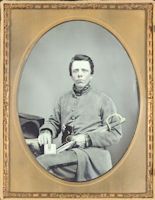
June 27 — We got to rest last night. Everything was more quiet all night than common. Firing commenced at daylight again this morning. 8 o’clock a.m. — the mortars are dropping shells about us. They are throwing them about five miles. 7 o’clock p.m. We now start out to the trenches again. A young man by the name of Garghess belonging to the 3rd Tenn. Regt. was killed here in fifty yards of me this evening with a piece of a shell. Oh! Lord I pray for thy protection. W. R. Clack
June 2013
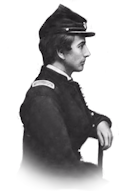
June 27th. Remained in bivouac until 3 P. M., by which time the stragglers had come up and the command well rested. Then marched via Poolsville to Barnsville, arriving at the latter place at 11 P. M. The weather cleared up and the roads rapidly improved, so that the day’s march, although long and exhausting, was much less distressing than that of yesterday.
Passing through these various towns, our experiences of last autumn were renewed. Everybody was, of course, on the streets and showed us the greatest attention, looking in amazement at the interminable lines of infantry, moving day and night without interruption. We came in for many presents of cherries, which were in abundance.
by John Beauchamp Jones
JUNE 27th.—An officer of the Signal Corps reported, yesterday, the force of Gen. Keyes, on the Peninsula, at 6000. To-day we learn that the enemy is in possession of Hanover Junction, cutting off communication with both Fredericksburg and Gordonsville. A train was coming down the Central Road with another installment of the Winchester prisoners (some 4000 having already arrived, now confined on Belle Island, opposite the city), but was stopped in time, and sent back.
Gen. Elzey had just ordered away a brigade from Hanover Junction to Gordonsville, upon which it was alleged another raid was projected. What admirable manœuvring for the benefit of the enemy!
Gen. D. H. Hill wrote, yesterday, that we had no troops on the Blackwater except cavalry. I hope he will come here and take command.
Gen. Whiting has arrested the Yankee crew of the Arabian, at Wilmington. It appears that she is owned by New Yorkers, sailed from New York, and has a Yankee cargo!
Capt. Maury writes from London that R. J. Walker, once a fire-and-fury Mississippi Senator (but Yankee-born), is in Europe trying to borrow £50,000,000 for the United States. Capt. Maury says the British Government will not willingly let us have another “Alabama;” but that it is also offended at the United States for the atrocities of Wilkes, and this may lead to war. The war, however, would not be intended as a diversion in our behalf.
Nothing is heard to-day from Lee, except what appears in Northern papers several days old, when our troops were occupying Hagerstown, Cumberland, etc., in Maryland, and foraging pretty extensively in Pennsylvania.
Nothing from Vicksburg.
Just as I apprehended! The brigade ordered away from Hanover to Gordonsville, upon a wild-goose chase, had not been gone many hours before some 1200 of the enemy’s cavalry appeared there, and burnt the bridges which the brigade had [click to continue…]
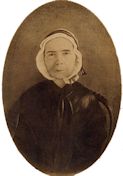
Saturday Evening.—Just heard from W. and S. H.; both terribly robbed by the raiders in the last three days. All of my brother’s horses and mules taken. Some of the servants were forced off, who staid so faithfully by them, and resisted all the Yankee entreaties twice before. They attempted to burn the wheat, which is shocked in the field, but an opportune rain made it too wet to burn. The raiders came up the river, destroying crops, carriages, etc., stealing horses and cattle, and carrying off the servants from every plantation, until they got to Hickory Hill, (Mr. W. F. Wickham’s,) where they found a prize in the person of General W. F. Lee, who was wounded at the cavalry fight of Beverley’s Ford, and was at Mr. Ws, unable to move. Notwithstanding the remonstrances of his wife and mother, they took him out of his bed, placed him in Mr. Wickham’s carriage, and drove off with him. I can’t conceive greater hardness of heart than it required to resist the entreaties of that beautiful young wife and infirm mother. F. has just received a note from the former, written in sorrow and loneliness. She fears that the wound may suffer greatly by locomotion; beyond that, she has much to dread, but she scarcely knows what.
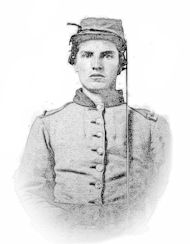
Saturday, 27th.—All pretty quiet; boys getting very low-spirited.
June 26.—Andrew G. Curtin, Governor of Pennsylvania, issued a proclamation, calling for sixty thousand men to serve for three months, or the period of the rebel invasion.—(Doc. 79.)
—Brashear City, La., was captured by the rebel forces under Generals Green and Mouton — (Docs. 19, 26, and 80.)
—The Twenty-first regiment of New-York militia, under the command of Colonel Nugent, left Poughkeepsie for Baltimore, Md.—The Fifth regiment of Massachusetts volunteers returned to Boston, and were welcomed by an imposing and enthusiastic demonstration.—McConnelsburgh, Pa., was evacuated by the rebels under General Stuart.—Rear-admiral A. H. Foote died at New-York City.—By direction of President Lincoln, Major-General N. J. T. Dana was assigned to the organization and command of the militia and volunteer forces and defences of Philadelphia, Pa.—Frederick, Md., was occupied by the National cavalry.
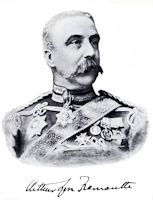
26th June (Friday).—I got up a little before daylight, and, notwithstanding the drenching rain, I secured our horses, which, to my intense relief, were present. But my horse showed a back rapidly getting worse, and both looked “mean” to a degree. Lawley being ill, he declined starting in the rain, and our host became more and more surly when we stated our intention of remaining with him. However, the sight of real gold instead of Confederate paper, or even greenbacks, soothed him wonderfully, and he furnished us with some breakfast. All this time McLaws’s division was passing the door; but so strict was the discipline, that the only man who loafed in was immediately pounced upon and carried away captive. At 2 P.M., the weather having become a little clearer, we made a start, but under very unpromising circumstances. Lawley was so ill that he could hardly ride; his horse was most unsafe, and had cast a shoe ;—my animal was in such a miserable state that I had not the inhumanity to ride him ;—but, by the assistance of his tail, I managed to struggle through the deep mud and wet. We soon became entangled with McLaws’s division, and reached the Potomac, a distance of nine miles and a half, at 5 P.M. ; the river is both wide and deep, and in fording it (for which purpose I was obliged to mount) we couldn’t keep our legs out of the water. The little town of Williamsport is on the opposite bank of the river, and we were now in Maryland. We had the mortification to learn that Generals Lee and Longstreet had quitted Williamsport this morning at 11 o’clock, and were therefore obliged to toil on to Hagerstown, six miles farther. This latter place is evidently by no means Rebel in its sentiments, for all the houses were shut up, and many apparently abandoned. The few natives that were about stared at the troops with sulky indifference.
After passing through Hagerstown, we could obtain no certain information of the whereabouts of the two generals, nor could we get any willing hospitality from any one; but at 9 P.m., our horses being quite exhausted, we forced ourselves into the house of a Dutchman, who became a little more civil at the sight of gold, although the assurance that we were English travellers, and not Rebels, had produced no effect. I had walked to-day, in mud and rain, seventeen miles, and I dared not take off my solitary pair of boots, because I knew I should never get them on again.
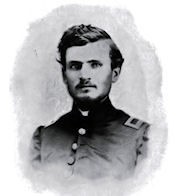
26th. Wounded boys all happy with the promise of going home on furlough. Rebs reported at the river again. Invitation to dinner at Mrs. Vickery’s. Col. and his men. Stayed in camp. Bought some cakes, pies and bread from bakery. Still continues to rain. Makes camp life seem rather dull.
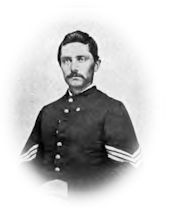
Friday, 26th—I went on picket again this morning with very strict orders as to passes and keeping cartridge boxes on day and night. The rebels are becoming active and desperate in their determination to get out, for their provisions are very low. No news from the rear.
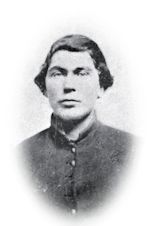
Before Vicksburg, Friday, June 26. Our men still claim their side of the fort, nothing daunted by the stubbornness of yesterday. An active engagement was continued during the night by grenades, all the surplus shells of smooth bores taken to be used for such. The 5th Platoon driver turned in with us this morning to dig a well to water the horses, which we completed by 4 P. M., 15 feet deep, width 30 inches. At evening I received my weekly letters.


