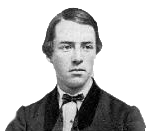
June 26.—We got up and breakfasted at daylight. It was a most dismal morning, being drizzly and thoroughly uncomfortable. General Reynolds and staff rode down to the ferry, where General Hooker and General Slocum soon came up. We then rode back to Poolesville, and from there General R. went to Barnesville, about 6 miles, passing near Sugar Loaf. Barnesville is a small, old-fashioned town, with one or two neat little cottages in it, with pretty flower-gardens in front; quite a contrast to anything we had seen in Virginia. Some of the houses had overhanging eaves, others piazzas all round, and on the main street there was a well with windlass and wheel, quite different from anything I ever saw in New England. It seemed more like my idea of a European town than an American one. Like almost all Maryland towns the houses were all on one main street. From Barnesville we went on to Adamstown, a small way-station on the Baltimore & Ohio R. R. From here we went to Jefferson, lying on the other side, and at the foot of the Little Catoctin range. The scenery all along the route was very beautiful. We passed neat farmhouses with whitewashed palings, and through fields of wheat, rye, etc., almost ready to be gathered. From the top of Little Catoctin the view was splendid. The fertile valley lying between the Little Catoctin and South Mountain ranges presented an appearance truly delightful to our eyes, which had been disgusted and wearied by the monotonous and uncultivated soil of the Old Dominion. Here acres upon acres of clover, wheat, oats, etc., were spread out to our view, seeming like a perfect paradise. We found that Jefferson was a strong Union town, with many pretty houses, and some three or four churches. We pitched, or rather established, our headquarters in a house at the west end of the town, and here I slept in a bed, for the first time since I have been in the field. Our wagons did not get up with us. We travelled about 27 miles to-day, and most of the time in a drenching rain. I ate some cherries, the first I had tasted this season, in Jefferson. General Reynolds still has command of three corps.
June 2013

Friday, June 26th.
O praise the Lord, O my soul! Here is good news enough to make me happy for a month! Brother is so good about that! Every time he hears good news on our side, he tells it just as though it was on his side, instead of on ours; while all bad news for us he carefully avoids mentioning, unless we question him. So to-day he brought in a budget for us.
Lee has crossed the Potomac on his way to Washington with one hundred and sixty thousand men. Gibbes and George are with him. Magruder is marching on Fort Jackson, to attack it in the rear. One or two of our English ironclads are reported at the mouth of the river, and Farragut has gone down to capture them. O Jimmy! Jimmy! suppose he should be on one of them? We don’t know the name of his ship, and it makes us so anxious for him, during these months that we have heard nothing of his whereabouts.
It is so delightful to see these frightened Yankees! One has only to walk downtown to be satisfied of the alarm that reigns. Yesterday came the tidings of the capture of Brashere City by our troops, and that a brigade was fifteen miles above here, coming down to the city. Men congregated at corners whispering cautiously. These were evidently Confederates who had taken the oath. Solitary Yankees straggled along with the most lugubrious faces, troubling no one. We walked down to Blineau’s with Mrs. Price, and over our ice-cream she introduced her husband, who is a true blue Union man, though she, like ourselves, is a rank Rebel. Mr. Price, on the eve of making an immense fortune, was perfectly disconsolate at the news. Every one was to be ruined; starvation would follow if the Confederates entered; there was never a more dismal, unhappy creature. Enchanted at the news, I naturally asked if it were reliable. “Perfectly! Why, to prove how true, standing at the door of this salon five minutes ago, I saw two young ladies pass with Confederate flags, which they flirted in the face of some Federal officers, unrebuked!” Verily, thought I, something is about to happen! Two days ago the girls who were “unrebuked” this evening would have found themselves in jail instead.
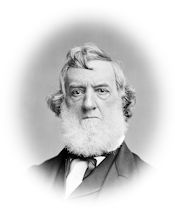
June 26, Friday. The conduct and course of Admiral Du Pont leaves no doubt on my mind that he intends to occupy a position antagonistic to the Department. Fox, who has been his special friend, is of the same opinion. He suggested to me yesterday that the capture of the Fingal presented to me a good opportunity to give Rodgers credit, and in turning the subject over, we both concluded that the letter might be so framed as to detach him, and perhaps others whom the Admiral has sought to attach to and make part of his clique. Fox caught the points earnestly and brought me his ideas in the rough form of a letter. His views were very good and I embodied them in a congratulatory commendation to Rodgers on his services.
Rumors are rife concerning the army. If Hooker has generalship in him, this is his opportunity. He can scarcely fail of a triumph. The President in a single remark to-day betrayed doubts of Hooker, to whom he is quite partial. “We cannot help beating them, if we have the man. How much depends in military matters on one master mind! Hooker may commit the same fault as McClellan and lose his chance. We shall soon see, but it appears to me he can’t help but win.”
A pretty full discussion of Vallandigham’s case and of the committee from Ohio which is here, ostensibly in his behalf, but really to make factious party strength. Blair is for letting them return, — turning him loose, — says he will damage his own friends. The President would have no objections but for the effect it might have in relaxing army discipline, and disgusting the patriotic sentiment and feeling of the country, which holds V. in abhorrence.
Blair assures me that Seward and H. Seymour have an understanding, are acting in concert. Says Stanton is beholden to Seward, who sustains him. Both he denounces. They are opposed to putting McClellan in position, fearing he will be a formidable Presidential candidate. Their conduct is forcing him to be a candidate, when he has no inclination that way. The tendency of things, B. thinks, is to make McClellan and Chase candidates, and if so, he says, McC. will beat C. five to one. He tells me he visited McC. last winter with a view of bringing him here to take Halleck’s place. The President was aware of his purpose. McC. assured him he had no Presidential aspirations; his desire was to be restored to his old military position. When B. returned from his successful mission to New York he found his plans frustrated, and the President unwilling to give them further consideration. Satisfied that Seward, whom he had made a confidant to some extent, had defeated his purpose, he embraced the first favorable opportunity, when returning in Seward’s carriage on the night of the 3d of March from the Capitol, to charge Seward with not having acted in good faith in the transaction. B. says Seward sunk down in the corner of the carriage and made no reply.
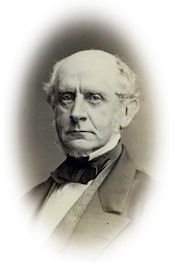
Charles Francis Adams to His Son
London, June 26, 1863
We are gradually working through the season here, which, owing to the marriage of the Prince of Wales at so early a date, has made itself as long as two ordinary ones. I am sure I wish it over, particularly as the feeling toward America in the highest circles is growing more and more unequivocal. Even the accounts of our successes do not have any good effect. They call it very bad news. I suppose we must all make up our minds to bear everything during the remainder of our stay, for the sake of the country. Personally, I cannot say that I have experienced any discomfort. At Court last week I was received with rather marked civility. But it is not pleasant to have the feeling that there is this ill-will to your country all around you. I suppose this to be an incident of diplomatic life everywhere and I now see it here in other cases than my own. Neither Russia nor Prussia is much more relished than the United States. Indeed there is a prevailing feeling of distrust as if we were on the eve of great troubles in Europe. Stocks are falling and active preparations in arming are going on. Napoleon is suspected of schemes eastward and westward, whilst England is not unlikely to be dragged into a war against her will, simply because there is no party strong enough to hold its own against the popular passions. In the midst of all this I cannot sometimes but cherish the wish that our arms would move a little faster. We are still in suspense about Vicksburgh and Port Hudson. . . .
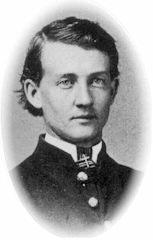
JUNE 26TH.—We have heard that Port Hudson is ours, and I hope this may be true, for it will tend to hasten the surrender of Vicksburg.
A little dirt has been thrown up ahead of us, as a shield, in case we have to fight the enemy. We hear all sorts of reports about the strength of Johnston‘s army, but the truth will only appear when we meet it. One captive said the report in Vicksburg was that Pemberton despaired of getting help from the out side, and was ready to surrender when the last meal rations have been eaten. He probably understands the resources of our commissary, as well as the magnanimous disposition of Grant to issue provisions to a starving foe.
Well; why not? The first square meal received from Uncle Sam will be an occasion to them of thanksgiving. They will get the best that we can issue. And when the war is over, true soldiers of both armies will be among the first to break the bread of reunion and quaff the cup of restored peace and good will.
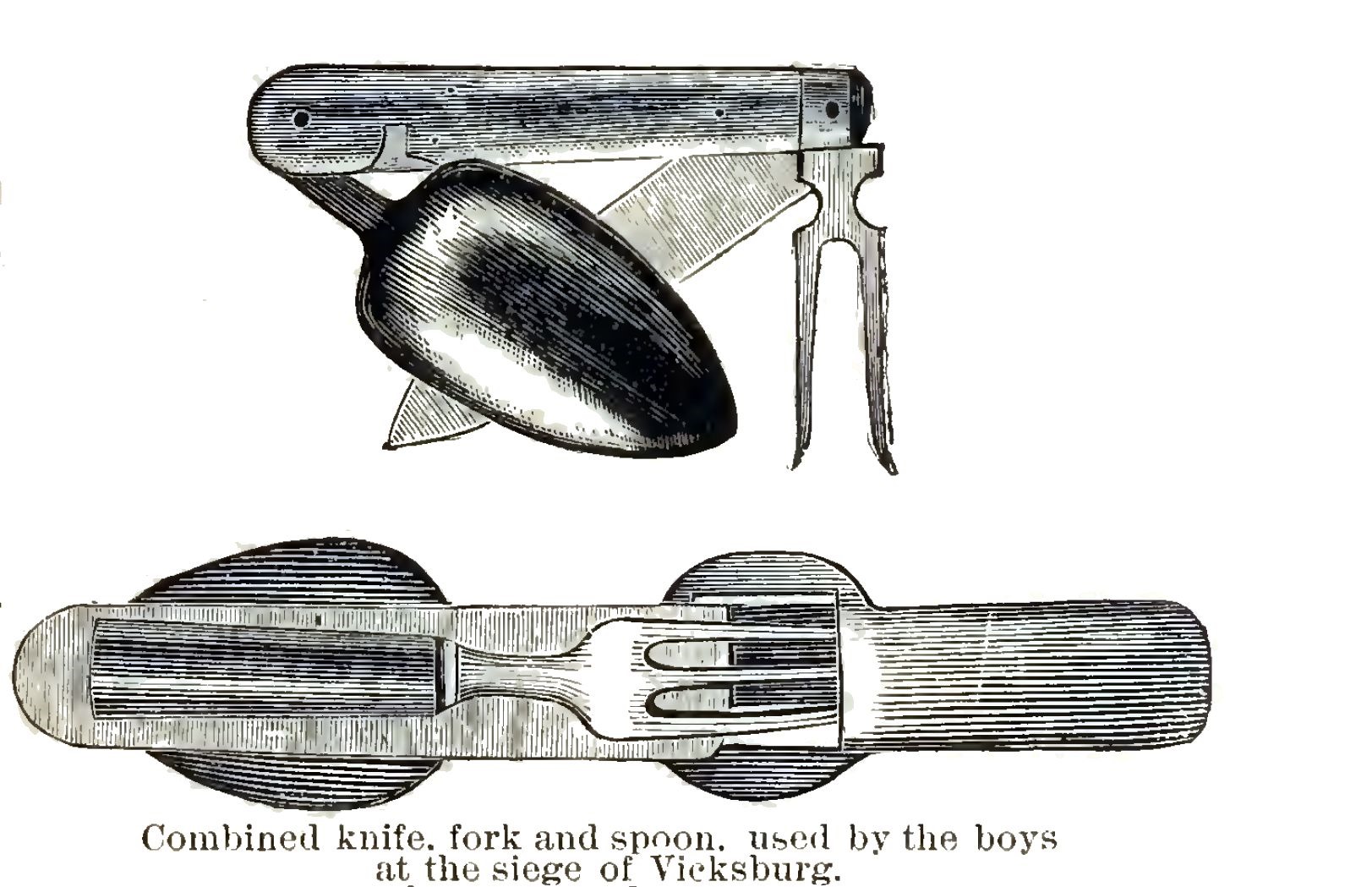
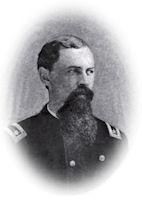
Jackson, Tenn., June 26, 1863.
Such splendid weather—nice, fresh breezes ruffling the leaves on the trees all the day long—and plenty of rain to keep the dust in order. I was up early this morning and the mocking birds were playing a reveille, from whose sweetness bees might make honey. There are hundreds of these birds living in a grove near our headquarters, and I can’t find time and ease enough to enjoy their concerts as I want to.
A flag of truce came to our lines yesterday on the Holly Springs road. The general sent me out to receive it. A lieutenant and eight men, all rough, dirty fellows, made the party. They were not very communicative. They brought a small mail and a trifling communication about prisoners. They belonged to Colonel Morton’s 2d Tennessee (Rebel) Cavalry, and were sent by General Ruggles. The general has promised to let me take a flag to Okolona. Don’t know when I shall go. I do think that General Oglesby is the very ideal of a chivalric, honorable, gallant, modest, high-spirited, dignified, practical, common-sense, gentleman. Nobody can help loving him. He hates a particle of meanness as much as he does a bushel. If we were only doing something more active I should be perfectly happy. As it is, I think seriously of asking to be sent back to my regiment. The general will not be able for any more field work, and I hardly think it right manly in me to stay back here with a railroad guard, when there is so much to be done in front, and I am so strong and able to bear the field duty. You should hear the general talk. There is such a big rolling river of fun and humor in his conversation. Such a hearty honest laugh; I know his heart is big enough to hold a regiment. I believe he thinks as much of the old 8th as of his family. When he has been speaking of the gallant conduct of the 8th at Donaldson and Shiloh, I have seen his face flush up and it seemed as though his heart jumped up to his throat. I was over to the negro camps yesterday and have seen a good deal of them since I last wrote you. An honest confession is good for the soul. I never thought I would, but I am getting strongly in favor of arming them, and am becoming so blind that I can’t see why they will not make soldiers. How queer. A year ago last January I didn’t like to hear anything of emancipation. Last fall accepted confiscation of Rebel’s negroes quietly. In January took to emancipation readily, and now believe in arming the negroes. The only objection I have to it is a matter of pride. I almost begin to think of applying for a position in a regiment myself. What would you think of it? We had quite an alarm two or three nights since. Nobody hurt, but some Tennesseans badly scared. I guess I will go to Memphis to-morrow to look for a spy who has been along our line, and whom we think is now in Memphis. Well, I must go and see the provost marshal about disposing of some prisoners. First, I’ll tell you what three soldiers did the night we had the alarm here. Colonel Mizner, with 1,000 of our cavalry, had been on a scout nine days, and that night we heard that he was within 15 miles of here on his return. We heard of the enemy about 1 a.m. and immediately sent these three men (volunteers for the purpose) to notify Colonel Mizner and have him march all night. They reached the little town, Mt. Pleasant, without incident on the way. There was a lot of guerrillas camped in town that night, and their guard hailed the boys and fired. Our men, only three, charged with a yell and scared the whole party out of town. They couldn’t find the colonel and started to return. When two miles on the way back, at a turn in the road, they met Mitchell’s Rebel company (60 men). Our boys yelled, “here they are, come on boys,” and charged, firing their revolvers. They brought one man down, and made the next fall back some 200 yards where they commenced forming line. Our fellows then took to the woods, got around them and back to camp at 6:30 a.m.
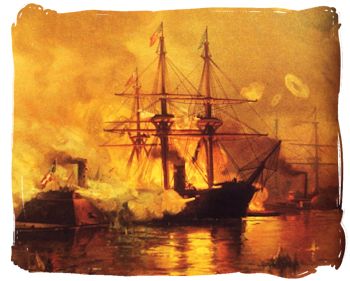
June 26th. This morning received on board two deserters from Port Hudson. They made their escape by swimming Thompson’s creek, and report the rebel garrison living on half rations, and in expectancy of soon having to eat mule beef. If such be the case, Port Hudson must soon be surrendered to our forces. Many are deserting from there at present, and coming within our lines. From four to six P. M., firing going on at Port Hudson; from eight o’clock to midnight, moderate firing from mortars and guns of lower fleet upon the enemy’s works.
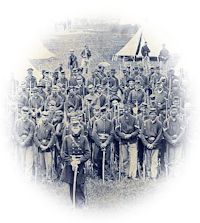
Haines Bluff, Miss., June 26th.
We get no news from the outside world. Not even the New York Herald or Detroit Free Press, those blatant organs of secession, can penetrate these lines. But the air is filled with rumors—rumors that are true today and false tomorrow. It is said the Rebels have a battery now where they fired on us when we came down; that they have captured all our mail and destroyed the mail boat. Today they sank the boat in shallow water and one of our gunboats secured the mail. All we are sure of is we are here, felling trees and throwing up breastworks; that General Grant is still knocking for admittance at the “Gates of Jericho.” Were I to credit what I hear, and it comes from “reliable sources,” I would believe he has already made the seventh circuit of that doomed city with his terrible ram’s horn in full blast, and now, covered with sweat and dust, has paused on a “commanding eminence” to witness the final consummation of his plans. But the continuous thundering of his artillery and the occasional rattle of musketry convince me that, in these latter days, the tumbling down of formidable walls is not so easily accomplished as in the olden times when the Almighty seemed to take more interest in the affairs of men. But, although the long-wished-for event is delayed until hope is well-nigh dead, still, seeing and knowing what I do, I have entire confidence in Grant’s final success.
But hark! What cry is this? Oh, joyful sound. The mail! the mail has come! Thank God, there is one for me!
Haines Bluff, June 24th.
Yesterday, as I was strolling through the ravines, picking berries, I came across a spring of delicious water, cold and pure. It is about half a mile from camp, in a lovely, romantic spot, almost shut out from the light of day by the thick foliage of the magnolia and other evergreens which are thickly interwoven with flowering vines. I wish I could picture the unrivaled beauty of the magnolia. The largest I have seen is about fifty feet in height, leaves from four to six inches in length by two in breadth in the middle, rounding each way to a point, and are of the darkest shade of green. Its chief beauty lies in its blossoms, which are pure white, about six inches in diameter, contrasting strongly with its dark green leaves. It is very fragrant, filling the air with sweet perfume. Nature is indeed prolific in this Southern clime, bestowing her gifts in the greatest variety and profusion, both animate and inanimate, things pleasant to look upon and grateful to the senses, and those that are repulsive and disgusting in the extreme. Insects and reptiles, varying in size from diminutive “chiggers,” too small to be seen by the unaided eye, but which burrows in the flesh and breeds there, to the huge alligator that can swallow, a man at a single gulp. I have not seen an alligator yet, but some of our men have seen him to their sorrow. Soon after our arrival some of the men went in to bathe and wash off some of the dust of travel. They had been in the water but a few minutes when one of their number uttered a shriek of terror and disappeared. Two of his comrades who happened to be near by seized him and dragged him to shore. The right arm was frightfully mangled, the flesh literally torn from the bone by an alligator. Since that incident bathing in the Yazoo is not indulged in.
Moccasin snakes and other poisonous reptiles abound, and a species of beautifully-tinted, brighteyed, active little lizards inhabit every tree and bush, creep into and under our blankets and scamper over us as we try to sleep. The nimble little fellows are harmless, but quite annoying.
There has been uninterrupted firing of small arms and artillery at Vicksburg today. We are busily engaged in throwing up breastworks two hundred rods from here. Our regiment was detailed for that purpose today.
June 26 — Sharp shooters firing away as usual this morning 4 o’clock p.m. we have received orders to move back to support Col. Bartlow. 7 o’clock we now start out to the trench.


