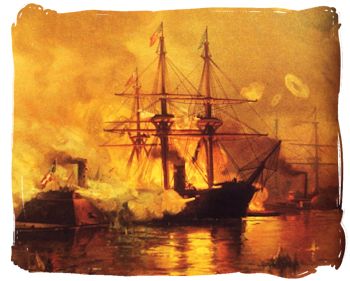
July 25th. During forenoon of this day, engaged in fitting topgallant and royal yards. Bent fore and main top-gallant sails and royals, and placed them in the rigging; also bent the foresail and mizzen topsail. Gunboat New London went down the river. During the hours of eight and ten P. M., squalls of rain accompanied by thunder and lightning; wind from the southward.
July 2013
Saturday, 25th. Breakfasted at a farmer’s. Off at 7, towards Lancaster, 45 miles. At Chancey got some horses shod. Rained considerably. Road lay along the canal. Two miles out of Lancaster, rested and remained till after dinner. A very pleasant family by the name of McLeary.
Saturday, 25th.—Had good place to sleep last night; went down to market house. Everything plentiful, but prices high. Saw one watermelon said to weigh eighty pounds; price, $5. Took steamboat at 3 o’clock; at Tensaw landing, 6 P. M.
Vicksburg, Saturday, July 25. Troops returning from Jackson, their expedition having been crowned with success. Notwithstanding the warm weather they marched in good order and high spirits.
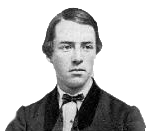
July 25. — Received orders to march at daylight this morning for Warrenton Junction. Started as ordered, and reached there by noon, a distance of io miles. Before leaving in the morning, Mrs. Smith, wife of Extra Billy,[1] came up to the hotel, to try to get back her cattle, which General Cutler took. I believe she was successful. She said that she hoped Extra B. would be inaugurated Governor of the State and the Union in January next. We found the Eleventh Corps just arriving at the Junction as we came in. Two divisions of the corps were placed on the right of the railroad, and one proceeded to Beale-ton. We found good water scarce, as it always is in this vicinity. Our headquarters were near the Junction, in a grove of trees. This makes the third time that I have encamped at Warrenton Junction during this war. The first time last August, with General Porter; the second time last month, with General Reynolds; and the third time with General Newton.
[1] “Extra Billy Smith,” Governor of Virginia somewhere about the beginning of the War. Called “Extra Billy” Smith because he put in so many bills for extras.

by John Beauchamp Jones
JULY 25TH.—Gen. Beauregard telegraphs that preparations should be made to withstand a bombardment at Savannah, and authority is asked, at the instance of Gov. Brown, to impress a sufficient number of slaves for the purpose.
Gen. Jos. E. Johnston telegraphs the President that Grant has fallen back to Vicksburg, and, from information in his possession, will not stay there a day, but will proceed up the river. Gen. Johnston asks if this eccentric movement does not indicate a purpose to concentrate the enemy’s forces for the reduction of Richmond.
Grant’s men, no doubt, objected to longer service at this season in the Southwest ; perhaps Lincoln thinks Grant is the only general who can take Richmond, or it may be necessary for the presence of the army in the North to enforce the draft, to overawe conspirators against the administration, etc. We shall soon know more about it.
Misfortunes come in clusters. We have a report to-day that Gen. Morgan’s command has been mostly captured in Ohio. The recent rains made the river unfordable.
It appears that Gen. Pemberton had but 15 days’ rations to last 48 days, that the people offered him a year’s supply for nothing if he would have it, and this he would not take, red tape requiring it to be delivered and paid for, so it fell into the hands of the enemy. He had a six months’ supply of ammunition when he surrendered, and often during the siege would not let his men reply to the enemy’s guns.
Advertisers in the papers offer $4000 for substitutes. One offers a farm in HanoverCounty, on the Central Railroad, of 230 acres, for a substitute. There is something significant in this. It was so in France when Napoleon had greatly exhausted the male population.
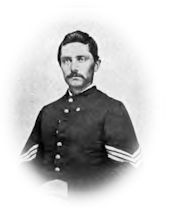
Saturday, 25th—Our brigade returned to the bridge and went into camp, with Colonel Chambers in command of the entire post. Our army field hospital is located here and the convalescents are being cared for in it. Refugees by the thousands are at this place and are still pouring in by the hundreds from every direction, ahead of Sherman’s returning army. It is a wonderful sight to see; they are of all colors and ages, though mostly women and children. I bought a gold pen today from the sutler for $2.00, and had the misfortune to lose it before night.
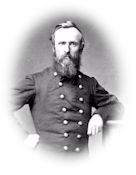
Camp White, July 24, [1863].
Dearest: — The happiness of this week’s operations is dashed by the death of Captain Delany and the probable loss of a number of other good officers and men in our cavalry. Captains Delany [and] Gilmore, the Thirty-fourth mounted infantry, and Second Virginia Cavalry left Raleigh, on the day we returned from there, to cut the Tennessee Railroad at or near Wytheville. On the very day we (the infantry) were gaining bloodless (or almost bloodless) victories over Morgan on the Ohio, our cavalry were fighting a most desperate battle with superior numbers three hundred miles off at Wytheville. Our men were victorious, carried the town by storm, but they lost Colonel Toland, Thirty-fourth killed, Colonel Powell, Second Virginia, mortally wounded, Captain Delany, killed, his two lieutenants, mortally wounded (you know them both), and four other lieutenants, wounded; thirteen privates, killed, and fifty, wounded or prisoners. It was a most creditable but painful affair.
I am expecting my two companies, the survivors, back tomorrow. Wytheville has been one of the most violent Rebel towns from the first. They always talked of “no quarter,” “the black flag,” etc. The citizens fired from their houses on the troops as they rode in. Colonel Powell was shot in the back. The town was burned to ashes. I will write you more about it when they get in.
We are cleaning camp and getting settled again. The old lady moved into the cottage when we left; I occupy the tent Captain and Mrs. Hood were in. Captain Zimmerman went today to relieve Captain Hunter as commandant of post at Gallipolis.
Uncle Scott and Uncle Moses will feel very hopeful in view of this month’s work. We have taken, as I reckon it, seventy thousand prisoners this month besides killing or disabling perhaps fifteen thousand to twenty-thousand more. A pretty big army of Rebels disposed of.
Morgan is not yet caught. He may get off, but his ruin is very complete. — Love to all.
Affectionately, your
R.
Mrs. Hayes.
Friday, 24th—We remained here in bivouac all day. Orders came for our brigade to return to Black river bridge and remain there until relieved by General Sherman. The cars are coming through now from Vicksburg twice a day. We are very anxious for mail, having had none for many days, and are disappointed in not receiving any today. We put in our time today cleaning clothes.
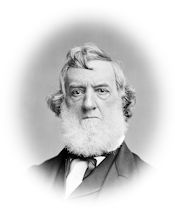
July 24, Friday. This being Cabinet day, Mr. Seward spent an hour with the President, and when the rest came in, he immediately withdrew. Some inquiry was made in regard to army movements and Meade in particular, but no definite information was communicated. Meade is watching the enemy as fast as he can since he let them slip and get away from him.
Some cheering news from Foster, who has cut the great Southern Railroad and burnt the bridge over Tar River.
A force from Kelley has also seized and destroyed the Southwestern Railroad at Wytheville. While something efficient is being done by Union generals with small commands, the old complaint of inactivity and imbecility is again heard against the great Army of the Potomac. Meade is — I say it in all kindness — unequal to his position, cannot grasp and direct so large a command, would do better with a smaller force and more limited field, or as second under a stronger and more able general. If he hesitates like McClellan, it is for a different reason. Since the Battle of Gettysburg he has done nothing but follow Lee at a respectful distance.


