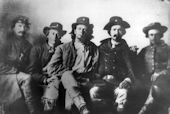
Wednesday., 15th—Came to Rome; pretty place for the Country. Camped two miles from town and spent all day in town.
July 2013
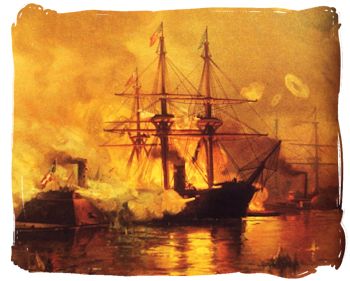
July 15th. At seven forty-five A. M., the U. S. mail steamship Columbia arrived from New York, bringing mails and passengers. This afternoon, broke down the cotton bales around poop, and sent them ashore (sixteen bales), since we needed them for a barricade no longer, our fighting days being over; also employed coaling ship, repairing damages to rigging, &c; at five P. M. the U. S. steam sloop-of-war Portsmouth came down, in tow of a steam-tug; at six, finished coaling ship; at seven thirty, two river steamers arrived with rebel prisoners from above, Vicksburg and Port Hudson.
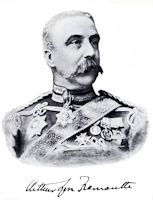
15th July (Wednesday).—The hotel this morning was occupied by military, or rather by creatures in uniform. One of the sentries stopped me; and on my remonstrating to his officer, the latter blew up the sentry, and said, “You are only to stop persons in military dress—don’t you know what military dress is?” “No,” responded this efficient sentry—and I left the pair discussing the definition of a soldier. I had the greatest difficulty in getting a conveyance down to the water. I saw a stone barricade in the distance, and heard firing going on—and was not at all sorry to find myself on board the China.
POSTSCRIPT.
During my voyage home in the China I had an opportunity of discussing with many intelligent Northern gentlemen all that I had seen in my Southern travels. We did so in a very amicable spirit, and I think they rendered justice to my wish to explain to them without exaggeration the state of feeling amongst their enemies. Although these Northerners belonged to quite the upper classes, and were not likely to be led blindly by the absurd nonsense of the sensation press at New York, yet their ignorance of the state of the case in the South was very great.
The recent successes had given them the impression that the last card of the South was played. Charleston was about to fall; Mobile, Savannah, and Wilmington would quickly follow; Lee’s army, they thought, was a disheartened, disorganised mob; Bragg’s army in a still worse condition, fleeing before Rosecrans, who would carry everything before him.
They felt confident that the fall of the Mississippian fortresses would prevent communication from one bank to the other, and that the great river would soon be open to peaceful commerce.
All these illusions have since been dispelled, but they probably still cling to the idea of the great exhaustion of the Southern personnel.
But this difficulty of recruiting the Southern armies is not so great as is generally supposed. As I have already stated, no Confederate soldier is given his discharge from the army, however badly he may be wounded; but he is employed at such labour in the public service as he may be capable of performing, and his place in the ranks is taken by a sound man hitherto exempted. The slightly wounded are cured as quickly as possible, and are sent back at once to their regiments. The women take care of this. The number actually killed, or who die of their wounds, are the only total losses to the State, and these form but a small proportion of the enormous butcher’s bills, which seem at first so very appalling.
I myself remember, with General Polk’s corps, a fine-looking man who had had both his hands blown off at the wrists by unskilful artillery-practice in one of the early battles. A currycomb and brush were fitted into his stumps, and he was engaged in grooming artillery horses with considerable skill. This man was called an hostler; and, as the war drags on, the number of these handless hostlers will increase. By degrees the clerks at the offices, the orderlies, the railway and post-office officials, and the stage-drivers, will be composed of maimed and mutilated soldiers. The number of exempted persons all over the South is still very large, and they can easily be exchanged for worn veterans. Besides this fund to draw upon, a calculation is made of the number of boys who arrive each year at the fighting age. These are all “panting for the rifle,” but have been latterly wisely forbidden the ranks until they are fit to undergo the hardships of a military life. By these means, it is the opinion of the Confederates that they can keep their armies recruited up to their present strength for several years; and, if the worst comes to the worst, they can always fall back upon their negroes as a last resort; but I do not think they contemplate such a necessity as likely to arise for a considerable time.
With respect to the supply of arms, cannon, powder, and military stores, the Confederates are under no alarm whatever. Augusta furnishes more than sufficient gunpowder; Atlanta, copper caps, &c. The Tredegar works at Richmond, and other foundries, cast more cannon than is wanted; and the Federal generals have always hitherto proved themselves the most indefatigable purveyors of artillery to the Confederate Government, for even in those actions which they claim as drawn battles or as victories, such as Corinth, Murfreesborough, and Gettysburg, they have never failed to make over cannon to the Southerners without exacting any in return.
My Northern friends on board the China spoke much and earnestly about the determination of the North to crush out the Rebellion at any sacrifice. But they did not show any disposition to fight themselves in this cause, although many of them would have made most eligible recruits; and if they had been Southerners, their female relations would have made them enter the army whether their inclinations led them that way or not.
I do not mention this difference of spirit by way of making any odious comparisons between North and South in this respect, because I feel sure that these Northern gentlemen would emulate the example of their enemy if they could foresee any danger of a Southern Butler exercising his infamous sway over Philadelphia, or of a Confederate Milroy ruling with intolerable despotism in Boston, by withholding the necessaries of life from helpless women with one hand, whilst tendering them with the other a hated and absurd oath of allegiance to a detested Government.
But the mass of respectable Northerners, though they may be willing to pay, do not very naturally feel themselves called upon to give their blood in a war of aggression, ambition, and conquest; for this war is essentially a war of conquest. If ever a nation did wage such a war, the North is now engaged, with a determination worthy of a more hopeful cause, in endeavouring to conquer the South; but the more I think of all that I have seen in the Confederate States of the devotion of the whole population, the more I feel inclined to say with General Polk—”How can you subjugate such a people as this?” and even supposing that their extermination were a feasible plan, as some Northerners have suggested, I never can believe that in the nineteenth century the civilised world will be condemned to witness the destruction of such a gallant race.
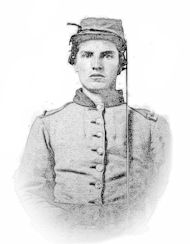
Wednesday, 15th.—We hobbled on; Elrod somewhat improved, but I was not. When in about three miles of Pearl River, which we must cross to-night or be cut off, we saw a man coming on horseback. Elrod begged me to try to get the man to let me ride behind him to the river. I at first refused, but after his urging, saying he could make it to the river before dark, and for me to wait on this side until he came, I consented to try the man. He agreed to take me, and by hard work they got me on behind without anything under me. He turned out to be drinking heavily, but took me to the river as hard as his horse could run, for which I paid him $4.00 and found myself badly skinned from the hard ride bareback. As it was getting dark, my friend, Elrod, made his appearance, and though he was very tired, we crossed over Pearl River near Byram’s Station, on New Orleans Railroad. Saw Yankee foragers. Got over river just in time; skirmishing towards Jackson.

15th.—In Richmond, to-day, I saw my old friend, Mrs. E. R. C, looking after her sons. One was reported “wounded;” the other “missing.” This sad word may mean that he is a prisoner; it may mean worse. She can get no clue to him. His company has not come, and she is very miserable. Two mothers, one from Georgia, another from Florida, have come on in pursuit of their sons, and are searching the hospitals for them. They were not in our hospital, and we could give them no information, so they went on to others. There is more unhappiness abroad among our people than I have ever seen before. Sometimes I wish I could sleep until it is over—a selfish wish enough; but it is hard to witness so much sorrow which you cannot alleviate.
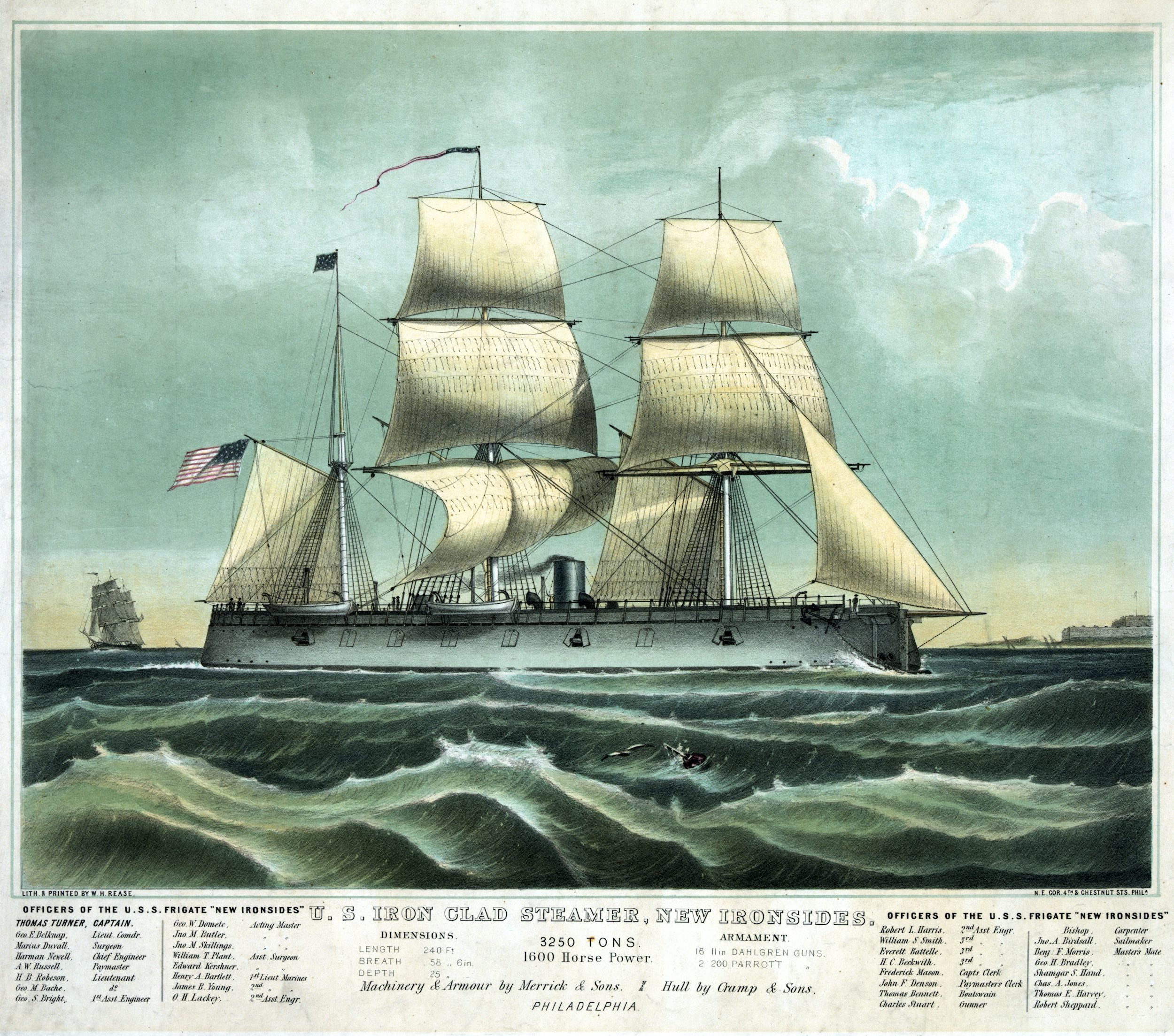
U.S. Iron clad steamer, New Ironsides
Library of Congress image.
From Wikipedia:
USS New Ironsides was a wooden-hulled broadside ironclad built for the United States Navy during the American Civil War. The ship spent most of her career blockading the Confederate ports of Charleston, South Carolina, and Wilmington, North Carolina, in 1863–65. New Ironsides bombarded the fortifications defending Charleston in 1863 during the First and Second Battles of Charleston Harbor. At the end of 1864 and the beginning of 1865 she bombarded the defenses of Wilmington in the First and Second Battles of Fort Fisher.
Although she was struck many times by Confederate shells, gunfire never significantly damaged the ship or injured the crew. Her only casualty in combat occurred when she was struck by a spar torpedo carried by the CSS David.
New Ironsides was 230 feet (70.1 m) long between perpendiculars and 249 feet 6 inches (76.0 m) long overall. She had a beam of 57 feet 6 inches (17.5 m) and a draft of 15 feet 8 inches (4.8 m). The ship displaced 4,120 long tons (4,190 t), 495 long tons (503 t) more than her designed displacement. To minimize her draft, New Ironsides was given a wide beam and a flat bottom. She had a rectangular ram that projected 6 feet (1.8 m) forward from her bow. The ship’s crew consisted of 449 officers and men.
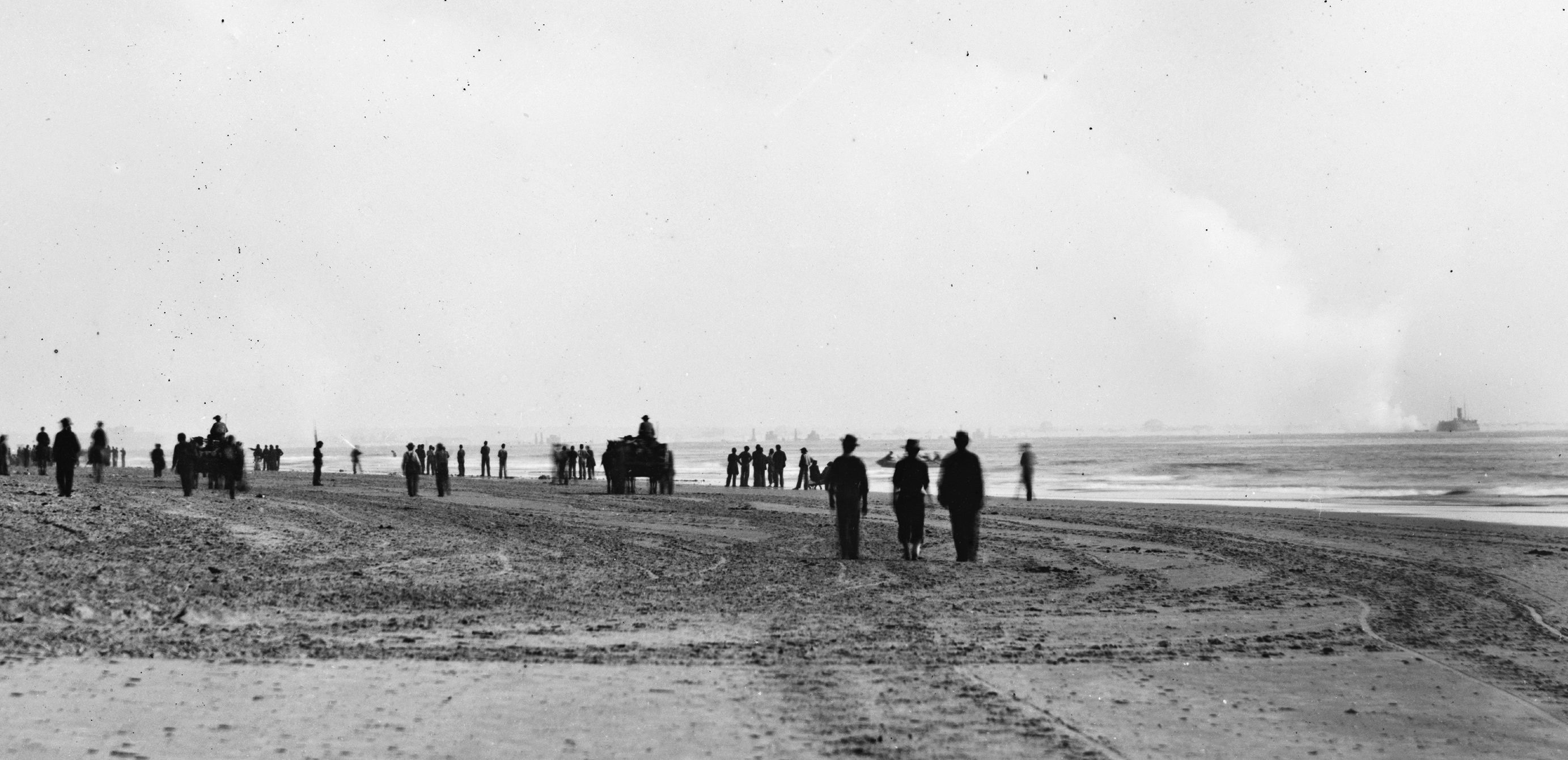
Soldiers on beach of Morris Island. In distance, ironclads, including USS New Ironsides and five monitor-class warships are in action against Fort Sumter and Fort Moultrie in Charleston harbor. (Source: 99 Historic Images of Civil War Charleston, ed. by Garry Adelman, John Richter, and Bob Zeller, Center for Civil War Photography, 2009, p. 18); from photographs by Philip Haas and Washington Peale.
Image cropped to show action.
Library of Congress image.
__________
 Note – This image has been digitally adjusted for one or more of the following:
- fade correction,
- color, contrast, and/or saturation enhancement
- selected spot and/or scratch removal
- cropped for composition and/or to accentuate subject matter
- straighten image

July 15.— Received orders to march to Berlin. We marched to Keedysville, and from there to Crampton’s Gap. Our corps did not go through the Gap, but headquarters were at Burkettsville on the other side of the Gap. Day pleasant most of the time. The march was long and tiresome, as other corps were ahead of us.
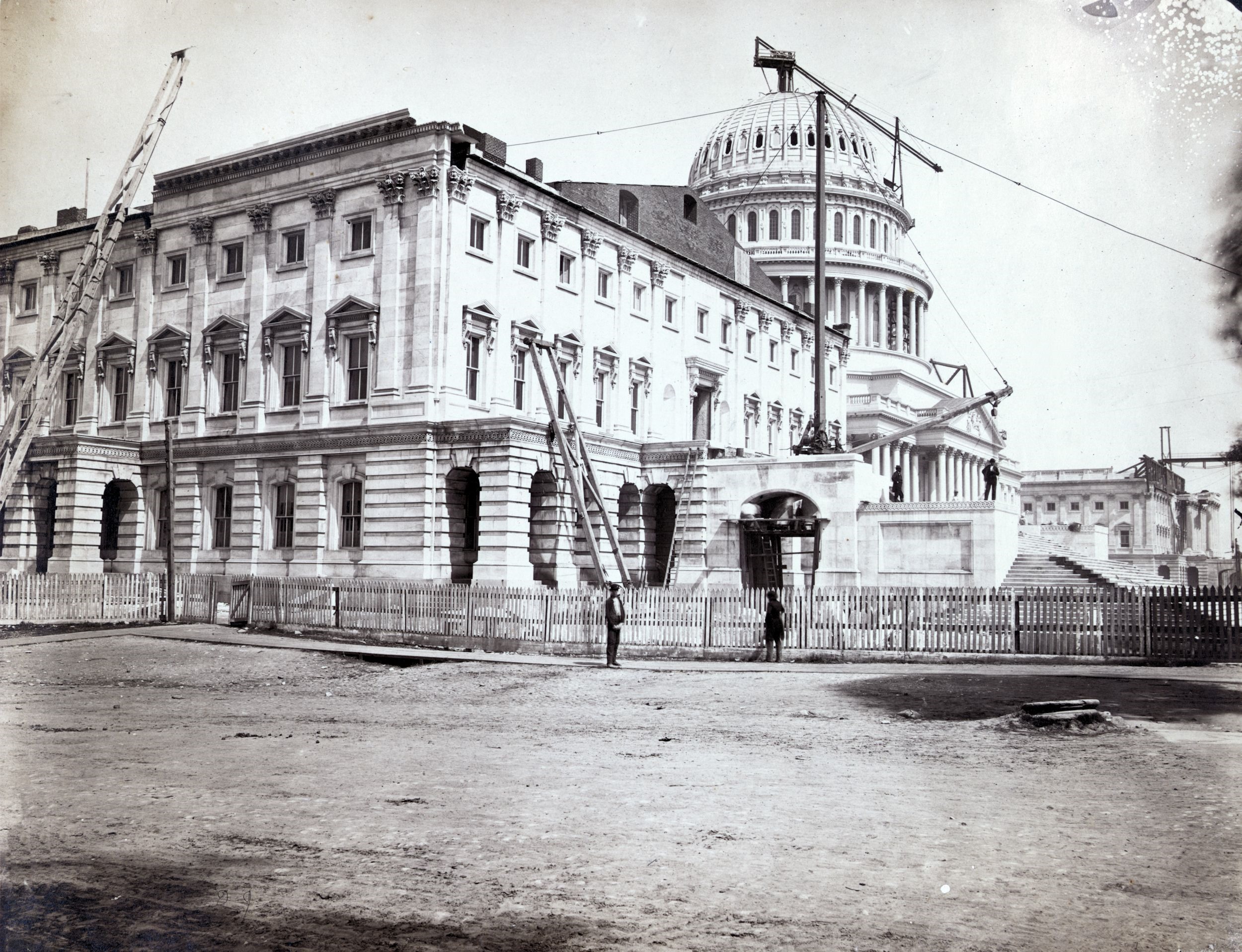
U.S. Capitol under construction, Washington, D.C., south-east view, July, 1863; photo by Andrew J. Russell.
Library of Congress image.
 __________
Note – This image has been digitally adjusted for one or more of the following:
- fade correction,
- color, contrast, and/or saturation enhancement
- selected spot and/or scratch removal
- cropped for composition and/or to accentuate subject matter
- straighten image

by John Beauchamp Jones
JULY 15TH—There was a rumor of another battle beyond the Potomac, this morning, but it has not been confirmed.
From Charleston we have no news; but from Jackson there has been considerable fighting, without a general engagement.
The Enquirer and Sentinel to-day squint at a military dictatorship; but President Davis would hardly attempt such a feat at such a time.
Gen. Samuel Jones, Western Virginia, has delayed 2000 men ordered to Lee, assigning as an excuse the demonstrations of the enemy in the KanawhaValley. “Off with his head—so much for Buckingham!”
There is some gloom in the community ; but the spirits of the people will rebound.
A large crowd of Irish, Dutch, and Jews are daily seen at Gen. Winder’s door, asking permission to go North on the flag of truce boat. They fear being forced into the army; they will be compelled to aid in the defense of the city, or be imprisoned. They intend to leave their families behind, to save the property they have accumulated under the protection of the government.
Files of papers from Europe show that Mr. Roebuck and other members of Parliament, as well as the papers, are again agitating the question of recognition. We shall soon ascertain the real intentions of France and England. If they truly desire our success, and apprehend danger from the United States in the event of a reconstruction of the Union, they will manifest their purposes when the news of our recent calamities shall be transported across the ocean. And if such a thing as reconstruction were possible, and were accomplished (in such a manner and on such terms as would not appear degrading to the Southern people), then, indeed, well might both France and England tremble. The United States would have millions of soldiers, and the Southern people would not owe either of them a debt of gratitude.


