July 9 — We remained near Funkstown until nearly night. Everything was quiet along the front until about five o’clock this evening, when the Yankees advanced and drove back our cavalry, and we were ordered to the front to meet the advancing enemy. We marched about three miles below Funkstown and sighted him, put our battery in position and fired two rounds, which completely checked the advance. It was getting dark when we fired, and we remained in position until an hour after dark, then fell back and camped a mile below Funkstown.
July 2013
July 9.—Charles Macbeth, the Mayor of Charleston, S. C., noticing the preparations being made by the Nationals for the attack on Morris Island, issued the following proclamation to the citizens of that city and its vicinity:
“Whereas, the enemy by land and sea have appeared in large force on the islands and neighborhood of the city, and in consultation with General Beauregard, he expressed the opinion that an attack upon our city is imminent, and with the concurrence of General Beauregard, I advise and earnestly request all women and children, and other non-combatants, to leave the city as soon as possible.”
This was followed by two other proclamations, calling on citizens to close their places of business, and ordering the arrest of all free negroes in the city, as they were wanted to work on some unfinished defences on Morris Island. During the day some five or more transports appeared off the harbor, and the National gunboats in Stono River were occupied in shelling two points on James’s Island.
—Corydon, Ind., was captured and plundered by the rebel forces under General John Morgan. —(Doc. 47.)
—A short engagement took place at Aransas Pass, Texas, between the gunboat Scioto and the rebel batteries at that place, without important results or loss of life.—General Abner Doubleday published an order, returning his thanks to the Vermont brigade, the One Hundred and Fifty-first Pennsylvania volunteers, and the Twentieth New-York State militia, for their gallant conduct in resisting in the front line the main attack of the enemy at Gettysburgh, after sustaining a terrific fire from seventy-five to one hundred pieces of artillery.—Mr. Wolff, a candidate for Congress in Kentucky, was arrested in Owen County, and sent to General Burnside, at Cincinnati, in consequence of the following words, used in a speech to the people of Owen: “This is a John Brown raid—a war against slavery, and he hoped every true Kcntuckian would rise in arms in opposition to it. He was for secession, separation, or any thing against it.”— The National troops marched into Port Hudson, Louisiana.
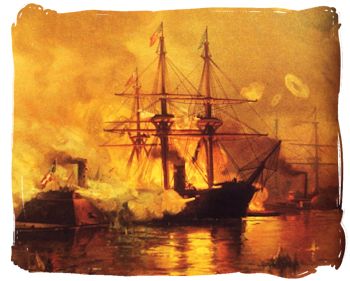
July 9th. At one A. M., received despatches from General Banks, and half an hour afterwards ordered the transports to get under way and report at Mount Pleasant Landing. Colonel Smith came on board, a bearer of despatches form General Banks, with orders to report for passage to Vicksburg. At three thirty A. M. the transports went down the river; at four thirty our Paymaster went below, in steamer Bee, for stores; at eight thirty called all to up anchor, and never before, during the Hartford’s cruise, was the anchor hove up by the boys with such a will and light hearts, or in a shorter period. The reader may here ask what was the stimulant administered to produce all this? In a few words I will tell him. The lads had been made to believe that the ship had been ordered home, and would leave New Orleans for the North very soon after she should arrive at that point, and general liberty had been given them; also there was another thing which made them light at heart: it was, that Port Hudson and Vicksburg had fallen, leaving the Mississippi clear from the Gulf to Cincinnati and St. Louis, and they had been in part instrumental in bringing about this work and felt proud of it. At nine A. M., came to anchor above Port Hudson batteries on account of some part of our machinery getting heated; at ten o’clock got under way again and stood down past Port Hudson; at ten ten the army firing a salute when the American flag was raised over the place; at ten forty-five came to anchor below Port Hudson; the gunboat Albatross accompanied us down; made signal to Richmond and New London at anchor here; finished taking provisions from steamer Bee on board during the afternoon; at seven thirty P. M., the steamer Laurel Hill passed down loaded with troops; at ten o’clock the transports St. Maurice, Empire Parish, Union, St. Charles, General Banks, and Louisiana Bell passed down the river with troops.
Thursday, 9th.—Reported that Johnston and the Yanks have been doing some hard fighting. Drew five days’ rations. Think we will start pretty soon. Very unwell.
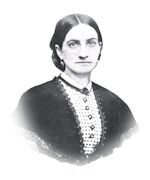
July 9.—Vicksburg has really gone. I suppose we were compelled to surrender it. I wish our people would not tell so many untruths as they have about this place. Only a few days ago we heard there were provisions enough in it to last six months, and now it is said our troops were dying of starvation. All looks gloomy; there is scarcely one bright spot to be seen.
General Lee went into Pennsylvania, and had a desperate battle at Gettysburg. After losing many of our best men, he was compelled to retreat. It is said he has brought out a vast amount of spoils. All these disasters only serve to prolong the war; for I am certain that, happen what will, we will never be slaves to the foe.
"A breath of submission we breathe not;
The sword that we’ve drawn we will sheath not!
Its scabbard is left where our martyrs are laid,
And the vengeance of ages has whetted its blade".
Earth may hide, waves engulf, fire consume us,
But they shall not to slavery doom us."
There is an old Scotch proverb which says "It is a lang road that has na a turnin." The Federals have been having every thing their own way lately. Our day will soon come.
"What though sunken be the sun,
There are stars when day is done."
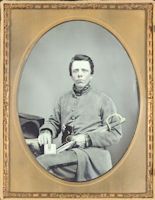
July 9 — We have just returned from town with our paroles. WRC
by John Beauchamp Jones
JULY 9TH.—The sad tidings from Vicksburg have been confirmed by subsequent accounts. The number of men fit for duty on the day of capitulation was only a little upwards of 7000. Flour was selling at $400 per barrel! This betrays the extremity to which they had been reduced.
A dispatch to-day states that Grant, with 100,000 men (supposed), is marching on Jackson, to give Johnston battle. But Johnston will retire—he has not men enough to withstand him, until he leads him farther into the interior. If beaten, Mobile might fall.
We have no particulars yet—no comments of the Southern generals under Pemberton. But the fall of the place has cast a gloom over everything.
The fall of Vicksburg, alone, does not make this the darkest day of the war, as it is undoubtedly. The news from Lee’s army is appalling. After the battle of Friday, the accounts from Martinsburg now state, he fell back toward Hagerstown, followed by the enemy, fighting but little on the way. Instead of 40,000 we have only 4000 prisoners. How many we have lost, we know not. The Potomac is, perhaps, too high for him to pass it—and there are probably 15,000 of the enemy immediately in his rear! Such are the gloomy accounts from Martinsburg.
Our telegraph operators are great liars, or else they have been made the dupes of spies and traitors. That the cause has suffered much, and may be ruined by the toleration of disloyal persons within our lines, who have kept the enemy informed of all our movements, there can be no doubt.
The following is Gen. Johnston’s dispatch announcing the fall of Vicksburg:
“JACKSON, July 7th, 1863.
“HON. J. A. SEDDON, SECRETARY OF WAR.
“Vicksburg capitulated on the 4th inst. The garrison was paroled, and are to be returned to our lines, the officers retaining their side-arms and personal baggage.
“This intelligence was brought by an officer who left the place on Sunday, the 5th.
“J. E. JOHNSTON, General.”
We get nothing from Lee himself. Gen. Cooper, the Secretary of War, and Gen. Hill went to the President’s office about one o’clock. They seemed in haste, and excited. The President, too, is sick, and ought not to attend to business. It will kill him, perhaps.
There is serious anxiety now for the fate of Richmond. Will Meade be here in a few weeks? Perhaps so—but, then, Lee may not have quite completed his raid beyond the Potomac.
The Baltimore American, no doubt in some trepidation for the quiescence of that city, gets up a most glowing account of “Meade’s victory”—if it should, indeed, in the sequel, prove to have been one. That Lee fell back, is true; but how many men were lost on each side in killed, wounded, and prisoners—how many guns were taken, and what may be the result of the operations in Pennsylvania and Maryland—of which we have as yet such imperfect accounts—will soon be known.
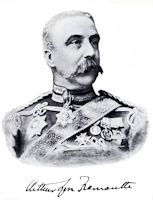
8th July (Wednesday).—My conductor told me he couldn’t go to-day on account of a funeral, but he promised faithfully to start to-morrow. Every one was full of forebodings as to my probable fate when I fell into Yankee clutches. In deference to their advice I took off my grey shooting-jacket, in which they said I was sure to be taken for a rebel, and I put on a black coat; but I scouted all well-meant advice as to endeavouring to disguise myself as an “American citizen,” or to conceal the exact truth in any way. I was aware that a great deal depended upon falling into the hands of a gentleman, and I did not believe these were so rare in the Northern army as the Confederates led me to suppose.
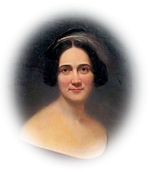
Portland, Ala., July 8, 1863.—My mother ill at her home on the plantation near here—where I have come to see her. But to go back first to my trip home from Flat Rock to Camden. At the station, I saw men sitting on a row of coffins smoking, talking, and laughing, with their feet drawn up tailor-fashion to keep them out of the wet. Thus does war harden people’s hearts.
Met James Chesnut at Wilmington. He only crossed the river with me and then went back to Richmond. He was violently opposed to sending our troops into Pennsylvania: wanted all we could spare sent West to make an end there of our enemies. He kept dark about Vallandigham.[1] I am sure we could not trust him to do us any good, or to do the Yankees any harm. The Coriolanus business is played out.
As we came to Camden, Molly sat by me in the cars. She touched me, and, with her nose in the air, said: “Look, Missis.” There was the inevitable bride and groom—at least so I thought—and the irrepressible kissing and rolling against each other which I had seen so often before. I was rather astonished at Molly’s prudery, but there was a touch in this scene which was new. The man required for his peace of mind that the girl should brush his cheek with those beautiful long eyelashes of hers. Molly became so outraged in her blue-black modesty that she kept her head out of the window not to see! When we were detained at a little wayside station, this woman made an awful row about her room. She seemed to know me and appealed to me; said her brother-in-law was adjutant to Colonel K——, etc.
Molly observed, “You had better go yonder, ma’am, where your husband is calling you.” The woman drew herself up proudly, and, with a toss, exclaimed: “Husband, indeed! I’m a widow. That is my cousin. I loved my dear husband too well to marry again, ever, ever!” Absolutely tears came into her eyes. Molly, loaded as she was with shawls and bundles, stood motionless, and said: ”After all that gwine-on in the kyars! O, Lord, I should a let it go ’twas my husband and me! nigger as I am.”
Here I was at home, on a soft bed, with every physical comfort; but life is one long catechism there, due to the curiosity of stay-at-home people in a narrow world.
In Richmond, Molly and Lawrence quarreled. He declared he could not put up with her tantrums. Unfortunately I asked him, in the interests of peace and a quiet house, to bear with her temper; I did, said I, but she was so good and useful. He was shabby enough to tell her what I had said at their next quarrel. The awful reproaches she overwhelmed me with then! She said she “was mortified that I had humbled her before Lawrence.”
But the day of her revenge came. At negro balls in Richmond, guests were required to carry “passes,” and, in changing his coat Lawrence forgot his pass. Next day Lawrence was missing, and Molly came to me laughing to tears. ”Come and look,” said she. ”Here is the fine gentleman tied between two black niggers and marched off to jail.” She laughed and jeered so she could not stand without holding on to the window. Lawrence disregarded her and called to me at the top of his voice: “Please, ma’am, ask Mars Jeems to come take me out of this. I ain’t done nothin’.”
As soon as Mr. Chesnut came home I told him of Lawrence’s sad fall, and he went at once to his rescue. There had been a fight and a disturbance at the ball. The police had been called in, and when every negro was required to show his “pass,” Lawrence had been taken up as having none. He was terribly chopfallen when he came home walking behind Mr. Chesnut. He is always so respectable and well-behaved and stands on his dignity.
I went over to Mrs. Preston’s at Columbia. Camden had become simply intolerable to me. There the telegram found me, saying I must go to my mother, who was ill at her home here in Alabama. Colonel Goodwyn, his wife, and two daughters were going, and so I joined the party. I telegraphed Mr. Chesnut for Lawrence, and he replied, forbidding me to go at all; it was so hot, the cars so disagreeable, fever would be the inevitable result. Miss Kate Hampton, in her soft voice, said: “The only trouble in life is when one can’t decide in which way duty leads. Once know your duty, then all is easy.”
I do not know whether she thought it my duty to obey my husband. But I thought it my duty to go to my mother, as I risked nothing but myself.
We had two days of an exciting drama under our very noses, before our eyes. A party had come to Columbia who said they had run the blockade, had come in by flag of truce, etc. Colonel Goodwyn asked me to look around and see if I could pick out the suspected crew. It was easily done. We were all in a sadly molting condition. We had come to the end of our good clothes in three years, and now our only resource was to turn them upside down, or inside out, and in mending, darning, patching, etc.
Near me on the train to Alabama sat a young woman in a traveling dress of bright yellow; she wore a profusion of curls, had pink cheeks, was delightfully airy and easy in her manner, and was absorbed in a flirtation with a Confederate major, who, in spite of his nice, new gray uniform and two stars, had a very Yankee face, fresh, clean-cut, sharp, utterly unsunburned, florid, wholesome, handsome. What more in compliment can one say of one’s enemies? Two other women faced this man and woman, and we knew them to be newcomers by their good clothes. One of these women was a German. She it was who had betrayed them. I found that out afterward.
The handsomest of the three women had a hard, Northern face, but all were in splendid array as to feathers, flowers, lace, and jewelry. If they were spies why were they so foolish as to brag of New York, and compare us unfavorably with the other side all the time, and in loud, shrill accents? Surely that was not the way to pass unnoticed in the Confederacy.
A man came in, stood up, and read from a paper, ”The surrender of Vicksburg.”[2] I felt as if I had been struck a hard blow on the top of my head, and my heart took one of its queer turns. I was utterly unconscious: not long, I dare say. The first thing I heard was exclamations of joy and exultation from the overdressed party. My rage and humiliation were great. A man within earshot of this party had slept through everything. He had a greyhound face, eager and inquisitive when awake, but now he was as one of the seven sleepers.
Colonel Goodwyn wrote on a blank page of my book (one of De Quincey’s—the note is there now), that the sleeper was a Richmond detective.
Finally, hot and tired out, we arrived at West Point, on the Chattahoochee River. The dusty cars were quite still, except for the giggling flirtation of the yellow gown and her major. Two Confederate officers walked in. I felt mischief in the air. One touched the smart major, who was whispering to Yellow Gown. The major turned quickly. Instantly, every drop of blood left his face; a spasm seized his throat; it was a piteous sight. And at once I was awfully sorry for him. He was marched out of the car. Poor Yellow Gown’s color was fast, but the whites of her eyes were lurid. Of the three women spies we never heard again. They never do anything worse to women, the high-minded Confederates, than send them out of the country. But when we read soon afterward of the execution of a male spy, we thought of the ”major.”
At Montgomery the boat waited for us, and in my haste I tumbled out of the omnibus with Dr. Robert Johnson’s assistance, but nearly broke my neck. The thermometer was high up in the nineties, and they gave me a stateroom over the boiler. I paid out my Confederate rags of money freely to the maid in order to get out of that oven. Surely, go where we may hereafter, an Alabama steamer in August lying under the bluff with the sun looking down, will give one a foretaste, almost an adequate idea, of what’s to come, as far as heat goes. The planks of the floor burned one’s feet under the bluff at Selma, where we stayed nearly all day—I do not know why.
Met James Boykin, who had lost 1,200 bales of cotton at Vicksburg, and charged it all to Jeff Davis in his wrath, which did not seem exactly reasonable to me. At Portland there was a horse for James Boykin, and he rode away, promising to have a carriage sent for me at once. But he had to go seven miles on horseback before he reached my sister Sally’s, and then Sally was to send back. On that lonely riverside Molly and I remained with dismal swamps on every side, and immense plantations, the white people few or none. In my heart I knew my husband was right when he forbade me to undertake this journey.
There was one living thing at this little riverside inn— a white man who had a store opposite, and oh, how drunk he was! Hot as it was, Molly kept up a fire of pine knots. There was neither lamp nor candle in that deserted house. The drunken man reeled over now and then, lantern in hand; he would stand with his idiotic, drunken glare, or go solemnly staggering round us, but always bowing in his politeness. He nearly fell over us, but I sprang out of his way as he asked, “Well, madam, what can I do for you?”
Shall I ever forget the headache of that night and the fright? My temples throbbed with dumb misery. I sat upon a chair, Molly on the floor, with her head resting against my chair. She was as near as she could get to me, and I kept my hand on her. “Missis,” said she, “now I do believe you are scared, scared of that poor, drunken thing. If he was sober I could whip him in a fair fight, and drunk as he is I kin throw him over the banister, ef he so much as teches you. I don’t value him a button!”
Taking heart from such brave words I laughed. It seemed an eternity, but the carriage came by ten o’clock, and then, with the coachman as our sole protector, we poor women drove eight miles or more over a carriage road, through long lanes, swamps of pitchy darkness, with plantations on every side.
The house, as we drew near, looked like a graveyard in a nightmare, so vague and phantom-like were its outlines.
I found my mother ill in bed, feeble still, but better than I hoped to see her. “I knew you would come,” was her greeting, with outstretched hands. Then I went to bed in that silent house, a house of the dead it seemed. I supposed I was not to see my sister until the next day. But she came in some time after I had gone to bed. She kissed me quietly, without a tear. She was thin and pale, but her voice was calm and kind.
As she lifted the candle over her head, to show me something on the wall, I saw that her pretty brown hair was white. It was awfully hard not to burst out into violent weeping. She looked so sweet, and yet so utterly brokenhearted. But as she was without emotion, apparently, it would not become me to upset her by my tears.
Next day, at noon, Hetty, mother’s old maid, brought my breakfast to my bedside. Such a breakfast it was! Delmonico could do no better. “It is ever so late, I know,” to which Hetty replied: ”Yes, we would not let Molly wake you.” “What a splendid cook you have here.” “My daughter, Tenah, is Miss Sally’s cook. She’s well enough as times go, but when our Miss Mary comes to see us I does it myself,” and she courtesied down to the floor. “Bless your old soul,” I cried, and she rushed over and gave me a good hug.
She is my mother’s factotum; has been her maid since she was six years old, when she was bought from a Virginia speculator along with her own mother and all her brothers and sisters. She has been pampered until she is a rare old tyrant at times. She can do everything better than any one else, and my mother leans on her heavily. Hetty is Dick’s wife; Dick is the butler. They have over a dozen children and take life very easily.
Sally came in before I was out of bed, and began at once in the same stony way, pale and cold as ice, to tell me of the death of her children. It had happened not two weeks before. Her eyes were utterly without life; no expression whatever, and in a composed and sad sort of manner she told the tale as if it were something she had read and wanted me to hear:
”My eldest daughter, Mary, had grown up to be a lovely girl. She was between thirteen and fourteen, you know. Baby Kate had my sister’s gray eyes; she was evidently to be the beauty of the family. Strange it is that here was one of my children who has lived and has gone and you have never seen her at all. She died first, and I would not go to the funeral. I thought it would kill me to see her put under the ground. I was lying down, stupid with grief when Aunt Charlotte came to me after the funeral with this news: ‘Mary has that awful disease, too.’ There was nothing to say. I got up and dressed instantly and went to Mary. I did not leave her side again in that long struggle between life and death. I did everything for her with my own hands. I even prepared my darling for the grave. I went to her funeral, and I came home and walked straight to my mother and I begged her to be comforted; I would bear it all without one word if God would only spare me the one child left me now.”
Sally has never shed a tear, but has grown twenty years older, cold, hard, careworn. With the same rigidity of manner, she began to go over all the details of Mary’s illness. ”I had not given up hope, no, not at all. As I sat by her side, she said: “Mamma, put your hand on my knees; they are so cold.’ I put my hand on her knee; the cold struck to my heart. I knew it was the coldness of death.” Sally put out her hand on me, and it seemed to recall the feeling. She fell forward in an agony of weeping that lasted for hours. The doctor said this reaction was a blessing; without it she must have died or gone mad.
While the mother was so bitterly weeping, the little girl, the last of them, a bright child of three or four, crawled into my bed. “Now, Auntie,” she whispered, “I want to tell you all about Mamie and Katie, but they watch me so. They say I must never talk about them. Katie died because she ate blackberries, I know that, and then Aunt Charlotte read Mamie a letter and that made her die, too. Maum Hetty says they have gone to God, but I know the people saved a place between them in the ground for me.”
Uncle William was in despair at the low ebb of patriotism out here. “West of the Savannah River,” said he, “it is property first, life next, honor last.” He gave me an excellent pair of shoes. What a gift! For more than a year I have had none but some dreadful things Armstead makes for me, and they hurt my feet so. These do not fit, but that is nothing; they are large enough and do not pinch anywhere. I have absolutely a respectable pair of shoes!!
Uncle William says the men who went into the war to save their negroes are abjectly wretched. Neither side now cares a fig for these beloved negroes, and would send them all to heaven in a hand-basket, as Custis Lee says, to win in the fight.
General Lee and Mr. Davis want the negroes put into the army. Mr. Chesnut and Major Venable discussed the subject one night, but would they fight on our side or desert to the enemy? They don’t go to the enemy, because they are comfortable as they are, and expect to be free anyway.
When we were children our nurses used to give us tea out in the open air on little pine tables scrubbed as clean as milk-pails. Sometimes, as Dick would pass us, with his slow and consequential step, we would call out, “Do, Dick, come and wait on us.” “No, little pussies, I never wait on pine tables. Wait till you get big enough to put your legs under your pa’s mahogany.”
I taught him to read as soon as I could read myself, perched on his knife-board. He won’t look at me now; but looks over my head, scenting freedom in the air. He was always very ambitious. I do not think he ever troubled himself much about books. But then, as my father said, Dick, standing in front of his sideboard, has heard all subjects in earth or heaven discussed, and by the best heads in our world. He is proud, too, in his way. Betty, his wife, complained that the other men servants looked finer in their livery. “Nonsense, old woman, a butler never demeans himself to wear livery. He is always in plain clothes.” Somewhere he had picked that up.
He is the first negro in whom I have felt a change. Others go about in their black masks, not a ripple or an emotion showing, and yet on all other subjects except the war they are the most excitable of all races. Now Dick might make a very respectable Egyptian Sphinx, so inscrutably silent is he. He did deign to inquire about General Richard Anderson. “He was my young master once,” said he. ” I always will like him better than anybody else.”
When Dick married Hetty, the Anderson house was next door. The two families agreed to sell either Dick or Hetty, whichever consented to be sold. Hetty refused outright, and the Andersons sold Dick that he might be with his wife. This was magnanimous on the Andersons’ part, for Hetty was only a lady’s-maid and Dick was a trained butler, on whom Mrs. Anderson had spent no end of pains in his dining-room education, and, of course, if they had refused to sell Dick, Hetty would have had to go to them. Mrs. Anderson was very much disgusted with Dick’s ingratitude when she found he was willing to leave them. As a butler he is a treasure; he is overwhelmed with dignity, but that does not interfere with his work at all.
My father had a body-servant, Simon, who could imitate his master’s voice perfectly. He would sometimes call out from the yard after my father had mounted his horse: “Dick, bring me my overcoat. I see you there, sir, hurry up.” When Dick hastened out, overcoat in hand, and only Simon was visible, after several obsequious “Yes, marster; just as marster pleases,” my mother had always to step out and prevent a fight. Dick never forgave her laughing.
Once in Sumter, when my father was very busy preparing a law case, the mob in the street annoyed him, and he grumbled about it as Simon was making up his fire. Suddenly he heard, as it were, himself speaking, “the Hon. S. D. Miller—Lawyer Miller,” as the colored gentleman announced himself in the dark—appeal to the gentlemen outside to go away and leave a lawyer in peace to prepare his case for the next day. My father said he could have sworn the sound was that of his own voice. The crowd dispersed, but some noisy negroes came along, and upon them Simon rushed with the sulky whip, slashing around in the dark, calling himself “Lawyer Miller,” who was determined to have peace.
Simon returned, complaining that “them niggers run so he never got in a hundred yards of one of them.”
At Portland, we met a man who said: “Is it not strange that in this poor, devoted land of ours, there are some men who are making money by blockade-running, cheating our embarrassed government, and skulking the fight?”
[1] Clement Baird Vallandigham was an Ohio Democrat who represented the extreme wing of Northern sympathizers with the South. He was arrested by United States troops in May, 1863, court-martialed and banished to the Confederacy. Not being well received in the South, he went to Canada, but after the war returned to Ohio.
[2] Vicksburg surrendered on July 4,1863. Since the close of 1862, it had again and again been assaulted by Grant and Sherman. It was commanded by Johnston and Pemberton, Pemberton being in command at the time of the surrender. John C. Pemberton was a native of Philadelphia, a graduate of West Point, and had served in the Mexican War.
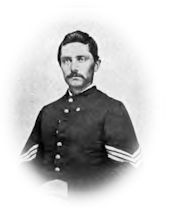
Wednesday, 8th—I came off guard duty this morning at 9 o’clock. There was a hailstorm last night and everything looks nice and green, notwithstanding the fact that there has been no rain for two months. But it is hot and the corn has suffered a great deal. All the fields are planted to corn, as that was the surest way to get food for the rebel army.


