Following the American Civil War Sesquicentennial with day by day writings of the time, currently 1863.

July 2013


Camp White, Charleston, West Virginia, July 8, 1863.

Dear Mother: — . . . We received the news of the capture of Vicksburg last night. I hope it will not turn out as so many reports — stock-jobbers’ lies. We have thus far had encouraging success in Pennsylvania. If it is continued the Rebels will hardly repeat the experiment of invading our soil. Altogether things wear a hopeful appearance, but I do not expect an early end of the war. A great deal remains to be done, and it is gratifying that the people seem determined to be patient and firm. . .

Affectionately, your son,

Rutherford.

Mrs. Sophia Hayes.

8th. Breakfasted and moved out about sunrise. Boys found amusement reading our brother soldiers’ letters which Morgan had feasted upon. Morgan reported near Elizabethtown. Find he turned off towards Brandenburg on the Ohio Road, over the hills. Reached Garnettsville before dark. Some fun with a girl who thought I looked like her former sweetheart—now dead. Three miles from Ohio. Morgan across the river. Captured several steamboats. Lay in the road till morn.

July 8, Wednesday. There was a serenade last night in honor of the success of our arms at Gettysburg and Vicksburg. The last has excited a degree of enthusiasm not excelled during the war. The serenade was got up for a purpose. As a matter of course the first music was at the President’s. Mr. Seward’s friend, General Martindale, arranged matters, and a speech of Mr. Seward duly prepared was loudly delivered, but the music did not do him the honors. To Mr. Secretary Stanton and Major-General Halleck they discoursed sweet sounds, and each responded in characteristic remarks. No allusion was made by either of them to the Navy, or its services. General Halleck never by a scratch of his pen, or by a word from his mouth, ever awarded any credit to the Navy for anything. I am not aware that his sluggish mind has ever done good of any kind to the country.

The rejoicing in regard to Vicksburg is immense. Admiral Porter’s brief dispatch to me was promptly transmitted over the whole country, and led, everywhere, to spontaneous gatherings, firing of guns, ringing of bells, and general gratification and gladness. The price of gold, to use the perverted method of speech, fell ten or fifteen cents and the whole country is joyous. I am told, however, that Stanton is excessively angry because Admiral Porter heralded the news to me in advance of General Grant to the War Department. The telegraph office is in the War Department Building, which has a censorship over all that passes or is received. Everything goes under the Secretary’s eye, and he craves to announce all important information. In these matters of announcing news he takes as deep an interest as in army movements which decide the welfare of the country.

The Potomac is swollen by the late heavy rains, and the passage of the Rebel army is rendered impossible for several days. They are short of ammunition. In the mean time our generals should not lose their opportunity. I trust they will not. Providence favors them. Want of celerity, however, has been one of the infirmities of some of our generals in all this war. Stanton and Halleck should stimulate the officers to press forward at such a time as this, but I fear that they are engaged in smaller matters and they will be more unmindful of these which are more important. Halleck’s policy consists in stopping the enemy’s advance, or in driving the enemy back, — never to capture. Enough has been said to S. and H. to make them aware of the urgency of the President and Cabinet, and I trust it may have a good effect, but I do not learn that anything extra is being done. The President says he is rebuffed when he undertakes to push matters.

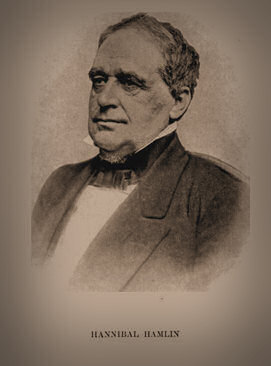
I yesterday informed Vice-President Hamlin and the Maine Senators we should try to keep a couple of steamers and two sailing-vessels cruising off New England during the fishing season; that we could not furnish a gunboat to every place; that the shore defenses belonged properly to the War Department, etc. They on the whole seemed satisfied.

2007-00707.jpg The President sends me a strange letter from Hamlin, asking as a personal favor that prizes may be sent to Portland for adjudication, — says he has not had many favors, asks this on personal grounds. Mr. Hamlin spoke on this subject to me, — said the President referred it to me; — and both he and Mr. Fessenden made a strong local appeal in behalf of Portland. I informed them that such a matter was not to be disposed of on personal grounds or local favoritism; that Portsmouth, Providence, New Haven, and other places had equal claims, if there were any claims, but that public consideration must govern, and not personal favoritism; that additional courts would involve great additional expense; that we had no navy yard or station at Portland, with officers to whom the captors could report, no prison to confine prisoners, no naval constructors or engineers to examine captured vessels, etc., etc. These facts, while they somewhat staggered the gentlemen, quieted Fessenden, but did not cause Hamlin, who is rapacious as a wolf, to abate his demand for government favors. He wanted these paraphernalia, these extra persons, extra boards, and extra expenditures at Portland, and solicited them of the President, as special to himself personally

Headquarters 1st Army Corps, MD., July 8, 1863.

Dear Father, — I joined the corps this morning at Middleton, where we now are, about 8 miles from Frederick. I reported to General Newton, who is in command of the corps, and shall stay for the present with him.

On my way back from Philadelphia and while at the Eutaw House in Baltimore, I met General Butterfield, who was wounded slightly in the breast. He said that he would like me to go with him when he came back. I told him that I was trying to get on to Sedgwick’s staff, but if not successful would be happy to go on to his staff.

On my way here from Frederick, I passed the body of a spy hanging to a tree. He was stark naked and was a most disagreeable object, as he had been hanging there for two days. Our cavalry captured him and hung him immediately. He was a man who had been selling papers, etc., in our camps, and when caught was leading the rebel cavalry to our trains. . . .

What glorious victories we are having! I really begin to think now that we are soon to see the end of this war.

July 8. — We broke camp this morning in a drenching rain, and started with the wagons for Middleton, where our corps is. I saw the Twelfth Corps passing through the town, and saw Major Morse, commanding the 2d Massachusetts, and Bill Perkins. Heard of Tom Robe-son’s[1] death, and Charley Mudge’s[2] also. About a mile out from town I passed the body of the rebel spy, hung by Buford, naked and discolored, still dangling to a tree, — a fearful warning to such rascals. He had been accustomed to sell papers and maps in our army. I found General Newton[3], who was put in command of the First Corps, near Middleton. He said he should be happy to have me stay with him, and I shall do so. At 3 P.M. we received an order to move to the Gap, which we did, bivouacking there for the night. Our cavalry pickets had been driven in to Boonesboro, and we were sent therefore to prevent John R.[4] from getting the Gap. The Eleventh Corps also went there. A cavalry fight was going on a mile or more beyond Boonesboro during the afternoon, in which we held our own. It cleared off at noon. Found that Egbert had been taken prisoner and his things sent home.


[1] Thomas R. Robeson, Harvard 1861.

[2] Charles R. Mudge, my classmate.

[3] Gen. John Newton.

[4] Johnny Reb.

Vicksburg, Wednesday, July 8. No immediate prospect of moving. Boys busy putting up tents, shades, etc. I strolled among the Alabams on the right. Got a “fly” fixed for which we had use. Found some of the greenest specimens of humanity I think, in the universe, their ignorance being little less than that of the slave they despise, with as imperfect a dialect. They “reckoned as how you ‘uns all would be a heap wus to we ‘uns all”. They wished they could come back to the old Union again.

Letter No. VIII.

Hagerstown, Md.,
July 8th, 1863.

To Master Stark West, four years old:

My Dear Little Man: I wrote to mamma from our camp near Chambersburg, Pennsylvania, and as to-morrow is your birthday, and you are getting to be a big boy, I thought you would like for papa to write you a letter and tell you something about the war and the poor soldiers.

God has been very good to me since I wrote to mamma. He has saved my life when many thousands of good men have been slain all around me. On the 1st, 2nd and 3rd of July a very terrible battle was fought near Gettysburg. We marched all night, leaving camp at 2 o’clock in the afternoon in order to reach the battlefield in time. There had been some fighting on the 1st and we passed a hospital where I saw a great many wounded soldiers, who were mangled and bruised in every possible way, some with their eyes shot out, some with their arms, or hands, or fingers, or feet or legs shot off, and all seeming to suffer a great deal. About two miles farther on I found a great many soldiers drawn up in a line, ready to meet the Yankees, who formed another line a mile or two in front of them. These lines were three or four miles long, and at different places on the hills were the batteries of artillery.

These, you know, are cannons, which shoot large shells, and iron balls a long distance. We kept in this line so long, and I was so tired, I went to sleep and dreamed about you and mamma and little sister, and I asked God to take care of you if I am taken away from you. After awhile we were marched off in a great hurry towards the left of the Yankee line of battle, which is called the left wing, and was opposite to our right wing, which was composed principally of Hood’s division. Our brigade was ordered to charge upon one of the Yankee batteries, which was posted on a mountain as high as mount Bonnell, with another battery on a still higher mountain, just back of it, to support it. We were standing in an open field, under the shot and shell of these batteries, for half an hour, before we moved forward, and a good many soldiers were killed all around me. One poor fellow had his head knocked off in a few feet of me, and I felt all the time as if I would never see you and little sister again. When the command was given to charge we moved forward as fast as we could towards the battery. It was between a half and three-quarters of a mile across an open field, over a marshy branch, over a stone fence, and up a very rugged and rocky hill, while Yankee sharpshooters were on the higher mountains, so as to have fairer shots at our officers. On we went yelling and whooping, and soon drove the Yankees from the first battery, but were too much worn out and exhausted to climb to the second, besides a great many of our men were killed, and minnie bullets and grape shot were as thick as hail, and we were compelled to get behind the rocks and trees to save ourselves.

We renewed the charge several times, but the slaughter of our men was so great that after four or five efforts to advance we retired about sunset and slept behind the rocks. I had thrown away my blanket and everything except my musket and cartridge box in the fight, and so spent a very uncomfortable night. We remained at the same place all the next day, and every now and then Yankee bullets would come pretty thick amongst us. One bullet went through my beard and struck a rock half an inch from my head, and a piece of the bullet hit me on the lip and brought the blood.

Lieutenant Joe Smith, of McLennan county, was killed in ten feet of me, and John Terry and Tom Mullens were both wounded in the shoulders. I wanted to write my little man a letter, which he could read when he was a big boy, but it has been raining and the ground is very wet and everything so uncomfortable that I cannot enjoy it.

Tell mamma she had better put off her visit to South Carolina until the war is over, as she seems to be doing very well, and it will be better for her.

Your father, truly,

John C. West.
July 8—We are resting, and, goodness knows, we need it very much. I sold my coat for twenty dollars and a gray jacket. We lost in the last fight in our company eleven killed and twenty-six wounded; three of the latter will not live, and nine of our number became prisoners, besides the wounded. Our three lieutenants are all wounded and prisoners. Katz is also a prisoner. Nothing further up to the 10th.

July 8.—An engagement occurred at Boonsboro, Md., between the National cavalry, under Generals Buford and Kilpatrick, and the rebels, under Generals J. E. B. Stuart, Hampton, and Jones, resulting in the defeat of the latter.— (Doc. 32.)

—The brig W. B. Nash, in latitude 40°, longitude 70°, was captured and burned by the rebel privateer Florida.—At Louisville, Ky., a meeting of the citizens was held to take measures for the defence of that city, then threatened by the rebels, supposed to be under Generals Morgan and Buckner. A resolution was adopted: “That all male citizens between the ages of eighteen and forty-five be enrolled into companies for service, if required, and that all such who refuse shall be sent to the North.”

—General Burnside, at Cincinnati, Ohio, issued a general order, giving directions for the conduct of the military affairs of his department in cases of habeas corpus.—A Company of General Stahel’s cavalry under Colonel Wynkoop, on a reconnoissance near Hagerstown, Md., succeeded in capturing a rebel company, consisting of two officers and fifty men, who were sent to Carlisle, Pa.—Two rebel schooners were destroyed at the Rio Grande, Texas, by a party of men, belonging to the National gunboat Scioto.—A Detachment of National cavalry, under the command of Captain Greenfield and Lieutenant Kelley, of General Kelley’s command, captured a train of fifteen wagons, sixty mules, two officers and twenty men, with their horses, at a point four miles from Williamsport, Md.—There was a heavy freshet in the Potomac River, which, it was supposed, would prevent the crossing of the retreating army under the rebel General Lee.— General Dabney H. Maury, commanding the rebel department of the Gulf, at Mobile, Ala., issued the following to the citizens of that place and its vicinity:

“The calamity which has befallen our arms at Vicksburgh has a peculiar significance for you. Mobile may be attacked within a very short time, and we must make every preparation for its successful defence.

“All able-bodied men within the limits of the city and county must at once organize into companies, and report for duty in defence of this position. Owners of able-bodied slaves are urged to send them immediately to work on the fortifications.

“Brigadier-General Slaughter will receive the reports of the companies which may be organized, have arms issued to such as have none, give orders for their instruction, and assign them to their stations.

“Reports of slaves for labor on the defences may be made to Brigadier-General Leadbetter, who has made arrangements for their good treatment while in his employ.”—Port Hudson, La., was surrendered to the Union General Banks, by the rebel commander Frank Gardner. — (Docs. 38 and 89.)

Wednesday, 8th—Remain in camp.