Following the American Civil War Sesquicentennial with day by day writings of the time, currently 1863.

July 2013

July 6. — Bought some things this morning, and had my photographs taken, and started for Baltimore in the 11 o’clock train with the rest of the staff. On arriving in Baltimore we found out that headquarters of the Army of the Potomac would be in Frederick the next day. We made two efforts to get a train for Frederick, but found that we could not get off until to-morrow. Met Rev. James F. Clarke at the Eutaw House, looking for Henry Huidekoper.[1] Before leaving Philadelphia, I called on General Reynolds’s sisters, and received the general’s pocketbook as a memento. Saw General Butterfield, and he offered me a place on his staff when he came back.


[1] Henry S. Huidekoper, Harvard 1862, Mr. Clarke’s nephew.

Vicksburg, Monday, July 6. To-day we lay waiting all day for orders to hitch up to go into permanent park, but for some reason or other they did not come, and we were exposed to the burning sun all day, but well amused, strolling over the scarred surface of Vicksburg, plowed everywhere by raking shot and bursting shell, exploring the extensive caves inhabited by the citizens during the siege, but now deserted, and they once more were not afraid to walk in God’s sunlight. Received mail.

Camp White, July 6, 1863.

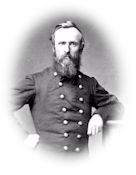
Dearest: — Dr. Joe got back yesterday — twenty-four hours from Chillicothe. Very glad to hear his cheerful account of you.

I am in the tent occupied by Captain Hood and wife in front of the cottage. We all miss you. You could not have felt the loss of me more than I did of you. Notwithstanding the loss of the dear little boy, your visit leaves a happy impression. I love you more than ever, darling.

The Ninth has gone to Fayette. If the good news from the East holds out, I think the Twenty-third will follow soon.

We had a good Fourth. Salutes from Simmonds and Austin. A good deal of drinking but no harm. We let all out of the guard-house.

I send you a deed to execute and send to Stephenson. Do it before a notary. I will ask Uncle to put twenty-five hundred dollars stock in his bank in your name.

I am sorry to hear Uncle Scott is in poor health. I think the news from the East will be a good tonic. We shall whip the rascals some day. — Love to all.

Affectionately,

R. B. Hayes.

Mrs. Hayes.

July 6 — This morning we started for Hagerstown, passing through Lighterstown, a small village six miles from our destination. We did not go the direct road to Hagerstown, as the Yanks held the town and were on the principal roads leading to it from the east and north, consequently we flanked, and moved on different by-roads east of town during the fore part of the day, through a rolling country and over some hilly roads.

Late this evening we first sighted the town, and the most interesting object that attracted our earliest attention was a body of blue cavalry, drawn up at the edge of town ready for business, and to give us a warm and lively reception. We unlimbered two of our rifled guns and opened fire on their cavalry, and soon after our cavalry charged into the southern suburbs of town and dislodged the enemy there.

Then we advanced our battery and flanked around the southern outskirts of town and moved to the Williamsport pike. Immediately after we arrived on the pike the Yankees placed a battery of Parrott guns in position in the Female Seminary yard on the outskirts of the town, and opened a rapid fire on us, to which we responded with our battery forthwith, and gave them the best fresh work that our establishment could supply at short notice. For awhile the artillery fire was severe, the range was short, and their ten-pound shrapnel whizzed fearfully and exploded all around us. The artillery duel was hot and lively, yet it was but a prelude to a more severe conflict that raged for several hours along the Williamsport pike, in which the cavalry and some infantry on both sides took a hand.

A body of the enemy’s cavalry — I do not know from whence it came — appeared in our rear and struck the pike between us and Williamsport, and for awhile we were between two fires. Just at dusk the fire of their dismounted sharpshooters in our front was heavy and severe. The bullets zipped around us as thick as hail. At the first volley my lead driver fell fatally wounded.

Night, fight, shell, and bullets at last settled the enemy in our front. Then we moved back just a little distance and quickly turned our guns on the cavalry in our rear and opened fire on them with a few rounds of canister and short-range shell. The Yankees soon wavered under our artillery fire and began to break and retire. We kept up a running fight for about four miles, and at last about ten o’clock to-night they were forced from the road in our rear, and retreated in the direction of Harper’s Ferry, which left the Williamsport road clear of Yanks. After the fight we moved back toward Hagerstown and bivouacked for the remainder of the night.

During the latter part of the fight we were so close to the Potomac that I saw the camp-fires blaze on the Virginia hills not far away, yet the Yanks were between us and the river. No doubt the cavalry we fought this evening and to-night were the same set of gentlemen that destroyed some of our wagons night before last, and were trying the same trick to-night, as a great many of our wagons are parked around Williamsport; but this time the raiders struck another sort of game quite different from defenseless teamsters, a few guards, and Company Q.

Night fighting is a perilous business and full of guesswork; ofttimes it is difficult to distinguish friend from foe in the darkness, and it is resorted to only in cases of extreme emergencies or pressing exigency. The artillery firing to-night was certainly beautiful and grand. The flash from the gun brilliantly illuminated all its immediate environments, and the burning fuses of the shell spun threads of sparkling fire in graceful curves across the somber face of night. The whole scene was a splendid display of dangerous fireworks.

The first position we fired from to-day on the Williamsport pike was right close to a small country house about a mile from Hagerstown. Before we commenced firing there was an old cow grazing quietly and leisurely in sweet contentment in front of the house, which was the only sign of life about the premises. The house was closed and apparently deserted.

The enemy was pressing us, and we opened a rapid fire, which abruptly broke the old cow’s quietude, imbued her with a frenzical war spirit that caused her to run wildly about the yard. Then an old man and an old lady came rushing out of the little house and ran after the cow, trying to drive her in a stable, and they had a lively and exciting race around the house, the cow in the lead and by far the best runner, the old woman next doing her very best on a short heat, and the old man brought up the rear, slow but sure.

After the race had been in progress some four or five minutes the enemy opened fire on us with twelve-pounders at close range, and the shell came shrieking through the evening air, exploding all around us in showers of whizzing fragments and pinging slugs. Yet like a heroine that old lady still pursued her cow amid the storm of shot and shell, perfectly heedless of the danger around her on every side. At last a shell exploded over her head, causing her to fall to the ground, and as she fell she screamed and cried, “Oh, God!” With that the old man gave up the chase and ungallantly left the field and struck a bee-line into the house, without even looking back to see what had happened. We all thought that the old lady was killed, but after she had laid on the ground a moment she jumped up and renewed the race after the cow, determined to succeed in her undertaking. Such bravery and cool courage as that old woman manifested is highly commendable and rarely found among the female sex in any land. No doubt to-day was the first time she ever heard a cannon fired, and certainly the first time that she ever was under an artillery fire hot enough for tried men. An army of such plucky women could be killed, but never conquered.
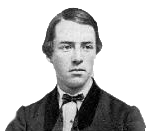
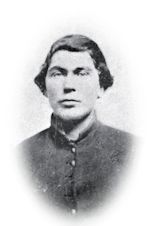
July 6—Our company was ordered out as skirmishers to-day, as our regular skirmish corps was broken up during the fight. We were the rear of the army, and therefore had a very hard job before us. Fighting all day in falling back we certainly had fun. We were close enough to the enemy to hear their commands. We would hold them in check and give them a few rounds, then fall back again. They would then advance until we would make a stand, fight again, and so it was until we reached Fairfield, six miles from Gettysburg. I don’t think there were many lost on either side in this skirmish. We crossed South Mountain at Monteray Gap. When we came to the above town I pressed into service a citizen’s coat, in this way: We were ordered to rest, and, as usual, we would sit on fences and lay about the road. Some of the boys jumped on an old hog pen. It broke through. They fell in, and, lo and behold, there were boxes of clothing, dresses, shawls, blankets, and, in fact, everything in the line of wearing apparel. I, being a little fellow, crawled through some of the boys’ legs and captured the coat. If the fool citizen would have left his things in his house they would have been safe, but to put it in our way was too much for us to leave behind. We also passed through Waterboro, and Waynesboro, Pa., where the Maryland line commences. We then passed through Latisburg, and halted in Hagerstown, Md., on the evening of the 7th. We marched yesterday and all night up to 11 o’clock—twenty-four miles.

August 6th. At nine A. M. made all sail; sent aloft the royals and set them; practiced ship’s company at general quarters, without powder; made Cape Florida light; four sails reported in sight during watch; saw a large steamer standing to the southward.

July 6.—Portions of the Tenth Kentucky and First Ohio, under the command of Major Brown, made an expedition through Pound Gap, Ky., into South-western Virginia, and succeeded in surprising the rebels, capturing one hundred and twenty-five prisoners, killing thirty, and wounding about the same number. The National loss was one killed and fourteen wounded.—The English schooner Lady Maria, was captured off Mobile Bay, by the National gunboat De Soto.

—A fight took place near Quaker Bridge, on the Trent River, N. C., in which the rebels were defeated by a force under the command of General Heckman.—The case of the British prize ship Peterhoff, was opened before Judge Bctts, sitting in prize court at New-York.—The cavalry battles of Hagerstown and Williamsport, Md., were fought this day.—(Doc. 32.)

—Knights of the Golden Circle entered the depot at Huntington Indiana, at an early hour this morning, and seized and distributed among themselves a quantity of guns and ammunition.— A large amount of money and other necessaries, in aid of the wounded at Gettysburgh, was raised throughout the loyal States.—At New York City a conspiracy to resist the draft was discovered, and precautionary measures were taken to thwart it.

—So much of the order, issued by Brigadier General Emory, at New-Orleans, on the third instant, as prohibited peaceable citizens from being out after nine o’clock P.M., provided that they are not in parties of more than three, was rescinded.—General Lee’s army was in full retreat, the Nationals following rapidly. Hopes were entertained that the whole army of rebels would be captured.—At Frederick, Md., a rebel spy, named Wm. Richardson, about fifty years old, was hung this morning. He was captured yesterday at Oxford, Md. He had been previously captured, and made his escape. He admitted the charge, and said that he had been in the business a long time. Important communications between Lee and Ewell were found on his person.—Major-General Oglesby resigned command of the left wing, Sixteenth army corps, army of the Tennessee, in consequence of the effects of a severe wound which he received in the battle at Corinth, in October last.—The Richmond Sentinel published an elaborate article, setting forth the plan of General Lee for his movement into Pennsylvania. The “most important part of it was to quit the defensive and assume the offensive toward the enemy.”

July 6.—I have just had a visit from our old surgeon, Dr. P. Thornton. He is in Wharton’s cavalry, which is under Wheeler. They covered the retreat . He says they fought day and night for a week, and that our men have had a trying time, as every thing had to be brought off in a hurry, and we had so many mountains to cross. He also says they have left the enemy far behind.

We have just received orders to send every man away. Those who are not able to leave this place are to be sent to other hospitals, as we are so near the river, and would get, in case of an attack, the full benefit of the firing.

This place already begins to look like Corinth. Troops are passing and repassing constantly; the noise from the wagons is deafening. We used to have guards to stop wagons and horsemen galloping past; but those things are not heeded now.

It is thought, if this place should be well fortified, and we chose to hold it, it would stand a siege of years, as it has the strongest natural defenses in the Confederacy.

All are in the dark as to what is going to be done. Some feel satisfied that General Bragg could not have made any other move than the one he has, as the Federals were aiming to flank him, and he had not men enough to force them to fight. If he had enemies before, they can be numbered now by the score. He seems to have no friends except the Alabamians; they have not lost confidence in him. He has certainly had much to contend with. I do not feel competent to judge of his abilities as a commander, but I do wish, for his own sake and that of the country, he would leave this department, as the confidence of men in a commander is every thing.

I am told that many of the Tennesseans have deserted. I think we are well rid of all who are base enough to live under the Lincoln government after the outrages it has committed on us.


“When so base as be a slave,

Let him turn and flee!”


With this retreat, as with every other I have seen, the men are so worn out that they tell all kind of stories about the army’s being demoralized. I have got used to this, and do not put faith in it. After they are well rested they will forget it.

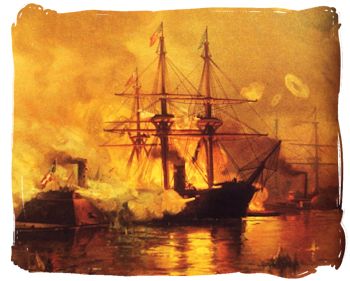
July 6th. At nine in the morning inspected crew at quarters. Ship’s company engaged in repairing fore and main standing-rigging, which has been shot away in action. Between the hours of four and six in the afternoon, U. S. naval batteries were engaged with the enemy at Port Hudson. From eight o’clock till twelve midnight, heavy squalls of wind and rain, accompanied with thunder and lightning. All quiet at Port Hudson at this hour.

Monday, 6th.—Drew crackers, bacon, pickled beef, peas, sugar, coffee and vinegar; very unwell to-day.