Following the American Civil War Sesquicentennial with day by day writings of the time, currently 1863.

July 2013

I Get Promoted.

July 7. Today a sergeant, corporal and eight privates from each company have been detailed to manipulate the big guns. I had the honor of being selected from my company, and was assigned the left gun, a most dangerous and hazardous position. I feel proud of my promotion and am sure I shall sustain the honor of the artillery service. For a day or two we shall be under the, instructions of a battery sergeant who will instruct us in loadings and firings. We shall also have to inform ourselves from a small book, giving instruction in loading and firing, and in calculating distances, elevations and depressions of the guns. My gun on the left occupies a very commanding position, being some ten feet higher than the other guns. From the top of the parapet to the bottom of the ravine, it is some 30 or 40 feet, and a part of the way nearly perpendicular. I have a range of the whole clearing and covering both the other guns; because of its great natural strength and commanding position, I have dubbed it the Malakoff. 1 being the senior sergeant, am styled on all hands, by both officers and men, as the chief of artillery, a rank I accept and have assumed all the privileges which that rank implies.

The little steamer Undine plies between town and this port, making her trips mornings and afternoons, giving us frequent and easy transit to town. I intend giving my command two or three passes a day, so they can visit town if they wish to. I am going to be liberal with them, and then if their professional services should be required, I shall expect them to stand by those guns and fight like bloodhounds till the last armed foe expires.

July 7th, 1863.—I did not enjoy quiet long. First came Martha, who announced her intention of going to search for her sons, as she was free now. I was hardly able to stand since the severe cold taken in the cave that night, but she would not wait a day. A colored woman came in wanting a place, and said she had asked her mistress for wages and her mistress had turned her out. I was in no condition to stand upon ceremony then, and engaged her at once, but hear to-day that I am thoroughly pulled to pieces in Vicksburg circles; there is no more salvation for me. Next came two Federal officers and wanted rooms and board. To have some protection was a necessity; both armies were still in town, and for the past three days every Confederate soldier I see has a cracker in his hand. There is hardly any water in town, no prospect of rain, and the soldiers have emptied one cistern in the yard already and begun on the other. The colonel put a guard at the gate to limit the water given. Next came the owner of the house and said we must move; he wanted the house, but it was so big he’d just bring his family in; we could stay till we got one. They brought boarders with them too, and children. Men are at work all over the house shoveling up the plaster before repairing. Upstairs they are pouring it by bucketfuls through the windows. Colonel D. brought work for H. to help with from headquarters. Making out the paroles and copying them has taken so long they wanted help. I am surprised and mortified to find that two-thirds of all the men who have signed made their mark; they cannot write. I never thought there was so much ignorance in the South. One of the men at headquarters took a fancy to H. and presented him with a portfolio, that he said he had captured when the Confederates evacuated their headquarters at Jackson. It contained mostly family letters written in French, and a few official papers. Among them was the following note, which I will copy here, and file away the original as a curiosity when the war is over.

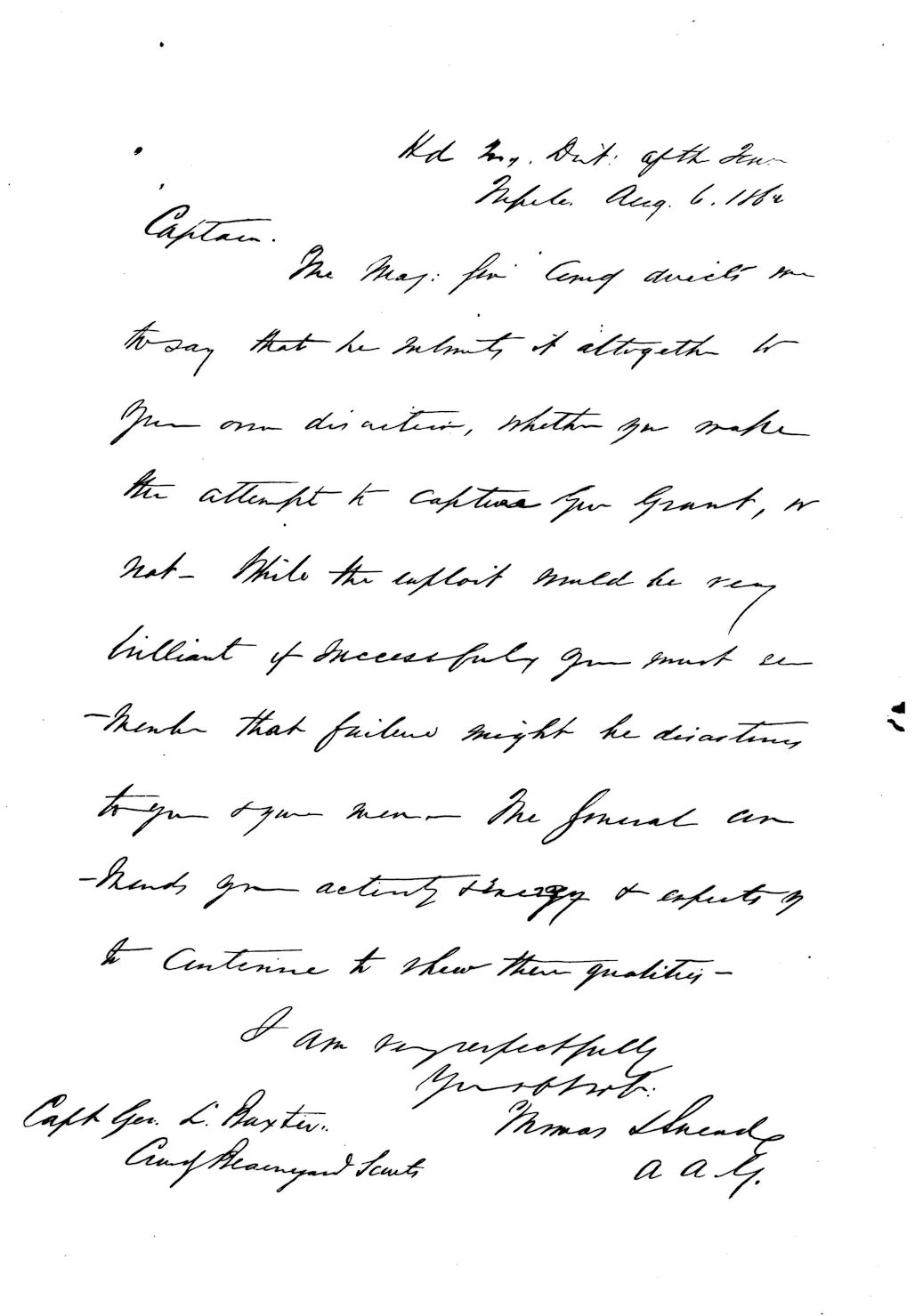
HEADQUARTERS DEPT. OF TENN.

TUPELO, AUG 6, 1862.

Capt.: The Major-General Commanding directs me to say that he submits it altogether to your own discretion whether you make the attempt to capture General Grant or not. While the exploit would be very brilliant if successful, you must remember that failure might be disastrous to you and your men. The General commends your activity and energy and expects you to continue to show these qualities.

I am, very respectfully, yr. obt. svt.

Thomas L. Snead, A.A.G.

CAPT. GEO. L. BAXTER,

Commanding Beaureguard Scouts.

I would like to know if he tried it and came to grief or abandoned the project. As letters can now get through to New Orleans, I wrote there.

by John Beauchamp Jones

            JULY 7TH.—It appears that the fighting near Gettysburg began on Wednesday, July 1st, continued until Sunday, the 5th, and perhaps longer. Up to Friday the Northern papers claim the advantage.

            This morning at 1 P.M. another dispatch was received from the same (unofficial) source, stating that on Sunday the enemy made a stand, and A. P. Hill’s corps fell back, followed by the enemy, when Longstreet’s and Ewell’s corps closed in their rear and captured 40,000 prisoners—who are now guarded by Pickett’s division. It states that the prisoners refused to be paroled. This might possibly be true.

            This account is credited. Col. Custis Lee, from the President’s office, was in my office at half-past two P.M. to-day, and said nothing had been received from his father yet—but he did not deny that such accounts might be substantially true.

            The President still keeps his eye on Gen. Beauregard. A paper from the general to Gen. Cooper, and, of course, referred to the President, in relation to the means of defense in his department, and a call for more guns, was sent back to-day, indorsed by the President, that by an examination of the report of Gen. Huger, he thought some discrepancies would appear in the statements of Gen. B. Thus, it would seem, from a repetition of similar imputations, the President has strong doubts of Gen. B.’s accuracy of statements. He is quick to detect discrepancies.

            Gen. D. H. Hill sends in a characteristic letter. He says the rivers are all swollen, and he can make no movement to-day in pursuit of Dix’s army of the Pamunky—or rather “the monkey army.” He says that the Brooke Pike outer defenses are so defective in design, that a force there could be driven off in five minutes by the enemy’s sharpshooters. He wants them amended, and a certain grove cut down—and recommends that engineers be put to work, with orders to leave their “kid gloves behind.” He thinks more is to be apprehended from an attack on Petersburg than Richmond; and requests that Gen. Wise be ordered to march thither from Chaffin’s Bluff, on the first alarm. He had not heard of the reported victory of Lee.

by John Beauchamp Jones

            JULY 6TH.—Yesterday evening we received Baltimore and New York papers with accounts (and loose ones) of the battle of Gettysburg. The Governor of Pennsylvania says it was “indecisive,” which means, as we read it, that Meade’s army was defeated.

            The forces (Federal) are withdrawing from the neighborhood of this city, another indication that Lee has gained a victory. Dix has done but little damage. In retreating from HanoverCounty, he burnt the bridges to retard pursuit.

            The “War Department Guard” have returned, my son among them, sun-burnt and covered with dust. They were out five days and four nights, sleeping on the ground, without tents or blankets, and with little or nothing to eat, although the Commissary-General had abundance. The President, however, is better to-day, and able to get out of bed; but his health is apparently gone, and it may be doubtful whether he will ever be quite well again.

            The Vice-President went down to the flag of truce boat on Saturday, some say to Fortress Monroe, and others to Washington. It is surmised that he is authorized by the President to have a definitive understanding with the Federal authorities, whether or not private property is to be respected hereafter in the future progress of the war. If not, Gen. Lee will have orders to desolate the Northern States, where he has the power. Some, however, think he goes to Washington, to propose terms of peace, etc.

            There is a rumor in the city, generally credited, that another battle was fought in Pennsylvania on Friday, and that the enemy was annihilated; these rumors sometimes assume form and substance, and this one, as if by some sort of magnetism, is credited by many. It is certain that Mr. Morris, superintendent of the telegraph office, has called upon his friends for the largest Confederate flag in the city to hang out of his window. He says nothing more; but he may have sent dispatches to the President, which he is not at liberty to divulge. There may be later news from Lee; or Vicksburg may be relieved; or New Orleans taken; or an armistice; or nothing.

            I am glad my son’s company were ordered in to-day; for, after a week of fine fair weather, it is now raining furiously. This would have prostrated the tender boys with illness.

July 7th. Near where General Reno fell, during the battle of Antietam. Passed down the west side of the mountain into the Antietam country, becoming a part of the 3d Corps, Army of the Potomac, General French commanding, taking part in the battle of Boonsborough, and supporting the cavalry at the battle of Falling Waters. Both armies are back in Maryland from the battle of Gettysburg.

6th July (Monday).—Several horses were stolen last night, mine nearly so. It is necessary to be very careful, in order to prevent this misfortune. We started at 6.30, but got on very slowly, so blocked up was the road with waggons, some of which had been captured and burnt by the enemy yesterday. It now turned out that all Ewell’s waggons escaped except thirty-eight, although, at one time, they had been all in the enemy’s hands.

At 8.30 we halted for a couple of hours, and Generals Lee, Longstreet, Hill, and Willcox had a consultation.

I spoke to about my difficulties with regard to getting home, and the necessity of doing so, owing to the approaching expiration of my leave. He told me that the army had no intention at present of retreating for good, and advised me to stop with them and see what turned up; he also said that some of the enemy’s despatches had been intercepted, in which the following words occur:—” The noble but unfortunate army of the Potomac has again been obliged to retreat before superior numbers.” I particularly observed the marching to-day of the 21st Mississippi, which was uncommonly good. This regiment all wear short round jackets, a most unusual circumstance, for they are generally unpopular in the South.

At 12 o’clock we halted again, and all set to work to eat cherries, which was the only food we got between 5 A.M. and 11 P.M.

I saw a most laughable spectacle this afternoon— viz., a negro dressed in full Yankee uniform, with a rifle at full cock, leading along a barefooted white man, with whom he had evidently changed clothes. General Longstreet stopped the pair, and asked the black man what it meant. He replied, “The two soldiers in charge of this here Yank have got drunk, so for fear he should escape I have took care of him, and brought him through that little town.” The consequential manner of the negro, and the supreme contempt with which he spoke to his prisoner, were most amusing. This little episode of a Southern slave leading a white Yankee soldier through a Northern village, alone and of his own accord, would not have been gratifying to an abolitionist. Nor would the sympathisers both in England and in the North feel encouraged if they could hear the language of detestation and contempt with which the numerous negroes with the Southern armies speak of their liberators.[1]

I saw General Hood in his carriage; he looked rather bad, and has been suffering a good deal; the doctors seem to doubt whether they will be able to save his arm. I also saw General Hampton, of the cavalry, who has been shot in the hip, and has two sabre-cuts on the head, but he was in very good spirits.

A short time before we reached Hagerstown there was some firing in front, together with an alarm that the Yankee cavalry was upon us. The ambulances were sent back; but some of the wounded jumped out, and, producing the rifles which they had not parted with, they prepared to fight. After a good deal of desultory skirmishing, we seated ourselves upon a hill overlooking Hagerstown, and saw the enemy’s cavalry driven through the town pursued by yelling Confederates. A good many Yankee prisoners now passed us; one of them, who was smoking a cigar, was a lieutenant of cavalry, dressed very smartly, and his hair brushed with the greatest care; he formed rather a contrast to his ragged escort, and to ourselves, who had not washed or shaved for ever so long.

About 7 P.m. we rode through Hagerstown, in the streets of which were several dead horses and a few dead men. After proceeding about a mile beyond the town we halted, and General Longstreet sent four cavalrymen up a lane, with directions to report everything they saw. We then dismounted and lay down. About ten minutes later (being nearly dark) we heard a sudden rush—a panic—and then a regular stampede commenced, in the midst of which I descried our four cavalry heroes crossing a, field as fast as they could gallop. All was now complete confusion;—officers mounting their horses, and pursuing those which had got loose, and soldiers climbing over fences for protection against the supposed advancing Yankees. In the middle of the din I heard an artillery officer shouting to his “cannoneers” to stand by him, and plant the guns in a proper position for enfilading the lane. I also distinguished Longstreet walking about, hustled by the excited crowd, and remarking, in angry tones, which could scarcely be heard, and to which no attention was paid, “Now, you don’t know what it is—you don’t know what it is.” Whilst the row and confusion were at their height, the object of all this alarm at length emerged from the dark lane in the shape of a domestic four-wheel carriage, with a harmless load of females. The stampede had, however, spread, increased in the rear, and caused much harm and delay.

Cavalry skirmishing went on until quite dark, a determined attack having been made by the enemy, who did his best to prevent the trains from crossing the Potomac at William sport. It resulted in the success of the Confederates; but every impartial man confesses that these cavalry fights are miserable affairs. Neither party has any idea of serious charging with the sabre. They approach one another with considerable boldness, until they get to within about forty yards, and then, at the very moment when a dash is necessary, and the sword alone should be used, they hesitate, halt, and commence a desultory fire with carbines and revolvers.

An Englishman, named Winthrop, a captain in the Confederate army, and formerly an officer in H.M.’s 22d regiment, although not in the cavalry himself, seized the colours of one of the regiments, and rode straight at the Yankees in the most gallant manner, shouting to the men to follow him. He continued to distinguish himself by leading charges until his horse was unfortunately killed. I heard his conduct on this occasion highly spoken of by all. Stuart’s cavalry can hardly be called cavalry in the European sense of the word; but, on the other hand, the country in which they are accustomed to operate is not adapted for cavalry.

—— was forced at last to give up wearing even his Austrian forage-cap; for the last two days soldiers on the line of march had been visiting his ambulance in great numbers, under the impression (encouraged by the driver) that he was a Yankee general. The idea now was that the army would remain some days in or near its present position until the arrival of the ammunition from Winchester.


[1] From what I have seen of the Southern negroes, I am of opinion that the Confederates could, if they chose, convert a great number into soldiers; and from the affection which undoubtedly exists as a general rule between the slaves and their masters, I think that they would prove more efficient than black troops under any other circumstances. But I do not imagine that such an experiment will be tried, except as a very last resort, partly on account of the great value of the negroes, and partly because the Southerners consider it improper to introduce such an element on a large scale into civilised warfare. Any person who has seen negro features convulsed with rage, may form a slight estimate of what the result would be of arming a vast number of blacks, rousing their passions, and then allowing them free scope.

Monday, 6th—We have had very changeable weather for a week now—hot and sultry, then cool and pleasant, then warm and hazy. The Eleventh Iowa received two months’ pay today. I got $37.25; of this, $11.25 was allowed for clothing not drawn. The Thirteenth Iowa and the Tenth Ohio Battery went out on picket duty.

Camp White, July 6, 1863.

Dear Uncle:—. . . I propose to take in your bank twenty-five hundred dollars stock in Lucy’s name. Please see when you get the cash to put the stock in her name. I have in Stephenson’s hands one thousand dollars and expect fifteen hundred dollars more in three weeks. I send you an order for it.

Reports from the East look well. If true, we shall perhaps go forward here. The Rebels found fighting in the enemy’s country a different thing from battling on their own ground.

Sincerely,

R. B. Hayes.

S. BIRCHARD.

6th. Aroused early and breakfasted. Marched two or three miles and got forage. Our brigade in advance. Passed through several villages. A beautiful country for farming, good residences. Reached Lebanon at 3 P. M. 20th Ky. 350, surrendered here to Morgan, but not till punishing him. Out a mile, fed and got supper. Passed through Springfield, 9 miles and camped on Pike, 8 miles.

July 6, Monday. There was a special Cabinet-meeting at 9 A.M. on the subject of A. H. Stephens’s mission. Seward came prepared with a brief telegram, which the President had advised, to the effect that Stephens’s request to come to W. was inadmissible, but any military communication should be made through the prescribed military channel. A copy of this answer was to be sent to the military officer in command at Fortress Monroe by the Secretary of War, and the Secretary of the Navy was to send a copy to Admiral Lee. The President directed Mr. Seward to go to the telegraph office and see that they were correctly transmitted. All this was plainly prearranged by Seward, who has twice changed his ground, differing with the President when Chase and Stanton differed, but he is finally conimissioned to carry out the little details which could be done by an errand boy or clerk.

The army news continues to be favorable. Lee is on the retreat, and Meade in hot pursuit, each striving to get possession of the passes of the Potomac.

A note from Wilkes stating he had reached home, and would have reported in person but had received an injury. A letter is published in one of the papers, purporting to be from him at Havana, written by himself or at his instigation, expressing a hope that Lardner, his successor, will be furnished with men and more efficient vessels. I hope so too. Wilkes has not had so large a force as I wished; he could not under any circumstances have had so large a squadron, as he desired. To say nothing of the extensive blockade, Farragut’s detention through the winter and spring before Vicksburg was unexpected, and the operations before Charleston have been long and protracted.

The papers this evening bring us the speeches of the two Seymours, Horatio and Thomas Henry, on the Fourth at New York. A couple of partisan patriots, neither of whom is elated by Meade’s success, and whose regrets are over Rebel reverses.