Gettysburg, Penn., July 4, 1863, 10 A. M.
Dear Father:—
I am safe and well. We have met the enemy and given them hell. Colonel Vincent is mortally wounded. Alf Ayres is safe; so is Conway. No time for more.
Gettysburg, Penn., July 4, 1863, 10 A. M.
Dear Father:—
I am safe and well. We have met the enemy and given them hell. Colonel Vincent is mortally wounded. Alf Ayres is safe; so is Conway. No time for more.
July 4.—The rebel gunboat Torpedo, formerly the Dragon, came down the James River, Virginia, having on board Alexander H. Stephens, Vice-President of the rebel government. By flag of truce it was reported that Stephens was the bearer of a letter from Jefferson Davis to President Lincoln, and ho requested permission to go to Washington in the Torpedo, to present the letter to President Lincoln in person. This request was declined by the President and Cabinet, but before their determination could be communicated, the Torpedo had left its moorings and proceeded up the James River, without waiting for an answer.—(Docs. 23 and 34.)
—Vicksburg, Miss., was surrendered to the National forces under the command of Major General Grant—(Docs. 25, 36, 94, and 141.)
—Abraham Lincoln, President of the United States, “announces to the country, that the news from the army of the Potomac to ten P.M. of the third, is such as to cover the army with the highest honor and promise a great success to the cause of the Union, and to claim the condolence of all for the many gallant fallen, and that for this ho especially desires, on this day, that He whose will, not ours, should ever be done, be everywhere remembered with the profoundest gratitude.”
—The battle of Helena, Ark., was fought this day, by the National troops under the command of Major-General B. M. Prentiss, and the rebels under Generals Marmaduke, Price, and Holmes.— (Docs. 24 and 111.)
—General Sheridan’s division of Rosecrans’s army, in pursuit of General Bragg, crossing the Elk River, Tenn., was thrown forward toward Dechard and Cowan, after reoccupying Winchester. This day he sent his cavalry force, under Colonel Watkins of the Sixth Kentucky, toward the mountains. Near University Place, they encountered the rebel cavalry, killed and wounded forty, routed and drove them three miles up the side of the mountain, and returned with the loss of twelve men. The rebels’ flight was so precipitate, that they threw away every thing which could at all impede them, and their course could be traced for miles by their cast-off equipments and accoutrements.
—Captain Turner, the Commandant at the Libby Prison, at Richmond, Va., received the following order:
“Headquarters Department of Henrico,
“July 4,1863.
“Special Order, No. 160.—Captain T. N. Turner, commanding confederate States prison, is hereby commanded to select, by lot, from among the Federal Captains now in his possession, two of that number for execution. ” John H. Winder,
“Major-General Commanding.”
Captain Turner at once proceeded to carry out the order, and caused all the captains, seventy-five in number, to be assembled in the large room on the first floor. The order commanding the selection of two of them for execution was then read aloud in their presence, by the Captain, and the seventy-five names deposited in a box placed upon a table. Captain Turner inquired if they would designate any particular person to draw from the box, and explained that the two first names drawn would be the parties selected. There was a deep silence for some moments, when one of the captains spoke and named Rev. Mr. Brown, Chaplain of the Fifth Maryland (Yankee) regiment, as their choice. Mr. Brown here stepped forward, from three chaplains in the room, and, evincing considerable emotion, drew the first name from the box, written upon a piece of paper.
Without glancing at the card, he handed it to Captain Turner, who read out: “Henry Washington Sawyer, Captain First New-Jersey cavalry.” Then it was a singular coincidence struck every one present, for Sawyer was the party who named Mr. Brown for the unpleasant duty he was then discharging. Great drops of sweat beaded Sawyer’s brow, as he stepped out from the ranks. The next name was drawn and read out, as before, “John Flinn, Fifty-first Indiana regiment;” and Flinn took his place with Sawyer. The drawing over, the balance of the officers were returned to their quarters, and Sawyer and Flinn taken from the prison to the office of General Winder. Sawyer was talkative, and said if it was his fate, he would stand it. Flinn said but little.—Richmond Examiner, July 8.
—The First North-Carolina (Union) volunteers, Colonel McChesney, returned to Newborn, N. C., from an expedition up the Pungo River, where the regiment captured two large schooners heavily laden with rebel supplies, large numbers of prisoners, horses, cattle, negroes, and several thousand bushels of corn. This regiment effected a landing near Wade’s Point, and moved with great celerity at midnight, taking the enemy everywhere by surprise. Several thousand dollars’ worth of rebel commissary stores were also destroyed.
—Orlando H. Moore, Colonel of the Twenty-fifth regiment of Michigan infantry, commanding at Green River Bridge, Kentucky, was summoned to surrender, by the rebel General John Morgan, when he replied, “that the Fourth day of July was no day to entertain such a proposition,” and immediately after, a fight was commenced by the rebels, which resulted in their defeat and the loss of over fifty killed and two hundred wounded.—(Doc. 44.)
July 4th, 1863.
“Be ready to march at a minute’s notice,” is the order. At the same time we learn that Vicksburg has surrendered; that Johnson is in a trap, and that we are to help “bag the game.” So away we go, in light marching order. We marched eight miles and camped for the night.
July 4 — All is very quiet this morning around Vicksburg. The boys and the Yanks are conversing together.10 o’clock a.m. —Vicksburg is surrendering on account of our rations giving out. We marched to General Reynold’s headquarters and stacked our arms and then came back to our old position where we expect to remain until we are paroled. The evening passed off very quiet. WRC
HE FOURTH OF JULY! The siege is at last ended. Behold the white flag now waving over the rebel ramparts. Vicksburg has at length surrendered. Speed the glad news to our loved ones at the North, who, during our long trial, have helped us with their prayers. Speed it to the entire forces of the Union, that they may all take courage and move again.
We are all full of rejoicing, as the event will no doubt prove a death-blow to the rebellion in the Southwest. Vicksburg has been the boast of the enemy, who thought it to be impregnable, and they confidently defied the Army of the West to take it. But by the untiring energy, skill and forecast of our gallant leader, U. S. Grant, aided by the willing and brave hearts about him, Vicksburg has been taken, and over it the stars and stripes now float proudly in all their majestic beauty. How glad I am that I have been one of those who have endured the trials requisite to plant our banner there. And while rejoicing over our success, let us not forget those who have died on these fields of honor. While we surviving raise Liberty‘s ensign over Vicksburg, let us remember the graves at Raymond and Champion Hills. And in after years, when we meet to refresh the memory of soldier days, let our dead here around Vicksburg never be forgotten. Let us think of them as standing guard over our dearly-won prize, until the final roll-call, when each shall be “present” or “accounted for.”
“They struggled and fell, their life-blood staining
The assaulting foeman’s hand;
And clasping freedom’s flag, sustaining,
Cried, God save our native land.
Let angels spread their wings protecting;
Let sweetest flowers ever bloom;
And let green bays, our faith reflecting,
Mark each martyr’s sacred tomb.”
Now that the enemy have resigned possession of Vicksburg, I trust the wicked rebellion will not fail soon to near its end, when all our boys in blue will have leave, at will, to present arms to the girls they left behind them. A star heralding the coming peace already seems to twinkle in the sky. We rejoice not less over our triumph to-day because it was consummated upon the glorious Fourth. And while we rejoice for our country, we show no unworthy exultation over the fallen, to whom we extend the sympathy of victors.
Our division, under its commander, General Logan, marched into the city in triumph, and there took command and completed the long desired event—raising the star spangled banner over the court house cupola.
“The armies of the Union
Round Vicksburg long had lain;
For forty-seven days and nights
Besieging it in vain.
Then came the morning of the Fourth,
Our Nation’s jubilee—
Ah, could the news this hour go north—
In Vicksburg soon we’ll be.
The siege is done, the struggle past.
On this eventful day
Glad triumph crowns us, as, at last,
Our thanks to God we pay.
Above the vanquished walls I stand,
My country, proud to see
The festive hosts, with flag and band,
Parading gloriously.
O, glorious Fourth! O blissful day!
How hearts of thousands swell
To see such toils such hopes repay,
Such dangers end so well.”
July 4th, 1863.—It is evening. All is still. Silence and night are once more united. I can sit at the table in the parlor and write. Two candles are lighted. I would like a dozen. We have had wheat supper and wheat bread once more. H. is leaning back in the rocking-chair; he says:
“G., it seems to me I can hear the silence, and feel it too. It wraps me like a soft garment; how else can I express this peace?”
But I must write the history of the last twenty-four hours. About five yesterday afternoon, Mr. J., H.’s assistant, who, having no wife to keep him in, dodges about at every change and brings us the news, came to H. and said:
“Mr. L., you must both come to our cave to-night. I hear that to-night the shelling is to surpass anything yet. An assault will be made in front and rear. You know we have a double cave; there is room for you in mine, and mother and sister will make a place for Mrs. L. Come right up; the ball will open about seven.”
We got ready, shut up the house, told Martha to go to the church again if she preferred it to the cellar, and walked up to Mr. J.’s. When supper was eaten, all secure, and the ladies in their cave night toilet, it was just six, and we crossed the street to the cave opposite. As I crossed a mighty shell flew screaming over my head. It was the last thrown into Vicksburg. We lay on our pallets waiting for the expected roar, but no sound came except the chatter from the neighboring caves, and at last we dropped asleep. I woke at dawn stiff. A draught from the funnel-shaped opening had been blowing on me all night. Every one was expressing surprise at the quiet. We started for home and met the editor of the “Daily Citizen.” H. said:
“This is strangely quiet, Mr. L.”
“Ah, sir,” shaking his head gloomily, “I’m afraid the last shell has been thrown into Vicksburg.”
“Why do you fear so?”
“It is surrender. At six last evening a man went down to the river and blew a truce signal; the shelling stopped at once.”
When I entered the kitchen a soldier was there waiting for the bowl of scrapings. (They took turns for it.)
“Good-morning, madam,” he said; “we won’t bother you much longer. We can’t thank you enough for letting us come, for getting this soup boiled has helped some of us to keep alive, but now all this is over.”
“Is it true about the surrender?”
“Yes; we have had no official notice, but they are paroling out at the lines now, and the men in Vicksburg will never forgive Pemberton. An old granny! A child would have known better than to shut men up in this cursed trap to starve to death like useless vermin.” His eyes flashed with an insane fire as he spoke. “Haven’t I seen my friends carted out three or four in a box, that had died of starvation! Nothing else, madam! Starved to death because we had a fool for a general.”
“Don’t you think you’re rather hard on Pemberton? He thought it his duty to wait for Johnston.”
“Some people may excuse him, ma’am, but we’ll curse him to our dying day. Anyhow, you’ll see the blue-coats directly.”
Breakfast dispatched, we went on the upper gallery. The street was deserted, save by a few people carrying home bedding from their caves. Among these was a group taking home a little creature, born in a cave a few days previous, and its wan-looking mother. About 11 o’clock a man in blue came sauntering along, looking about curiously. Then two followed him, then another.
“H., do you think these can be the Federal soldiers?”
“Why, yes; here come more up the street.”
Soon a group appeared on the court-house hill, and the flag began slowly to rise to the top of the staff. As the breeze caught it, and it sprang out like a live thing exultant, H. drew a long breath of contentment.
“Now I feel once more at home in my own country.”
In an hour more a grand rush of people set in toward the river,—foremost among them the gentleman who took our cave; all were flying as if for life.
“What can this mean, H.? Are the populace turning out to greet the despised conquerors?”
“Oh,” said H., springing up, “look! It is the boats coming around the bend.”
Truly, it was a fine spectacle to see that fleet of transports sweep around the curve and anchor in the teeth of the batteries so lately vomiting fire. Presently Mr. J. passed and called:
“Aren’t you coming, Mr. L.? There’s provisions on those boats: coffee and flour. ‘First come, first served,’ you know.”
“Yes, I’ll be there pretty soon,” replied H.
But now the new-comers began to swarm into our yard, asking H. if he had coin to sell for greenbacks. He had some, and a little bartering went on with the new greenbacks. H. went out to get provisions. When he returned a Confederate officer came with him. H. went to the box of Confederate money and took out four hundred dollars, and the officer took off his watch, a plain gold one, and laid it on the table, saying, “We have not been paid, and I must get home to my family.” H. added a five-dollar greenback to the pile, and wished him a happy meeting. The townsfolk continued to dash through the streets with their arms full, canned goods predominating. Towards five Mr. J. passed again. “Keep on the lookout,” he said; “the army of occupation is coming along,” and in a few minutes the head of the column appeared. What a contrast to the suffering creatures we had seen so long were these stalwart, well-fed men, so splendidly set up and accoutered! Sleek horses, polished arms, bright plumes,—this was the pride and panoply of war. Civilization, discipline, and order seemed to enter with the measured tramp of those marching columns; and the heart turned with throbs of added pity to the worn men in gray, who were being blindly dashed against this embodiment of modern power. And now this “silence that is golden” indeed is over all, and my limbs are unhurt, and I suppose if I were Catholic, in my fervent gratitude, I would hie me with a rich offering to the shrine of “our Lady of Mercy.”

______
Note: To protect Mrs. Miller’s job as a teacher in New Orleans, the diary was published anonymously, edited by G. W. Cable, names were changed and initials were often used instead of full names — and even the initials differed from the real person’s initials.A single life, even that of a distinguished general, in time of war is of slight consequence to the general result, and so in this case the battle continued in our absence, till late at night, when the Fifth corps took position on the front line.
The following day [3rd] about noon, the enemy opened fire from over one hundred guns, maintaining a terrific cannonading for over an hour, when again they attacked with extraordinary fury, making one of the most formidable charges of the war; thousands were slain, but our line was unbroken, and the Stars and Stripes defiantly floated over the line of brave men, who stood a steady, and valiant shield against all the fury and the power of the savage Confederacy. The following morning Lee withdrew, disheartened, and dismayed by his immense losses. The flower of the Southern Confederacy was left upon the bloody field, and its doom forever sealed; although they got away, they were maimed for life and beyond hope of recovery.
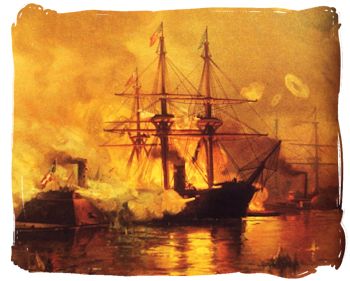
July 4th. This is the eighty-seventh anniversary of our national independence–a day dear to every true American heart on account of the event it commemorates; but since no salute has been fired by us in honor of the day, and Jack looks rather crest-fallen in the phiz on that account, still we have far more and greater reasons for being of the opposite cast of countenance than we had one year ago to-day. Let us look back into the past, as long ago as a twelvemonth since, and see what was our situation and condition then, and what our prospects of success in struggles about to take place for the supremacy of our arms. By reference to the author’s remarks of what occurred on the Fourth of July, 1862, one year ago to-day, you will please note the fact that Vicksburg, although having withstood, about three weeks since, a terrific naval bombardment from our vessels, still defied our powers. Now the tables are turned; General Grant, in command of U. S. forces, has invested the place and cut off supplies reaching same for the rebel army by railroad from Jackson, Miss., and a surrender of this rebel stronghold is looked for at an early day; in fact, I must say it was not Grant, even Unconditional Surrender Grant, or any other general, who has been mainly instrumental in bringing about this condition of things, although he has performed, as I have before stated, no mean part in the programme of action, but this ship, under the superintendence of Admiral Farragut, by taking the lead of the fleet in the experiment of running the rebel batteries of Port Hudson, on the ever-to-be-remembered night of the 14th March last, and by the mercy of Almighty God, being fortunate enough to pass safely through that fiery ordeal with so little loss of life, with a gunboat (tender) lashed to her port side; also a few days afterwards, another battery of the enemy at Grand Gulf on our way up the river to Warrenton, to have communication with Major-General Grant and Acting Rear Admiral Porter, and again on our return, permitted to repass the above-mentioned battery at Grand Gulf with little loss of life and injury to ship, arriving off the mouth of Red river, which it had been previously decided upon we should blockade for the purpose of cutting off supplies from being transported by rebel steamers out of this stream to the rebel army at Port Hudson and Vicksburg, and aiding General Banks with his forces coming round from New Orleans by way of Berwick’s Bay. Alexandria, and Atchafalaya river to get in rear of Port Hudson. While Admiral Farragut has rigidly enforced the blackade of the mouth of Red river, commenced by him with but two vessels, the Hartford and Albatross soon after the passage of the rebel fortifications at Port Hudson, cutting off relief from Texas reaching them by transportation down and out of this channel, or that of their fellows at Port Hudson, and starvation is now staring them in the face, making and early surrender of both places highly probable.
by John Beauchamp Jones
JULY 4TH.—The Department Guard (my son with them) were marched last night back to the city, and out to Meadow Bridge, on the Chickahominy, some sixteen miles! The clerks, I understand, complain of bad meat (two or three ounces each) and mouldy bread ; and some of them curse the authorities for fraudulent deception, as it was understood they would never be marched beyond the city defenses. But they had no alternative—the Secretaries would report the names of all who did not volunteer. Most of the poor fellows have families dependent on their salaries for bread—being refugees from their comfortable homes, for the cause of independence. If removed, their wives and little children, or brothers and sisters, must perish. They would be conscribed, and receive only $12 per month.
My friend Jacques did not return to the company yesterday, after all, although I saw him get into an ambulance with a basket of food. He got out again, sending the basket to Mr. K., the young chief of the bureau, and Judge Campbell allowed him to remain.
Mr. Myers the lawyer is much with Judge Campbell, working for his Jew clients, who sometimes, I am told, pay $1000 each to be got out of the army, and as high as $500 for a two months’ detail, when battles are to be fought. Mr. M. thinks he has law for all he does.
A letter from Gen. D. H. Hill shows that it was his intention to bring on a battle on the 2d inst., but the enemy fled. It was only a feint below; but we may soon hear news from HanoverCounty.
Col. Gorgas (ordnance) writes that as his men are marched out to defend the city, he can’t send much ammunition to Gen. Lee!
A letter from Lieut.-Gen. E. Kirby Smith, dated Jane 15th, shows he was at Shreveport, La., at that date.
The poor militia were allowed to return to their homes to-day; but an hour after the tocsin sounded, and they were compelled to assemble and march again. This is the work of the Governor, and the Secretary of War says there was no necessity for it, as Confederate troops here now can defend the city, if attacked.
3d July (Friday).—At 6 A.M. I rode to the field with Colonel Manning, and went over that portion of the ground which, after a fierce contest, had been won from the enemy yesterday evening. The dead were being buried, but great numbers were still lying about; also many mortally wounded, for whom nothing could be done. Amongst the latter were a number of Yankees dressed in bad imitations of the Zouave costume. They opened their glazed eyes as I rode past in a painfully imploring manner.
We joined Generals Lee and Longstreet’s Staff: they were reconnoitring and making preparations for renewing the attack. As we formed a pretty large party, we often drew upon ourselves the attention of the hostile sharpshooters, and were two or three times favoured with a shell. One of these shells set a brick building on fire which was situated between the lines. This building was filled with wounded, principally Yankees, who, I am afraid, must have perished miserably in the flames. Colonel Sorrell had been slightly wounded yesterday, but still did duty. Major Walton’s horse was killed, but there were no other casualties amongst my particular friends.
The plan of yesterday’s attack seems to have been very simple—first a heavy cannonade all along the line, followed by an advance of Longstreet’s two divisions and part of Hill’s corps. In consequence of the enemy’s having been driven back some distance, Longstreet’s corps (part of it) was in a much more forward situation than yesterday. But the range of heights to be gained was still most formidable, and evidently strongly intrenched.
The distance between the Confederate guns and the Yankee position—i.e., between the woods crowning the opposite ridges—was at least a mile,—quite open, gently undulating, and exposed to artillery the whole distance. This was the ground which had to be crossed in to-day’s attack. Pickett’s division, which had just come up, was to bear the brunt in Longstreet’s attack, together with Heth and Pettigrew in Hill’s corps. Pickett’s division was a weak one (under 5000), owing to the absence of two brigades.
At noon all Longstreet’s dispositions were made; his troops for attack were deployed into line, and lying down in the woods; his batteries were ready to open. The General then dismounted and went to sleep for a short time. The Austrian officer and I now rode off to get, if possible, into some commanding position from whence we could see the whole thing without being exposed to the tremendous fire which was about to commence. After riding about for half an hour without being able to discover so desirable a situation, we determined to make for the cupola, near Gettysburg, Ewell’s headquarters. Just before we reached the entrance to the town, the cannonade opened with a fury which surpassed even that of yesterday.
Soon after passing through the toll-gate at the entrance of Gettysburg, we found that we had got into a heavy cross-fire; shells both Federal and Confederate passing over our heads with great frequency. At length two shrapnel shells burst quite close to us, and a ball from one of them hit the officer who was conducting us. We then turned round and changed our views with regard to the cupola—the fire of one side being bad enough, but preferable to that of both sides. A small boy of twelve years was riding with us at the time: this urchin took a diabolical interest in the bursting of the shells, and screamed with delight when he saw them take effect. I never saw this boy again, or found out who he was. The road at Gettysburg was lined with Yankee dead, and as they had been killed on the 1st, the poor fellows had already begun to be very offensive. We then returned to the hill I was on yesterday. But finding that, to see the actual fighting, it was absolutely necessary to go into the thick of the thing, I determined to make my way to General Longstreet. It was then about 2.30. After passing General Lee and his Staff, I rode on through the woods in the direction in which I had left Longstreet. I soon began to meet many wounded men returning from the front; many of them asked in piteous tones the way to a doctor or an ambulance. The further I got, the greater became the number of the wounded. At last I came to a perfect stream of them flocking through the woods in numbers as great as the crowd in Oxford Street in the middle of the day. Some were walking alone on crutches composed of two rifles, others were supported by men less badly wounded than themselves, and others were carried on stretchers by the ambulance corps; but in no case did I see a sound man helping the wounded to the rear, unless he carried the red badge of the ambulance corps. They were still under a heavy fire; the shells were continually bringing down great limbs of trees, and carrying further destruction amongst this melancholy procession. I saw all this in much less time than it takes to write it, and although astonished to meet such vast numbers of wounded, I had not seen enough to give me any idea of the real extent of the mischief.
When I got close up to General Longstreet, I saw one of his regiments advancing through the woods in good order; so, thinking I was just in time to see the attack, I remarked to the General that “I wouldn’t have missed this for anything.” Longstreet was seated at the top of a snake fence at the edge of the wood, and looking perfectly calm and imperturbed. He replied, laughing, “The devil you wouldn’t! I would like to have missed it very much; we’ve attacked and been repulsed: look there!”
For the first time I then had a view of the open space between the two positions, and saw it covered with Confederates slowly and sulkily returning towards us in small broken parties, under a heavy fire of artillery. But the fire where we were was not so bad as further to the rear; for although the air seemed alive with shell, yet the greater number burst behind us.
The General told me that Pickett’s division had succeeded in carrying the enemy’s position and capturing his guns, but after remaining there twenty minutes, it had been forced to retire, on the retreat of Heth and Pettigrew on its left. No person could have been more calm or self-possessed than General Longstreet under these trying circumstances, aggravated as they now were by the movements of the enemy, who began to show a strong disposition to advance. I could now thoroughly appreciate the term bulldog, which I had heard applied to him by the soldiers. Difficulties seem to make no other impression upon him than to make him a little more savage.
Major Walton was the only officer with him when I came up—all the rest had been put into the charge. In a few minutes Major Latrobe arrived on foot, carrying his saddle, having just had his horse killed. Colonel Sorrell was also in the same predicament, and Captain Goree’s horse was wounded in the mouth.
The General was making the best arrangements in his power to resist the threatened advance, by advancing some artillery, rallying the stragglers, &c. I remember seeing a General (Pettigrew, I think it was)[1] come up to him, and report that “he was unable to bring his men up again.” Longstreet turned upon him and replied with some sarcasm, ” Very well; never mind, then, General; just let them remain where they are: the enemy’s going to advance, and will spare you the trouble.”
He asked for something to drink: I gave him some rum out of my silver flask, which I begged he would keep in remembrance of the occasion; he smiled, and, to my great satisfaction, accepted the memorial. He then went off to give some orders to McLaws’s division. Soon afterwards I joined General Lee, who had in the meanwhile come to that part of the field on becoming aware of the disaster. If Longstreet’s conduct was admirable, that of General Lee was perfectly sublime. He was engaged in rallying and in encouraging the broken troops, and was riding about a little in front of the wood, quite alone—the whole of his Staff being engaged in a similar manner further to the rear. His face, which is always placid and cheerful, did not show signs of the slightest disappointment, care, or annoyance; and he was addressing to every soldier he met a few words of encouragement, such as, “All this will come right in the end: we’ll talk it over afterwards; but, in the mean time, all good men must rally. We want all good and true men just now,” &c. He spoke to all the wounded men that passed him, and the slightly wounded he exhorted “to bind up their hurts and take up a musket” in this emergency. Very few failed to answer his appeal, and I saw many badly wounded men take off their hats and cheer him. He said to me, “This has been a sad day for us, Colonel—a sad day; but we can’t expect always to gain victories.” He was also kind enough to advise me to get into some more sheltered position, as the shells were bursting round us with considerable frequency.
Notwithstanding the misfortune which had so suddenly befallen him, General Lee seemed to observe everything, however trivial. When a mounted officer began licking his horse for shying at the bursting of a shell, he called out, “Don’t whip him, Captain; don’t whip him. I’ve got just such another foolish horse myself, and whipping does no good.”
I happened to see a man lying flat on his face in a small ditch, and I remarked that I didn’t think he seemed dead; this drew General Lee’s attention to the man, who commenced groaning dismally. Finding appeals to his patriotism of no avail, General Lee had him ignominiously set on his legs by some neighbouring gunners.
I saw General Willcox (an officer who wears a short round jacket and a battered straw hat) come up to him, and explain, almost crying, the state of his brigade. General Lee immediately shook hands with him and said, cheerfully, “Never mind, General, all this has been MY fault—it is I that have lost this fight, and you must help me out of it in the best way you can.” In this manner I saw General Lee encourage and reanimate his somewhat dispirited troops, and magnanimously take upon his own shoulders the whole weight of the repulse. It was impossible to look at him or to listen to him without feeling the strongest admiration, and I never saw any man fail him except the man in the ditch.
It is difficult to exaggerate the critical state of affairs as they appeared about this time. If the enemy or their general had shown any enterprise, there is no saying what might have happened. General Lee and his officers were evidently fully impressed with a sense of the situation ; yet there was much less noise, fuss, or confusion of orders than at an ordinary field-day: the men, as they were rallied in the wood, were brought up in detachments, and lay down quietly and coolly in the positions assigned to them.
We heard that Generals Garnett and Armistead were killed, and General Kemper mortally wounded; also, that Pickett’s division had only one field-officer unhurt. Nearly all this slaughter took place in an open space about one mile square, and within one hour.
At 6 P.M. we heard a long and continuous Yankee cheer, which we at first imagined was an indication of an advance; but it turned out to be their reception of a general officer, whom we saw riding down the line, followed by about thirty horsemen. Soon afterwards I rode to the extreme front, where there were four pieces of rifled cannon almost without any infantry support. To the non-withdrawal of these guns is to be attributed the otherwise surprising inactivity of the enemy. I was immediately surrounded by a sergeant and about half-a-dozen gunners, who seemed in excellent spirits and full of confidence, in spite of their exposed situation. The sergeant expressed his ardent hope that the Yankees might have spirit enough to advance and receive the dose he had in readiness for them. They spoke in admiration of the advance of Pickett’s division, and of the manner in which Pickett himself had led it. When they observed General Lee they said, “We’ve not lost confidence in the old man: this day’s work won’t do him no harm. ‘Uncle Robert’ will get us into Washington yet; you bet he will?” &c. Whilst we were talking, the enemy’s skirmishers began to advance slowly, and several ominous sounds in quick succession told us that we were attracting their attention, and that it was necessary to break up the conclave. I therefore turned round and took leave of these cheery and plucky gunners.
At 7 P.M., General Lee received a report that Johnson’s division of Ewell’s corps had been successful on the left, and had gained important advantages there. Firing entirely ceased in our front about this time; but we now heard some brisk musketry on our right, which I afterwards learned proceeded from Hood’s Texans, who had managed to surround some enterprising Yankee cavalry, and were slaughtering them with great satisfaction. Only eighteen out of four hundred are said to have escaped.
At 7.30, all idea of a Yankee attack being over, I rode back to Moses’s tent, and found that worthy commissary in very low spirits, all sorts of exaggerated rumours having reached him. On my way I met a great many wounded men, most anxious to inquire after Longstreet, who was reported killed; when I assured them he was quite well, they seemed to forget their own pain in the evident pleasure they felt in the safety of their chief. No words that I can use will adequately express the extraordinary patience and fortitude with which the wounded Confederates bore their sufferings.
I got something to eat with the doctors at 10 P.M., the first for fifteen hours.
I gave up my horse to-day to his owner, as from death and exhaustion the Staff are almost without horses.
[1] This officer was afterwards killed at the passage of the Potomac.
 Follow on facebook
 RSS
RSS email
email