Following the American Civil War Sesquicentennial with day by day writings of the time, currently 1863.

July 2013

JULY 2ND.—This is Camp Tiffin. Our regiment was favored to-day with a large mail, and nothing could have been more acceptable. Letters from home were looked into first, and next, of course, came sweethearts. One letter was read aloud, describing the capture of a butternut camp, in Holmes county, Ohio. The fort was built on a hill, and manned with several cannon, to resist the draft. A few soldiers from Camp Chase, however, went over and soon put an end to that attempt at resistance. I regret to hear of such a disgraceful affair occurring in my native State. From other letters and papers it appears this thing occurs in many other Northern States, and of course it must give encouragement to the rebels.

The rumor now runs that the paymaster will be at hand tomorrow, but he is about as reliable as Johnston, for we have been something like a week looking for both these gentlemen. I confess I would rather meet greenbacks than graybacks.

This afternoon, with several others, I went blackberrying again, and in searching for something to eat, we paid a visit to a house where, to our happy surprise, we found a birthday party, brightened by the presence of no less than eleven young ladies. We asked, of course, where “the boys” were, and they replied, as we expected, “out hunting Yanks.” Well, we found it a treat to get a taste of sociality once more, after being so long famished. They were very nice rebel girls, though I think the color of the eyes of one of them was what I might call true blue. They asked us to lunch with them, which we did with pleasure. The eatables were good, and we had a splendid time—all the while, of course, keeping one eye on the girls and the other on the window. We told our experience at our last blackberrying excursion, when they assured as we had nothing to fear with them, for they were all “for the Union.” No doubt they will be whenever their “boys” come home.

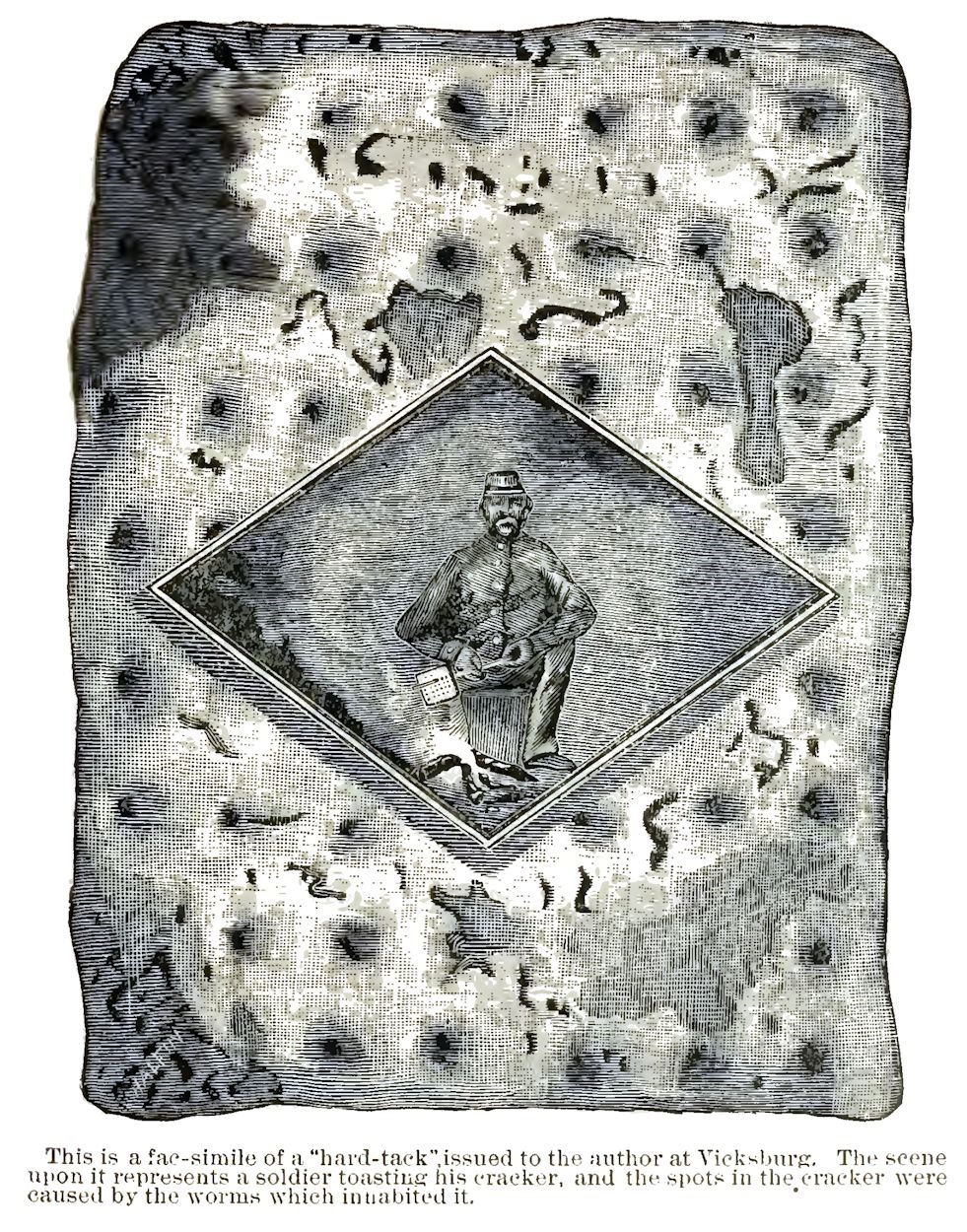
Fac-simile of a "hard tack" issued at Vicksburg, June, 1863.  The scene on it represents a soldier toasting his cracker, and the spots in the cracker were caused by the worms that inhabited it.

July 2 — Renewed our march this morning and moved toward Chambersburg, Penn. Early this morning we crossed the State line and passed into Franklin County, Pennsylvania.

The country south of Greencastle is pretty, the land fertile and well cultivated, and the barns look like churches. We passed through Greencastle, which is a beautiful clean town of about three thousand inhabitants, situated on the Chambersburg and Hagerstown Railroad, and in a rich and fertile country. The streets are wide and straight, the houses nearly all built of brick, and kept in good condition. I saw some beautiful, rosy-cheeked, bonny lassies on the street in Greencastle, but they looked as sour as a crab apple, frowns an inch wide and warranted pure vinegar playing over their lovely faces, like the shadow of a cloud that flits across the blushes of an opening rose. I wonder what made them look so frownful. We did not come here to harm nor molest the charming creatures, but we may hurt some of their relations if they get after us with guns.

The country between Greencastle and Chambersburg is a little rolling and rough. Chambersburg, the county seat of Franklin County, is situated in a beautiful country. The land around the town is under a state of careful and good cultivation. The little city contains about seven thousand inhabitants, and the buildings are nearly all brick. The Franklin House is a large and spacious hotel, built of brick, three stories high. The streets are wide, straight, and level, with good solid brick pavements on each side. Camped this evening on the Baltimore pike a mile from Chambersburg.

July 2, Thursday. A telegram this morning advises me of the death of General R. C. Hale, the brother of Mrs. Welles, at Reedsville in the County of Mifflin, Pennsylvania. He was the efficient Quartermaster-General of Pennsylvania, a good officer and capable and upright man. The public never had a more faithful and honest officer.

Met Sumner and went with him to the War Department. The President was there, and we read dispatches received from General Meade. There was a smart fight, but without results, near Gettysburg yesterday. A rumor is here that we have captured six thousand prisoners, and on calling again this evening at the War Department I saw a telegram which confirms it. General Reynolds is reported killed. The tone of Meade’s dispatch is good.

Met the elder Blair this evening at his son’s, the Postmaster-General. The old gentleman has been compelled to leave his pleasant home at Silver Spring, his house being in range of fire and Rebel raiders at his door. He tells me McClellan wrote Stanton after the seven days’ fight near Richmond that he (Stanton) had sacrificed that army. Stanton replied cringingly, and in a most supplicating manner, assuring McClellan he, Stanton, was his true friend. Mr. F. P. Blair assures me he has seen the letters. He also says he has positive, unequivocal testimony that Stanton acted with the Secessionists early in the War and favored a division of the Union. He mentions a conversation at John Lee’s house, where Stanton set forth the advantages that would follow from a division.

Mr. Montgomery Blair said Stanton was talking Secession to one class, and holding different language to another; that while in Buchanan’s Cabinet he communicated Toucey’s treason to Jake Howard and secretly urged the arrest of Toucey. During the winter of 1860 and 1861, Stanton was betraying the Buchanan Administration to Seward, disclosing its condition and secrets, and that for his treachery to his then associates and his becoming the tool of Seward, he was finally brought into the present Cabinet.

These things I have heard from others also, and there have been some facts and circumstances to corroborate them within my own knowledge. Mr. Seward, who has no very strong convictions and will never sacrifice his life for an opinion, had no belief that the insurrection would be serious or of long continuance. Familiar with the fierce denunciations and contentions of parties in New York, where he had, from his prominent position and strong adherents, been accustomed to excite and direct, and then modify, the excesses roused by anti-Masonry and anti-rent outbreaks by pliable and liberal action, he entertained no doubt that he should have equal success in bringing about a satisfactory result in national affairs by meeting exaction with concessions. He was strengthened in this by the fact that there was no adequate cause for a civil war, or for the inflammatory, excited, and acrimonious language which flowed from his heated associates in Congress. Through the infidelity of Stanton he learned the feelings and designs of the Buchanan Administration, which were not of the ultra character of the more impassioned Secession leaders. One of the Cabinet already paid court to him; Dix and some others he knew were not disunionists; and, never wanting faith in his own skill and management, he intended, if his opponents would not go with him, as the last alternative to go with them and call a convention to remodel the Constitution. Until some weeks after Mr. Lincoln’s inauguration Seward never doubted that he could by some expedient — a convention or otherwise —allay the storm. Some who ultimately went into the Rebellion also hoped it. Both he and they overestimated his power and influence. Stanton in the winter of 1861 whispered in his ear state secrets, it was understood, because Seward was to be first in the Cabinet of Lincoln, who was already elected. The Blairs charge Stanton with infidelity to party and to country from mere selfish considerations, and with being by nature treacherous and wholly unreliable. Were any overwhelming adversity to befall the country, they look upon him as ready to betray it.

July 2d, 1863. At daylight we were promptly under arms, and as soon as breakfast (coffee and crackers) was over, the brigade fell in and marched up the Cemetery Hill, already crowded with various bodies of troops moving into position.

Our entire corps came on the ground, and formed in order of battle, the First, our division, forming in front, the Second a very short distance in rear, connecting on the right with Howard, and on the left with Sickles, of the Third corps.

There was no firing during the formation, and as soon as it was completed, we had ample time to look about us and study the features of the field. We were posted on broad, high, open ground, gently sloping in front towards a small brook called Plum Run, some three or four hundred yards in front, running nearly parallel to our line of battle. An occasional clump of bushes interrupted the view. Towards the right, the ground was higher, completely overlooking the town of Gettysburg. On the left, arose abruptly a couple of small detached mountains, Round Top and Little Round Top, evidently the keys to the position.

The enemy lay in line of battle, some fifteen hundred yards in front of us, under cover of the woods, which fringed the open ground from right to left as far as we could see. On the whole, the field seemed worthy of the great contest now to be fought to the death upon its emerald slopes. It was an admirable field for artillery, and every gun that the army had was placed in position. Pettit’s battery of glorious memory, now commanded by Lieutenant Rhoerty, a brilliant young Irishman, lately ordnance officer of the division, was on our left; this battery and our brigade were on the best of terms, having fought together from Fair Oaks continuously till to-day. As the enemy made no movement, our men sat or lay down in their ranks, while the officers gathered in groups, and discussed the probable outlook for the day. Little, however, was said, most of the men being preoccupied by their own thoughts. About ten o’clock the enemy fired a few shots and our guns replied, and this continued till towards noon, when an ominous silence brooded over the entire field. We knew the enemy were preparing for the attack, and this time it was our turn to await the advance.

At 2 P. M. we stood to arms, on observing Sickles begin to advance and manœuver; after making several incomprehensible movements, his troops marched forward from in front of Round Top, and immediately brought on the action.

Longstreet’s corps advanced and savagely attacked the Third corps, forcing it back, after much fighting, ending in considerable confusion. From where we sat on our horses, the entire field of operations was in view, and was intensely interesting. The fighting continued by the Third corps alone until nearly 3 P. M. when Captain Tremain, of Sickles’s staff, rode up to Zook, and requested him to move to Sickles’s assistance. The general instantly put spurs to his horse and galloped directly across the field to Sickles, who, surrounded by a large staff, was in a state of great excitement; the enemy’s shot were dropping about him, and he seemed to be very much confused and uncertain in his movements. When Zook approached him, he excitedly asked him to put his command into action on his left, where he admitted Longstreet was steadily driving him back near the two small mountains. Zook declared his willingness to act, and galloped back to his command, taking the stone walls and ditches without swerving, either to the right or left. When we reached the brigade, the First and Second brigade of our division were already on the march towards the threatened left, and we promptly followed, marching by the left flank, arriving at the wooded crest adjacent to Round Top mountain; we halted and formed column of attack in two lines: the One Hundred and Forty Pennsylvania, and Fifty-seventh New York in front; the Fifty-second and Sixty-sixth New York in rear. The ground was rocky, strewn with immense boulders, and sparsely covered with timber. As soon as the formation was completed, we marched forward to the attack, at first over rising ground, and shortly received a tremenduous fire from the front; as we marched rapidly forward alongside the mountain, the tumult became deafening, the mountain side echoed back the musketry, so that no word of command could be heard, and little could be seen but long lines of flame, and smoke and struggling masses of men. We kept right on obliquing somewhat to the right, until apparently directly in front of the raging mass of combatants below, then rushed at a double quick boldly forward into the mouth of hell, into the jaws of death. Zook, accompanied by Broom, led the first line, while the second line, commanded by Morris of the Sixty-sixth, was placed in my charge; we soon came to a standstill and a close encounter, when the firing became terrific and the slaughter frightful. We were enveloped in smoke and fire, not only in front, but on our left, and even at times on the right, apparently from men posted on the mountain sides. Our men fired promiscuously, steadily pressing forward, but the fighting was so mixed, rebel and union lines so close together, and in some places intermingled, that a clear idea of what was going on was not readily obtainable. While trying to keep the lines as effective as possible, watching the situation in this pandemonium of death, I saw Zook a little towards the left, riding to the rear, supported by Broom and a mounted orderly. I rode over to him instantly, when he looked up with an expression I shall never forget, and said: “It’s all up with me, Favill.” I told Broom I would turn over the command to Morris and join him as soon as I could, but Morris was not to be found readily in the great confusion of battle. Roberts of the One Hundred and Fortieth was killed, and the troops by this time were sadly mixed up with other commands. I found Frazer, however, the lieutenant-colonel of the One Hundred and Fortieth Pennsylvania, next in rank, and notified him of the death of Zook, and directed him to assume command. He wished me to remain, but I was personal aide-de-camp to Zook, and my duty was to him, and therefore I declined. Just then Brooke came up and took command of the whole line, and relieved the situation completely. I rode off the field and overtook the general with Broom, riding very slowly towards the Baltimore pike. The General was in great pain, and Broom told me he was shot through the bowels. I went ahead to find an ambulance, but before I returned they had fallen in with one, and were driven to the field hospital. Surgeon Wood, one of our best doctors, after examining the wound, told us it was fatal, and nothing could be done; there being no shelter here, and the enemy’s shot frequently reaching the spot, we took the general on a stretcher, and carried him to a small house some distance in the rear on the Baltimore road, close to a bridge crossing a small creek. The house was already filled with men severely wounded, and the sight was most distressing; the howls of pain from the men in the hall and front room were so dreadful that we moved the general back into a small room cut off from the others, and here we spent the night, doing what we could to make our dear commander comfortable. I went out several times during the night, and looked at the ghastly scenes on the floors of the hall and parlor. As many men as could lay side by side completely covered the floors, which were streaming with blood, and the poor fellows seemed to give way completely to their misfortunes. Over twenty of them died and were carried into the yard during the night.
July 2—Our division was in reserve until dark, but our regiment was supporting a battery all day. We lost several killed and wounded, although we had no chance to fire—only lay by a battery of artillery and be shot at. The caisson of the battery we were supporting was blown up and we got a big good sprinkling of the wood from it. Just at dark we were sent to the front under terrible cannonading. Still, it was certainly a beautiful sight. It being dark, we could see the cannon vomit forth fire. Our company had to cross a rail fence. It gave way and several of our boys were hurt by others walking over them. We laid down here a short time, in fact no longer than 10 minutes, when I positively fell asleep. The cannonading did not disturb me. One of the boys shook me and told me Katz was wounded by a piece of a shell striking him on the side, and he was sent to the rear. We went on to the Baltimore Turnpike until 3 in the morning of the 3d.

Thursday, 2d.-—Pretty quiet to-day; think the rations are about out, as we have been getting two small biscuits and a pint of pea soup for a day’s rations for several days; no meat, and pea-bread seems to be out. Various rumors. Tom Meek, Company E, wounded; Jones Greene died of sickness; think the siege of Vicksburg is very nearly at an end.

Thursday, July 2nd—Came on to Deckerd this morning. Prom there took wrong road and came up Cumberland Mountain to the University with Hardee’s Corps. Found there that we had taken the wrong road. John went down to the house to get some information and I lost him. I came down to the railroad and staid all night. Polk’s Corps crossing all night.

July 2 — Firing was kept up all night from the mortar batteries on the opposite side of the river. Sharp shooters as usual this morning. The evening passed off tolerably quiet. WRC

by John Beauchamp Jones

            JULY 2D.—The President is unwell again; to what extent I have not learned. But the Vice-President is ready, no doubt, to take his place in the event of a fatal result; and some would rejoice at it. Such is the mutability of political affairs!

            The Attorney-General Watts, being referred to, sends in a written opinion that foreigners sojourning here, under the protection of the Confederate States, are liable to military duty, in defense of their homes, against any government but the one to which they claim to owe allegiance. This I sent in to the Secretary of War, and I hope he will act on it; but the Assistant Secretary and Mr. Benjamin were busy to-day—perhaps combating the Attorney-General’s opinion. Will Mr. Seddon have the nerve to act? It is a trying time, and every man is needed for defense.

            The enemy were drawn up in line of battle this morning below the fortifications. The Department Guard (my son Custis among them) were ordered out, and marched away; and so with the second class militia. A battle is looked for to-morrow; and there has been skirmishing to-day. A dispatch from Hanover Court House says the enemy is approaching likewise from the north in large force—and 15 guns. This is his great blunder. He cannot take Richmond, nor draw back Lee, and the detachment of so many of his men may endanger Baltimore and Washington, and perhaps Philadelphia.

July 2.—The Richmond Whig of this date contained the following: “If it be true that the confederate forces occupy Harrisburgh, the attention of the commanding general will no doubt be directed to the coal-fields, which lie within forty or fifty miles of that city. His first aim will be to cut all the railroad connections, and thus put a stop to the transportation of fuel. His next will be to destroy the most costly and not easily replaced machinery of the pits. Whether he would stop at this is questionable. He might set fire to the pits, withdraw the forces sent out on this special duty, and leave the heart of Pennsylvania on fire, never to be quenched until a river is turned into the pits, or the vast supply of coal is reduced to ashes. The anthracite coal is found in large quantities in no other part of the world but Pennsylvania. Enormous quantities are used in the United States navy, the countless workshops and manufactories of the North, in the river boats, and even upon locomotives. It cannot well be replaced by any other fuel. The bituminous coal which is found near Pittsburgh would not answer the purpose, even if it would bear the cost of transportation. Our troops already hold the railroads and canals leading from the Cumberland coal-fields. All that is needed is to seize the anthracite fields, destroy the roads and the machinery of the pits, set fire to the mines, and leave them. Northern industry will thus be paralyzed at a single blow.

“These views may have induced General Lee to move upon Harrisburgh. We doubt whether he would fire the mines, but the destruction of the Mauch Chunk Railroad and pit implements would be as legitimate as blowing up tunnels and aqueducts or burning bridges. Of one thing we may be sure, that whatever is best to be done will be done by General Lee, and if he thinks fit to destroy the Pennsylvania mines they will certainly bo destroyed. Should he leave them untouched, it will be for the best of reasons. But it is impossible not to indulge the hope that he will avail himself of the tremendous power which the possession of the coal-flelds, even temporarily, would confer.”

—A skirmish occurred near Bottom’s Bridge, Va., in which Sergeant Barnett, of company C, Fifth Pennsylvania cavalry, was killed. There were no other casualties. The Fifth Pennsylvania captured twenty-five prisoners. — The United States steamer Maumee was launched at Brooklyn, N. Y.

—General Neal Dow was captured by a party of rebel scouts at a private residence near Clinton, La., and sent to Richmond, Va.—The rebel blockade-runner Britannia was captured by the National gunboat Santiago de Cuba.—At Baltimore, Md., the following order was issued by the General Commanding :

“Until further orders, the citizens of Baltimore city and county are prohibited from keeping arms in their houses unless enrolled in volunteer companies for the defence of their homes.” The dwellings of citizens were visited by the Provost-Marshal and the police, for arms, in accordance with this order.

—General William Jackson, with one thousand seven hundred men, and two pieces of artillery, attacked the Union troops at Beverly, Va., but was repulsed and routed with some loss. The rebels expected to make an easy prize of the garrison, which contained the Tenth Virginia infantry, Captain Ewing’s battery, and one company of cavalry, under the command of Colonel Harris, of the Tenth Virginia, who was ordered by General Averill to hold the place until he could reach him with reinforcements, which he did ; but before their arrival, the rebels were repulsed and the Nationals were in pursuit.—The battle of Gettysburgh was resumed at early daylight this morning.—(Docs. 20 and 118.)

—The rebel Impressment Commissioners of the several States, met in convention at Atlanta, Ga., to-day. Virginia, North-Carolina, and Florida were not represented, and the other States only partially. Consequently the Convention adjourned to the twenty-seventh instant for a full attendance.

—A picked force of infantry, artillery, and cavalry, under General Foster in person, left Newbern, N. C., on an expedition inland.—The battle of Cabin Creek, Indian Territory, ended on this day.—(Doc. 30.)