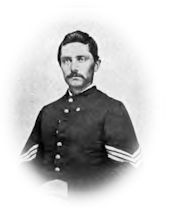
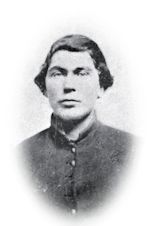
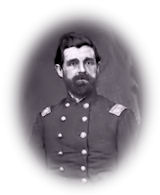
Following the American Civil War Sesquicentennial with day by day writings of the time, currently 1863.

July 2013

[July 3d]

Zook was calm, serene, and dignified, speaking occasionally, but never of himself, and apparently suffered but little pain. At daylight we concluded to move still further to the rear, as the cannon balls sometimes reached even this dreadful spot, so we took up the stretcher, and moved down the road amidst a motley crowd of ambulances, ammunition trains, and disorganized men, making it very difficult to get along; about a mile down the road we turned to the right, and took possession of a comfortable house; it was occupied by several women, who were scared out of their wits, and glad to have us in the house. We placed the general on the stretcher in the front room to the left on entering, and had the women make some chicken soup or broth. I asked the general if he would not like to see Dwight, the noted chaplain of the Sixty-sixth, a special favorite of his, but he declined, saying it was too late. He signified his wishes in respect to his private affairs, and requested me to attend to everything for him, then calmly awaited the end. At times he brightened up and spoke with considerable animation, so that we began to think the doctor might be mistaken, and tried to make him think so too, but he shook his head and said there was no hope. We had frequently amongst ourselves discussed the nature of various wounds, and were all aware that a shot through the intestines was considered necessarily fatal. He drank a little whiskey at times, and some of the broth that the women made for him, but towards evening he began to fail, and at five o’clock peacefully breathed his last.

Thus ended the career of a brilliant officer, an estimable gentleman, and a faithful friend. Killed at the head of his troops, on his native soil, defending the honor and integrity of the country he loved so well, is after all a glorious death to die, and so far as he is concerned, perhaps is the most fitting climax of a brilliant career. It is quite a different thing for those of us belonging to his military family, who have gone hand in hand together, since the very formation of the army of the Potomac. I was his chief aide-de-camp and enjoyed his confidence completely. He was to all of us friendly in the extreme, just, exacting at times, but always ready to acknowledge and give us credit whenever we deserved it. His death interrupts all our plans for the future, and our interest in military affairs seems to have entirely evaporated. What a blank in our lives his death will cause. From the day I met him first on Staten Island, when I turned out the guard to please him, I have been with him and always close to him, and knew him more intimately than any other person in the army. He was ambitious and intended getting transferred to the west at the first opportunity, where he held greater chances existed for independent commands, and consequently for gaining distinction.

Broom wrote Mitchell, of Hancock’s staff, a line notifying him of the general’s death, and asking for passes, so that we could take the body home, which were immediately sent to us. Early the following morning, July 4th, we secured some ice, packed the remains in a rude box, and sent them over to the railway station in an ambulance.

July 3d, 1863.—H. was going to headquarters for the requisite pass, and he saw General Pemberton crawling out of a cave, for the shelling has been as hot as ever. He got the pass, but did not act with his usual caution, for the boat he secured was a miserable, leaky one—a mere trough. Leaving Martha in charge, we went to the river, had our trunks put in the boat, and embarked; but the boat became utterly unmanageable, and began to fill with water rapidly. H. saw that we could not cross it and turned to come back; yet in spite of that the pickets at the battery fired on us. H. raised the white flag he had, yet they fired again, and I gave a cry of horror that none of these dreadful things had wrung from me. I thought H. was struck. When we landed H. showed the pass, and said that the officer had told him the battery would be notified we were to cross. The officer apologized and said they were not notified. He furnished a cart to get us home, and to-day we are down in the cellar again, shells flying as thick as ever. Provisions are so nearly gone, except the hogshead of sugar, that a few more days will bring us to starvation indeed. Martha says rats are hanging dressed in the market for sale with mule meat,—there is nothing else. The officer at the battery told me he had eaten one yesterday. We have tried to leave this Tophet and failed, and if the siege continues I must summon that higher kind of courage—moral bravery—to subdue my fears of possible mutilation.

______

Note: To protect Mrs. Miller’s job as a teacher in New Orleans, the diary was published anonymously, edited by G. W. Cable, names were changed and initials were often used instead of full names — and even the initials differed from the real person’s initials.

July 2nd, 1863.—Yesterday fighting began on Pennsylvania soil. The army of Northern Virginia, the bravest army in the history of wars, may, even now be struggling with the foe. Oh, how horrible it is to know that those you love are in such danger! There must be aching hearts at the North as well as here. I feel for all who suffer and it seems to me the bond of brotherhood, which once united the two sections, ought to make us kinder in our judgments; more merciful in our actions. But war is a monster and destroys charity.

by John Beauchamp Jones

            JULY 3D.—My son Custis stayed out all night, sleeping on his arms in the farthest intrenchments. A little beyond, there was a skirmish with the enemy. We lost eight in killed and wounded. What the enemy suffered is not known, but he fell back, and ran toward the White House.

            This morning, Mr. Child, agent for exchange of prisoners, reported that “not a Yankee could be found on the face of the earth.” And this induced a general belief that the enemy had retired, finally, being perhaps ordered to Washington, where they may be much needed.

            The Secretary of War, believing the same thing, intimated to Gen. Elzey (who for some cause is unable to ride, and therefore remains in the city) a desire to send several regiments away to some menaced point at a distance. In response, Elzey writes that none can be spared with safety; that the enemy had apparently divided his force into two bodies, one for Hanover, and the other for the Chickahominy, and both strong; and he advised against weakening the forces here. He said he had not yet completed the manning of the batteries, the delay being in arming the men—and he hoped “Hill could hold out.”

            We have 3400 convalescents at CampLee, and as many more may be relied on for the defense of the city; so we shall have not less than 22,000 men for the defense of Richmond. The enemy have perhaps 35,000; but it would require 75,000 to storm our batteries. Let this be remembered hereafter, if the 35,000 sent here on a fool’s errand might have saved Washington or Baltimore, or have served to protect Pennsylvania—and then let the press of the North bag the administration at Washington! Gen. Lee’s course is “right onward,” and cannot be affected by events here.

            My friend Jacques (clerk) marched out yesterday with the Department Guard; but he had the diarrhœa, and was excused from marching as far as the company. He also got permission to come to town this morning, having slept pretty well, he said, apart from the company. No doubt he did good service in the city today, having his rifle fixed (the ball, I believe, had got down before the powder), and procuring a basket of edibles and a canteen of strong tea, which he promised to share with the mess. He said he saw Custis this morning, looking well, after sleeping on the ground the first time in his life, and without a blanket.

            We have nothing further from the North or the West.

2d July (Thursday).—”We all got up at 3.30 A.M., and breakfasted a little before daylight. Lawley insisted on riding, notwithstanding his illness. Captain ——and I were in a dilemma for horses; but I was accommodated by Major Clark (of this Staff), whilst the stout Austrian was mounted by Major Walton. The Austrian, in spite of the early hour, had shaved his cheeks and ciréd his mustaches as beautifully as if he was on parade at Vienna.

Colonel Sorrell, the Austrian, and I arrived at 5 A.M. at the same commanding position we were on yesterday, and I climbed up a tree in company with Captain Schreibert of the Prussian army. Just below us were seated Generals Lee, Hill, Longstreet, and Hood, in consultation—the two latter assisting their deliberations by the truly American custom of whittling sticks. General Heth was also present; he was wounded in the head yesterday, and although not allowed to command his brigade, he insists upon coming to the field.

At 7 A.M. I rode over part of the ground with General Longstreet, and saw him disposing McLaws’s division for to-day’s fight. The enemy occupied a series of high ridges, the tops of which were covered with trees, but the intervening valleys between their ridges and ours were mostly open, and partly under cultivation. The cemetery was on their right, and their left appeared to rest upon a high rocky hill. The enemy’s forces, which were now supposed to comprise nearly the whole Potomac army, were concentrated into a space apparently not more than a couple of miles in length. The Confederates enclosed them in a sort of semicircle, and the extreme extent of our position must have been from five to six miles at least. Ewell was on our left; his headquarters in a church (with a high cupola) at Gettysburg; Hill in the centre; and Longstreet on the right. Our ridges were also covered with pine-woods at the tops, and generally on the rear slopes. The artillery of both sides confronted each other at the edges of these belts of trees, the troops being completely hidden. The enemy was evidently intrenched, but the Southerns had not broken ground at all. A dead silence reigned till 4.45 P.M., and no one would have imagined that such masses of men and such a powerful artillery were about to commence the work of destruction at that hour.

Only two divisions of Longstreet were present today—viz., McLaws’s and Hood’s—Pickett being still in the rear. As the whole morning was evidently to be occupied in disposing the troops for the attack, I rode to the extreme right with Colonel Manning and Major Walton, where we ate quantities of cherries, and got a feed of corn for our horses. We also bathed in a small stream, but not without some trepidation on my part, for we were almost beyond the lines, and were exposed to the enemy’s cavalry.

At 1 P.M. I met a quantity of Yankee prisoners who had been picked up straggling. They told me they belonged to Sickles’s corps (3d, I think), and had arrived from Emmetsburg during the night. About this time skirmishing began along part of the line, but not heavily.

At 2 P.m. General Longstreet advised me, if I wished to have a good view of the battle, to return to my tree of yesterday. I did so, and remained there with Lawley and Captain Schreibert during the rest of the afternoon. But until 4.45 P.M. all was profoundly still, and we began to doubt whether a fight was coming off today at all. At that time, however, Longstreet suddenly commenced a heavy cannonade on the right. Ewell immediately took it up on the left. The enemy replied with at least equal fury, and in a few moments the firing along the whole line was as heavy as it is possible to conceive. A dense smoke arose for six miles; there was little wind to drive it away, and the air seemed full of shells—each of which appeared to have a different style of going, and to make a different noise from the others. The ordnance on both sides is of a very varied description. Every now and then a caisson would blow up—if a Federal one, a Confederate yell would immediately follow. The Southern troops, when charging, or to express their delight, always yell in a manner peculiar to themselves. The Yankee cheer is much more like ours; but the Confederate officers declare that the rebel yell has a particular merit, and always produces a salutary and useful effect upon their adversaries. A corps is sometimes spoken of as a “good yelling regiment.”

So soon as the firing began, General Lee joined Hill just below our tree, and he remained there nearly all the time, looking through his field-glass—sometimes talking to Hill and sometimes to Colonel Long of his Staff. But generally he sat quite alone on the stump of a tree. What I remarked especially was, that during the whole time the firing continued, he only sent one message, and only received one report. It is evidently his system to arrange the plan thoroughly with the three corps commanders, and then leave to them the duty of modifying and carrying it out to the best of their abilities.

When the cannonade was at its height, a Confederate band of music, between the cemetery and ourselves, began to play polkas and waltzes, which sounded very curious, accompanied by the hissing and bursting of the sheik.

At 5.45 all became comparatively quiet on our left and in the cemetery; but volleys of musketry on the right told us that Longstreet’s infantry were advancing, and the onward progress of the smoke showed that he was progressing favourably; but about 6.30 there seemed to be a check, and even a slight retrograde movement Soon after 7 General Lee got a report by signal from Longstreet to say “we are doing well” A little before dark the firing dropped off in every direction, and soon ceased altogether. We then received intelligence that Longstreet had carried everything before him for some time, capturing several batteries, and driving the enemy from his positions; but when Hill’s Florida Brigade and some other troops gave way, he was forced to abandon a small portion of the ground he had won, together with all the captured guns, except three. His troops, however, bivouacked during the night on ground occupied by the enemy this morning.

Every one deplores that Longstreet will expose himself in such a reckless manner. To-day he led a Georgian regiment in a charge against a battery, hat in hand, and in front of everybody. General Barksdale was killed and Semmes mortally wounded; but the most serious loss was that of General Hood, who was badly wounded in the arm early in the day. I heard that his Texans are in despair. Lawley and I rode back to the General’s camp, which had been moved to within a mile of the scene of action. Longstreet, however, with most of his Staff, bivouacked on the field.

Major Fairfax arrived at about 10 P.M. in a very bad humour. He had under his charge about 1000 to 1500 Yankee prisoners who had been taken to-day; among them a general, whom I heard one of his men accusing of having been “so G—d d—d drunk that he had turned his guns upon his own men.” But, on the other hand, the accuser was such a thundering blackguard, and proposed taking such a variety of oaths in order to escape from the U.S. army, that he is not worthy of much credit. A large train of horses and mules, &c, arrived to-day, sent in by General Stuart, and captured, it is understood, by his cavalry, which had penetrated to within six miles of Washington.
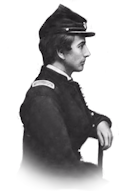
2nd. Borrowed one day’s rations of the 12th R. I. Expecting a train for ourselves. Boys very accommodating. Regt. to be mustered out of service on the 13th. All very happy. It makes me almost homesick and still I am glad my time is not out. I could not be satisfied at home with this cruel war going on. Many will re-enlist. Boys went for forage.

July 2. — Started from Westminster in the cars at 5 A.M. and reached Baltimore about 12. I gave my mare to an officer of the 84th Pennsylvania, who promised to send her to our headquarters train. In Baltimore we met Major Reynolds, the general’s brother, and Mr. Gildersleeve, his brother-in-law. We had the body embalmed, and placed in a coffin, and at 8.30 P.M. took the train for Philadelphia. We reached there about 12, and met Rosengarten’s father and brother. The general’s body was taken to his brother-in-law’s, Mr. Landis. We went to the Continental.

Thursday, 2d—We loaded up our baggage and started at 8 o’clock to join our regiment and brigade in camp on the Big Black river, about ten miles distant. We found our command cutting away the trees which were cut down to keep General Johnston from coming in our rear after Vicksburg should surrender.[1]


[1] It was reported that Pemberton had raised the white flag, asking for terms of surrender. This being the case, our forces were set to work clearing the road for our artillery; for we understood that upon the surrender of Vicksburg, we were to pursue Johnston’s army.—A. G. D.

Before Vicksburg, Thursday, July 2. Hearing that William Jones of the 23rd was wounded, I obtained permission of Lieutenant Clark, commanding Battery, to go and visit him. G. R. Jones and myself found him in the Division hospital with his leg amputated above the knee, wounded on the 30th ult. by a chance musket ball. Looked well under the circumstances. Called upon J. Savage before returning. Rebs showed a line in front of us in the afternoon. Several shots exchanged.

Colonel Lyons.

Fort Donelson, July 2, 1863.—We are mounting our infantry under command of Major Bigney. He takes great interest in it. There are to be five companies of forty men each. Fort Heiman is reoccupied by some of General Grant’s command.