Vicksburg, Sunday, Aug. 16. Weather very warm and heavy. Health—not sick, not well. Feel dull—a headache. Completed Sparks’s Biographies of Gen. Chas. Lee and Joseph Reed. Read also a sermon of H. W. Beecher in the Independent. Wrote home. 4 P. M. we were suddenly startled by a loud peal of thunder, others followed, and in ten minutes the sky so clear and blue, was enshrouded with black frowning clouds and a heavy storm of wind with heavy rain followed. It rained nearly all night. A Southern storm comes unexpectedly and leaves the same.
August 2013
August 16th. Sunday morning, immediately after breakfast, four officers were detailed from the staff to inspect the several brigades, notice of which had been given to their commanders. I was ordered to the Irish brigade, Colonel Kelly commanding, a painstaking, competent, and excellent officer. I followed my instructions closely, and made the most critical inspection of arms, accoutrements, contents of knapsacks, and of the three days’ supply of rations supposed to be in the men’s haversacks, subsequently of company quarters. I was surprised to find the brigade in such excellent condition, and made a very favorable report; after the inspection I accepted an invitation to the colonel’s quarters, and was regaled with champagne and fine cigars; there were, of course, all the regimental commanders present and we had an agreeable half hour. They are a brilliant lot of soldiers, and jolly boon companions.
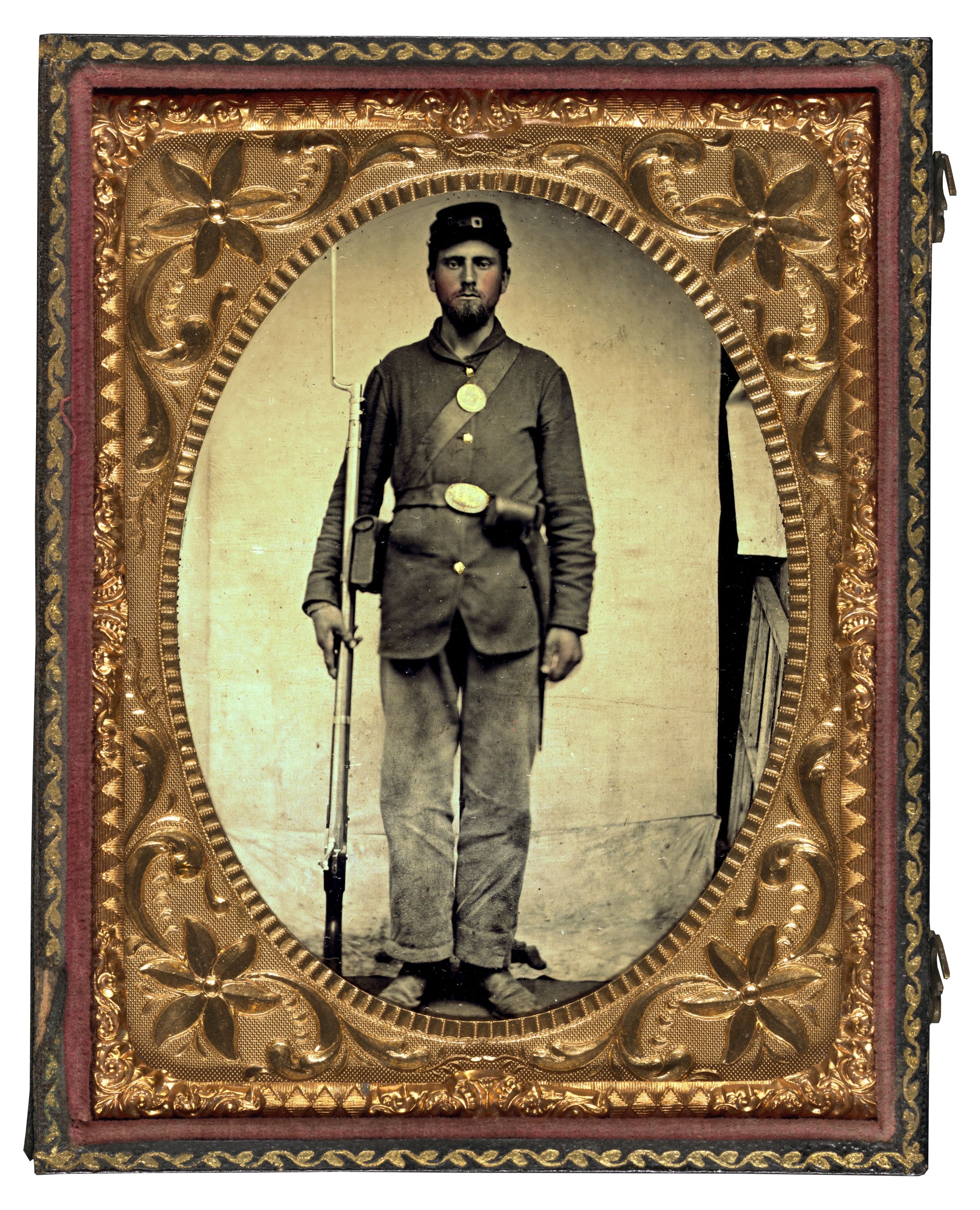 Unidentified soldier in Union uniform with bayoneted musket, cartridge box, and cap box.
__________
Quarter-plate tintype, hand-colored ; 11.8 x 9.3 cm (case)
Deposit by Tom Liljenquist; 2012
Liljenquist Family Collection of Civil War Photographs; Ambrotype/Tintype photograph filing series; Library of Congress Prints and Photographs Division.
Record page for image is here.
__________
 Note – This image has been digitally adjusted for one or more of the following:
- fade correction,
- color, contrast, and/or saturation enhancement
- selected spot and/or scratch removal
- cropped for composition and/or to accentuate subject matter
- straighten image
Civil War Portrait 059
August 16.—The rebel steamer Cronstadt, from Wilmington, N. C., for Nassau, N. P., was captured by the Union gunboat Rhode Island, at a point forty miles from Abaco.—The letter from President Lincoln to the Union Convention at Springfield, Ill., was made public. It is remarkable for its plain strong sense, and for directness of purpose and clearness of language. — Bridgeport, Alabama, was evacuated by the rebel forces.—The rebel blockade-runner, Alice Vivian, was captured by the United States steamer, De Soto, under the command of Captain William M. Walker.

by John Beauchamp Jones
AUGUST 16TH. —The President rides out with some of the female members of his family every afternoon, his aids no longer accompanying him. In this he evinces but little prudence, for it is incredible that he should be ignorant of the fact that he has some few deadly enemies in the city.
Everywhere the ladies and children may be seen plaiting straw and making bonnets and hats. Mrs. Davis and the ladies of her household are frequently seen sitting on the front porch engaged in this employment. Ostentation cannot be attributed to them, for only a few years ago the Howells were in humble condition and accustomed to work.
My wife borrowed $200 of Mr. Waterhouse, depositing $20 in gold as security—worth $260—which, with the $300 from Evans on account of rent, have been carefully applied to the purchase of sundry housekeeping articles. After the 1st September we shall cease to pay $40 per month rent on furniture, but that amount for house-rent, so that in the item of rent my expenses will be less than they were the preceding year. So far, with the exception of crockery-ware and chairs, the purchases (at auction) have been at low prices, and we have been fortunate in the time selected to provide indispensable articles.
I often wonder if, in the first struggle for independence, there was as much suffering and despondency among certain classes of the people as we now behold. Our rich men are the first to grow weary of the contest. Yesterday a letter was received by the Secretary of War from a Mr. Reanes, Jackson, Mississippi, advising the government to lose no time in making the best terms possible with the United States authorities, else all would be lost. He says but a short time ago he was worth $1,250,000, and now nothing is left him but a shelter, and that would have been destroyed if he had not made a pledge to remain. He says he is an old man, and was a zealous secessionist, and even now would give his life for the independence of his country. But that is impracticable—numbers must prevail—and he would preserve his wife and [click to continue…]

Sunday, August 16.—To-day Dr. Quintard preached twice. As our chapel is not yet up, he had service under a large oak tree. In the morning his text was one I had heard him preach from in Chattanooga: “We are journeying on to the place of which the Lord hath said, I will give it you.” He asked me before preaching if I would object hearing it again. I told him, on the contrary, that I would be much pleased.
As the text is taken from Numbers, which is a history of the children of Israel and their wanderings, a more appropriate one to the scene before us, could not have been selected. Here we were, wanderers, pitching our tents, wo know not for how long. Nearly every patient in the hospital was there; among them the lame and the halt. The tents in the distance, and God’s messenger before us, delivering God’s commands, as Moses and Aaron did to the children of Israel, could not but be an impressive scene. It struck me as such, and I have no doubt many others who were there. O, how earnestly I prayed that we, with all the warning of that unhappy race before us, might not forget the Lord our God, and he cast us wanderers over the earth.
Mr. Green, our chaplain, sat with Dr. Q., and I observed he did not assist him with the service. This caused me to reflect on the diversity of the Christian religion, and I thought what a pity it is that there should be any difference about it.
I do not think that any one will deny the necessity of having a stable government in the church. Surely, as in every thing else, God has made order predominant. He never meant that his church should be without it.
Who can not see the evil effects produced by the many different sects which are constantly springing up around us?
And another evil, is ignorant men being permitted, as they are in many churches, to preach. I have seen men get up in the pulpit, and try to explain the Scriptures, in doing which they have made a perfect failure of it. Common sense ought to tell us, even had we not the Bible for proof, that God never meant that his Holy Book should be expounded by such men, and his holy church left to their care.
Many say, were not the apostles ignorant men? forgetting that they were so, like all others, until they were taught. They had no mean teacher; none less than our blessed Savior himself, who instructed them daily. And even then their education was not completed until the day of Pentecost, when a miracle was performed, and they spake in other tongues, as the Spirit gave them utterance. We have no miracles now-adays, but we have colleges and teachers, which answer the same purpose.
But I must drop this subject, it has carried me much further than I had any idea of going. I was only deploring this state of affairs, and wondering which body of Christians ought to yield. I must think, with religion, as with many other things, that which is the most stable and makes most use of the Bible, must certainly be the best.
I can not deny that I have seen good, yea, much good, come from the teachers of all denominations; and, in fact, I have met so few ministers and members of the Episcopal Church, that I have many a time said that if the soldiers had none but it to look to for light, they would certainly have been in darkness; and of all times in the world, this is the last to draw distinctions. I am so much rejoiced when a man tells me he is a professor of religion, and trying to be a follower of the lowly Jesus, that I never think or care of which Christian church he is a member.
I sincerely trust that all who now worship God in spirit and in truth may ere long be in one fold, as we have one Lord Jesus Christ. And that we may not forget that, as we are all striving for the one goal—all sinners alike—apt to go astray when left to ourselves—that whatever differences of opinion we may have on minor subjects, to exercise that Christian virtue toward each other which St. Paul says is the bond of perfectness; and, in the words of the venerable Bishop Green, never to speak unkindly of any, especially of one who is trying to serve Jesus Christ; and remember that it is no advantage, rather a curse, to be in the church, and at the same time a stranger to that holiness which all her ministrations are designed and calculated to produce in our hearts and lives.
Dr. Q. gave out that he would have service after dark; I did not see how he could, as we had no lights of any kind, but I was not long in finding out. He omitted the most part of the service in which the congregation joins, and read out the lines of the psalm and hymn, like a good Methodist, and preached a very fine extempore sermon.
I can now understand how it is that he is so popular and does so much good in the army. He suits himself and all he does to the times.
We had a call from Dr. Sizemore and his wife; he is now assistant surgeon in the Foard Hospital, in Ringgold; Mrs. S. is matron. We had a long talk about Corinth, and the terrible times we had seen there.
This morning Mrs. Dr. Gamble, Mrs. Bragg, and myself raised the tunes, but in the evening Dr. Q. did not give us the chance, as he raised them himself. General Bragg attended service. His health is very bad, which is no wonder, as he is so much harassed. He is a member of the church, and, I am told, a sincere Christian. He has done his utmost to have Christianity diffused in the army.
Mrs. B. has the appearance of being a very modest, lady-like person, as I am told she is. She is also in bad health. It is said she worries a good deal whenever she hears of the necessity of shooting any of the men, and pleads for them when she can.
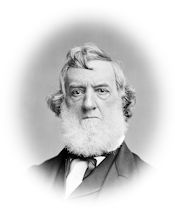
August 15, Saturday. Certain persons in Boston have an innate conviction that they can improve the administration of the Navy Department. They are never united among themselves as to how this is to be effected, but all are fond of criticism. They always claim that they expected this thing would fail or that would succeed after the event occurred. I must do them the justice to say, however, that with all their grumbling and faultfinding they have generally given me a fair support. In special cases, where I have been lectured, I have invariably found there was an axe to grind, a purpose to be accomplished. Some one, or more, important personage has had suggestions to make, and for a consideration — never omitting that—would consent to help along the work of putting down the Rebellion. These have been the captious ones.
A man by the name of Weld has written a long letter to Governor Andrew. He wants the Governor to aid the Navy Department by writing to the President to form a Naval Board in Massachusetts, with authority to build vessels, fast steamers, such as Massachusetts can build, steamers which will capture or destroy the Alabama, and allow the Massachusetts Board to commission the officers. If there is no appropriation, says good Mr. Weld, take the necessary funds from the Secret Service money. Mr. Weld informs Governor Andrew he is ready to be employed. Governor Andrew indorses over the letter. He also indorses Mr. Weld, who is, he says, one of the most eminent shipbuilders in Massachusetts, and he (Governor A.) is ready to cooperate with Mr. Weld in his patriotic suggestions, etc., etc., etc. This is Boston all over. I have had it from the beginning and periodically. The Welds, etc., from the commencement of hostilities, have prompted and promised almost anything, only requiring the Government to give them power and foot the bills.
I had to-day a very full and interesting account of the campaign and fall of Vicksburg from General F. P. Blair, who has done good service in the field and in politics also. He was a fearless pioneer in the great cause of the Union and breasted the storm in stormy Missouri with a bold front. Of the factions and feuds in St. Louis I pretend to no accurate knowledge, and am no partisan of or for either. Frank is as bold in words as in deeds, fearless in his utterances as in his fights; is uncalculating, — impolitic, it would be said, — rash, without doubt, but sincere and patriotic to the core. I detect in his conversation to-day a determination to free himself from personal and local complications, and if possible to reconcile differences. It is honorable on his part, but I apprehend he has materials to deal with that he cannot master.
G. W. Blunt came to see me. Ridicules Barney and all the government officials in New York but Wakeman. Says old General Wool made himself ridiculous in the mob difficulties. Calls him a weak old man. If weak, it is from age, for there is no one more patriotic. At eighty he was not the proper man to quell an outbreak. Blunt and others are sore over the removal of General Harvey Brown.. He is earnest to have the draft go forward, but says it will be followed by incendiarism. It may be so. Blunt is ardent, impulsive, earnest, and one-sided.
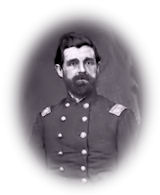
Colonel Lyons.
Fort Donelson, Aug. 15, 1863.—We are scouting and chasing guerillas pretty lively now. A party of mounted infantry, which I sent out last Saturday, had several skirmishes with them; wounded some of them and made some captures. None of our men were hurt. I sent out a whole battalion for an extensive scout.
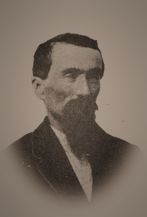
August 15 — Late this evening the first section went on outpost duty. I, being on the sick list, remained at the reserve.
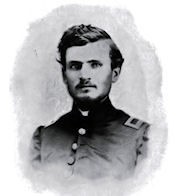
15th. After morning duties went with wagon and three men to Camp Nelson for rations. Had returned to within half a mile of the place when we met the boys in wagons. Turned back again. Camped near the 86th Ohio. Saw Capt. Lindsley and Lieut. Steele of our old regiment. Drew some horses. Had the blue sky for our covering, the first time for a long while.


