Following the American Civil War Sesquicentennial with day by day writings of the time, currently 1863.

August 2013

An Inspection.

August 12. A few days ago orders came to get ready for inspection the next afternoon. All was now hurry and bustle, cleaning up camp, arms, equipments and clothing, and putting everything in order. The artillerists worked like beavers, cleaning up the gun carriages and limbers, using all the grease in the kitchen to brighten them up. The old brass guns were polished up and shone like mirrors and we were congratulating ourselves on being highly complimented.

At the appointed time, Lieut. Col. Moulton and Capt. Rawlston of somebody’s staff put in an appearance. The captain was the inspecting officer; a very airy, pompous young gentleman, with a remarkable faculty of making his weak points conspicuous. When the companies fell in, he noticed the artillery detail did not fall in and inquired the reason. Col. Moulton replied that they were expecting to be inspected as artillery. The captain said he knew nothing about that, he was sent here to inspect this detachment as infantry and every man must fall in. Now that was all right enough, only it placed me at a disadvantage, for I had taken no thought or care of Spitfire since my promotion and it was looking pretty bad. But I had no time to clean it up, and I must say it was a sorry looking piece to take out for a show. But as bad as it looked, I had the utmost confidence in its shooting qualities, in fact I have never lost confidence in Spitfire but once, that was when I dropped it in the creek at Goldsboro.

We were marched out and paraded, and after the inspecting officer had “sassed” Col. Moulton and nearly all the other officers, he commenced his job. He found right smart of fault, but didn’t find a really good subject until he came to me. He looked me over, and taking Spitfire gave it a very careful and thorough inspection. Handing it back he very gravely informed me that he had inspected the whole army of the Potomac and had never before seen a rifle looking so bad as Spitfire, and still further complimenting me by saying I was about the roughest looking sergeant he had ever seen. I nodded assent, venturing the remark that I had been in the artillery detail while here and my rifle had been somewhat neglected, but I had a gun on the Malakoff that could knock the spots off the sun. He allowed that that was insolence and any more of it would subject me to arrest. Imagine the indignation of the chief of artillery on being threatened with arrest by an infantry captain. My first impulse was to call my command, lash him to the muzzle of the gun on the Malakoff and give him rapid transit over the tops of the pines, but better thoughts soon succeeded and I forgave him, thinking that perhaps he was doing as well as he knew how. The inspection over, he had not long to stay, as the boat was waiting for him. I noticed the officers didn’t pet him very much and I don’t believe he got more than one drink.

Miss Carroll.

Three or four miles out here, through the woods, lives a Mr. Carroll. He has two sons in the 1st North Carolina union volunteers, stationed up in Washington. He makes frequent visits up there to see the boys and is often accompanied by his daughter, a rather good-looking young lady of about 20 years of age. It sometimes happens that they get here early in the morning and have to wait an hour or so for the boat, and will sometimes stop an hour on their return before going home. At these times they are guests at headquarters and a few of us, without the fear of the captain before our eyes, will happen in to have a chat with the old gentleman and his daughter. She expressed a great fondness for literature and claims to be “the only really literary young lady in these yere parts.” We occasionally fit her out with such story papers and magazines as we may have lying around, for which she expresses great pleasure.

She one day inquired if we had read a certain piece of poetry in one of the magazines we had given her. She was told we had and thought it very nice. We inquired if she was pleased with it. She replied she thought it was “Splendid! beautiful!” ‘We asked if she was fond of poetry. She said, she was excessively fond of it and read a great deal; in a sly, blushing kind, of way, she hinted that she sometimes tried her hand at composing. “Ah, indeed; would you favor us with a few specimens, some day when you come over? We should be pleased to look at them.” She promised she would, and the next time she came she brought a composition entitled “Lines to the Union Boys.” They were the merest doggerel, but we were loud in their praise and told her that by reading poetry and practising composing she would excel; that when the cruel war was over and we had retired to the peaceful pursuits of life in our far northern homes, we hoped to be reminded of her occasionally, by seeing some of her productions in print. She seemed a good deal pleased with such flattering encomiums, but thought she would hardly attain to that distinction. I thought so too. I asked if she would allow me to take a copy of the lines during her absence up town, and she kindly consented. Below is the copy:


I suppose you have herd of Swift creek

An the victory there was won

The yankee boys was wide awake

An they made them rebels run.


Chorus—Farewell Father an Mother

An a true sweetheart

An the girls we leave in pain

Oh dont forget those yankee bys they are coming back again.


An when the yankees did come in

The guerrillas took to flight

An tore down the bonna blue flag

An hoisted the stars an stripes.


When South Carolina did secede

An surely did go out

The yankee boys must have bin asleep

They had not whipt her back


I take my stand in Richmond

An Swift creek Il persue

I do not care for Whitford[1]

Nor none of his cowardly crew


The gurrillas hates the Buffalows[2]

But they dont care for that

If they dont shut their mouths an let them alone

They will make them clere the track


There is good many men in this war

By the names of Hill

An if the yankees dus get them

They will larn them how to drill


There is good many men here

By the name of Whitford two

An when the Yankees does get them

They will put them rebels through


The secesh girls look mighty loansum

Walking the road in there homemade homespun

The Union girls dont look sad

Walking the road in there yankee plad


An when the war is ended

The guerrillas they will say

They rather fight the devil

Than the boys that gains the day


Hold your toungs you secesh ones

An see what will be don

The yankees boys are bound to go

The whole hog or none


The Union men looks mighty grand

With there cork heel boots an their gloves on their hands

The secesh men looks mighty mean

Going through the woods an never are seen. Chorus, &c.

 
Now whatever fault can he found with the above lines, there can certainly no fault he found with their loyalty.

[1] Whitford was a Guerrilla captain.

[2] Buffaloes were North Carolina Union volunteers.

Wednesday, 12th—We had a fearful windstorm today, though no rain. Everything in camp is moving along fine and the boys are quite cheerful. We have plenty of wood, canebrake and Spanish moss for our use and our camp is in good shape.

Vicksburg, Wednesday, Aug. 12. Received mail. I got two letters from home bearing date of July 12th and August 2nd,, the first being detained at Memphis. What a source of comfort these weekly messengers from home are to me. How anxiously I wait for the week to roll around so as to be the recipient.

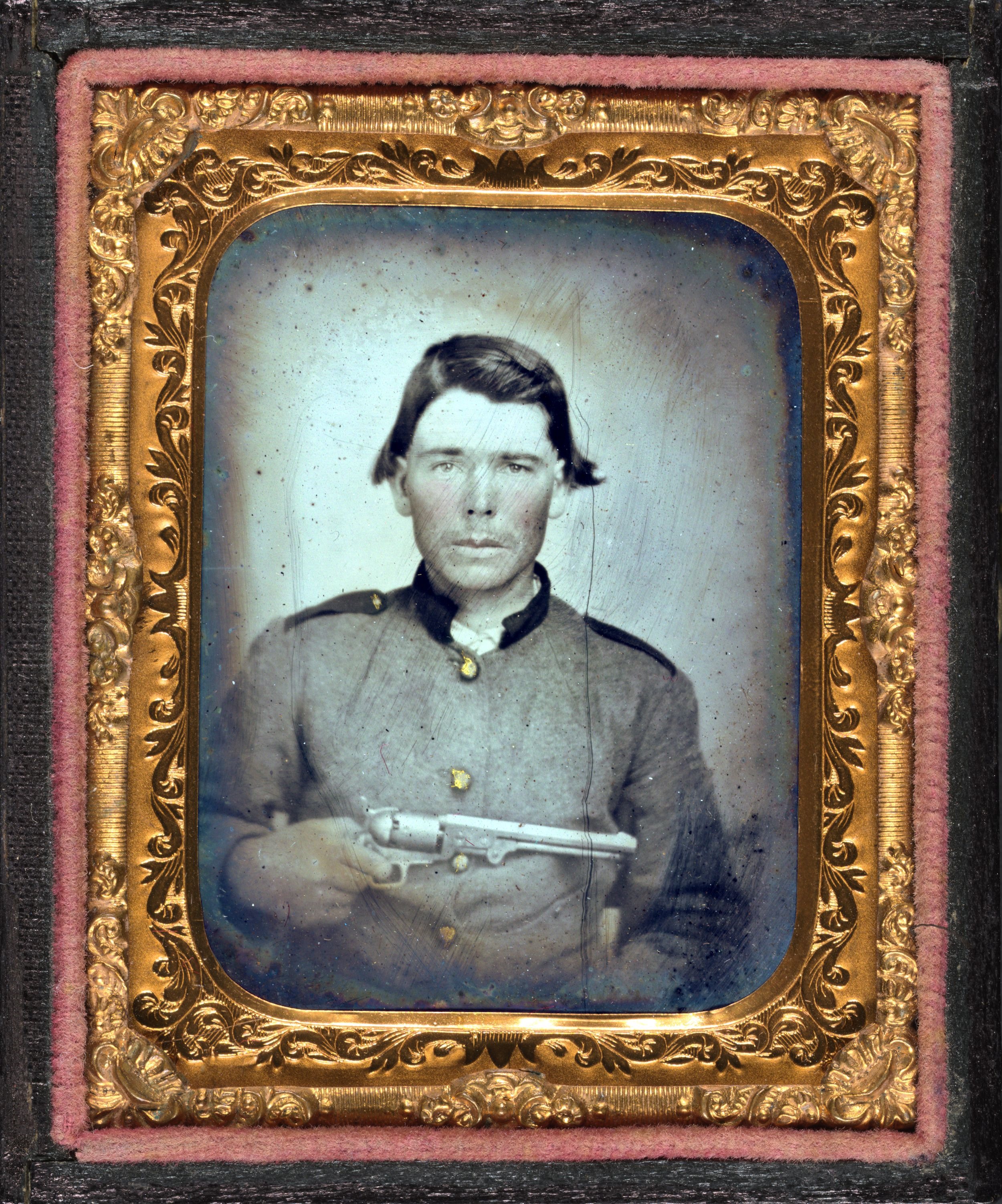
Unidentified soldier in Confederate uniform with Colt revolver in photo case


Unidentified soldier in Confederate uniform with Colt revolver.

__________

Ninth-plate tintype, hand-colored ; 7.4 x 6.1 cm (case)

Gift by Tom Liljenquist; 2010

Liljenquist Family Collection of Civil War Photographs; Ambrotype/Tintype photograph filing series; Library of Congress Prints and Photographs Division.

Record page for image is here.

__________

digital file from original, tonality adjusted Note – This image has been digitally adjusted for one or more of the following:

  • fade correction,
  • color, contrast, and/or saturation enhancement
  • selected spot and/or scratch removal
  • cropped for composition and/or to accentuate subject matter
  • straighten image

Civil War Portrait 056

by John Beauchamp Jones

AUGUST 12TH.—Letters from Georgia to-day assure the government that the grain crops of that State will afford a surplus sufficient for the army, cavalry and all, for 12 months.

Also one from P. Clayton, late Assistant Secretary of the Treasury, censuring the commissary agents in Georgia, who are sent thither from other States, who insult the farmers and encourage speculation.

Mr. Memminger is shipping gold from Wilmington, $20,000 by each steamer, to Bermuda and Nassau. Why is this? Cotton is quite as good as gold, and there are thousands of millions worth of that in the country, which Mr. Memminger might buy, certainly might have bought for Confederate notes, but, in his peculiar wisdom, he would not. And now, the great financier is shipping gold out of the country, thinking, perhaps, it may arrest the depreciation of paper money!

Col. Northrop, Commissary-General, is still urging a diminution of rations, and as our soldiers taken by the enemy fare badly in the North, and as the enemy make a point of destroying all the crops they can when they invade us, and even destroy our agricultural implements and teams, he proposes, in retaliation, to stop meat rations altogether to prisoners in our hands, and give them instead oat gruel, corn-meal gruel, and pea soup, soft hominy, and bread. This the Secretary will not agree to, because the law says they shall have the same as our troops.

I read to-day Gen. Lee’s report or his operations (an outline) in June and July, embracing his campaign in Maryland and Pennsylvania.

The enemy could not be attacked advantageously opposite Fredericksburg, and hence he determined to draw him out of his position by relieving the lower valley of the Shenandoah, and, if practicable, transfer the scene of hostilities north of the Potomac.

The movement began on the 3d of June. The divisions of McLaws and Hood (Longstreet’s) marched for Culpepper C. H. They were followed on the 4th and 5th by Ewell’s corps, A. P. Hill’s still occupying our lines at Fredericksburg.

When the enemy discovered the movement (on the 5th), he sent an army corps across the Rappahannock, but this did not arrest Longstreet and Ewell, who reached Culpepper C. H. on the 8th, where they found Gen. Stuart and his cavalry. On the 9th the enemy’s cavalry and a strong force of infantry crossed the Rappaannock and [click to continue…]

August 11—Nothing up to to-day. This, I suppose, is to be our regular camp, as we have commenced to drill again.

August 11.—A meeting of the citizens of North-Carolina, representing every county in the First and Second Congressional districts and a portion of the Third, was held at Washington, N. C. The First North-Carolina Union regiment, stationed at that point, participated in the meeting.

Addresses were made and resolutions adopted expressing sympathy with the great conservative movement of North-Carolina, declaring an energetic prosecution of the war in that department to be the only means by which the Union sentiment in the interior of the State could be made practically useful in restoring her to the national jurisdiction, asking the Government for reenforccments for this purpose, accusing the confederate government of perfidy and cruelty toward North-Carolina, declaring that her people were therefore absolved from any further obligations to sustain it, placing the responsibility for the destruction of slavery upon Jefferson Davis and his co-conspirators against the Union, expressing the belief that North-Carolina would, notwithstanding, find ample compensation in the blessings of free labor for the present inconveniences of emancipation, rejoicing in the recent Union victory at the Kentucky election, denouncing copperheadism at the North, and commending the ability and patriotism of the Administration in the conduct of the war, and especially in the sound national currency originated by the Secretary of the Treasury.—President Lincoln closed the correspondence with the Governor of New York relative to the draft.

August 11, Tuesday. Admiral Farragut has arrived in New York and telegraphs me he will report in person when I direct. I congratulated him on his safe return but advised repose with his family and friends during this heated term and to report when it should suit his convenience.

At the Cabinet council the President read another letter from Governor Seymour. I have little respect for him. It may be politic for the President to treat him with respect in consequence of his position.

The draft makes an inroad on the clerical force of the Departments and on the experts in the public service. The law authorizing the draft is crude, and loose, and wrong in many respects; was never matter of Cabinet consultation, but was got up in the War Department in consultation with the Military Committees, or Wilson, and submitted to no one of the Secretaries, who all, except Stanton, were ignorant of its extraordinary provisions. Some sixty men, many of them experts whose places can hardly be supplied, are drafted as common soldiers from the ordnance works. I have striven to get some action in regard to these men, whose services are indispensable for military purposes, whose labors are of ten times the importance to the government and country in their present employment that they would be were they bearing arms in camp, but as yet without success. I proposed to Chase, who is much annoyed and vexed with the operation of the law in his Department, that we should have the subject considered in the Cabinet to-day; but he declined, said he had no favors to ask of the War Department and nothing to do with it. If the law and that Department in its construction of the law would take the clerks from the Treasury desks, so as to interrupt its business and destroy their capacity, he should be relieved and glad of it. He was bitter toward the War Department, which he has heretofore assiduously courted.

I brought up the subject, but Chase had left. Stanton said he had not yet decided what rule would govern him, but promised he would do as well by the employees of the Navy as of the War Department. He thought, however, he should exact the $200, a substitute, or the military service in all cases, when the conscript was not relieved by physical disabilities. All present acquiesced in this view, Chase being absent, but Attorney-General Bates, who agreed with me.

A singular telegram from General Halleck to his partner in California in relation to the Almaden mines (quicksilver) was brought forward by Mr. Bates and Mr. Usher. In the opinion of these gentlemen it did not exhibit a pure mind, right intentions, or high integrity on the part of the General-in-Chief. The President, who had been apprised of the facts, thought Halleck had been hasty and indiscreet but he hoped nothing worse. Stanton said, with some asperity and emphasis, that the press and distinguished men had abused him on these matters, — had lied about him and knew they were lies. He turned away from Blair as he poured out these denunciations, yet there was no mistaking for whom these invectives were intended.

11th. Went to Capt. Burr’s office and stable. Found my horse almost blind. Did some trading and did errand with Gov. Tod for Dr. Johnson. Over the State House with Ampt. Thunder shower. Took the freight train at 9:45. Got into a caboose and rested nicely. A Mo. Captain aboard. One fright. Brakes whistled down—all startled.

Louisville, Ky., August 11th, 1863.

Again in Louisville—eleven hundred miles nearer home than one week ago—and yet how far. Still, it is joy to feel I am comparatively near. We reached Cairo on the evening of the seventh, took on fresh supplies, and left next day at noon for Cincinnati, which place we expect to reach some time tomorrow. We are now—3 p. m.—taking on coal, and will start in a few minutes.

The Ohio is very low—in places not more than three feet deep. We have brought up against sand bars and been forced to back off perhaps fifty times since leaving Cairo. From this place to Cincinnati, I am told, there are no obstructions. The most difficult part of our way was from New Albany to Louisville. We were six hours in making three miles last night. It was nothing but “Back ‘er and try again” for about a mile, and then we had a canal with three locks to pass through.

We have had no deaths since the seventh, and our sick and wounded boys are doing nicely. These fresh northern breezes are more exhilarating than wine, and the hope that they may be sent to their homes to recruit their health is more healing than medicine.