
Tuesday, 11th—No news from the Army of the Potomac nor from Charleston, South Carolina.
August 2013
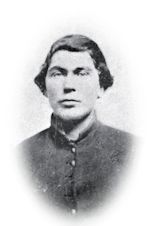
Vicksburg, Tuesday, Aug. 11. Warm—yes, hot. Lay in camp with no excitement; notwithstanding I whiled the hours away without much trouble with plenty of papers and, captured books to read.
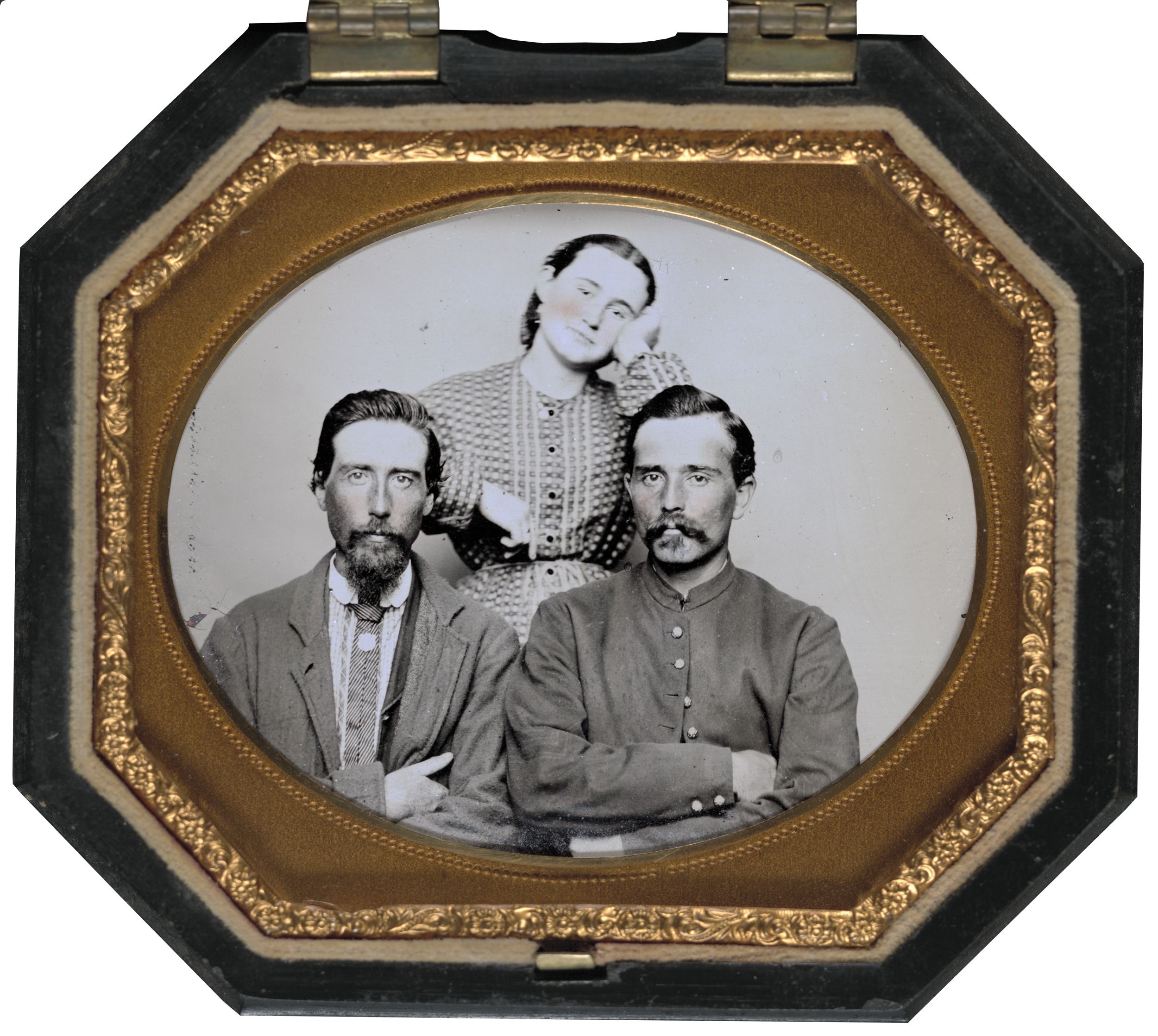
Two unidentified soldiers in Union uniforms with unidentified woman.
__________
Sixth-plate ambrotype, hand-colored ; 8.7 x 9.9 cm (case)
Deposit by Tom Liljenquist; 2011
Liljenquist Family Collection of Civil War Photographs; Ambrotype/Tintype photograph filing series; Library of Congress Prints and Photographs Division.
Record page for image is here.
__________
 Note – This image has been digitally adjusted for one or more of the following:
- fade correction,
- color, contrast, and/or saturation enhancement
- selected spot and/or scratch removal
- cropped for composition and/or to accentuate subject matter
- straighten image
Civil War Portrait 055

by John Beauchamp Jones
AUGUST 11TH.—After all the applications of the railroad companies when Gen. Lee was in Pennsylvania, and the enemy had withdrawn from this side of the Potomac, it appears that the fine iron on the road from Fredericksburg to Aquia Creek was not removed! Mr. Seddon’s subordinates must answer for this. The iron was wanted more than anything else but men. The want of men cannot be alleged for not securing it, because the railroad companies would have procured negroes enough for its removal.
Well, the first of August has passed, and the grand scheme of the War Office at Washington of a general servile insurrection did not take place. On the contrary, a large army of slaves might be organized to fight for their masters.
To-day, it must be confessed, I saw some of the booty (if, indeed, it was not fairly bought) of the recent invasion of the North. A number of boxes of fine stationery, brought from Carlisle, Chambersburg, etc., were opened at the War Department.
There is a controversy between the Secretary of War, Assistant Secretary, and Attorney-General on one side, and the Commissary-General, Col. L. B. Northrop, on the other. It appears that one of the assistant commissaries exchanged sugar for flour and rice in Alabama with a merchant or speculator, and then, after the lapse of a month or so, impressed the sugar. The party got the Attorney-General’s opinion in his behalf, which was approved by the Assistant Secretary of War, and the Secretary issued an order for the release of the sugar. In response to this, Col. N. rebuts the arguments of the whole three (lawyers) by saying it is not good sense to exempt anything, under any circumstances, from impressment, when needed to carry on the war; and that the way to success is to do justice to the whole country—and not to please the people. A palpable hit at the politicians. He says if the Secretary insists on the sugar being released, it will be done against his (N.’s) judgment.
August 10.—Major-general Grant, at his headquarters at Vicksburgh, Miss., issued an order, establishing camps “for such freed people of color as are out of employment at all military posts within his department, where slavery had been abolished by the proclamation of the President of the United States;” and setting forth rules for their government.
—At Chicago, Ill., the City Council unanimously passed an ordinance providing for an appropriation for raising bounties for volunteers, to act as substitutes for the drafted men who were unable to leave their homes or raise three hundred dollars for exemption.
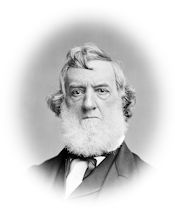
August 10, Monday. Have not been well for the last two days, and am still indisposed, but cannot omit duties. The weather is oppressively warm. Friends think I ought to take a few days repose. Dr. Horwitz advises it most earnestly. Rest and a change of atmosphere might be of service, but I think quiet here better than excitement and uncertainty elsewhere. I had arranged in my own mind to spend a couple of weeks in entire seclusion at Woodcliff, but M., after the exhibition of mob hostility in New York, is apprehensive that my presence there will jeopardize him and his property. I must therefore seek another place if I go from Washington, which I now think is hardly probable.
The papers are discussing very liberally the Parliamentary statement of Laird and my denial. To sustain himself, Laird publishes an anonymous correspondence with some one who professes to be intimate with the “Minister of the Navy.” His correspondence, if genuine, I have reason to believe was with Howard of Brooklyn, whom I do not know and who is untruthful.
Charles B. Sedgwick, Chairman of the Naval Committee of the House, writes Chief Clerk Faxon, that Howard called on him in the summer of 1861 in behalf of the Lairds, with plans and specifications and estimates for vessels; that he, Sedgwick, referred H. to me; that I refused to negotiate. In other words, I doubtless refused to entertain any proposition. Of Howard I know very little, having never, that I am aware, seen him. I may have done so as the agent or friend of Laird in 1861, and if so declined any offer. From his letters to Laird I judge he tried to palm himself on Laird for all he was worth, and as possessing an intimacy which I neither recognize nor admit. He seems to have gone to the Naval Committee instead of the Navy Department or “Minister of the Navy” with his plans. Was confessedly an agent of Laird, who is an unmitigated liar and hypocrite. Professing to be an antislavery man from principle and an earnest friend of the Union, he and his firm have for money been engaged in the service of the slaveholders to break up our Union.
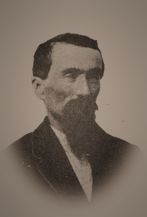
August 10 — On outpost picket till late this evening, were then relieved by the second section.
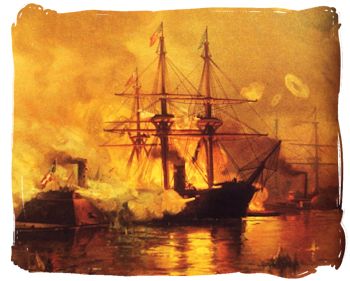
Aug. 10th. At twelve thirty A. M., passed a brig standing to the northward and eastward; at two thirty trimmed sails to the wind; set port fore-topmast and top-gallant studding sails; got port lower studding sails ready for setting; took in studding sails, and braced yards up to shift of wind; at three o’clock Delaware light-boat bore, per compass, north by west; at seven thirty Barnegat lighthouse reported; at nine o’clock, stood up for a pilot boat; at nine forty-five took a pilot on board; several sail in sight during watch; at eleven o’clock set the jib, flying jib, and main topmast stay-sail; at twelve o’clock set the main try-sail; at two P. M., steamer Golden Gate met and cheered us, which we returned; at three o’clock crossed the bar, at which time the battery on Sandy Hook saluted us with fifteen guns, returned with thirteen; sent down royal and squared yards; from four to six o’clock steaming up New York harbor; received salutes from the lower fleet, also Forts Hamilton and the Battery, which we returned; received a salute from an English sloop-of-war, and from a Spanish frigate, which we answered; at five thirty rounded to, and anchored off the Battery.
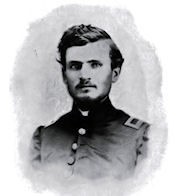
10th. Went to Minnie’s at 7 and saw the folks off for the lake. Ed., Frankie, Phoebe, M., E. J. and Terrell’s people. At 9:30 called on Fannie. Supposed I had gone. Interchanged sentiment, and agreeably. Happiest day of my life. Most fortunate boy. God grant it may cause no regret to either of us. Oh for grace to nobly do my part of life. Off at 2. Hard to leave again. Reached Columbus at 9:30 with Ampt. Supper at Exchange.

August 10.—This morning Mrs. C. and myself called on Dr. Stout. He informed me that he could not hear of any hospital that would suit Mrs. W. and myself, with the exception of one, where there was a lady already. She would be head matron, and he did not think we would be willing to go on that account. I told him we did not go into the hospital for position, and if we were only doing something for the cause, cared for little else. We were willing to make the trial.
Dr. S. complimented the women for what they were doing in the hospitals. So we told him that we had always heard that he was opposed to them in that capacity. He replied, he knew how he had received that name. When surgeon of a hospital in Nashville, the ladies had interfered with him so much that he was compelled to forbid them coming to it; but when he saw them having but one aim—that of doing good, and doing it in the right way—no man could think more of them than he did; furthermore, there was no end to the good they could do. I have heard many surgeons remark the same thing.


