Following the American Civil War Sesquicentennial with day by day writings of the time, currently 1863.

August 2013

August 10.—Spent this morning in the house of mourning. Our neighbour Mrs. S. has lost her eldest son. The disease was “that most fatal of Pandora’s train,” consumption. He contracted it in the Western Army. His poor mother has watched the ebbing of his life for several months, and last night he died most suddenly. That young soldier related to me an anecdote, some weeks ago, with his short, oppressed breathing and broken sentences, which showed the horrors of this fratricidal war. He said that the day after a battle in Missouri, in the Fall of 1861, he, among others, was detailed to bury the dead. Some Yankee soldiers were on the field doing the same thing. As they turned over a dead man, he saw a Yankee stop, look intently, and then run to the spot with an exclamation of horror. In a moment he was on his knees by the body, in a paroxysm of grief. It was his brother. They were Missourians. The brother now dead had emigrated South some years before. He said that before the war communication had been kept up between them, and he had strongly suspected that he was in the army; he had consequently been in constant search of his brother. The Northern and Southern soldier then united in burying him, who was brother in arms of the one, and the mother’s son of the other!

The Bishop and Mrs. J. returned home to-day from their long trip in the South-west. They travelled with great comfort, but barely escaped a raid at Wytheville. We welcomed them gladly. So many of our family party are wandering about, that our little cottage has become lonely.

Mr. C. has come out, and reports a furious bombardment of Sumter. This has been going on so long, that I begin to feel that it is indeed impregnable.

Monday, 10th—We are living on fresh bread now; we got our first today, baked in the new oven. Each man is allowed to draw a one-pound loaf per day. We again have company drill twice a day, with dress parade at 5 o’clock. The weather is fearfully hot, day and night.

Richmond, Va., August 10, 1863.—To-day I had a letter from my sister, who wrote to inquire about her old playmate, friend, and lover, Boykin McCaa. It is nearly twenty years since each was married; each now has children nearly grown. ”To tell the truth,” she writes, “in these last dreadful years, with David in Florida, where I can not often hear from him, and everything dismal, anxious, and disquieting, I had almost forgotten Boykin’s existence, but he came here last night; he stood by my bedside and spoke to me kindly and affectionately, as if we had just parted. I said, holding out my hand, ‘Boykin, you are very pale.’ He answered, ‘I have come to tell you goodby,’ and then seized both my hands. His own hands were as cold and hard as ice; they froze the marrow of my bones. I screamed again and again until my whole household came rushing in, and then came the negroes from the yard, all wakened by my piercing shrieks. This may have been a dream, but it haunts me.

“Some one sent me an old paper with an account of his wounds and his recovery, but I know he is dead.” “Stop!” said my husband at this point, and then he read from that day’s Examiner these words: “Captain Burwell Boykin McCaa found dead upon the battle-field leading a cavalry charge at the head of his company. He was shot through the head.”

The famous colonel of the Fourth Texas, by name John Bell Hood,[1] is here—him we call Sam, because his classmates at West Point did so—for what cause is not known. John Darby asked if he might bring his hero to us; bragged of him extensively; said he had won his three stars, etc., under Stonewall’s eye, and that he was promoted by Stonewall’s request. When Hood came with his sad Quixote face, the face of an old Crusader, who believed in his cause, his cross, and his crown, we were not prepared for such a man as a beau-ideal of the wild Texans. He is tall, thin, and shy; has blue eyes and light hair; a tawny beard, and a vast amount of it, covering the lower part of his face, the whole appearance that of awkward strength. Some one said that his great reserve of manner he carried only into the society of ladies. Major Venable added that he had often heard of the light of battle shining in a man’s eyes, he had seen it once—when he carried to Hood orders from Lee, and found in the hottest of the fight that the man was transfigured. The fierce light of Hood’s eyes I can never forget.

Hood came to ask us to a picnic next day at Drury’s Bluff.[2] The naval heroes were to receive us and then we were to drive out to the Texan camp. We accused John Darby of having instigated this unlooked-for festivity. We were to have bands of music and dances, with turkeys, chickens, and buffalo tongues to eat. Next morning, just as my foot was on the carriage-step, the girls standing behind ready to follow me with Johnny and the Infant Samuel (Captain Shannon by proper name), up rode John Darby in red-hot haste, threw his bridle to one of the men who was holding the horses, and came toward us rapidly, clanking his cavalry spurs with a despairing sound as he cried: “Stop! it’s all up. We are ordered back to the Rappahannock. The brigade is marching through Richmond now.” So we unpacked and unloaded, dismissed the hacks and sat down with a sigh.

“Suppose we go and see them pass the turnpike,” some one said. The suggestion was hailed with delight, and off we marched. Johnny and the Infant were in citizens’ clothes, and the Straggler—as Hood calls John Darby, since the Prestons have been in Richmond—was all plaided and plumed in his surgeon’s array. He never bated an inch of bullion or a feather; he was courting and he stalked ahead with Mary Preston, Buck, and Johnny. The Infant and myself, both stout and scant of breath, lagged last. They called back to us, as the Infant came toddling along, “Hurry up or we will leave you.”

At the turnpike we stood on the sidewalk and saw ten thousand men march by. We had seen nothing like this before. Hitherto we had seen only regiments marching spick and span in their fresh, smart clothes, just from home and on their way to the army. Such rags and tags as we saw now. Nothing was like anything else. Most garments and arms were such as had been taken from the enemy. Such shoes as they had on. “Oh, our brave boys!” moaned Buck. Such tin pans and pots as were tied to their waists, with bread or bacon stuck on the ends of their bayonets. Anything that could be spiked was bayoneted and held aloft.

They did not seem to mind their shabby condition; they laughed, shouted, and cheered as they marched by. Not a disrespectful or light word was spoken, but they went for the men who were huddled behind us, and who seemed to be trying to make themselves as small as possible in order to escape observation.

Hood and his staff finally came galloping up, dismounted, and joined us. Mary Preston gave him a bouquet. Thereupon he unwrapped a Bible, which he carried in his pocket. He said his mother had given it to him. He pressed a flower in it. Mary Preston suggested that he had not worn or used it at all, being fresh, new, and beautifully kept. Every word of this the Texans heard as they marched by, almost touching us. They laughed and joked and made their own rough comments.


[1] Hood was a native of Kentucky and a graduate of West Point.

[2] Drury’s Bluff lies eight miles south of Richmond on the James River. Here, on May 16, 1864, the Confederates under Beauregard repulsed the Federals under Butler.
Vicksburg, Monday, Aug. 10. Took my team this morning and reported at roll call, having been off duty thirteen days. 10 A. M. Coulter Campbell died in the hospital, the first death of the season, a strong, healthy man. A burying party went over at 4 P. M. to consign his earthly remains to their last abode. His death had but little effect in camp, so estranged is the soldier’s mind. But some hearts have been wounded and are bleeding that have been patiently waiting his return for many hours, never to be realized in this world.

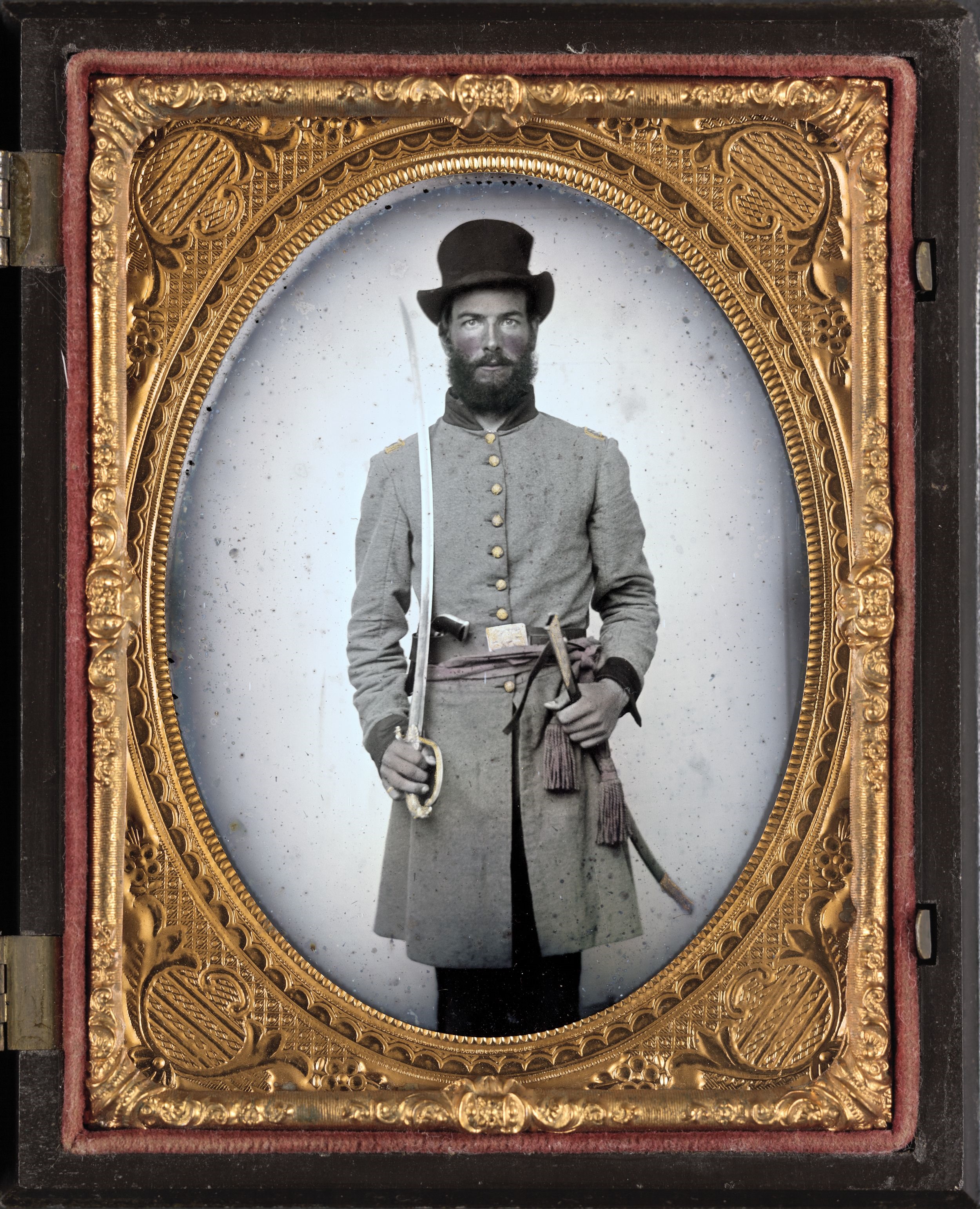
Captain Augustus C. Thompson of Co. G, 16th Georgia Infantry Regiment with sword in photo case

Captain Augustus C. Thompson of Co. G, 16th Georgia Infantry Regiment with sword

__________

Quarter-plate ambrotype, hand-colored ; 12.6 x 10.2 cm (case)

Deposit by Tom Liljenquist; 2012

Liljenquist Family Collection of Civil War Photographs; Ambrotype/Tintype photograph filing series; Library of Congress Prints and Photographs Division.

Record page for image is here.

__________

digital file from original item Note – This image has been digitally adjusted for one or more of the following:

  • fade correction,
  • color, contrast, and/or saturation enhancement
  • selected spot and/or scratch removal
  • cropped for composition and/or to accentuate subject matter
  • straighten image

Civil War Portrait 054

by John Beauchamp Jones

            AUGUST 10TH.—NO army news of immediate importance.

            South Carolina has set an example in the prices of supplies for the army, under the Impressment Act, fixed by the Commissioners. By this schedule (for August, and it will be less in succeeding months) bacon is to be from 65 to 75 cents per pound; beef, 25 cents; corn, $2 per bushel; flour $20; pork, 35 cents; hay, $1.50 per 100 pounds; oats, $2 per bushel; potatoes, $3; rice, 10 cents; sugar, 80 cents; soap, 40 cents; and wheat, $3.50 per bushel.

            Gen. Lee writes that the railroad brings him but 1000 bushels of corn per day; not enough to bring up his exhausted cavalry and artillery horses; and he suggests that passenger cars be occasionally left behind for the purpose of supplying the army—an indispensable measure.

            Gen. Lee also writes that he has 1700 unarmed men in his army; in two weeks there will be 5000, and in a month 10,000. He suggests that the troops for local defense here, and even the militia, be disarmed, to supply his men. This indicates that Lee is to have an immense army, and that Richmond is to be defended.

            But the Central and Fredericksburg Railroads must be repaired immediately, and at any expense to the government, or else all will fail

August 9.—A reconnoissance under Major Warden, of General Ransom’s staff, to Woodville, seventy miles from Natchez, Miss., destroyed five locomotives, forty-three platform and twelve passenger cars; and burned a rebel cotton factory at Woodville, and also cotton and manufacturing goods to the value of two hundred thousand dollars.

—John L. Chatfield, Colonel of the Sixth regiment of Connecticut volunteers, died at Waterbury, from wounds received in the assault on Fort Wagner, of July eighteenth.

Charles Francis Adams, Jr., to his Mother

Camp of the 1st Mass. Cav’y
Sulphur Springs, August 9, 1863

They ‘re not very unlike us and really pleasant, sociable men — their cavalry, now that we have whipped them out of their conceit. There’s much better feeling between Yankees and Southerners now than there ever was before, and now we meet on very pleasant terms.

Not so with the non-combatants, only! don’t they hate us? and I must say with cause. Everywhere war is horrid — no more so here than elsewhere, and we are not so bad as other nations, as we see from the fact that of all our troops the Germans, as ruffians, thieves and scourges, are most terribly dreaded by all natives of Virginia. They say they don’t fear the Cavalry, but they dread the Infantry and the Germans. They turn pale at the name of the 11th Corps. As for me, I can only say if they don’t fear the cavalry, I don’t want to see those they do fear, as I see only Cavalry, and I daily see from them acts of pillage and outrage on the poor and defenceless which make my hair stand on end and cause me to loathe all war. We owe a high debt to Colonel Williams for the high stand he took on this subject in our regiment, a stand at the start which enables us now, amidst universal demoralization and pillage around us, to hold our men substantially in check. Poor Virginia! She has drunk deep of the cup and today she is draining the last bitter dregs. Her fighting men have been slaughtered; her old men have been ruined; her women and children are starving and outraged; her servants have run away or been stolen; her fields have been desolated; her towns have been depopulated. The most bitter against Virginia would, were they here, say it was enough. They have come to be thankful for a little thing at last. It was sad enough the other day when I was on picket out here. Kilpatrick’s ruffians had just gone through the country when we came out and relieved them, and presently I was sent down to Hazel River with my squadron. The first day an old woman came groaning up and said that my men were chasing her four sheep, all that she had left. I told her I would see to it, but meanwhile two of the four were gone. I ordered all killing of stock at once to stop, and did it savagely, for the old woman bored me. Early next morning up she panted again. Two of my men were chasing the two sheep left. Hereat I had roll-calls and cursed and swore and denounced vengeance on the first man I could catch, but I could n’t fix on any one. Meanwhile I thought things were getting as bad in this regiment as in the others and felt rather ashamed of myself. That evening the old woman sent me a present of butter and milk. I remarked to Flint “coals of fire” and sent her back some sugar. But next day she hobbled into camp and the truth came out, the bitter truth. Far from being coals of fire the milk and butter was an expression of gratitude to be continued every evening while I remained, and oh! she did “hope I was n’t going away; my men behaved so well, she felt so safe with them there. She was seventy-four years old, but those who had been there before had broken into her house in the night, and broken into her closets and drawers, and stolen all her meat and provisions, and abused and threatened her; and she had n’t been able to sleep for nights, and last night, when she heard that I was there she had slept so well, and she did hope I was going to stay,” and so on, from which I discovered that she thought it first rate treatment that my men only killed her sheep and did n’t rifle her dwelling and beat her. And this is the Cavalry which the Virginians say they’re “not afraid of”; only the Infantry and (a shudder) “the Germans.” It’s awful here now in these respects and this country is just going to be cleaned out. As for me I expect we shall earn a lofty reputation as philanthropists if we only allow our men to take horses and cattle. One of the charges against McClellan was that he gave guards to the houses of prominent Virginians. He never did anything of which he has more cause to be proud, and those who advance that against him as a charge are either demons or ignoramuses in the horrors of war. If I could have my say there should be a guard at every house and barn within the lines of the army, and the taking an article of property from any, even the most offensively outspoken, rebel, should be instantly punished by death. I would also punish straggling with death. I would do this on strictly humane principles. The horrors of war are not all to be found in the battle-field and every army pillages and outrages to a terrible extent. By establishing guards and making straggling the highest military offense, you not only divest war of its main horrors, so far as all noncombatants are concerned, but you stop the greatest cause of demoralisation in all armies, and, by keeping men in the ranks, bring your whole force effectively before the enemy. In the Maryland campaign last year McClellan’s army left behind 12,000 fighting men — stragglers, plundering the land. So it goes. Traditionally I rate Cromwell’s army above any other in history because in those respects he had it so completely in hand; but, as a rule, the English are very brutal and bad in those respects. Napoleon’s army lived on pillage, but did not straggle. They say the Germans are the worst and most cruel of all, as vide the thirty years war. . . .

August 9 — On reserve picket until nearly night, then moved to the outpost on picket.

Aug. 9th. At twelve forty-five A. M., a light reported off port-quarter; at two o’clock took in and furled all the studding and square sails; at six o’clock set all plain sail to royals; at six thirty made a sail off weather bow, proved to be a schooner, standing on same course; weather clear and pleasant; at nine o’clock made a sail off port bow, and at twelve, noon, one right ahead; had inspection at quarters, and performed Divine service; at two P. M., passed a steamer standing to the southward, also passed the John Adams who made her number, which we answered; several sail in sight; at four thirty set all the port studding sails; clear and pleasant; at sundown three sail were in sight.