Following the American Civil War Sesquicentennial with day by day writings of the time, currently 1863.

Thursday, October 10, 2013

[October 10,] Saturday. Lord Lyons, who returned last night, called on me to-day with Admiral Milne and staff, accompanied by Secretary Seward. Admiral Milne has a pleasant face, more Scotch than English. He is tall, —six feet two, —strongly built, not fleshy yet not spare, — a good physique in every respect. While we were conversing, Mr. Seward interrupted to say he had referred the Spanish claim of maritime jurisdiction to the King of Belgium. I asked whether the King of Belgium was an authority on international law and impowered to decide questions of this character so as to make them binding on others. His decision might be conclusive against Spain if he should adhere to the marine league, but were he to decide otherwise, his decision would conclude no government but the United States. I did not believe Great Britain would yield to the dictum of the King of Belgium against tradition and usage and the established law of nations, if the United States did. She would therefore approach Spanish territory to within three miles, while we, by this submission, would be excluded for six miles by the decree if against us.

Seward was a little nonplused. Both Lord Lyons and Admiral Milne exchanged significant looks at this singular reference, which jeopardized our rights and secured us nothing.

Dining at Lord Lyons’s this evening, Admiral Milne, who sat next me, stated that he is the first British admiral who has visited New York since the government was established, certainly the first in forty years. He said that it had been the policy of his government to avoid such visitations, chiefly from apprehensions in regard to their crews, their language and general appearance being the same as ours. There were doubtless other reasons which neither of us cared to introduce. He was exceedingly attentive and pleasant. Said he had tried to preserve harmony and good feeling, and to prevent, as far as possible, irritation and vexatious questions between us. Complimented the energy we had displayed, the forbearance exercised, the comparatively few vexatious and conflicting questions which had arisen under the extraordinary condition of affairs, the management of the extensive blockade, and the general administration of our naval matters, which he had admired and in his way sustained without making himself a party in our conflict.

There were some twenty or twenty-five guests, including the Prussian, Spanish, and Brazilian Ministers, the Secretary of State, the Attorney-General, and myself of the Cabinet. The whole was well-timed and judiciously got up for the occasion, and with a purpose. It is, I think, the harbinger of a better state of things, or rather of a change of policy by the English government.

Chase has gone to Ohio preparatory to the election, which takes place next Tuesday. Great interest is felt throughout the country in the result. Chase is understood to have special interest in this election.
Saturday, 10th—Jimmy did not come.

Memphis, Tenn., October 10, 1863, 4 p.m.

Have just got here; bored to death. Had to march around three sandbars between Helena and Memphis. Never want to see a steamboat again. Never want to journalize again. We started at 5 in the morning for Corinth and then, maybe, for Rosecrans. I’ll be furiously glad to get ashore once more.

10th. Before breakfast was over, “Boots and Saddles” sounded. Packed up and moved to Blue Springs. Burnside up. Ordered to various parts of the field but always recalled till near night when the 9th A. corps charged and drove the enemy. Result of day’s fighting, 60 wounded and 8 killed. Bivouacked where night found us. Troops moving up and taking positions. Big fight expected tomorrow.

Glendale, Saturday, Oct. 10. A very fine day and my health is very good with the exception of a slight cold. Enjoyed myself pleasantly in this rural retreat. I like the wilds of nature better than a mock at civilization by the hand of slavery, such as we everywhere meet. Grazed our horses in the woods today. Middling good grass. Our horses are on half rations of grain, which after so much confinement and fasting on boat and cars, look very bad.

October 10 — All quiet in front, except some picket firing this evening after dark, at Mitchell’s Ford, two miles below Raccoon.

Saturday, 10th—The Thirteenth came in and the Eleventh again went out on picket this morning. I was relieved from camp guard after two days’ steady duty, and accompanied my regiment on picket. About dark our brigade received orders to be prepared to march at 6 in the morning, with one day’s rations in haversacks and four days’ rations in the wagons.

Camp White, October 10, 1863.

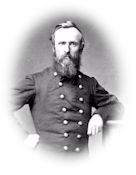
Dear Mother: — I have just received your good long letter from Delaware on [of] the 3d. . . . There was no time for Lucy to stop at Delaware on her way here. We were likely to be sent South immediately after the battle in Georgia, and I telegraphed her to come at once if she wished to see me. Our going was not ordered as expected, and now we are more likely to go to Ohio to recruit this winter than South. The Twenty-third was the first original three-year regiment and its time will be out in a few months. The men are re-enlisting for another three years and there is a fair prospect of continuing the regiment if we can get a little while at home this winter.

In the present uncertainty as to our winter campaign, I can make no arrangements for my family. In the meantime Lucy is enjoying a visit here. We have a number of agreeable ladies in camp, and are making pleasant acquaintances among the citizens. Charleston was a fine town before the war, and had a very cultivated society. The war broke it up, but now the town is gaining again and will ultimately recover its former prosperity. Give my love to friends.

Affectionately,

R.

Mrs. Sophia Hayes.

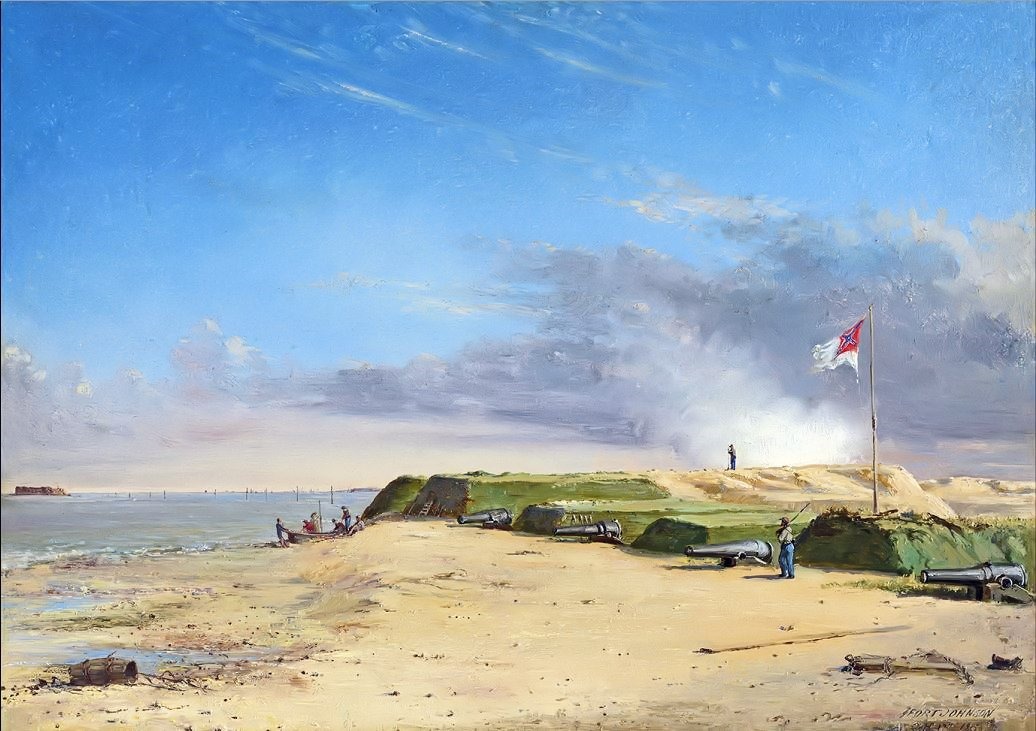
Fort Johnson, October 10, 1863 by Conrad Wise Chapman

Painting by Conrad Wise Chapman.

“Shows also Fort Sumter and Morris Island. Telegraph poles can be seen, but there was no telegraphic communication at the time.  The four guns displayed were very effective and considered as good as any to be had in those days; they could carry almost to the opposite side of the river.  The artist took particular care in painting these guns. Observe the effect of the flag against the dark sky. Preparations are being made to dispatch a boat to Fort Sumter.” – Conrad Wise Chapman, 1898

by John Beauchamp Jones

            OCTOBER 10TH. —The enemy is undoubtedly falling back on the Rappahannock, and our army is pursuing. We have about 40,000 in Lee’s army, and it is reported that Meade has 50,000, of whom many are conscripts, altogether unreliable. We may look for stirring news soon.

            About 2500 of the “local” troops were reviewed to-day. The companies were not more than half filled; so, in an emergency, we could raise 5000 fighting men, at a moment’s warning, for the defense of the capital. In the absence of Custis Lee, Col. Brown, the English aid of the President, commanded the brigade, much to the disgust of many of the men, and the whole were reviewed by Gen. Elzey, still more to the chagrin of the ultra Southern men.

            The Secretary seems unable to avert the storm brewing against the extortioners; but permits impressments of provisions coming to the city.

            It is said the President and cabinet have a large special fund in Europe. If they should fall into the hands of Lincoln, they might suffer death; so in the event of subjugation, it is surmised they have provided for their subsistence in foreign lands. But there is no necessity for such provision, provided they perform their duty here. I cut the following from the papers:

            “The Vicomte de St. Romain has been sent by the French Government to ours to negotiate for the exportation of the tobacco bought for France by French agents.

            “The Confederate States Government has at last consented to allow the tobacco to leave the country, provided the French Government will send its own vessels for it.

            “The latter will send French ships, accompanied by armed convoys.

            “To this the United States Government objects in toto.

            “Vicomte de St. Romain is now making his way to New York to send the result of his mission, through the French Consul, to the Emperor.

            “The French frigates in New York are there on this errand.”