Following the American Civil War Sesquicentennial with day by day writings of the time, currently 1863.

Monday, November 11, 2013

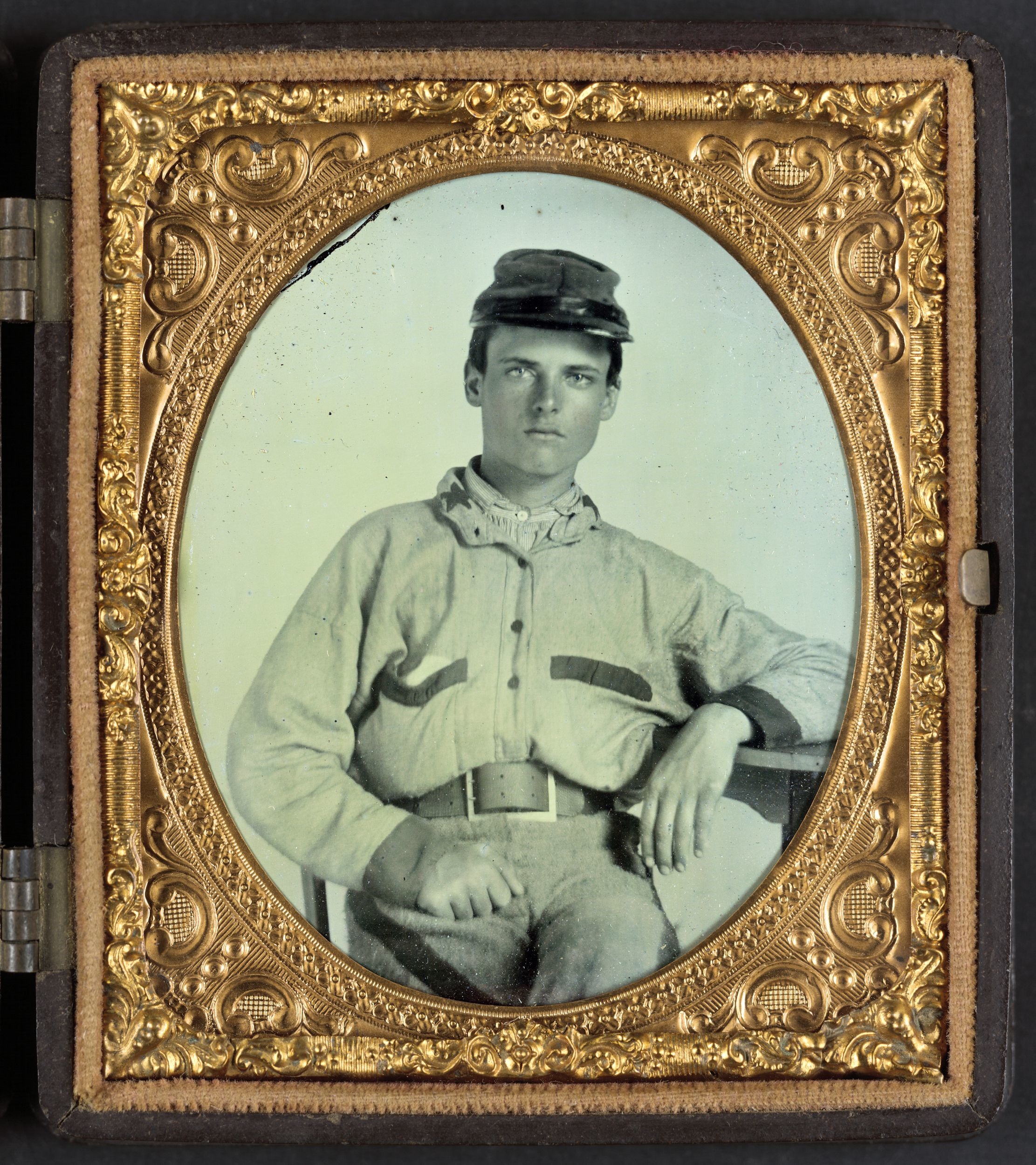
Unidentified soldier in Confederate battleshirt, kepi, and wishbone belt buckle -- in frame


Unidentified soldier in Confederate battleshirt, kepi, and wishbone belt buckle.

__________

Sixth-plate ambrotype ; 9.5 x 8.5 cm (case)

Liljenquist Family Collection of Civil War Photographs; Ambrotype/Tintype photograph filing series; Library of Congress Prints and Photographs Division.

Record page for image is here.

__________

digital file from original itemNote – This image has been digitally adjusted for one or more of the following:

    • fade correction,
    • color, contrast, and/or saturation enhancement
    • selected spot and/or scratch removal
    • cropped for composition and/or to accentuate subject matter
    • straighten image

Civil War Portrait 090

by John Beauchamp Jones

NOVEMBER 11TH.—NO news. I saw, to-day, Gen. Lee’s letter of the 7th instant, simply announcing the capture of Hoke’s and Haye’s brigades. They were on the north side of the river, guarding the pont de tete. There is no excuse, no palliation. He said it was likely Meade’s entire army would cross. This had been sent by the Secretary to the President, who indorsed upon it as follows: “If it be possible to reinforce, it should be done promptly. Can any militia or local defense men be made available?—J. D.”

Gen. Whiting writes that he has refused to permit Mr. Crenshaw’s correspondence with Collie & Co. to pass uninspected, from a knowledge of the nature of previous correspondence seen by him.

The Northern papers state that Mr. Seward has authorized them to publish the fact that the French Government has seized the Confederate rams building in the ports of France.

I have written Custis Lee, the President’s aid, that but one alternative now remains: for the President, or some one else, to assume all power, temporarily, and crush the speculators. This I think is the only chance of independence. I may be mistaken—but we shall see.

Capt. Warner, who feeds the 13,000 prisoners here, when he has the means of doing so, says Col. Northrop, the Commissary, does not respond to his requisitions for meat. He fears the prisoners will take or destroy the city, and talks of sending his family out of it.

I condemned the reign of martial law in this city, in 1862, as it was not then necessary, and because its execution was intrusted to improper and obnoxious men. But now I am inclined to think it necessary not only here, but everywhere in the Confederacy. Many farmers refuse to get out their grain, or to sell their meat, because they say they have enough Confederate money! money for the redemption of which their last negro and last acre are responsible. So, if they be permitted to maintain this position, neither the army nor the non-producing class of the population can be subsisted; and, of course, all classes must be involved in a common ruin. A Dictator might prevent the people from destroying themselves, and it seems that nothing short of extreme measures can prevent it. But, again, suppose the Federal Government were to propose a sweeping amnesty, and exemption from confiscation to all who should subscribe to a reconstruction of the Union—and this, too, at a time of suffering and despondency—and so large a body were to embrace the terms as to render a prolongation of the war impracticable? What would the money the farmers now possess be worth? And what would become of the slaves, especially in Virginia, Tennessee, Kentucky, and Missouri?
November 11.— Major-General Foster having been relieved from the command of the Department of Virginia and North-Carolina, issued an order bidding farewell to the officers and men serving in the department.

—Secretary Stanton sent the following despatch to the Mayor of Buffalo, N. Y., this night:

“The British Minister, Lord Lyons, has tonight officially notified the Government that, from telegraphic information received from the Governor-General of Canada, there is reason to believe there is a plot on foot by persons who have found asylum in Canada to invade the United States and destroy the city of Buffalo; that they propose to take possession of some steamboats on Lake Erie, to surprise Johnson’s Island, free the prisoners of war confined there, and proceed with them to Buffalo. This Government will employ all means in its power to suppress any hostile attack from Canada; but as other towns and cities on the shores of the lakes are exposed to the same danger, it is deemed proper to communicate this information to you, in order that any precautions which the circumstances of the case will permit may be taken. The Governor-General suggests that steamboats or other vessels, giving cause for suspicion by the number or character of persons on board, shall be arrested.

“You will please acknowledge the receipt of this despatch, and communicate to this Department any information you may now or hereafter have on this subject.”

—Major-General Butler assumed command of the departments of Eastern Virginia and North-Carolina. His order contained the following:

“Representations having been made to the Commanding General that certain disloyally disposed persons within this department do occasionally, by force, interfere with, and by opprobrious and threatening language insult and annoy loyal persons employed in the quiet discharge of their lawful occupations, it is hereby announced that all such conduct and language is hereafter strictly forbidden, and will be punished with military severity. All officers of this department are directed to order the arrest, and to bring such persons as are found offending against this order before the tribunal established for the purpose of punishing offences within this department.”