Wednesday, 11th—I spent the day and night at Mr. Hatchers.
Monday, November 11, 2013
Lenoir, Tenn., November 11th, 1863.
This morning we were aroused by the Orderly at 3 o’clock, with orders to be ready to move at daylight. We sprang out of bed, built fires, cooked breakfast, which consisted of pancakes made of wheat flour and corn meal, issued in place of bread, beefsteak and coffee; packed up, and then sat down to await the coming of day. At 6 o’clock the bugle sounded, and we fell in and stacked arms. We then received orders to go to our quarters and be ready to fall in at a minute’s notice. And so the matter has stood all day, and still remains. The reason for the movement is as follows: The Second Division has been engaged today in throwing a pontoon bridge across the Holston about a mile from here, and, not knowing the strength of the enemy, on the opposite side, we are to be ready to support them if necessary.
The bridge is nearly completed, and the Rebels have not shown themselves. Tomorrow the Second Division is to cross over. I understand they are to build winter quarters on the other side.
A “contraband” came into camp yesterday and reported himself direct from Rebeldom. He appeared intelligent, and told a straightforward story. He reports the Rebels in strong force across the river, and says they are building pontoons in which to cross over to attack us. His information was considered so important General Ferrera sent him, under guard, to General Burnside at Knoxville.
Winchester, Tenn., November 11, 1863.
We arrived here at 9 this a.m., our brigade making the distance from Salem, 11 miles, in three hours. That, we call fast walking. I wrote you last from Florence., Ala., on the 1st inst. From there we marched to Rodgersville and thence up the right bank of Elk river to Fayetteville, where we crossed there onto this place. Rumor says that we draw 20 days’ rations here. It is three-fourths official, too. It is certain that we leave here in the morning, but nobody knows where for. We could certainly march to Chattanooga in six days, but could go much quicker by the railroad from Decherd station, which is only two miles from here. The wagon road from here to Chattanooga is awful. But one brigade has ever marched it. The mountains commence right here and continue to, the Lord knows where. Our brigade is to be mounted immediately. In the last 60 miles marching we have mounted 800 or nearly half. The citizens along the road very kindly furnished all of stock and equipments. My company was mounted four days ago. Company C is to be mounted next. As fast as the men are mounted they are put out as foragers for more horses, etc. The first day my company was mounted we got 30 horses, and would have done better, but confound me if I could take horses from crying women, although I am satisfied that half of their howling is sham, got up for the occasion. My first day’s foraging almost used me up. We had fed our horses and I went to unhitch a mule from the fence to give him in charge of one of the men, and the brute scared and jerked the rail from the fence and started like lightning. The end of the rail struck me on the calves of my legs and elevated my boots five feet. The attraction of gravitation brought me down to the globe and I landed with a great deal of vim on a rock about the size of our parlor floor, and as smooth as a peach stone. The only severe injury either the rock or myself sustained was a very badly sprained wrist. I got that. My left hip and left shoulder were hurt some, but the wrist has pained me so confoundedly that I don’t count them. It has pained me so for the last two days and is so tender that I could stand neither the jolting of a horse or wagon. I tried to ride my horse this morning; we were in column and had to strike a trot and that beat me. Think I will be all right for the saddle in a few days, though will have a tender wrist for a good while. Well, our division came through in the advance and our brigade has had the lead most of the time. We have had plenty of forage, but light issues of regular rations probably average. Half Morgan L. Smith’s and John E. Smith’s divisions are close up to us, will be here to-morrow. Osterhaus and Dodge are behind them. We have five divisions all told, probably 25,000 or 30,000 men. We met here the first troops belonging to the Army of the Cumberland.
11th. Sent out June for cattle. Brought in several nice ones. About noon drew rations and issued them to the 2nd and 7th Ohio. Did the work myself with the help of Mose. The detail for the boys was received. They reported. Mail came. Nothing for me. Oh!
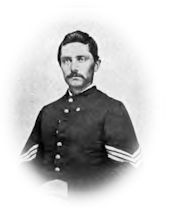
Wednesday, 11th—It is very pleasant after four or five days of quite warm weather. I was on picket again, the first time for a week. Two brigades of General Crocker’s Division arrived from Natchez to reinforce the troops here at Vicksburg. Two negroes entering an old vacant Confederate magazine today were blown to pieces. They were smoking and it is supposed that the loose powder on the floor in some way became ignited. The explosion was heard for miles around. So much again for the filthy habit of smoking.
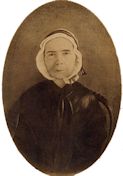
11th.—Just received a visit from my nephew, W. N., who is on his way to Fauquier to be married. I had not seen him since he lost his leg. He is still on crutches, and it made my heart bleed to see him walk with such difficulty. I believe that neither war, pestilence, nor famine could put an end to the marrying and giving in marriage which is constantly going on. Strange that these sons of Mars can so assiduously devote themselves to Cupid and Hymen; but every respite, every furlough, must be thus employed. I am glad they can accomplish it; and if the “brave deserve the fair,” I am sure that the deeds of daring of our Southern soldiers should have their reward. My niece, L. B., of Lexington, would have been married to-morrow night, but her betrothed, Captain S., has been ordered off to meet the enemy. The marriage is, of course, postponed. Poor fellow! I trust that he may come safely home.
I have just written to Colonel Northrup, Commissary-General, to ask an appointment as clerk in his department. So many of the young men have been ordered to the field, that this office has been open to ladies. My cousin, Colonel F. G. Ruffin, of the same office, has interested himself for me. They require us to say that we are really in want of the office—rather a work of supererogation, I should say, as no lady would bind herself to keep accounts for six hours per day without a dire necessity.
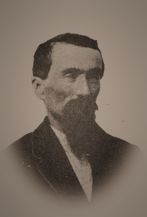
November 11—We renewed our march this morning and moved down the plank road about four miles, then turned off to the left and moved in a northerly course through an almost barren section of country. About middle of the day we struck the Culpeper and Fredericksburg plank road at Wilderness Run, five miles west of Chancellorsville. We halted here and camped for the remainder of the day and to-night. We are now near the old field hospital in which General Stonewall Jackson’s arm was amputated after the battle of Chancellorsville last May. The house stands on Wilderness Run, in a lonely place about half a mile south of the Culpeper plank road; it is a good-sized farmhouse, built of wood, square, with two porticos and painted a dove color. From the apex of the roof a hospital flag still flutters in the cold November wind.
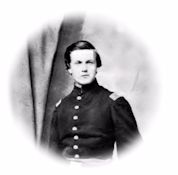
Headquarters Third Brigade,
Kelly’s Ford, Nov. 11, 1863.
Dear Sister L.:—
I have another name to put on my battle pin (when I get it), that of “Rappahannock Station, November 8th.” Soldiers have a fashion of counting up their battles, with an honest pride when they reach a certain number, and I will count up mine and then tell you a little about the last. Hanover Court House, a battle then, a skirmish now, Mechanicsville, Gaines’ Mill, which no one calls less than a battle even now, Savage Station, White Oak Swamp, Glendale, Malvern Hill, then the greatest battle of America, Second Bull Run, Antietam, Shepherdstown Ford, Fredericksburg, the slaughter pen, skirmish at Richards’ Ford, Chancellorsville, Loudon Valley, Gettysburg, Jones’ Cross Roads, and Rappahannock Station.
Quite a little list, and as I have always been there when the Third Brigade has, I do not feel ashamed of my record.
About four o’clock last Saturday morning the reveille sounded and in half an hour the camps of our division were all astir, brilliant with fires, bristling with preparation for the march at daylight. Daylight came and we began the march toward the river. The day was cold and windy and very dusty, but we marched rapidly and by noon we reached the rebel pickets, or our advance discovered them a mile from the river. We halted for an hour or two, while the generals made their dispositions, and then formed in line. Our division came next to the railroad, on the south of it. On the other side was the Sixth Corps, Second Division of the Fifth Corps on our left and Third Division in reserve.
At 2:30 p. m. the line advanced. The skirmishers soon ran on to a cavalry picket and fired, and the way the rebs did “git” over the little hill was a warning to slow horses. We advanced steadily and soon came to a line of rebel skirmishers thrown out to meet us. They fired and fell back and soon the artillery opened on our line, but oh, such firing! Shells burst all around and over us, but hardly one in the right place. On our side of the river just above the railroad was a fort mounting six or seven guns and the opposite bank of the river was bristling with field batteries.
Griffin’s battery (our favorite) got into position to send a message to the nearest fort and our skirmishers advanced. The rebs opened on them and the aforesaid pet opened on the rebs, and over the rampart went our boys and out went the rebs. Some of them jumped into the river up to their necks, but they had to come back. The result was sixty-five men and five officers prisoners, and seven guns (all in the fort).
The paper states that the Sixth Corps took the fort. It may be so, but men who were the first in say that only one sergeant and one officer from the Sixth were there, and I know that the Eighty-third and Forty-fourth took the prisoners, because I saw and counted them myself and heard Colonel Connor’s report when he brought them to Colonel Chamberlain.
Well, that was about all of it. It was after sundown when the fort was taken and we could not cross the river till morning. Our casualties were very small, twenty killed and wounded in the brigade, three wounded and none killed in the Eighty-third.
We went back into the woods to bivouac. No fires were allowed, but a good many were made, nevertheless, and I made out to get a cup of coffee. I tied my horse to a fallen tree and lay down close by him, and the rascal kept me awake half the night. He pulled my haversack out from under my head, pulled my blankets off, and once I woke and found him with my bugle in his mouth chewing the tassel.
By daylight we were on the move down the river to Kelly’s Ford, crossed on pontoons and back into the country three miles and bivouacked. Monday we lay all day in bivouac and at sundown got up and came back this side the river. Our First Division did. The rest of the corps remained.
We had big times that night for fires. We had no wood, camped on a plain where there had been an old camp, and not a stake for our horses or stick to burn could we find. The wind blew furiously and it began to snow.
The mounted orderlies and I after unsaddling put out and finally found a pole thirty feet long half a mile away. We took that, carried it up and laid it on the ground to tie to. The other boys had got some brush afire and we got coffee and lay down. That night it snowed an inch deep on our blankets. Next morning we moved back into the woods, where we are now and expect to stay a few days to watch guerrillas.
I have heard nothing from the War Department yet. Begin to think I am rejected. Write again soon.
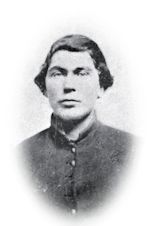
Winchester, Tenn., Wednesday, Nov. 11. Called up at 4 A. M. Harnessed before daylight. The horses covered with frost. Cold work for bare hands. Started as soon as daylight; about seven miles more of barrens without a house or trace of civilization. Slough holes very often, the pioneer corps bridging many of them while we waded through the others. Four or five horses gave out before we got through. Three left behind. Came out of there by noon on higher ground, well settled, but not very productive. Citizens look decidedly Secesh. Passed Salem at 2 P. M., two overshot waterwheels and a tower. Came into camp within two miles of Winchester at sundown. We are within our own lines. The Army of the Cumberland has a force stationed here, among which is the 1st Wisconsin Cavalry. Drew one day’s rations of crackers.
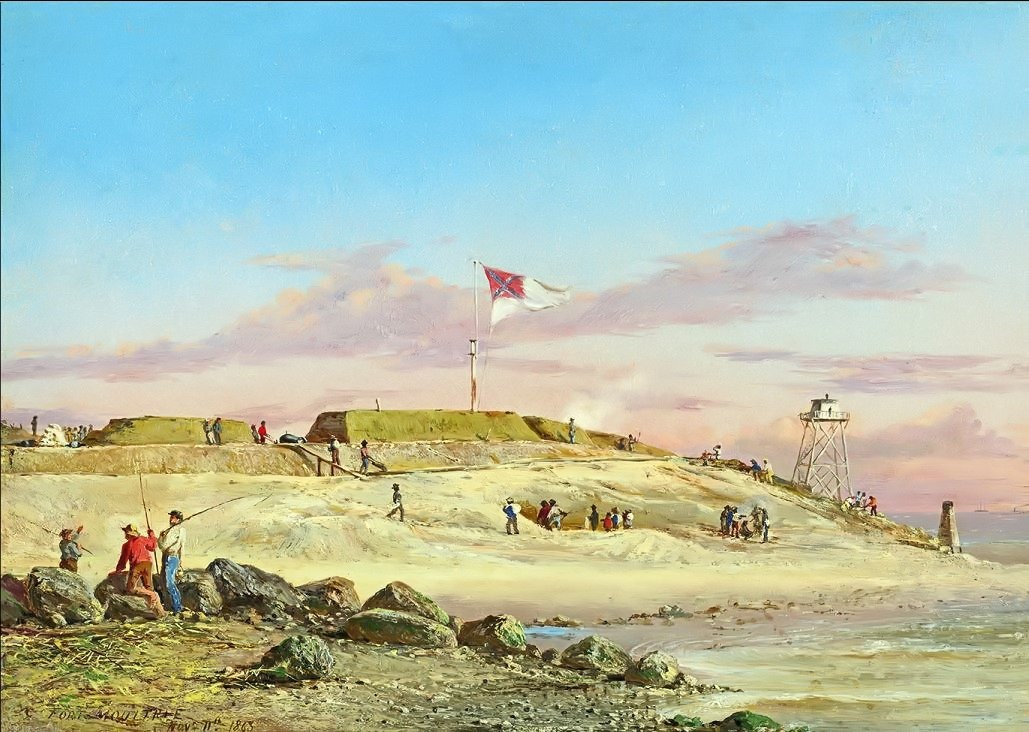
Painting by Conrad Wise Chapman.
“External view of Fort Moultrie, negroes at work, getting sand to repair fortifications. Shows some soldiers who have probably been out fishing; and in the distance can be seen blockading fleet.” – Conrad Wise Chapman, 1898


