25. — Lucy and I came up on the Viola.
November 2013
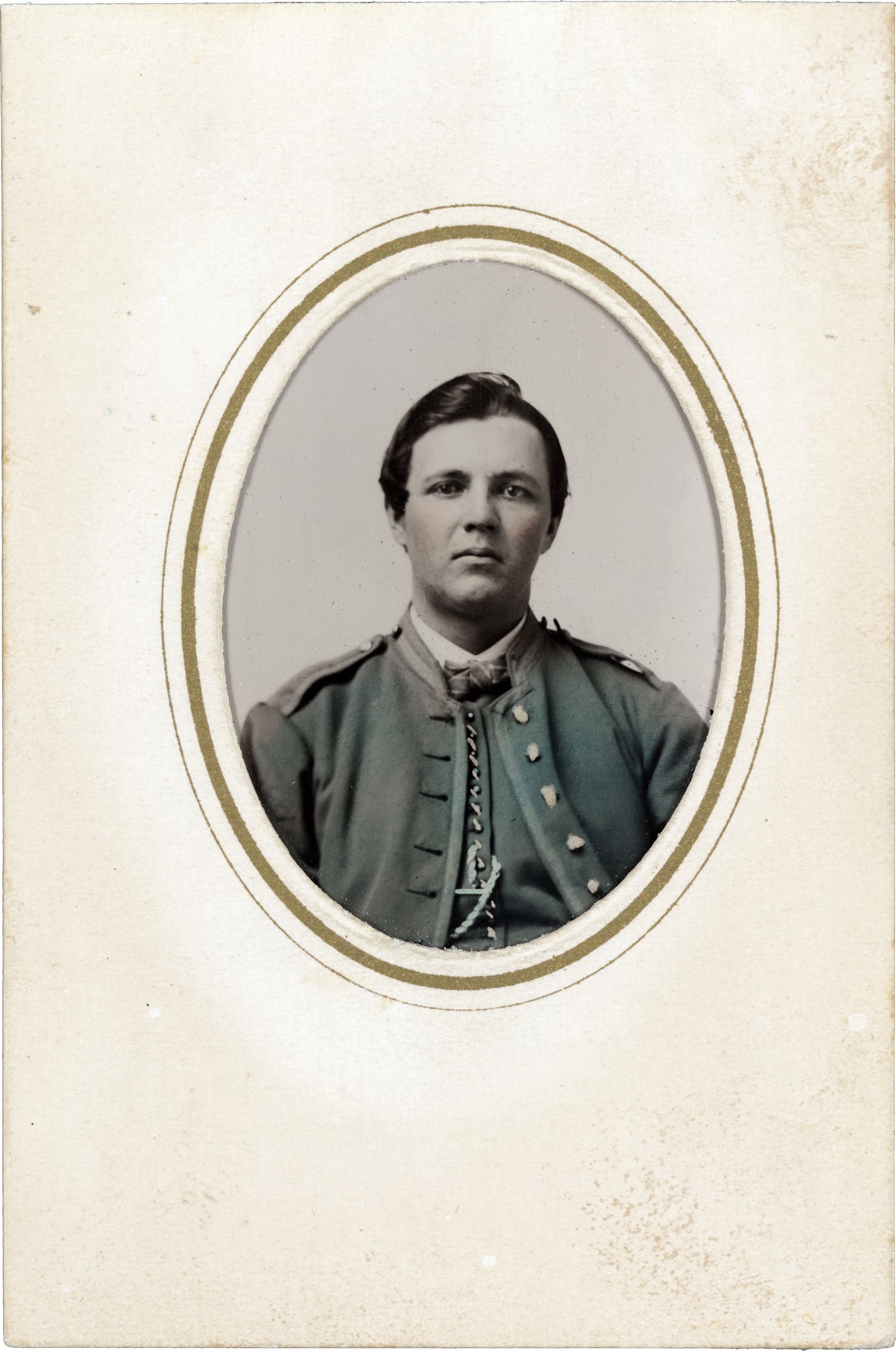
Unidentified soldier in Union uniform
__________
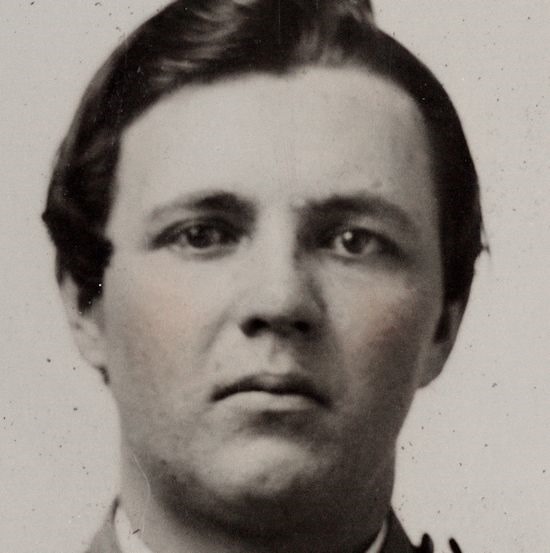
Close-up crop:
__________
approximate sixteenth-plate tintype, hand-colored ; 9.4 x 6.2 cm (carte de visite mat)
Photographer: G. P. Lasselle, No. 4 Summer St., Boston.
Liljenquist Family Collection of Civil War Photographs; Ambrotype/Tintype photograph filing series; Library of Congress Prints and Photographs Division.
Record page for image is here.
__________
 Note – This image has been digitally adjusted for one or more of the following:
- fade correction,
- color, contrast, and/or saturation enhancement
- selected spot and/or scratch removal
- cropped for composition and/or to accentuate subject matter
- straighten image
Civil War Portrait 104
by John Beauchamp Jones
NOVEMBER 25TH.—We have an unintelligible dispatch from Gen. Bragg, saying he had, yesterday, a prolonged contest with the enemy for the possession of Lookout Mountain, during which one of his divisions suffered severely, and that the manœuvring of the hostile army was for position. This was the purport, and the language, as well as I remember. There is no indication of the probable result—no intimation whether the position was gained. But the belief is general that Bragg will retreat, and that the enemy may, if he will, penetrate the heart of the South! To us it seems as if Bragg has been in a fog ever since the battle of the 20th of September. He refused to permit — to move on the enemy’s left for nearly two months, and finally consented to it when the enemy had been reinforced by 30;000 from Meade, and by Sherman’s army from Memphis, of 20,000, just when he could not spare a large detachment! In other words, lying inert before a defeated army, when concentrated; and dispersing his forces when the enemy was reinforced and concentrated! If disaster ensues, the government will suffer the terrible consequences, for it assumed the responsibility of retaining him in command when the whole country (as the press says) demanded his removal.
From letters received the last few days at the department, I perceive that the agents of the government are impressing everywhere —horses, wagons, hogs, cattle, grain, potatoes, etc. etc.—leaving the farmers only enough for their own subsistence. This will insure subsistence for the army, and I hope it will be a death-blow to speculation, as government pays less than one-fourth the prices demanded in market. Let the government next sell to non-producers, and every man of fighting age will repair to the field, and perhaps the invader may be driven back.
We have the speech of the French Emperor, which gives us no encouragement, but foreshadows war with Russia, and perhaps a general war in Europe.
We have rain again. This may drive the armies in Virginia into winter quarters, as the roads will be impracticable for artillery.
The next battle will be terrific; not many men on either side will be easily taken prisoners, as exchanges have ceased.
Dr. Powell brought us a bushel of meal to-day, and some persimmons.
November 25.—An expedition composed of details from the First North-Carolina volunteers, Twelfth New-York cavalry, and the Twenty fourth New-York battery, under command of Captain George W. Graham, First North-Carolina volunteers, (Captain R. R. West, Twelfth New-York cavalry, having generously waived his rank, in deference to Captain Graham’s familiarity with the country to be traversed,) attacked a camp of rebels near Greenville, North-Carolina, and after a brief and gallant contest, more than fifty prisoners, a hundred stand of arms, and a considerable amount of subsistence and quartermaster’s stores fell into the hands of the Nationals, while but one of their men was fatally wounded.
It was an affair in which the sterner virtues of the soldier, patience and fortitude, were equally exhibited with gallantry and daring, but twenty-four hours having been occupied in all, and a march of nearly seventy miles having been performed.—General Peck’s Order.
—The battle of Chattanooga, Tennessee, closed this day. Missionary Ridge was carried completely by the National troops, and the rebels routed, so that they fled in the night (Docs. 14 and 18.)
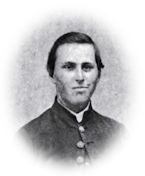
November 25th. Thanksgiving Day. Weather fine. Our second one in the U. S. service. Some of the boys received boxes from home containing good things which they divided with others. Connecticut mince pies were all right. We had baked chicken prepared by a baker in town. Our Thanksgiving in camp passed very quiet and pleasant. Excused from all duty except picket and guard. These days are passing quietly, nothing extra so far to perform. Kept busy most of the time.
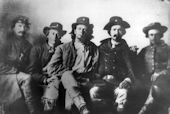
Tuesday, 24th—All quiet in Camp. Firing at Kingston, Wheeler and Wilder.
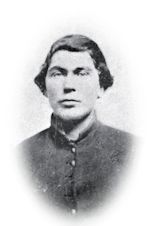
Mission Ridge, Tenn., Tuesday, Nov. 24. Marched to our position of night before last, unhitched and unharnessed. Laid down till 1 A. M. when we were awakened and ordered to hitch up. No noise allowed to be made. The pontooners marched by on quick time with axes, etc. Cogswell’s Battery moved out and took position in the front. We soon followed in breathless silence, entered an open field and followed it up nearly half a mile, when we came upon the column of infantry moving along in close order and very fast. Not a breath could be heard, nothing but the grating of their feet on the gravel was to be heard. Never did a more earnest or thoughtful column move to meet the enemy. The column proceeded to the river, and we went into battery in the field thirty rods from the bank. The infantry were ferried across in the pontoon boats. One division was already across. Contrary to all expectations not a gun was fired, and we could hear nothing from our position of the advancing column. The out-post guard were gobbled up by surprise and sent over on this side. One escaped and carried the alarm that the Yankees were coming, which was not believed. But the officer of the day with seventeen men reconnoitered the grounds, and they too were “taken in out of the wet” and taken across and put in charge of the guard of the 5th Wisconsin Battery, they being stationed in a bastion on the bank. The out-post very innocently told the story that upon hearing a rustle in the brush which he challenged with a “Halt! Hush you d fool you, the Yankees are right here upon us.’ The fust thing I knew you ‘uns hed me.” While our Division was crossing, long trains of pontoons came up there with a, long line of snow-white ambulances which caused the anxious question—”Who will be obliged to be borne in these from the field of battle?” Then came the hospital train, a wagon for each regiment in the Division, loaded with stores to establish a Division hospital.
6 A. M. . Two divisions were safely across and a more beautiful scene I never witnessed. Through the gray dawn a long line of infantry could be seen drawn up on the opposite banks a mile long, while the waters were covered with boats busily going and coming, loaded with men, the regimental colors standing in the center of the boat. The bridge was now covered, boats brought up, anchored in line, and the floor laid without any delay, the 4th Division marching in the boats and the artillery covering the field. Fires were allowed, to be built now and we soon had coffee. It commenced raining, as cold and disagreeable as the day could be. A steamboat was due at 4 A. M. to take us across, but did not come till 6:30 A. M. (an old rebel boat, but rebuilt). Taylor’s Battery crossed the river first, and as we were not pressed we waited for the bridge to be built. It was very disagreeable, and I felt almost sick; late hours and irregular meals having brought on diarrhea, etc. A large constellation of stars were gathered on the bank, watching the progress of the bridge, among which were Sherman, Blair, W. P. Smith, chief engineer, etc. The line on the other side in one hour had a line of breastworks up and advanced out of sight to form another.
12 M. The bridge completed and we crossed it, being the second battery to do so. The dread of crossing had passed. Halted at a corn crib and the cannoneers got as much corn as they could, but the infantry was formed and advanced in column of division at secure arms, it raining very heavy. This savage-looking column moved forward with caution, crossed a forty-acre lot and halted. The skirmishers went out but not a gun was fired. Advanced again, the batteries were in column of sections. An occasional gun shot, but we advanced until we were directly under Mission Ridge. Not a reb seen and our infantry soon climbed it. Our line formed on the brow when the artillery moved up. Battery D, 1st Missouri was the first up and soon opened fire on them from the right. Our Battery started for the left. The “smooth bores” were left on the other side of the river for want of horses, and we had four teams on a carriage, but the hill was too steep for us and two more teams were put on the pieces, and caissons left behind. A detail of two hundred men were sent to our aid with axes, the enemy sending shells over us quite thick. 1st piece failed to advance with the horses. Ropes brought forward and it was hauled up by hand, we following with all haste. By this time a very brisk skirmishing was going on right to our left and rear quite close, and General Matthies came down at the head of his Brigade on double quick, the old general on foot, making fine time. Captain Dillon ordered the howitzer section and Cogswell’s Battery to the rear in all haste. The extra teams were unhitched and the pieces unlimbered, and with great difficulty we made a left about, the hill being so steep that it shoved our horses down amongst the infantry that were pouring down. But the cannoneers fastened a rope to the axle-tree, and down we went in good earnest. Halted at the R. R. crossing in a complete jam of infantry, artillery and ambulances near General Smith’s headquarters, who knew nothing of our movements and demanded by whose orders we came down. A flank movement by General Longstreet was apprehended, and we were to guard it by order of General Sherman. We stood there in the cold damp evening for half an hour, got a feed of shelled corn from an out-house close by, when we moved back into the first field above General Matthies, and came into camp alongside of Cogswell’s Battery and the 2nd and 3rd Brigades of our Division. Unhitched but did not unharness. Our rations were entirely out with the exception of coffee and some cornmeal picked up, so we ate hastily of unsifted mush and coffee.
Three drivers from each piece sent after sheaf oats for horses. I was on the detail and we rode back nearly three miles toward the river. Found the oats all gone, but plenty of good tame hay, of which we took as much as possible. Returned to camp by 9 P. M. I was nearly exhausted from cold and loss of sleep, having been up since 1 A. M. Lay down in cold and wet blankets.
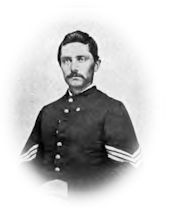
Tuesday, 24th—The weather is clear and cool, and the regiment is in good health. No news of importance.
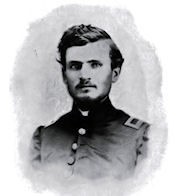
24th. Rob came before daylight and got flour for 2nd O. V. C. Hard up for rations seemingly. Another alarm and all saddled up before noon. Wagons moved to the rear and flour and meal collected. Letters from home and A. B. Moved to Tazewell. Wagons moved beyond. Couldn’t find them. Slept at Hdqrs. after rambling round awhile. Cold night.
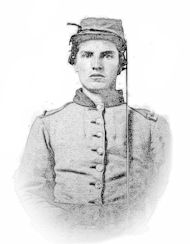
Monday, 24th.—15th Company F, sent on picket two hours before day. 8 A. M., still in line of battle on Chattanooga Creek; heavy cannonading about the point of the mountain. 12 M., very heavy cannonading on point; 1 P. M., heavy skirmishing on the mountain. 1:15 P. M., Federals charged mountain; came over the mountain, down under the point, across a field, in plain view of us; went up to works; our forces have fallen back a little. 2 P. M. Fog has risen so we can see the battle; 3 P. M., firing rather slow; 3:15 P. M., battle raging with renewed vigor. Yanks have our works, but seem as though they can’t go farther. 4 P. M., battle still raging; 4:30 P. M., reported Walthal’s Brigade pretty badly cut up, there being no other troops on the mountain; 5 P. M., battle continues unabated. Yanks falling back a little. Rebs re-inforced with Lee’s Brigade, Alabamians; 6 P. M., raining; 11 P. M., firing ceased. The general opinion is that Lookout Mountain is taken.


