Following the American Civil War Sesquicentennial with day by day writings of the time, currently 1863.

February 2014

February 6th, 1864.

I begin to feel quite certain that “the world does move.” The conviction is forced upon me by the fact that our Congress, the slowest of slow coaches, has actually begun to do what it should have done last year. Then look at Missouri, Arkansas, Louisiana, Texas and Tennessee. The fires of war have lighted up these dark places, and the people begin to see the hideousness of their cherished institution. Like true patriots they have set themselves at work to make their country what its vain boast has been—a land of freedom. I have become more firmly convinced, every day, that when this war ends slavery will not exist. The States I have mentioned will be free within a year.

Huntsville, Saturday, Feb. 6. A wet night and muddy morning. On guard—to appear on guard mounting with polished boots, all things accordingly. Spent the hours not on duty reading Ned Buntline’s thrilling tale of the times Ella Adams. One hundred horses distributed to the three Batteries by chief of artillery, having received them from Nashville. “We had thirty-two beautiful animals, large and fat. —— and J. Keller returned, the former after five months’ confinement in military prison at Vicksburg, the other from hospital, wounded at Champion Hills. They were gladly welcomed.

On the 6th, we marched out of camp with the rest of the corps to Morton’s ford, and bivouacked on open ground, overlooking the river and the opposite shore, which is unusually open for this country. General Warren being sick, General Caldwell took command of the corps. Hayes with the Third division crossed over early in the day and drove in the rebel pickets who were quickly reinforced, and a heavy skirmish commenced, which lasted throughout the afternoon. The field of operations was in full view, and our division lay intently watching the progress of the fight, which like all battles, big or little, was extremely fascinating.

Towards evening the enemy showed up in force, Ewell, with his entire corps coming on the field; our batteries opened on them, and for a while there was a lively fight. Hayes gradually fell back, and after dark retired in safety. As usual during the night it rained, making it extremely unpleasant. We lost about two hundred and fifty killed and wounded, without apparently gaining any equivalent; the following morning, February 7th, we marched back to camp and resumed the usual routine.

by John Beauchamp Jones

            FEBRUARY 6TH.—Major-Gen. Breckinridge, it is said, is to command in Southwestern Virginia near the Kentucky line, relieving Major-Gen. Sam Jones.

            Yesterday the cabinet decided to divide the clerks into three classes. Those under eighteen and over forty-five, to have the increased compensation; those between those ages, who shall be pronounced unable for field service, also to have it; and all others the Secretaries may certify to be necessary, etc. This will cover all their cousins, nephews, and pets, and exclude many young men whose refugee mothers and sisters are dependent on their salaries for subsistence. Such is the unvarying history of public functionaries.

            Gen. Pickett, finding Newbern impregnable, has fallen back, getting off his prisoners, etc. But more troops are going to North Carolina.

February 6.—The English steamer Dee was discovered ashore and on fire, at a point one mile south of Masonboro Inlet, N. C, by the National gunboat Cambridge. Finding it impossible to extinguish the flames or get her off, Commander Spicer, of the Cambridge, abandoned the attempt, and still further destroyed her by firing into her.—Admiral Lee’s Report.

—The Sixteenth army corps, General Hurlbut, and Seventeenth corps, General McPherson, under orders of Major-General Sherman, entered Jackson, Miss., the enemy offering but little resistance.—(Doc. 122.)

—A party of Yankees went to Windsor, in Bertie County, N. C, in boats, while another party landed on the Roanoke River, eight miles below, and marched on the town, where they made a junction with those that went up in boats. They burned up some meat, destroyed some salt, and carried off the Rev. Cyrus Walters, of the Episcopal Church, and several others. They attacked Captain Bowcrs’s camp, and routed the small force there; but, Captain Bowers being reenforced with a small body of cavalry, after some sharp fighting, the Yankees retired.—Raleigh Confederate.

—A detachment of the Seventh Indiana entered the town of Bolivar, Tenn., under the impression that the place was still occupied by the Federal troops. Much to their surprise, they found a regiment and a half of rebels in posession. They were in the town, and demanded what troops they were. The reply was, Mississippi. The Indianans, with the shout, “Remember Jeff Davis!” made a furious attack upon the astonished and disconcerted rebels, and drove them out of Bolivar in the utmost confusion, killing, wounding, and capturing about thirty. The Union loss was one killed and three wounded.

—In the rebel Congress, the following resolution was introduced this day: “Whereas, The President of the United States, in a late public communication, did declare that no propositions for peace had been made to that Government by the confederate States, when in truth such propositions were prevented from being made by the President, in that he refused to hear or even to receive two commissioners appointed to treat expressly of the preservation of amicable relations between the two governments; nevertheless that the confederate States may stand justified in the sight of the conservative men of the North of all parties, and that the world may know which of the two governments it is that urges on a war unparalleled for fierceness of conflict, and intensifying into a sectional hate unsurpassed in the annals of mankind; therefore,

Resolved, That the confederate States invite the United States through their government at Washington, to meet them by representatives equal to their representatives and senators in their respective congresses ——, on the day of ——, next ——, to consider, first, whether they cannot agree upon a recognition of the confederate States of America. Second, in the event of declining such a recognition, whether they cannot agree upon the formation of a new government, founded upon the equality and sovereignty of the States; but if this cannot be done, to consider, third, whether they cannot agree upon treaties offensive, defensive, and commercial.

February 1st-5th. This month so far has brought snow and cold rains. Regular duty kept up from day to day. Our regiment has been without a chaplain for several months. The Rev. William C. Walker, a Baptist clergyman of Putnam, Connecticut, having been appointed chaplain, arrived in camp and began the duties of that office. Believe that he will make a good chaplain. We all welcome him.

The 123d Ohio Regiment having received orders, left our brigade and camp. Ordered to New Creek, West Virginia, following the 3d and 4th Pennsylvania Regiments. Andrew Washburn, 1st Sergeant of our company, having been appointed a Captain in the 29th Connecticut Colored Regiment, left us to join that regiment. Albert Green, Company A, organized a singing school in town. It is very much enjoyed by the townspeople and the soldiers, passing the evenings very pleasantly. I attend once in a while when off duty. Enjoy it very much.

Camp West.

Feb. 5. Yesterday afternoon Camp Hancock became a thing of the past. Under command of Major Mulcay, we marched on to the parade ground of the 139th New York during their dress parade, and before it was dismissed, the major marched us up and introduced us to Col. Hoberts. The colonel received us cordially, and complimented us for our soldierly bearing and the good appearance of our arms, equipments and uniforms. We then listened to the reading of an order, assigning us temporarily for duty to this command. A gleam of light now dawned on us. Col. Roberts again addressed us, saying we were here only during the absence of our own regiment, and would hold the same rank and perform the same duties we had done in our own regiment. He added: “Although among strangers, with not a single officer of your own, I know by your appearance .and from what I have heard of you, that you will as willingly observe your orders and perform your duties as cheerfully as you have done heretofore.” Then addressing his own regiment, he said: “Receive these men cordially, sharing with them your quarters and blankets, and in all ways treating them as you would like to he treated under similar circumstances.” We made the welkin ring with cheers for Col. Roberts and his command, which were responded to by the 139th. After this another order was read, stating that the long expected march would commence tomorrow morning, the 6th. Col. Roberts, after addressing a few remarks to his own regiment, turned to us and said: “To you of the 25th Massachusetts, I have nothing to say. You know your duty and I am satisfied you will perform it.”

We were then divided off into parties which would equalize the companies of the regiment; the balance, about 25, were sent to Fort Magruder, which is only a short distance away. A dozen others and myself were assigned to company I, Capt. Phillips. The boys were warmly welcomed, and all set about introducing themselves to each other and getting acquainted. This camp is constructed of small log houses, with board floors and glass windows. The houses are furnished with stoves, chairs, stools, table and sleeping bunks. The officers’ quarters are built of logs with the bark left on, and are large and roomy. Some of them are two stories, others are neat little cottages built in Gothic style, and all present a neat, attractive and artistic appearance. These houses are all supplied and furnished with home comforts, some of them containing cabinet organs. The officers have with them their wives, sisters and other female relatives, who fancy the romance and rough experience of a soldiers’ camp. This is a Brooklyn regiment; it has been out but little more than a year and has been stationed here all this time, so the men have had the opportunity to fix up their camp to suit them. Their first and only service was with Gen. Dix, when he went up the country towards Richmond in the fall of 1862. Since then they have done picket duty around here, and some scouting up in the woods beyond the town.

They seem to have a mortal horror of bushwhackers, and say the woods above here are full of them, with some guerilla bands, it would seem from what these fellows say that the principle business of these guerilla bands is to look out for prisoners escaping from Richmond, and in connection with bushwhackers, to harass small parties of troops who are sent out to look after them. The scouting parties which go out seem to think that the proper way to deal with bushwhackers is to capture them, but scarcely a party goes out without bringing back one or more of their own number either dead or wounded. It is only two days ago I saw a funeral from the camp of the New York First Mounted Rifles of a man who had been killed up there. I tell the Brooklyn boys that the best use a bushwhacker can be put to is to make a target of him, and be sure to hit the bull’s eye when you draw a bead on him; never make a prisoner of one. The Brooklynites are asking our boys a thousand questions, and he latter are telling them blood and thunder stories till the former have come to think we are the veritable heroes of Waterloo.

Our friends here seem to be anxious and troubled about the morrow, wondering what kind of a scrape they are going to get into and whether they will come out all right, and are probing to the bottom the dark side of the matter. I try to cheer them up by telling them that from what experience I have had in this business I am not anticipating much of a storm. It has been too long underway and has been too well advertised; we may have a skirmish, nothing more. If the force around here is all that is going, we shall have to look out and not get into much of a skirmish.

The mystery which has for so many days hung over us is at last cleared up, and Gen. Butler, after finding we were not to be driven nor frightened, has in his order assigning us temporarily for duty, acknowledged he was exceeding his authority in threatening us with permanent assignment and taking our warrants from us. If it had been some other general who didn’t know any better I should think he was relenting of his shabby treatment of us, but Gen. Butler knew better, and that makes his treatment of us all the more reprehensible. I presume we shall have to get ourselves and knapsacks back to the News the same way we got here, although there are boats running round twice and three times a week.

February 5th.—When Lawrence handed me my husband’s money (six hundred dollars it was) I said: “Now I am pretty sure you do not mean to go to the Yankees, for with that pile of money in your hands you must have known there was your chance.” He grinned, but said nothing.

At the President’s reception Hood had a perfect ovation. General Preston navigated him through the crowd, handling him as tenderly, on his crutches, as if he were the Princess of Wales’s new-born baby that I read of to-day. It is bad for the head of an army to be so helpless. But old Blücher went to Waterloo in a carriage, wearing a bonnet on his head to shade his inflamed eyes—a heroic figure, truly; an old, red-eyed, bonneted woman, apparently, back in a landau. And yet, “Blücher to the rescue!”

Afterward at the Prestons’, for we left the President’s at an early hour. Major von Borcke was trying to teach them his way of pronouncing his own name, and reciting numerous travesties of it in this country, when Charles threw open the door, saying, “A gentleman has called for Major Bandbox.” The Prussian major acknowledged this to be the worst he had heard yet.

Off to the Ives’s theatricals. I walked with General Breckinridge. Mrs. Clay’s Mrs. Malaprop was beyond our wildest hopes. And she was in such bitter earnest when she pinched Conny Cary’s (Lydia Languish’s) shoulder and called her “an intricate little huzzy,” that Lydia showed she felt it, and next day the shoulder was black and blue. It was not that the actress had a grudge against Conny, but that she was intense.

Even the back of Mrs. Clay’s head was eloquent as she walked away. “But,” said General Breckinridge, “watch Hood; he has not seen the play before and Bob Acres amazes him.” When he caught my eye, General Hood nodded to me and said, “I believe that fellow Acres is a coward.” “That’s better than the play,” whispered Breckinridge, “but it is all good from Sir Anthony down to Fag.”

Between the acts Mrs. Clay sent us word to applaud. She wanted encouragement; the audience was too cold. General Breckinridge responded like a man. After that she was fired by thunders of applause, following his lead. Those mighty Kentuckians turned claqueurs, were a host in themselves. Constance Cary not only acted well, but looked perfectly beautiful.

During the farce Mrs. Clay came in with all her feathers, diamonds, and fallals, and took her seat by me. Said General Breckinridge, “What a splendid head of hair you have.” “And all my own,” said she. Afterward she said, they could not get false hair enough, so they put a pair of black satin boots on top of her head and piled hair over them.

We adjourned from Mrs. Ives’s to Mrs. Child’s, where we had the usual excellent Richmond supper. We did not get home until three. It was a clear moonlight night—almost as light as day. As we walked along I said to General Breckinridge, “You have spent a jolly evening.” “I do not know,” he answered. “I have asked myself more than once to-night, ‘Are you the same man who stood gazing down on the faces of the dead on that awful battle-field? The soldiers lying there stare at you with their eyes wide open. Is this the same world? Here and there?'”

Last night, the great Kentucky contingent came in a body. Hood brought Buck in his carriage. She said she “did not like General Hood,” and spoke with a wild excitement in those soft blue eyes of hers—or, are they gray or brown? She then gave her reasons in the lowest voice, but loud and distinct enough for him to hear: “Why? He spoke so harshly to Cy, his body-servant, as we got out of the carriage. I saw how he hurt Cy’s feelings, and I tried to soothe Cy’s mortification.”

“You see, Cy nearly caused me to fall by his awkwardness, and I stormed at him,” said the General, vastly amused. “I hate a man who speaks roughly to those who dare not resent it,” said she. The General did own himself charmed with her sentiments, but seemed to think his wrong-doing all a good joke. He and Cy understand each other.
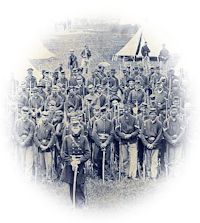
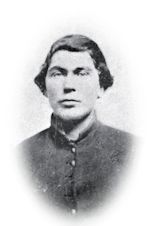
Friday, 5th—We left our bivouac this morning at 8 o’clock and moved forward about fifteen miles. General Liggett’s Division was assigned the advance today, while our brigade was taken from the supply train and placed immediately in Liggett’s rear. General Hurlbut’s Division is on a road just off to our left. There was some skirmishing, though with little loss to either side. We drove the rebels out of Clinton this morning and at dark routed them from Jackson, capturing one piece of artillery and some prisoners. We did not get into bivouac until 10 o’clock.

5th. Stayed in camp. Board of Survey. Read in “Tales and Sketches.”