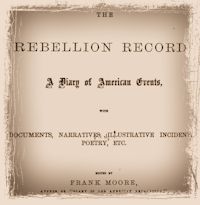
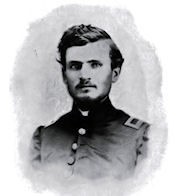
Following the American Civil War Sesquicentennial with day by day writings of the time, currently 1863.

February 2014

5th

Not dead! not dead! O my God! Gibbes is not dead! Where — O dear God! Another?

Only a few days ago came a letter so cheerful and hopeful —we have waited and prayed so patiently — at my feet lies one from Colonel Steadman saying he is dead. Dead! Suddenly and without a moment’s warning summoned to God! No! it cannot be! I am mad! O God, have mercy on us! My poor mother! And Lydia! Lydia! God comfort you! My brain seems afire. Am I mad? Not yet! God would not take him yet! He will come again! Hush, God is good! Not dead! not dead!

O Gibbes, come back to us!

Huntsville, Friday, Feb. 5. Rainy day, consequently no drill. Laid in quarters all day reading papers received from home. No mail, no news. Poor fare makes such days as these hang heavily and moodily, and I found it uncommon hard to keep a cheerful face upon it. All the disagreeable things seemed to be heaped up for my particular benefit. But I did not allow my feelings much sway and amused myself in reading, which always has a charm for me, and went to bed at night with a satisfied but a homesick heart.

February 5, Friday. Went last night to Blair’s reception and also to a party at Riggs’s, the banker. At the latter there were many semi-Secessionists whose modified views and changed opinions and course enable or induce them once more to mingle with the vulgar world from which they have kept secluded since these troubles commenced. The party was magnificent in its display and profusion, worthy the best, and the house is baronial in its appearance. In other days the Secession aristocracy gathered there, though at Corcoran’s and some others the association was more earnest and hearty. Riggs was a sympathizer, not an actor; his social affinities, rather than his political opinions, were with the Rebels.

Saturday, 5th—We are all glad to get back in camp again and to sleep in the bunks instead of lying on the ground in open bivouac. The boys spent the day in washing clothes and cleaning guns and accouterments.

February 5th. An order was received to-day to be ready to march in light marching order at a moment’s notice and all hands were relieved from the preparation for the great ball.

by John Beauchamp Jones

            FEBRUARY 5TH—Bright frosty morning, but warmer and hazy later in the day. From dispatches from North Carolina, it would seem that our generals are taking advantage of the fine roads, and improving the opportunity, while the enemy are considering the plan of the next campaign at Washington.

February 5.—The Fourteenth Illinois cavalry, commanded by Major Davis, which had been out on an expedition from Knoxville, Tenn., reported at headquarters, after having performed one of the most daring raids of the war. Evading the enemy’s cavalry, the force dashed round into Jackson County, North-Carolina, surprised the camp of Thomas’s celebrated Indian Legion, capturing fifty of those outlaws—among whom were three lieutenants and an Indian doctor—besides killing and wounding a large number. Thomas, himself, with a remnant of his band escaped. Before the war he was the United States agent for the Cherokees of East-Tennessee and North-Carolina, a position which gave him great influence with the savages.

The Union loss in the fight was three killed— among whom was Lieutenant Capran, son of the colonel who first commanded the regiment—and five wounded. A detachment of the Forty-ninth Ohio were sent to bring in the prisoners.

—Day before yesterday a scouting-party sent out from Cape Girardeau, Mo., by Colonel J. B. Rogers, under command of Captain Shelby, Second regiment of cavalry, M. S. M., attacked a largo band of guerrillas under the noted chief, John F. Bolin, killed seven, and captured eight men, thirteen horses, and fifteen wagons loaded with corn. Bolin was captured and confined in the guard-house at that post.

At a late hour to-night he was forcibly taken by the enraged soldiers and citizens from the custody of the guard, and hung. No intimation of the act reached the officers until the deed was perpetrated. The officers did all in their power to suppress the violation of the law, but to no avail. Bolin made the following confession before his execution:

“I was at Round Pond; there were eight men killed; two by Nathan Bolin and one by John Wright. They were killed with handspikes. I emptied one revolver. At Round Point I shot one man; at Dallas I wounded another. I captured eight men on Hickory Ridge; I told them I was going to shoot them, but their soldiers recaptured them before I could do so. I have killed six or seven men; I killed my cousin; I ordered him to halt—he would not, and I shot him down.”

—Governor Yates, of Illinois, issued a proclamation, saying that that State, under every call, had exceeded her quota, and was not, on the first of January or at any other time, subject to a draft.

—Day before yesterday, an expedition, under command of Colonel Jourdan, left Newport, N. C, for the White River, for the purpose of making a reconnoissancc. The command was made up of Vermont and New-York troops, and a part of the Second North-Carolina regiment, who rendered efficient service as guides. Last evening they came upon a body of cavalry about five miles from Young’s Cross-Roads, and captured the entire party, numbering twenty-eight men and thirty horses, with their arms and equipments. A quantity of corn was also captured and brought in. The command returned to Newport this day, without losing a man.

—The steamer Emma was fired into at a point fifteen miles below Helena, Ark., with cannon and musketry. The shells were filled with Greek fire, three of which exploded in various parts of her, setting her on fire, but the flames were extinguished.—The bombardment of Fort Sumter was continued; eighty-six shots were fired at the city of Charleston during the day.
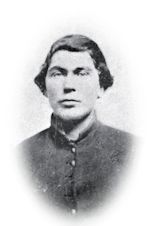
Thursday, 4th—We started to move at 8 o’clock and by night reached Bolton Station, where we went into camp. Our brigade being in the rear did not get into camp until 11 p. m. There was some skirmishing by Crocker’s Division, which lost three men killed and several wounded. Two men were killed by a ball from the rebels’ battery striking the top rail of a rail fence, which broke and struck the two men, knocking off their heads and spilling their brains about. It was a gruesome sight. Their bodies were buried where they fell.

4th. Went down to the stable with the boys to see the horses. Went to clothing store—vest and hat—measured for pants. Camp in time for dinner. Wrote some.

4th. Saturday. Made out my report and handed it in at Guard Mount. Learned that recruiting orders had gone by the board.