Following the American Civil War Sesquicentennial with day by day writings of the time, currently 1863.

April 2014

Huntsville, Sunday, April 3. The mail that came in last night was not distributed till this morning. I received three goodly letters. Inspection and reading of order No. 6, at 8 A. M. after which I went to church. Attended the Methodist Sabbath School, took part in the soldiers’ class taught by a captain. Listened to a sermon in the elegant Presbyterian church on atonement; poor and inconsistent. Wrote a letter to brother John in the afternoon.

General McPherson rode through camp this afternoon at 3 P. M., the idol of all soldiers. Had not seen him since we left Vicksburg before. A true gentleman and noble patriot. Teams back from Whitesburg after rations for men.

April 3—As I have not heard from my parents since the war, thev living in New York, I thought I would send a personal advertisement to a New York paper to let them know that my brother and myself are well, and for them to send an answer through the Richmond paper. I gave this to a Yankee picket, who promised me he would send it to New York. Nothing more up to the 7th.

April 3.—This night a band of forty rebels landed at Cape Lookout, took possession of the lighthouse, put the keeper and his wife in durance, and exploded a keg of powder, which seriously damaged the building. They then retired on the approach of the steamer City of Jersey.

—General J. P. Hatch, commanding the district of Florida, issued the following order from his headquarters at Jacksonville: “The Brigadier-General Commanding desires to make known to his command the successful accomplishment of a daring and difficult expedition, by a detachment of twenty-five men of the One Hundred and Fifteenth New-York volunteers, commanded by Captain S. P. Smith, of the same regiment. This little party, sent from Pilatka to a point thirty-two miles from the post, surprised and captured a picket of the enemy, consisting of one sergeant and nine men, with their arms, and thirteen horses, and equipments complete. To bring off the horses, it was necessary to swim them across the St. John’s River, and force them for a mile and a half through a swamp previously considered impracticable. The energy, intrepidity, and skill with which this expedition was conducted demands the praise of the commander of this district, and the imitation of troops hereafter detached on similar expeditions.

“II. The Brigadier General Commanding announces that the Marine Battery, which was so promptly and cheerfully placed on the line of our intrenchments when they were first thrown up in the vicinity of Jacksonville, and at a time when it was much needed, has been ordered on board the sloop-of-war Mahaska. He takes this opportunity to return his thanks to Captain G. B. Balch, commanding United States naval forces on St. John’s River, for his kindness, and to Ensign Augustus E. French, and the petty officers and men under him, for their valuable services, very good conduct, and exhibition of excellent discipline, throughout their intercourse with the troops of this command.”

by John Beauchamp Jones

            APRIL 3D.—The snow has disappeared; but it is cloudy, with a cold northwest wind. The James River is very high, and all the streams are so much swollen that no military operations in the field are looked for immediately. It is generally believed that Grant, the Federal lieutenant-general, will concentrate an immense army for the capture of Richmond, and our authorities are invoked to make the necessary dispositions to resist the attempt.

            The papers contain a supplemental proclamation of President Lincoln, and understand it to be merely an electioneering card to secure the Abolition vote in the convention to nominate a candidate for the Presidency. If it does not mean that, its object must be to induce us to send an army North to burn and pillage, so that the Federal authorities may have a pretext to raise new armies, and prosecute the war, not for the Union, but for conquest and power.

            Custis and I received yesterday $500 in the new Treasury notes, but we had to pay $16 for two pounds of bacon. So no diminution of prices is yet experienced. It is now a famine, although I believe we are starving in the midst of plenty, if it were only equally distributed. But the government will not, it seems, require the railroads to bring provisions to the exclusion of freight for the speculators. Certain non-combating officers of the government have abundance brought them by the Southern Express Co., and the merchants have abundance of goods brought hither by the same company for the purposes of speculation. Well, we shall see the result! One is almost ready to believe that the government declines to fill the depots here, harboring the purpose of abandoning the city. That would be abandonment of the cause. Nearly all who own no slaves would remain citizens of the United States, if permitted, without further molestation on the part of the Federal authorities, and many Virginians in the field might abandon the Confederate States army. The State would be lost, and North Carolina and Tennessee would have an inevitable avalanche of invasion precipitated upon them. The only hope would be civil war in the North, a not improbable event. What could they do with four millions of negroes arrogating equality with the whites?

2nd. Got up some straw and forage. A rainy day. Slept with Bill in Q. M. Dept.

Camp Holmes, Annapolis, Md., April 2, ’64.

Dear Father, —We are in the midst of a heavy snowstorm, which seems more like November in New England than April in the “Sunny South.” Since we have been here we have only had three sunny days, a great disadvantage to us, as we want all the pleasant weather possible to drill our men.

I am detailed on court-martial, which will take up most of my time for some weeks to come. We shall have ten or twelve cases from our own regiment to be tried.

I have been riding around in the camps of some of the regiments here, and am glad to say that our men and officers look more like true soldiers than any that I have seen. They are more uniform in their dress, more respectful, and better disciplined by far, than the men of any other regiment here. Our camp is the neatest and most comfortable one that I have seen. We have cook-houses and cooking-stoves for every company, and most of our men have floors for their tents. Altogether I am very well satisfied with the regiment, and think that it will be one of the best in the corps.

In regard to shooting that man Casey, I was perfectly justified in so doing. He was formerly in the 12th Massachusetts, where he was utterly unmanageable. The lieutenant colonel of that regiment once drew a pistol on him, and told him he would shoot him if he did not keep quiet. Casey damned him and told him that he dared not shoot him, and he did not. This I heard since my trouble with him. When I had the trouble with him, he was tied up, and while in that position he kicked an officer. I told him I should shoot him if he did any such thing again. He at once kicked an officer who was passing by. I immediately drew my pistol and shot at him twice. He has often threatened my life, which of course I paid no attention to, as I knew he would never dare attempt it. I called him up a few days after shooting him, and told him that I meant to have killed him when I fired at him, but that if he would promise to let rum alone, I would release him from the guard-house. I might have had him tried by court-martial and shot, but I thought I would give him another chance. I have no doubt now but that the fellow will make a good soldier. He and other men in the regiment know that I will enforce discipline at all hazards. and that if I say that I shall shoot them, it will be done. I am firm and strict with all but always endeavor to be just and to discriminate between the totally bad and those temporarily led away) I find that I can govern men with strictness and yet be liked, although popularity is a thing that I never have and never shall seek for, with my men. If an officer does his duty, it comes of itself. The good men in the regiment feel very sorry that I did not kill Casey, as they consider him a disgrace to the regiment. On the whole I am glad that I did not, as the results produced by the shooting are just as good as if I had killed him.

I am rather discouraged at the poor condition of the portion of the Ninth Corps that I have seen. If the remainder is at all like what is here, I hope we shall soon leave it. . . .

I think that General Grant is going to concentrate all his forces on Richmond this spring and take it by overwhelming it. I dare say that he will concentrate between 150, and 200,000 men. I think that two columns will move against the city. One will probably go up James River, and I dare say that we shall form part of that force. If we only get Virginia from the rebels, we shall get North Carolina and East Tennessee, and then our lines will be shortened wonderfully. It is absolutely necessary to get some great advantage over the Confederates this spring, and with Grant at the head of our armies, I feel confident that we shall succeed in doing so. . . .

I forgot to say to you that the liquor dealer that I carried off from Philadelphia was a big rascal. Several of the citizens and policemen thanked me for taking him off, and begged me to keep him, saying that he enticed soldiers to desert, got them drunk, etc. I do not anticipate any trouble from the matter. I merely took him and delivered him over to the nearest provost marshal. I don’t think he complained much about having his head shaved. He was probably afraid of being laughed at if he did so.
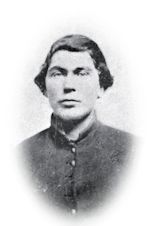
Saturday, April 2. — Stormy all night, with heavy snow-storm in the morning, which changed again to rain at noon. Reported to headquarters 1st Michigan Sharpshooters, where the court-martial was ordered to meet, but found that the colonel was away in town. The court will not meet until next Monday. Received a letter from Hannah, dated Baltimore.

Saturday, April 2nd.

This morning we found the ground covered with snow to the depth of about four inches and a snow storm still raging. Went over to my company camp and found everything in the most cheerless possible condition. The field officers of the regiment have their tents up, but find them little protection, though they strenuously endeavor to get up a little fire in two or three camp stoves which have been smuggled thus far, and whiskey is in great demand. As to the men, their condition is truly deplorable, and the sick list is very long this morning owing to the exposure and consequent suffering. Having ascertained that no new orders have been received, and that most of my own company are quartered with the 126th. I returned to Lieut. Lincoln’s tent and accepted the invitation of Capt. and Lieut. Munson of the 126th to spend the night with them. After I had turned in I was aroused by Capt. Platt of the 126th, who, personating a raw recruit who had enlisted with the promise of a Captain’s commission as soon as he had joined his regiment, was convulsing a party of officers in the hut, with the recital of his grievances in not getting the promised position. Capt. Platt is a perfect mimic, and would do credit to any stage as a first-class comedian.

April 2 — Rained all last night, with a cold freezing wind blowing from the north; this morning it commenced snowing, and snowed until midday. We have had a great deal of rain and snow since we moved to this camp; the ground is well saturated with water, and our camp is in the same fix, with deep adhesive mud of the finest grade.

Saturday, 2d—They had a very cold winter here in Iowa and the ground has been frozen so deep that it is slow in thawing out. Farmers, as yet, have sown but little wheat, but they have everything ready to push the seeding as soon as the ground will permit. It is quite pleasant today, but the roads are very muddy yet, and there is no news of any importance.