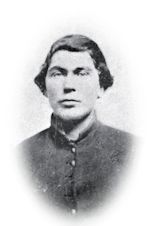
Huntsville, Saturday, April 2. Dry day. No duty to-day except the policing in the afternoon which was soon completed. 63rd Illinois Veteran Volunteers started on their homeward-bound journey this evening. As they marched out to the music of their fine martial band, each heart bounded with animation at the prospect of meeting the familiar faces once more. The 48th and 59th Indiana Volunteers marched into their old camping ground which they had left two months ago for home. They had marched all the way from Nashville in five days, one hundred and thirty miles, footsore and tired with three years of service before them. In company with Griff and D. J. D. visited the theatre, first one I ever saw. Well pleased.
April 2014
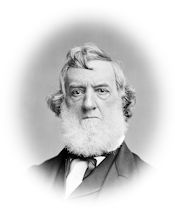
April 2, Saturday. John M. Forbes called. After talking on one or two subjects he spoke of the National Convention and his regret that the call was so early, and asked me as one of the committee to reconsider the subject. Told him I would hear and consider anything from him, but that my mind was deliberately made up, and I thought the sooner the nomination was made, the better united we should be. He went over the usual ground, — if the summer campaign was unfortunate, etc., etc., how could we change our candidates? I answered we did not intend to be unfortunate, but if we were, I could not see how any different candidate would help the Union cause. Reverses might strengthen the Copperheads.
He then talked of the President, — his want of energy, decision, promptness, in consequence of which the country suffered. It was evident from what I gathered that Mr. Forbes wanted another candidate than Abraham Lincoln, and hence he desired delay. Forbes means well. His heart is right. He is shrewd and sagacious, but men betray their feelings and partialities unavoidably. I have no doubt he desires to have Mr. Chase a candidate, though he speaks of only Ben Butler, whom he dislikes.
Cautioned Fox to beware of yielding to the suggestions and opinions of detective Olcott, unless fully satisfied by facts in his possession. Mr. Wilson, the counsel, must advise in these matters, and nothing be done in the way of seizure and arrest but by Mr. Wilson’s direction.
April 2.—Captain Schmidt, of company M, Fourteenth New-York cavalry, while scouting near Pensacola, Florida, with thirty of his men, came upon a party of fifty rebels belonging to the Seventh Alabama cavalry, under command of Major Randolph, C. S. A. The Nationals immediately charged them, and after a hand-to-hand fight of about ten minutes, defeated them with a loss of from ten to fifteen killed and wounded, eleven prisoners, one lieutenant, two sergeants, and eight men. The loss of the Nationals was First Lieutenant Lengerche and two men slightly wounded.
by John Beauchamp Jones
APRIL 2D —It rained furiously all night; wind northwest, and snowed to-day until 12 to a depth of several inches. It is still blowing a gale from the northwest.
To-day the clerks were paid in the new currency; but I see no abatement of prices from the scarcity of money, caused by funding. Shad are selling at $10 each, paper; or 50 cents, silver. Gold and silver are circulating—a little.
A letter from Liberty, Va., states that government bacon (tithe) is spoiling, in bulk, for want of attention.
From Washington County there are complaints that Gen. Longstreet’s impressing officers are taking all, except five bushels of grain and fifty pounds of bacon for each adult—a plenty, one would think, under the circumstances.
Senator Hunter has asked and obtained a detail for Mr. Daudridge (under eighteen) as quartermaster’s clerk. And Mr. Secretary Seddon has ordered the commissary to let Mrs. Michie have sugar and flour for her family, white and black.
Mr. Secretary Benjamin sent over, to-day, for passports to the Mississippi River for two “secret agents.” What for?
Gen. Lee has made regulations to prevent cotton, tobacco, etc. passing his lines into the enemy’s country, unless allowed by the government. But, then, several in authority will “allow” it without limit.
I set out sixty-eight early cabbage-plants yesterday. They are now under the snow!
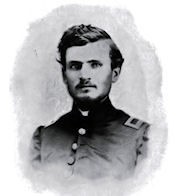
April 1st. Moved camp over the railroad, three-quarters of a mile. Went to town and got camp and G. equipage, and hay and wood.
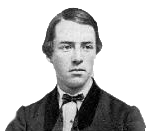
Camp Holmes, Annapolis, April 1, 1864.
Dear Hannah, — . . . I am glad to find that you are so pleasantly situated in Baltimore, and hope you will enjoy your visit very much. As to my coming on to see you, I am afraid that I shall not have any chance to do so. I have not been out of camp but once since arriving here, and now I am on court-martial, which will take up all my time from nine A.M. until three P.M. every day. I am very sorry that I cannot accept the invitation for the ball this evening, but as I have said, my duties prevent.
The regiment is getting into very good shape indeed. The men begin to appear and act like soldiers. We have very little trouble with them, and the number in the guard-house is diminishing. For the worst cases, we have provided a scaffold some twenty feet from the ground, erected on poles. Here the hard cases are placed, with the ladder withdrawn at night.
The troops around here are very poorly drilled and disciplined. Many of them are old regiments just returned from furloughs, which I most sincerely hope accounts for their want of drill and discipline. They are many of them Pennsylvania troops, however, which accounts for their deficiencies or failings. . . .
I am most happy to inform you that the regiment has improved greatly in battalion drills, etc. It will be a fine regiment soon. . . .
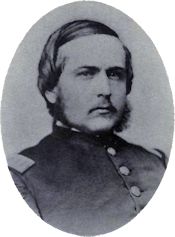
Friday, April 1st.
We received orders this morning to join the Artillery Brigade of the Second Corps, and so, breaking camp, we marched through devious ways to a point near a little settlement called Stevensburg. As the well filled ranks of the regiment wound along across the plain, through the gullies and over the hills, we were frequently saluted by the old campaigners near whose camps we passed, with “What division is that?” “How are your heavy Infantry?” “What’s the size of your siege guns?” “How are the fortifications?” and other equally pointed and aggravating interrogations, to all of which the men either turned a deaf ear or replied with becoming emphasis.
Rain commenced falling about the time we had completed the first half of the distance and continued uninterruptedly during the rest of the day, rendering progress exceedingly toilsome and slow, and to add to our discomfort, on arriving at our destination and being kept standing and lying in the rain and mud for some time, the Colonel selected the side of a steep hill for our camping ground, in my judgment the very worst locality for such a purpose in all that region. But having long since learned obedience to orders, we occupied the ground to the best advantage, satisfied that at least no water would settle in our company streets. Immediately on locating the metes and bounds of the company camp, I gave the men liberty to put up their tents at once, or seek refuge for the night in the quarters of any acquaintances they might find in regiments lying near us. Many of the men, therefore, accepted the hospitalities of the 126 N. Y. Infantry, which was camped on a hill across the ravine from us, that regiment having been recruited mainly in the western part of the State, where my own company was originally organized, and containing many friends and acquaintances of the boys. The 126th had originally been camped in a grove, but during the winter had cut away the trees for fuel and to stockade their winter quarters, so that at the time we saw them they were surrounded only by a few stumps. Their habitations were, however, comparatively luxurious, being built about six or eight feet square and four or five feet high, of logs nicely laid in mud-mortar, and covered with two shelter tents fastened together. They were provided with fire places of the old outside, New England pattern, with cracker boxes and barrels for chimneys, and with “bunks” of small parallel poles supported by posts driven into the ground and covered with leaves and army blankets, usually occupying about half the interior and doing duty as beds, chairs and tables. I spent the night with Lieut. Lincoln of the 126th, who, being Adjutant of his regiment, had appropriated a wall tent and was most comfortably situated. Here I met Col. Bull of the 126th, formerly of Canandaigua, with whom I had studied law, and several of his officers, and spent a very pleasant evening chatting with them. The Colonel evidently enjoyed the fact that the defenders of Washington had been ordered to the front, and took great delight in reminding me that he had prophesied as much sometime before when we had met at the Capital.
One little incident occurred to-day which put me out of all conceit touching my ability entirely to control the men of my command as to “what they should eat or what they should drink or wherewithal they should be clothed.” Now it has heretofore been my pride and boast that the preeminence of Co. H in drill, discipline and all the military virtues, was owing principally to the fact that whiskey was not allowed in the company, except on very rare state occasions or after unusual fatigue, and never without my knowledge. Fancy my feelings then, as we halted at the foot of the hill waiting for the Colonel to locate our position, when I asked Sergt. Lincoln if he “had anything in his canteen,” meaning thereby to inquire for water, for my own canteen had given out on the road, and he with a prompt “Yes, sir,” handed it to me and I took a swallow that would have done credit to a sluice-way, and discovered too late that I had taken an overdose of the vilest “commissary” known to army contractors. The effect was instantaneous and apparent, and so embarrassed my respiratory and vocal powers, that I failed to find language adequate to convey my astonishment, or thanks, to the Sergeant, who evidently congratulated himself that “no remarks were made” as I handed back the canteen without note or comment. I shall, however, be more explicit in my inquiries hereafter.
Friday, April 1. — Pleasant in the morning, but raining in afternoon. Gave Casey a pass to go to Annapolis on condition that he would touch no liquor. Received an order detailing me for court-martial to meet to-day, but as I did not receive it until late in the afternoon I did not report. Rode out of camp for first time since I have been here. Went about three miles on the road to Annapolis Junction. Bath.
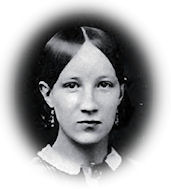
April 1.—Grandfather had decided to go to New York to attend the fair given by the Sanitary Commission, and he is taking two immense books, which are more than one hundred years old, to present to the Commission, for the benefit of the war fund.
Friday, 1st—The same old thing over and over. I almost wish myself back in the army; everything seems to be so lonesome here. There is nothing going on that is new, and there is no work of any kind.


