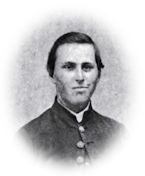
May 17th. Near Cedar Creek. Took account of stock this morning. A requisition goes to the quartermaster for a supply of clothes, rubber blankets, shelter tents. Much of our luggage gets lost on the march and in battle. Captain Wm. L. Spaulding, Co. B, killed at Newmarket. Body brought along by members of his company. Buried today near Cedar Creek, with military honors, the regiment taking part. It is intended to send the body home later. I expect to sleep tonight in an army wagon, near camp.
May 2014
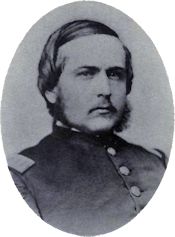
Tuesday, May 17th.
An order was received to-day reducing all batteries of artillery from six to four guns. The day was quiet, but from the dispositions being made it was apparent that a battle was anticipated. A rumor was current that the Rebs had four twenty-pound guns covering our front.
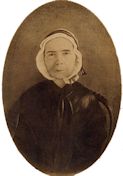
Tuesday Morning, May 17.—For some days the cannon has been resounding in our ears, from the south side of James River. Colonel Garnett has come in to tell us that for the first two days there was only heavy skirmishing, but that on yesterday there was a terrific fight all along the lines. Yesterday evening a brigadier, his staff, and 840 men, were lodged in the Libby Prison. Nothing definite has been heard since that time. The impression is, that we have been generally successful. Very brilliant reports are afloat on the streets, but whether they are reliable is the question. My nephew, Major B., has just called to tell me that his brother W. is reported “missing.” His battery suffered dreadfully, and he has not been seen. God grant that he may be only a prisoner! We suppose that it would have been known to the fragment of his battery which is left, if he had fallen.
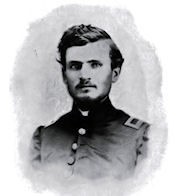
17th. Lay in camp all day. Played whist with Seward and Abbey.
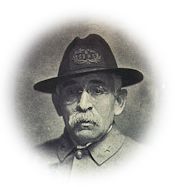
May 17—Saw Mack Sample, Will Stone and several of our company to-day that have been prisoners since the battle of Gettysburg. We get two meals a day.
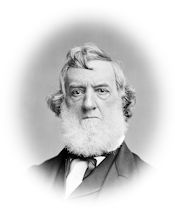
May 17, Tuesday. A painful suspense in military operations. It is a necessary suspense, but the intense anxiety is oppressive, and almost unfits the mind for mental activity. We know it cannot be long before one or more bloody battles will take place in which not only many dear friends will be slaughtered but probably the Civil War will be decided as to its continuance, or termination. My faith is firm in Union success, but I shall be glad when faith is past.
There was nothing special to-day at the Cabinet. No information received from the Army of the Potomac. Sherman had had hard fighting in northern Georgia at Resaca, and the Rebels under Johnston have retreated.
The President informs me that four of the Massachusetts delegation have waited upon him in relation to the condition of affairs at the Charlestown Navy Yard. They fear the Navy has too much control, and charge Admiral Smith with opposition to the Administration. I stated briefly to the President some of the difficulties, and that Mr. Gooch was not a free agent when there was a conflict or difference between the Government and the Navy Yard, that G. could not do otherwise than go with the men in the yard, and that Merriam was a cunning fellow who stirred up a citizen’s feeling for selfish purposes.
Things are getting in such condition that I see no alternative but to dismiss the man Merriam. Admiral Stringham writes me that M. has got up a paper or memorial to the Massachusetts Senators and Representatives which he has hired a man to circulate for signatures, remonstrating against the naval management of the yard and getting up a hostile feeling. It is this, I presume, which led to the call on the President.
Met Governor Morrill this evening, who at once spoke of the misconduct of the Treasury agents. We frankly discussed the subject. He is on the Committee of Commerce and has a right to know the facts, which I gave him. The whole proceeding is a disgrace and wickedness. I agree with Governor M. that the Secretary of the Treasury has enough to do to attend to the finances without going into the cotton trade. But Chase is very ambitious and very fond of power. He has, moreover, the fault of most of our politicians, who believe that the patronage of office, or bestowment of public favors, is a source of popularity. It is the reverse, as he will learn.
by John Beauchamp Jones
MAY 17TH.—Sunshine and showers.
The battle yesterday decided nothing, that I am aware of. We captured 1000 prisoners, stormed some of their intrenchments; losing altogether probably as many as the enemy. But we drove them back to Bermuda Hundred, behind their fortifications, and near their ships.
Gen. Johnston was attacked at Dalton by 80,000 men last week; accounts, some five days old, say he repulsed the assaults of the enemy.
The Departmental Battalion is out yet; the city being still in danger. The government is almost suspended in its functions. The Secretary of the Treasury cannot get money from Columbia, S. C., whither he foolishly sent the girls that sign the notes.
Some of the idle military officers, always found about the departments, look grave, and do not hesitate to express some apprehension of the success of Grant in forcing Lee back, and spreading over all Northern and Northwestern Virginia. The Secretary of War is much secluded, and I see by a correspondence between him and the Secretary of the Treasury, relating to the million and three-quarters in coin, belonging to the New Orleans banks, that the Secretary of the Treasury can make no “valid objection to the proposition of the Secretary of War.” I do not understand what disposition they propose to make of it.
A list is being prepared at the War Department (by Mr. Assistant Secretary Campbell) for Congress to pass, authorizing the seizure of all the railroads in the Confederacy. Also one establishing and reorganizing the Bureau of Conscription.
If Butler remains between Richmond and Petersburg, and is reinforced, and Grant is strong enough (two to Lee’s one) to push on toward Richmond, our perils and trials will be greater than ever.
Vice-President Stephens has not yet arrived. I do not understand that he is ill.
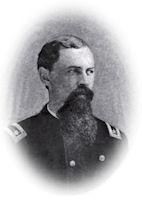
May 17, 1864, 10 a.m.
Our regiment moves in rear of the division to-day and we are still waiting for the trains to pass. We can hear firing in front occasionally, and although we have seen fighting enough to satisfy us for a time, still it’s more disagreeable to be away in the rear and hearing, but not knowing what’s going on, than to be in the field. I saw several hundred Rebel prisoners yesterday, among then one colonel. The country is much more level this side of the Coosa, but the pine woods spoil it. Our advance, from the faint sound of the artillery firing, must be seven or eight miles ahead. We will make it very warm for Johnston.
Ten p.m.—Have just got into camp, made12 miles to-day. Heavy firing on our left, which I hear is a division of Howard’s Corps.
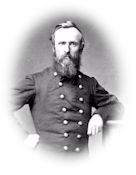
May 16. Monday. — Ordered to march at 8 A. M. on road to Alderson’s Ferry. We guard the trains. Before trains [were] all out, General Averell requests that I detain one regiment; his pickets fired on or approached on Sweet Springs Road. At his request remain until 11 A. M. Marched one hour and fifteen minutes to [within] about four and one-half miles from Union. There shown a dispatch from General Crook by an aide-de-camp of General Averell authorizing him to detain me but no orders given. Told the aide I would halt there until he could send orders from General Averell if I was wanted. Waited one and one-fourth hours; sent a messenger to Captain Bottsford for orders. Reports from Union indicate no force. After 3 P. M. marched slowly on after the infernally slow train. Soon overtook it at Little Flat Top. After crossing met my orderly (Heckler, Company C, wounded severely) from Captain Bottsford directing me to remain at place I sent from. I rode rapidly forward towards ferry to get further orders. Met Lieutenant Patton and got from him verbal orders and also a written order to camp near ferry. A bad road over Little Flat Top and also near the river. The rest of the road good. Three or four wagons broken; men tired, weak and hungry. “Living on the country”; showery still, muddy of course.
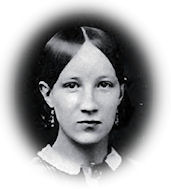
May 16.—I have not written in my diary for a month and it has been the saddest month of my life. Dear, dear Grandfather is dead. He was buried May 2, just two weeks from the day that he returned from New York. We did everything for him that could be done, but at the end of the first week the doctors saw that he was beyond all human aid. Uncle Thomas told the doctors that they must tell him. He was much surprised but received the verdict calmly. He said “he had no notes out and perhaps it was the best time to go.” He had taught us how to live and he seemed determined to show us how a Christian should die. He said he wanted “grandmother and the children to come to him and have all the rest remain outside.” When we came into the room he said to grandmother, “Do you know what the doctors say?” She bowed her head, and then he motioned for her to come on one side and Anna and me on the other and kneel by his bedside. He placed a hand upon us and upon her and said to her, “All the rest seem very much excited, but you and I must be composed.” Then he asked us to say the 23d Psalm, “The Lord is my Shepherd,” and then all of us said the Lord’s Prayer together after Grandmother had offered a little prayer for grace and strength in this trying hour. Then he said, “Grandmother, you must take care of the girls, and, girls, you must take care of Grandmother.” We felt as though our hearts would break and were sure we never could be happy again. During the next few days he often spoke of dying and of what we must do when he was gone. Once when I was sitting by him he looked up and smiled and said, “You will lose all your roses watching over me.” A good many business men came in to see him to receive his parting blessing. The two McKechnie brothers, Alexander and James, came in together on their way home from church the Sunday before he died. Dr Daggett came very often. Mr Alexander Howell and Mrs Worthington came, too.
He lived until Saturday, the 30th, and in the morning he said, “Open the door wide.” We did so and he said, “Let the King of Glory enter in.” Very soon after he said, “I am going home to Paradise,” and then sank into that sleep which on this earth knows no waking. I sat by the window near his bed and watched the rain beat into the grass and saw the peonies and crocuses and daffodils beginning to come up out of the ground and I thought to myself, I shall never see the flowers come up again without thinking of these sad, sad days. He was buried Monday afternoon, May 2, from the Congregational church, and Dr Daggett preached a sermon from a favorite text of Grandfather’s, “I shall die in my nest.” James and John came and as we stood with dear Grandmother and all the others around his open grave and heard Dr Daggett say in his beautiful sympathetic voice, “Earth to earth, ashes to ashes, dust to dust,” we felt that we were losing our best friend; but he told us that we must live for Grandmother and so we will.
The next Sabbath, Anna and I were called out of church by a messenger, who said that Grandmother was taken suddenly ill and was dying. When we reached the house attendants were all about her administering restoratives, but told us she was rapidly sinking. I asked if I might speak to her and was reluctantly permitted, as they thought best not to disturb her. I sat down by her and with tearful voice said, “Grandmother, don’t you know that Grandfather said we were to care for you and you were to care for us and if you die we cannot do as Grandfather said?” She opened her eyes and looked at me and said quietly, “Dry your eyes, child, I shall not die to-day or to-morrow.” She seems well now.
Inscribed in my diary :
.
“They are passing away, they are passing away,
Not only the young, but the aged and grey.
Their places are vacant, no longer we see
The arm chair in waiting, as it used to be.
The hat and the coat are removed from the nail,
Where for years they have hung, every day without fail.
The shoes and the slippers are needed no more,
Nor kept ready waiting, as they were of yore,
The desk which he stood at in manhood’s fresh prime,
Which now shows the marks of the finger of time,
The bright well worn keys, which were childhood’s delight
Unlocking the treasures kept hidden from sight.
These now are mementoes of him who has passed,
Who stands there no longer, as we saw him last.
Other hands turn the keys, as he did, before,
Other eyes will his secrets, if any, explore.
The step once elastic, but feeble of late,
No longer we watch for through door way or gate,
Though often we turn, half expecting to see,
The loved one approaching, but ah! ’tis not he.
We miss him at all times, at morn when we meet,
For the social repast, there is one vacant seat.
At noon, and at night, at the hour of prayer,
Our hearts fill with sadness, one voice is not there.
Yet not without hope his departure we mourn,
In faith and in trust, all our sorrows are borne,
Borne upward to Him who in kindness and love
Sends earthly afflictions to draw us above.
Thus hoping and trusting, rejoicing, we’ll go,
Both upward and onward, through weal and through woe
‘Till all of life’s changes and conflicts are past
Beyond the dark river, to meet him at last.”

In Memoriam
Thomas Beals died in Canandaigua, N. Y. on Saturday, April 30th, 1864, in the 81st year of his age. Mr Beals was born in Boston, Mass., November 13, 1783.
He came to this village in October, 1803, only 14 years after the first settlement of the place. He was married in March, 1805, to Abigail Field, sister of the first pastor of the Congregational church here. Her family, in several of its branches, have since been distinguished in the ministry, the legal profession, and in commercial enterprise.
Living to a good old age, and well known as one of our most wealthy and respected citizens, Mr Beals is another added to the many examples of successful men who, by energy and industry, have made their own fortune.
On coming to this village, he was teacher in the Academy for a time, and afterward entered into mercantile business, in which he had his share of vicissitude. When the Ontario Savings Bank was established, 1832, he became the Treasurer, and managed it successfully till the institution ceased, in 1835, with his withdrawal. In the meantime he conducted, also, a banking business of his own, and this was continued until a week previous to his death, when he formally withdrew, though for the last five years devolving its more active duties upon his son.
As a banker, his sagacity and fidelity won for him the confidence and respect of all classes of persons in this community. The business portion of our village is very much indebted to his enterprise for the eligible structures he built that have more than made good the losses sustained by fires. More than fifty years ago he was actively concerned in the building of the Congregational church, and also superintended the erection of the county jail and almshouse; for many years a trustee of Canandaigua Academy, and trustee and treasurer of the Congregational church. At the time of his death he and his wife, who survives him, were the oldest members of the church, having united with it in 1807, only eight years after its organisation. Until hindered by the infirmities of age, he was a constant attendant of its services and ever devoutly maintained the worship of God in his family. No person has been more generally known among all classes of our citizens. Whether at home or abroad he could not fail to be remarked for his gravity and dignity. His character was original, independent, and his manners remarkable for a dignified courtesy. Our citizens were familiar with his brief, emphatic answers with the wave of his hand. He was fond of books, a great reader, collected a valuable number of volumes, and was happy in the use of language both in writing and conversation. In many unusual ways he often showed his kind consideration for the poor and afflicted, and many persons hearing of his death gratefully recollect instances, not known to others, of his seasonable kindness to them in trouble. In his charities he often studied concealment as carefully as others court display. His marked individuality of character and deportment, together with his shrewd discernment and active habits, could not fail to leave a distinct impression on the minds of all.
For more than sixty years he transacted business in one place here, and his long life thus teaches more than one generation the value of sobriety, diligence, fidelity and usefulness.
In his last illness he remarked to a friend that he always loved Canandaigua; had done several things for its prosperity, and had intended to do more. He had known his measure of affliction; only four of eleven children survive him, but children and children’s children ministered to the comfort of his last days. Notwithstanding his years and infirmities, he was able to visit New York, returning April 18th quite unwell, but not immediately expecting a fatal termination. As the final event drew near, he seemed happily prepared to meet it. He conversed freely with his friends and neighbors in a softened and benignant spirit, at once receiving and imparting benedictions. His end seemed to realise his favorite citation from Job: “I shall die in my nest.”
His funeral was attended on Monday in the Congregational church by a large assembly, Dr Daggett, the pastor, officiating on the occasion — Written by Dr O. E. Daggett in 1864.


