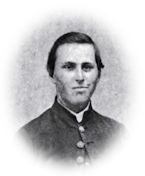
May 11th. Marching orders. Left camp early this morning. The army on the move. Waded Cedar Creek, on through the town of Strasburg, up Fishers Hill. The boys are all in good spirits as we go marching on. Halt and go into camp near the town of Woodstock, in the valley. Marched about ten miles.
May 2014

Wednesday, May 11.—The last three days have been most exciting. The enemy on the south side of the river have made heavy demonstrations; their force is perhaps 40,000; ours not half that number. The militia, the City Battalion, and the clerks have gone from Richmond. They have had a heavy fight at Port Walthall, and another near Chester, in which we had, upon the whole, the advantage of them. In the mean time a large body of raiders are going over the country. They have cut the Central Railroad, and burnt three trains of cars, laden with provisions for General Lee’s army, and are doing all manner of mischief to public and private property. Not a word can we hear from General Lee, except through private telegrams sent from Guiney’s Station. The wires (telegraph) above that place have been cut. Our accounts from Guiney’s are very encouraging. It is astonishing how quiet everybody is—all owing, I must believe, to an abiding faith in the goodness of God. Prayer-meetings are held in almost all the churches, and we take great comfort in them. It seems to me evident that the Lord is fighting our battles for us.
The last was a most disturbed night. We knew that the attaches of the War Department had received orders to spend the night there, and our son had promised us that if any thing exciting occurred he would come up and let us know. We were first aroused by hearing a number of soldiers pass up Broad Street. I sprang up, and saw at least a brigade passing by. As we were composing ourselves to sleep, I heard several pebbles come against the window. On looking out, I saw J. standing below. In a moment the door was opened and he was in our room, with the information, brought by a courier, that 7,000 raiders were within sixteen miles of us, making their way to the city. He also said that 3,000 infantry had marched to meet them. Every lady in the house dressed immediately, and some of us went down to the porch. There we saw ladies in every porch, and walking on the pavements, as if it were evening. We saw but one person who seemed really alarmed; every one else seemed to expect something to occur to stop the raiders. Our city had too often been saved as if by a miracle. About two o’clock a telegram came from General Stuart that he was in pursuit of the enemy. J. came up to bring us the information, and we felt that all was right. In a very short time families had retired to their chambers, and quietness reigned in this hitherto perturbed street. For ourselves, we were soon asleep. To-day General Stuart telegraphs that the enemy were overtaken at Ashland by Lomax’s Brigade, and handsomely repulsed. We have just heard that they have taken the road to Dover’s Mills, and our men are in hot pursuit.
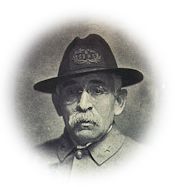
May 11—This morning about 800 more prisoners came in. Most of them were from my brigade, as well as from Dole’s Georgians. I was surprised to see my brother with them. He was taken yesterday, but before he surrendered he sent two of the enemy to their long home with his bayonet.
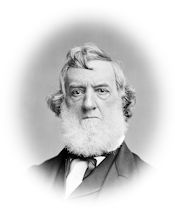
May 11, Wednesday. A craving, uneasy feeling pervaded the community through the day. No intelligence from any quarter received, yet a conviction pervades everywhere that much is being done. I was at the War Department at 9 P.M. The President and Stanton were anxiously waiting intelligence.
I met Blair as I came from the Department, who wished me to go to his house. A letter from Governor Morgan asking me to name the month to which I would postpone the Union National Convention, if I desired a postponement, was received and answered by me this evening. It was a singular document and surprised me. I spoke of it to Blair, who said he had seen the circular last week. This gave me even greater surprise, for Morgan has frequently consulted and interchanged views with me, both of us concurring against postponement. It was discussed by us at our last interview.
Blair, as well as myself, was puzzled, but we both were willing to believe that no mischief was intended. The course of Thurlow Weed and some New York politicians has been singular. Blair took from his pocket a letter from Barlow of New York, a Copperhead leader, with whom, he informs me, he has corresponded for some weeks past. Barlow is thick with General McClellan, and Blair, who has clung also to McC., not giving him up until his Woodward letter betrayed his weakness and his ambition, still thought he might have military service, provided he gave up his political aspirations. It was this feeling that had led to the correspondence.
I do not admire the idea of corresponding with such a man as Barlow, who is an intense partisan, and Blair himself would distrust almost any one who should be in political communication with him. Blair had written Barlow that he would try to get McC. an appointment to the army, giving up party politics. Barlow replied that no party can give up their principles, and quotes a letter which he says was written by a distinguished member of Mr. Lincoln’s Cabinet last September, urging the organization of a conservative party on the basis of the Crittenden compromise. This extract shocks Blair. He says it must have been written by Seward. I incline to the same opinion, though Usher crossed my mind, and I so remarked to Blair. Last September U.’s position was more equivocal than Seward’s, and he might have written such a letter without black perfidy. Seward could not.
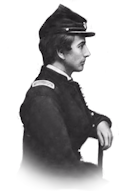
May 11th. Everything quiet this morning. The enemy hug their entrenchments and are now around the Spottsylvania court house. In the afternoon Miles’s brigade was sent back to Todd’s tavern, but returned to camp in the evening, without finding any trace of the enemy. He never fired a shot, I think. Shortly after dark, we received orders to fall in and march, our division following Birney. The night was very dark and rainy, and the roads narrow and bad, but we stepped out briskly and very quietly. About midnight the column halted near a house, the “Brown house,” closed up and massed in close column of brigade, and was then informed it was to assault the enemy’s works in front, which at this point forms a salient angle. The success of this attack depended upon its secrecy, and so all were ordered to keep very quiet and commands were to be given in a whisper. The troops moved up near the enemy’s picket line, supposed to be twelve or fifteen hundred yards from the enemy’s works. Nobody knew exactly the position of the works or the nature of the ground, and so we had to take our chances, moving forward till we struck them. In front of our division the ground gradually ascended and was sparsely covered with trees, shrubs and bushes till near the rebel works, where it was entirely open. Birney’s division was on our right, also in brigade masses, with Mott in rear of him, while Gibbon’s division remained in reserve in rear of all. It took a long time to form the division in column of assault; each brigade was closely massed, all the mounted officers dismounted, and the orders were to advance without firing a shot, and by simple weight of numbers crush everything in front of us. Before starting, the engineer officers found the general direction of the rebel lines by compass and pointed it out to Barlow and the brigade commanders. There was another house in front, called the Landron house, which was supposed to be some four hundred yards from the rebel works, and this was to be our principal guide. The Fourth brigade was on the left, the Second brigade on the right, with Miles and Brooke in command. The Third brigade, now commanded by Brown, and Smyth’s Irish brigade formed the second line and were to advance close behind the first line.
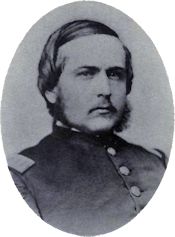
Wednesday, May 11th.
Slept on our arms all night, but everything was comparatively quiet. It looks very much like rain this morning. Hear a report that rebels have been flanked and two thousand prisoners and twelve guns captured, but the report proves to be without foundation. Hear nothing from the cavalry. A thunderstorm came on about 4 P. M., the first rain since we left Culpepper Court House. Reported that the Twenty-second Corps is on the way to join this army. Started towards Fredericksburg in the afternoon and marched all night in the mud, many of the men falling out of the ranks by the way. Very little cannonading during the day.
by John Beauchamp Jones
MAY 11TH.—Bright and pleasant—breezy. This has been a day of excitement.
At midnight the Departmental Battalion were marched from the south side of the river back to the city, and rested the remainder of the night at CampLee. But at 9 A.M. they were marched hurriedly to MeadowBridge. They came past our house. Custis and his brother Thomas ran in—remaining but a moment. Custis exclaimed : “Let me have some money, mother (I had to go to the office), or we will starve. The government don’t feed us, and we are almost famished. Cook something, and get Captain Warner to bring it in his buggy—do, if possible.” He got $20. They looked worn, and were black with dust, etc. My daughter said “they looked like negroes.”
The Secretary issued this morning a new edition of his handbills, calling the people “to arms.”
Mr. Mallory’s usual red face turned purple. He has not yet got out the iron-clad Richmond, etc., which might have sunk Gen. Butler’s transports.
Lieut.-Col. Lay was exhibiting a map of our defenses, and predicting something,—whether good or evil, I did not stay to learn. But I thought such maps ought not to be shown in the public ball of the department.
The armory was open to-day, and all who desired them were furnished with arms.
The Governor, I hear, issued a notification that the enemy would be here to day, etc. I did not see it.
All classes not in the army were gathered up and marched to the defenses.
2 P.M. Respectable men just from the vicinity report a great victory for Lee, yesterday, though we have nothing from him. The Secretary believes these concurring reports, which state that the battle, beginning near Spottsylvania Court House, ended at Fredericksburg, indicating a WATERLOO.
And a dispatch from Gen. Ransom from the south side of the river, states that Butler’s army is retreating to the transports. This is regarded as confirmation of Lee’s victory.
Several dispatches from Gen. Stuart state that the raiders have been severely beaten in several combats this morning, and are flying toward Dover Mills. They may come back, for they have not heard of Grant’s defeat.
Mr. Memminger is said to have been frightened terribly, and arrangements were made for flight.
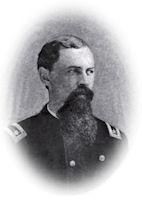
Six miles from Resaca, May 11, 1864.
We had a real hurricane last night, and a tremendous rain-storm. We lay right in the woods, and of course thought of the Point Pleasant storm and falling trees, but were too lazy to move, and thanks to a bed of pine boughs, slept good and sound. There is a scare up this morning. We have moved a mile toward the front, and building breast-works is going on with the greatest life. A full 1,000 axes are ringing within hearing. Our division is drawn up in column by brigade and at least another division is in rear of us. The latest rumor is that “the railroad has surrendered with 40,000 depots,”
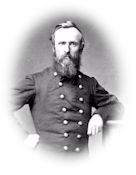
Tuesday, [May] 10. — Went to New River Bridge. They shelled the woods filled with our men killing three or four. A fine artillery duel between our guns on the high ground on the west side of the river, theirs on the east. The Rebel effort was to keep our men from firing the bridge. It was soon done. A fine scene it was, my band playing and all the regiments marched on to the beautiful hills hurrahing and enjoyed the triumph. Marched thence to Pepper’s Ferry and spent the afternoon and night fording and ferrying the river. Sixteen miles.
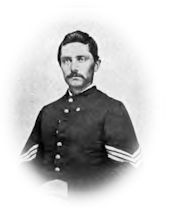
Tuesday, 10th—We had an all day rain, and there was no drill or dress parade. The country around Clifton is very rough. There are but a few small farms, found only in the bottom land. Clifton is on the east bank of the Tennessee river about twenty-five miles below Savannah. The town has been burned and the people driven out, there being only four or five of the thirty log huts standing.


